The Proposal in the Drawer
Rereading my community paramedicine plan, ten years later
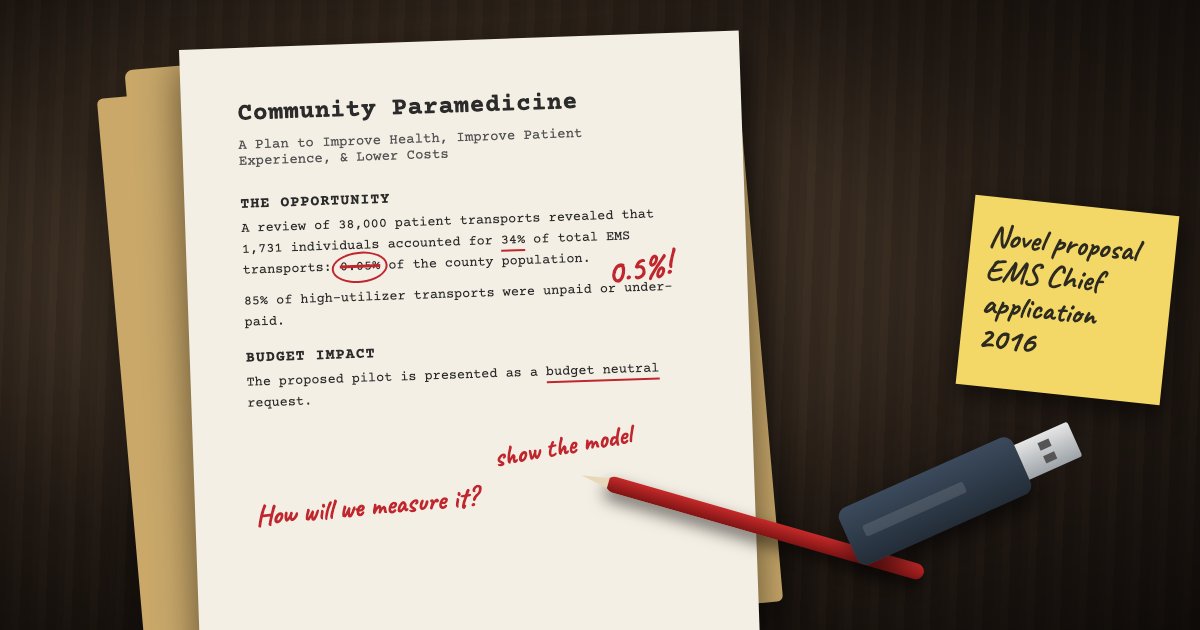
A little over a decade ago, I applied for an EMS Chief position. Like many executive searches, it came with homework. Every candidate had to submit a novel proposal: one new idea for the department, written as if it were going to the county commissioners for a vote. I chose community paramedicine, wrote a full proposal, an executive summary for the board, and a presentation to go with it.
I had not seen it in ten years. Last week it turned up on an old USB drive, tucked in a folder between training files. I read it the way I would read anyone else's work: with a red pen and a little less patience than its author probably deserved.
Some of it held up. Some of it did not. And one part of it is still the most important unanswered question in EMS.
What I proposed
The proposal started with the department's own data, not with a success story from somewhere else.
In one year, the agency transported about 38,000 patients. When I sorted those transports by patient, roughly 1,700 people accounted for 34 percent of them. That is about half of one percent of the county's population generating a third of the ambulance's work. Two hundred people had more than twenty transports in a single year.
Then I matched the transports to the billing records. Of those high-utilizer transports, 85 percent were either unpaid or paid below what it cost us to run the call. Only about 15 percent were reimbursed at or above the actual cost of a transport.
The problem was not the patients. Most of them genuinely needed care. The problem was that the traditional EMS model gave our crews exactly two options: transport to an emergency department, or obtain a refusal. A refusal was the wrong answer for someone who was sick. An ambulance and an emergency department were the most expensive possible answer for someone whose needs were not an emergency.
So I proposed a three-year community paramedicine pilot built around three groups:
- Frequent 911 callers who had difficulty navigating the healthcare system, and for whom 911 and the emergency department had become their primary care.
- Medically fragile patients who depend on electricity. Federal preparedness data identified thousands of residents relying on ventilators, pumps and other powered medical devices. Community paramedics could find them before a storm, update dispatch records, and help families build evacuation plans.
- Home hospice patients whose families called 911 in a moment of crisis, where a community paramedic working with the hospice nurse would serve the patient better than an emergency ambulance.
I framed it around the Institute for Healthcare Improvement's Triple Aim (better patient experience, better population health, lower cost), and I added a section on the workforce. Attrition in the region ran from 10 to 36 percent. EMS offered few paths for advancement. Community paramedicine was a career ladder as much as a clinical program.
What held up
Reading it now, three things still feel right.
Start with your own data. In 2016, most community paramedicine proposals opened with a national example and asked a board to imagine it locally. The strongest pages of mine were the ones that told the commissioners who was calling, how often, and what it cost. Every agency has that data. Few look at it this way.
Plan for the people who can't evacuate themselves. The electricity-dependent patients were the part of the proposal I'm proudest of. It treated community paramedicine as part of emergency preparedness, not just a cost-control program. That argument is stronger today than it was then, as agencies plan for longer outages and more fragile supply chains.
The workforce case. Burnout, attrition and a flat career ladder were the problems then. They are the problems now.
What I would change
The red pen had plenty to do.
I called the pilot budget neutral and projected a 15 to 20 percent reduction in transports without a loss of revenue. I believed both, and I still think they were plausible. But I did not show the model behind either claim, and a sharp commissioner would have asked how.
There was no evaluation design. No baseline, no defined measures, no comparison group, no plan for what would count as success or failure at the end of year one. Today I would write the stop-and-go numbers before writing anything else.
There was no plan for data sharing. The program depended on hospitals, hospice and primary care, but the proposal said almost nothing about how information would move between them. That is the gap that has quietly limited community paramedicine ever since.
And yes, there were typos. In one place I wrote that the high utilizers were 0.05 percent of the population. It was 0.5 percent. Ten years later, the decimal point still stings.
What changed in ten years
Community paramedicine is no longer a novel idea. Programs exist across the country, and many states now recognize the role in rule or statute. That is real progress.
But the core problem in my proposal is still mostly unsolved: how EMS gets paid for care that does not end in a transport. The federal ET3 model (Emergency Triage, Treat, and Transport) tested payment for treatment in place and alternate destinations, and it ended early, at the close of 2023. Too many community paramedicine programs still run on grants, hospital partnerships and the goodwill of the agencies that started them.
What has changed is the toolset. Ten years ago, finding the 1,700 people took a spreadsheet and a lot of late nights. Today, data integration and AI can find those patients, flag the ones at risk, and help a community paramedic prepare before the visit. The opportunity is larger than it was. So is the cost of not being ready for it.
The question underneath it all
Rereading the proposal, I noticed something I could not have seen when I wrote it. The whole document was an argument about identity.
Is EMS healthcare, or transportation to healthcare?
My answer has evolved. I once believed every system had to choose healthcare. I now believe EMS may carry two identities, living in parallel. Not every community can afford, will choose, or will value EMS as full healthcare, and transportation to healthcare has a real and respected role. What matters is that the systems that do choose healthcare are not held back by the ones that don't.
The proposal in the drawer was a small, local version of that choice. The decision in front of agencies today is the same one, just with higher stakes and better tools.
If you have a proposal in a drawer of your own, take it out and read it. You may find that the idea was right, and only the timing was wrong.