Amazon Just Built What I've Been Predicting. Here's What Comes Next.
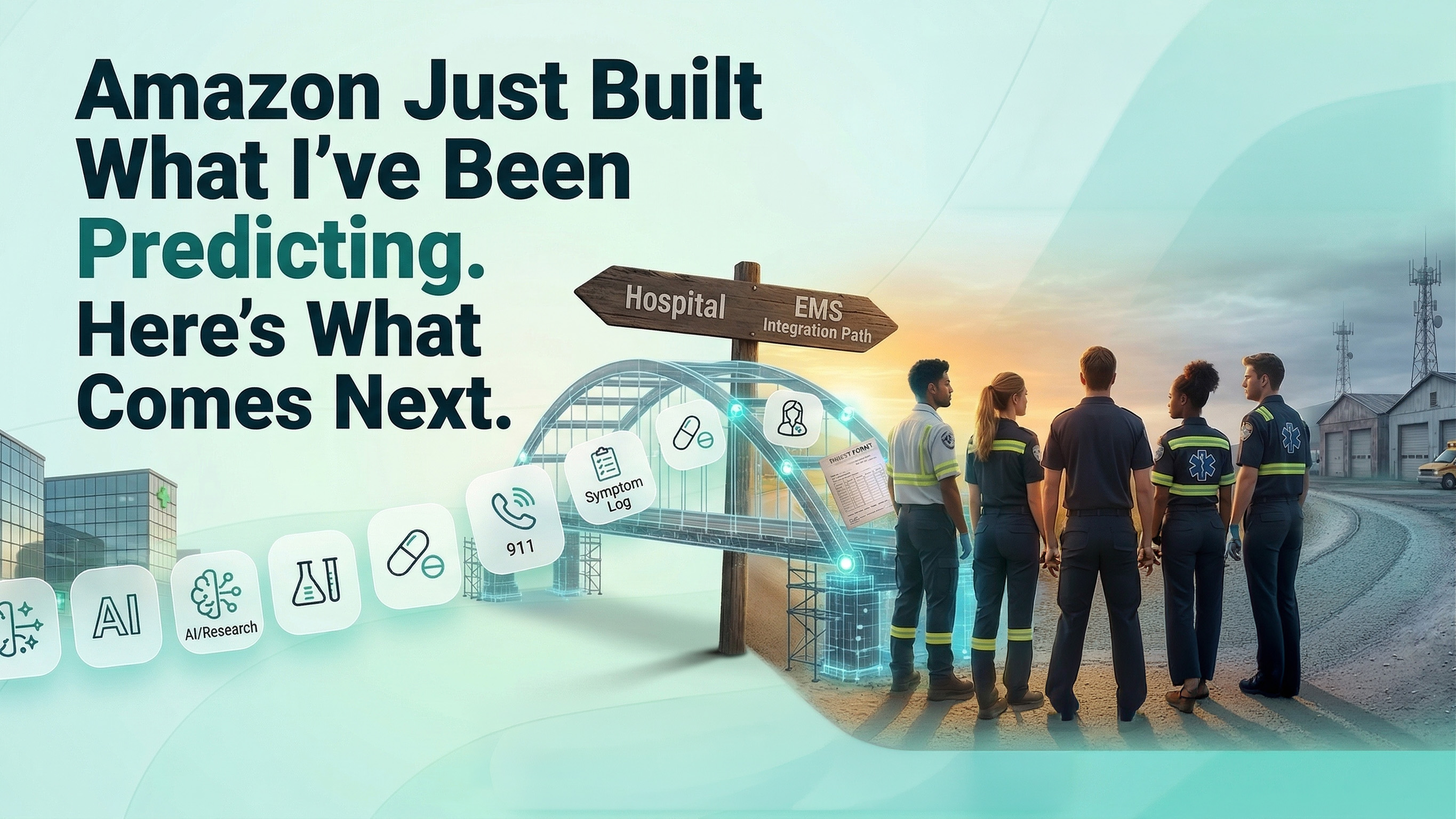
On March 10, Amazon announced it was expanding its Health AI assistant from the One Medical app to U.S. customers on Amazon.com and in the Amazon app, with availability rolling out nationwide. Eligible U.S. Prime members receive an introductory offer of up to five free direct-message virtual care consultations with One Medical providers for more than 30 common conditions. For a company that acquired One Medical for $3.9 billion in 2023 and integrated Amazon Pharmacy into a unified consumer health experience, this was not a minor product update. It was the most significant consumer health AI deployment in American healthcare to date.
For those of us who have been watching the convergence of AI, consumer technology, and health system infrastructure, it was confirmation of what we have been saying for years: the future of healthcare navigation will not be built by hospitals or insurance companies. It will be built by the platforms that already own the consumer relationship.
I have been making this case on stages and in print for some time now. Two years ago, I was using AI to do live translation between languages in real time at EMS conferences, demonstrating that AI was no longer theoretical. One year ago, I built a working chatbot to show how AI connected to a health information exchange could help paramedics quickly obtain life-saving patient information and deliver better prehospital care. Two weeks ago, I gave that same presentation to an audience of EMTs and paramedics in Georgia. And then Amazon announced it had launched the building blocks of that very system to the entire country.
Amazon proved the point.
What Amazon Actually Built
Most of the coverage has focused on the consumer-facing Health AI assistant, the chatbot that answers your symptom questions, explains your lab results, and books your One Medical appointment. That alone would be significant. But it is only half of the picture.
Amazon is deploying a two-sided health AI strategy that positions it on both ends of the healthcare interaction simultaneously.
On the patient side, Health AI is an agentic AI system built on Amazon Bedrock that uses a patient's health data, including diagnoses, medications, and lab results, with consent to provide personalized guidance. It can explain what results mean in the context of a patient's specific health history, flag potential medication issues, manage prescription renewals through Amazon Pharmacy, and connect patients to licensed One Medical providers by message, video, or in person. It uses a multi-agent architecture with specialized agents for patient interaction, workflow handling, and safety oversight, plus escalation paths into human clinicians for clinical review.
On the system side, Amazon is simultaneously selling the infrastructure layer to health systems themselves. Amazon Connect Health uses agentic AI to automate intake, appointment scheduling and management, identity and insurance eligibility verification, and related front-end administrative workflows for health system contact centers and digital front doors. The AWS Health AI Hub provides a curated toolkit of healthcare-specific AI models, APIs, and reference architectures for NLP, imaging, voice, and clinical documentation, targeted at payers, providers, life sciences companies, and health technology builders.
This means Amazon is not just building the front door patients walk through. It is building the operating system that health systems run behind that door. Major health systems such as Cleveland Clinic, Rush University System for Health, Montefiore, and Hackensack Meridian Health have announced collaborations with Amazon and One Medical around care delivery and digital health. Amazon has indicated plans to extend Health AI into nutrition coaching, exercise guidance, and chronic disease management.
Read that landscape clearly: the same company that routes a patient to care on the consumer side is also powering the back-end infrastructure of the health systems that receive them.
And that brings us to the gap no one is talking about.
When Health AI Calls 911, the Data Dies
When Amazon Health AI determines that a patient's symptoms suggest a possible emergency, it does one thing: it advises them to contact emergency services.
And then it stops.
The prehospital system that responds to that 911 call receives no information from the AI that made the routing decision. No symptom summary. No medical history. No medication list. No record of what the patient disclosed to Health AI in the moments before they called for help. The carefully constructed data loop that Amazon built to personalize every other aspect of a patient's care experience simply breaks at the point of highest clinical urgency.
Think about what that means in the context of Amazon's two-sided strategy. Amazon's Health AI knows the patient's history, medications, and the conversation that led to the 911 recommendation. Amazon's Connect Health platform may be powering the scheduling and intake systems at the hospital the ambulance is headed toward. But the EMS crew in the middle, the clinicians making life-or-death treatment decisions in the field, has access to none of it. They are the only participants in this care chain operating without data.
This is not a criticism of what Amazon built. It is a description of a structural gap that exists because EMS has never been integrated into the health data ecosystem that the rest of medicine now shares. And that gap is not Amazon's to close. It is ours.
The Crossroads EMS Can No Longer Avoid
I have been saying for years that EMS stands at a crossroads. The question has always been the same: Is EMS healthcare, or is EMS transportation to healthcare?
For three decades, that question has been surprisingly forgiving. EMS could avoid answering it directly and still function. Agencies could operate in a gray zone, providing clinical care in the field while remaining structurally disconnected from the data systems, the quality frameworks, and the continuity-of-care expectations that define every other clinical discipline in American medicine. The rest of the healthcare system let that ambiguity persist because, frankly, nobody was forcing the issue.
Amazon just forced the issue. So did OpenAI, Anthropic, and Microsoft, each of which launched healthcare-focused versions of their AI platforms in early 2026. The competitive pressure among major technology companies to own the consumer health AI layer is accelerating, and every one of these platforms has the same structural blind spot: when a patient's condition escalates to the point where they need emergency medical services, the data trail goes dark.
That blind spot exists because EMS has not demanded its place in the health data ecosystem. And the window for making that demand on our own terms is closing.
If EMS is healthcare, truly healthcare, then the care we deliver must be documented, shared, and integrated with the same transparency as every other clinical encounter in a patient's record. Today, when someone calls for an ambulance, the only thing most patients receive from the EMS system afterward is a bill in the mail. The patient care report that paramedics write, documenting assessments, interventions, medications administered, clinical decision-making in real time under the most urgent conditions imaginable, largely disappears into a silo. It does not flow into the patient's longitudinal health record. It is not visible to the emergency physician who receives the patient. It is not accessible to the primary care provider who manages the patient's chronic conditions. It is not available to a health AI system trying to build a complete picture of a patient's medical history.
That has to stop. Immediately.
The prehospital patient care report must become as transparent and as accessible as the family physician's note, the lab results, the imaging report, the surgeon's progress notes. Medications administered in the ambulance must be seamlessly integrated into the patient's medication history. The clinical decisions made by paramedics at two in the morning on the side of a highway must carry the same weight and the same visibility in the health record as decisions made in a clinic or a hospital.
This is not a technology problem. The standards exist. The health information exchange infrastructure exists. The national EMS coordinated database architecture is designed to support exactly this kind of bidirectional integration. What has been missing is the will, the policy alignment, and the investment to make it happen.
If EMS chooses the other path, if we accept the role of transportation to healthcare rather than healthcare itself, then we accept permanent structural irrelevance in the emerging AI-enabled health ecosystem. We become the segment that platforms like Amazon's Health AI route patients into but never integrate with. We become a gap in the data, not a participant in the system.
I do not believe that is where EMS belongs. And having spent my career working alongside EMS clinicians across this country, I do not believe they would accept it either.
What It Will Take
The gap between where EMS is today and where it must be is solvable. It requires three things that, together, are achievable.
First, data integration. The national EMS data infrastructure must connect to the health information exchange ecosystem that Amazon and other health AI platforms are building on. When a patient who has been navigating their care through Health AI activates 911, the responding crew should have access to the relevant clinical context. And when that crew completes a patient care report, it must flow back into the patient's longitudinal record with the same fidelity as any other clinical documentation. This is a technical problem with a technical solution, and the national EMS coordinated database architecture is designed to support it.
Second, policy alignment. No single state or agency can negotiate data sharing agreements with national health platforms at the scale required. Moving forward will require collaboration across individual states, national associations, and multi-state compacts to create the governance frameworks that enable bidirectional data exchange between EMS and the broader health ecosystem.
Third, federal investment. The Rural Health Transformation Program, now being operationalized by CMS with approximately $50 billion over five years, represents a historic opportunity to fund the infrastructure that closes this gap. EMS agencies in rural communities, where telehealth routing will most frequently default to 911 because specialty and even primary care access is limited, need the data connectivity and clinical AI tools that urban systems are beginning to access.
The Window Is Open, but It Will Not Stay Open
Amazon did not build Health AI with an EMS-shaped hole in its architecture. It built a health platform around the data infrastructure that existed, and EMS was not part of that infrastructure. The same will be true for every platform that follows. If EMS does not build the connections now, while the consumer health AI landscape is still taking shape, then the architecture will harden around our absence. The systems will be designed, the data standards will be set, the partnerships will be formed, and EMS will find itself exactly where it has been for the past 30 years: clinically present but structurally invisible.
The difference is that this time, the rest of the system will have moved so far ahead that catching up may not be an option.
I was involved in designing one of the first electronic patient care records for EMS over 25 years ago. I have spent decades working on national EMS data infrastructure. I have built working demonstrations of what AI-integrated prehospital care could look like. The future I have been describing is no longer a prediction. Amazon just built half of it. The other half is ours to build, and the time to build it is now.
Donnie Woodyard Jr., NRP, MAML is Executive Director of the Interstate Commission for EMS Personnel Practice (U.S. EMS Compact) and author of The Future of Emergency Medical Services: Artificial Intelligence, Technology and Innovation. He has worked in EMS policy, data infrastructure, and international system development for over 30 years.