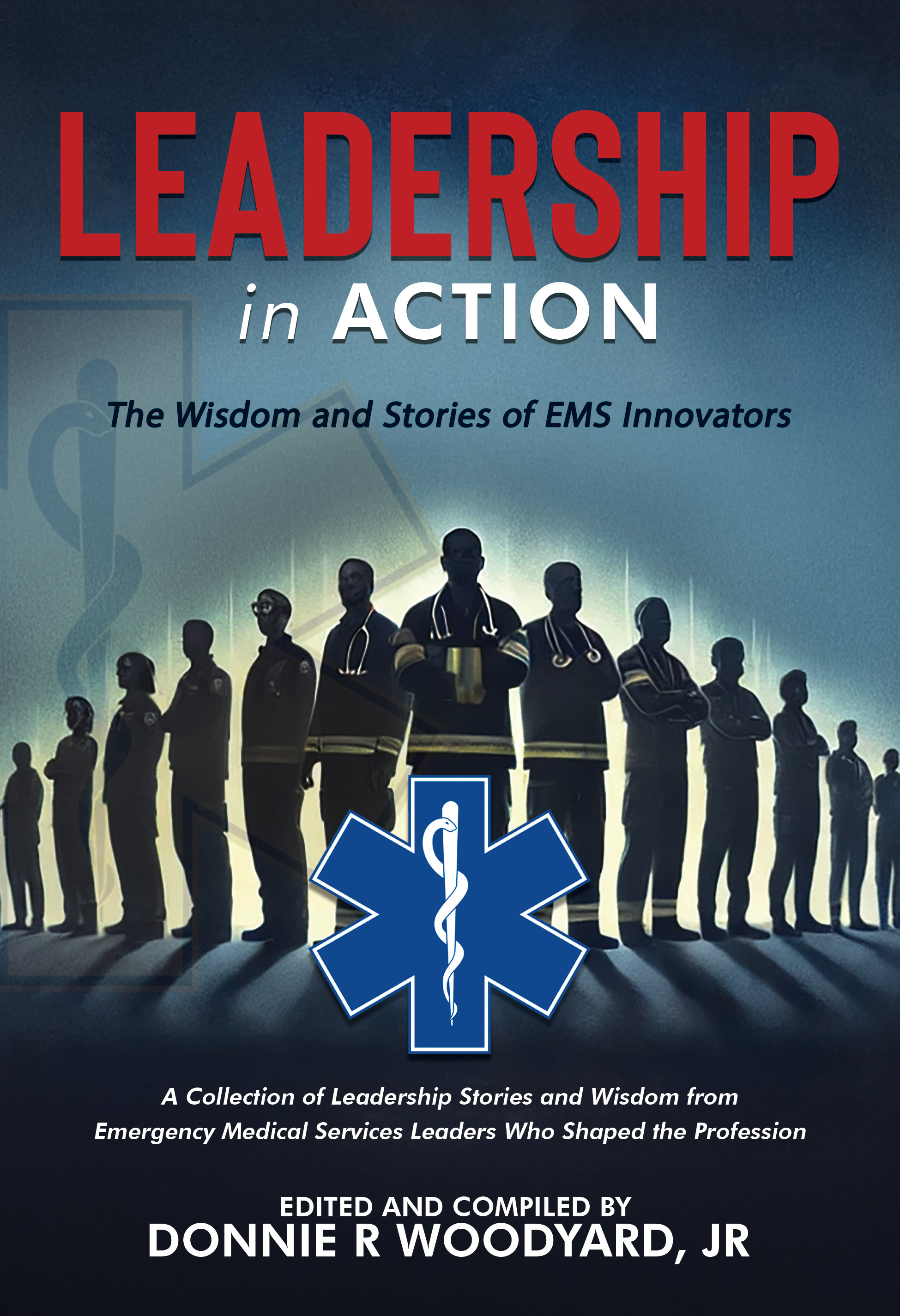
Leadership
in Action
Listen or read free — 53 chapters from 45 EMS leaders
Every chapter of Leadership in Action is available here — listen or read online, completely free. No signup, no paywall. This is our gift to the EMS community.
Prefer to read offline? Download the free EPUB. Want the paperback? Buy on Amazon — 80% of net proceeds go to EMS charities.
Foreword
Dear Mr. Woodyard:
I am honored to be invited to contribute an opening letter to future EMS leaders for the book you are compiling: Leadership in Action: The Wisdom and Stories of EMS Innovators, that celebrates leadership and innovation in Emergency Medical Services and features the advice, lessons, and stories from more than forty of our nation’s most respected EMS leaders who have shaped the system we know today. The aim and objective of your efforts coincide with the goals and objectives of The Panetta Institute for Public Policy, which is to attract thoughtful men and women to lives of public service, helping them master the policy process and develop their skills as future leaders.
Each year the Panetta Institute sponsors two programs that especially focus on leadership, the Congressional Internship Program and the Education for Leadership in Public Service Seminar, the latter which invites student body presidents from the California State University System and three private universities to learn from exceptional leaders representing all walks of society. Recently, we invited Admiral William McRaven to speak on the foundation for his Navy Seals’ success in bringing Osama bin Laden to justice. He highlighted non-partisan teamwork; fact-based analysis; relentless focus on a national priority; self-sacrifice; rigorous and objective debate among a team striving for a clear goal; and humility in the face of victory.
During that same seminar, a student asked me my five best leadership lessons and I answered: set clear goals; develop the best strategy to achieve those goals; build a strong team and empower them to do their job; be honest with your team; and be honest with yourself. I believe that your collection addresses and amplifies the key elements of both Admiral McRaven’s and my insights.
But let me emphasize an aspect of the EMS experience that is not always explicitly or publicly highlighted and is crucial at this moment in America’s history. And that involves the question of Taking Action: Is it wise to step forward against criminal aggression and hooligans in a public setting? Is it a moral duty to do so? This issue correlates with what many scholars see as a major social evil today, the breakdown of community—a reduction in the people’s sense of mutual responsibility and concern as members of society.
Further, given the commonality of weapons in the United States, more of our citizenry are inclined to think that the person who turns away instead of stepping forward with courage is not being cowardly but rational. It seems like common sense now not to get involved. This is where I believe the EMS example is particularly salient—more and more of our citizens witness the effectiveness, the courage, and the successes of EMS personnel, and are implicitly persuaded to help others. In an important way, then, the sense of belonging in our society is vitally enhanced, which is the richest sustenance that any people can have.
Again, Mr. Woodyard, thank you for this opportunity to address the leaders and members of the illustrious EMS organizations. One of the aims of our great democracy is to raise people as closely as possible to the ideal of excellence in their chosen calling and that means providing the leadership of the best and most demanding kind. That is what you are admirably trying to do, and this book is a great step forward in that direction.
Yours very sincerely,
Leon E. Panetta, Chairman
The Panetta Institute for Public Policy
My five leadership lessons:
1: Set clear goals;
2: Develop the best strategy to achieve those goals;
3: Build a strong team and empower them to do their job;
4: Be honest with your team; and
5: Be honest with yourself.
- Leon E. Panetta
Leon E. Panetta
The Honorable Leon E. Panetta is an American statesman and public servant with a distinguished career spanning over five decades in government, intelligence, and national security. He served as the 23rd U.S. Secretary of Defense (2011–2013), Director of the CIA (2009–2011), White House Chief of Staff (1994–1997), and U.S. Representative from California (1977–1993). A champion of fiscal responsibility and bipartisanship, he also served as Director of the Office of Management and Budget and was instrumental in budget negotiations during his tenure in Congress. After leaving public office, he co-founded the Panetta Institute for Public Policy, which is dedicated to developing future leaders.
Editor’s Note
“If you want to go fast, go alone. If you want to go far, go together.”
This African proverb captures the essence of leadership and the spirit of this book. Leadership in EMS is not about quick fixes or individual success—it’s about the collective journey, the lessons we share, and the impact we leave behind. Whether you are stepping into leadership for the first time or seeking renewed purpose, we created this book for you. I hope the stories and wisdom in these pages will be your guide, a mentor, and a source of inspiration drawn from the real-life experiences of those who have led before you.
Leading an EMS agency is not for the timid. It requires resilience, vision, and a steadfast commitment to something bigger than yourself. Whether you're ascending to leadership for the first time or are a veteran leader looking for a fresh reason to continue your chosen path, this book is for you.
When I began creating this book, I aimed to assemble the wisdom and experiences from the EMS leaders and mentors who invested in my journey, with the next generations of leaders. I also wanted to take a moment to reflect, with the help of those leaders, on the path my life has taken—a path in which I have been incredibly fortunate to be surrounded by so many incredible leaders.
This book is not a leadership textbook or manual of theories—it is a compilation of real-life encounters of leaders with the many facets of life and leadership. The highs, the lows, and everything in between have been lived, and these leaders are willing to tell the truth about their experiences and provide the raw and honest detail that allows us to glimpse the personal side of their leadership journeys. Each chapter stands alone, offering a unique perspective shaped by the contributing author’s leadership journey.
You will notice some themes—resilience, vision, and collaboration—recurring throughout this book. That is by design. Leadership truths are constant; their expression is as diverse as those who live them. Leadership is not a monolithic endeavor. Some authors share decades of experience, while others are earlier in their leadership journey. Yet all the insights shared here have equal value. If one chapter does not resonate, I'm confident the next will ignite your passion—or at least engage your mind more than the previous one.
This book results from the collective effort of over 40 esteemed EMS leaders who generously invested their time and shared their stories, experience, and wisdom—not only to aid national EMS charities but also as an investment in you: the next generation of EMS leadership. Their willingness to share their experiences is a profound gift to all who struggle to grow in our leadership. I am deeply thankful for their contributions, and I encourage you to draw from their insights as I have.
I’m especially grateful to Secretary Leon Panetta for offering a foreword for this book. I’ve long respected his service as a national leader. His career in public service stands as a shining example of two things: a bipartisan approach to solving some of the most complex problems of our time and a dedication to integrity and purpose that makes him quite the role model for anyone aspiring to lead in a challenging environment.
I also wish to convey my deep appreciation for my colleagues and instructors at the Center for Homeland Security and Defense of the Naval Postgraduate School, in the Executive Leaders Program (ELP2401). This past year has been an incredible journey of shared wisdom, camaraderie, and growth. The lessons I have learned throughout this program are hard to quantify, but their impact on my leadership and perspective is beyond measure.
EMS leadership does not happen in isolation. It is a journey shared with many, taken in close step with companions in this endeavor. This is why I’m donating ~80% of the net royalties from this book to national EMS charities, including the National EMS Museum.
The EMS future is bright—but only if we, as leaders, make it so. I commend you for picking up this book and thank you for being the kind of person who strives to make a difference. Your commitment to growth, resilience, and service inspires us to keep pushing forward. Together, we will build a legacy of leadership in EMS that lasts for generations.
With gratitude and hope for the future,
Donnie Woodyard, Jr.
Section 1: Foundations of Leadership
Foundations of Leadership
1
From Fascination to Innovation:
Lessons in EMS Leadership
Roger White, MD
My fascination with ambulances began as a young boy. I remember standing on the curb, watching in awe as they sped past, their sirens wailing and lights flashing, each time carrying the promise of help in someone’s darkest hour. To me, they weren’t just vehicles; they were symbols of hope, urgency, and the power to change lives. I’d spend hours writing letters to ambulance manufacturers, requesting brochures and photos, and was thrilled when I received their replies. By my teenage years, my collection of ambulance memorabilia rivaled any enthusiast’s. But it wasn’t just about the ambulances themselves—it was about what they represented: a lifeline in moments of crisis.
That childhood fascination matured into a career rooted in purpose and discovery. When I joined the Mayo Clinic in 1970 as a staff anesthesiologist, my passion for ambulances took on a new dimension. I sought out the owner of Gold Cross Ambulance Service in Rochester, Minnesota, recognizing an opportunity to merge my love for ambulances with my burgeoning interest in medicine and prehospital care. I volunteered to become Gold Cross’s first medical director. At the time, medical oversight for EMS was a novel concept, and I quickly realized this role's vast potential—and responsibility.
Training the first EMTs was one of the most rewarding experiences of my early career. In the early 1970s, the initial group of EMTs I helped train became some of the first in the nation to be examined and certified by the National Registry of Emergency Medical Technicians (NREMT). This certification established a critical national standard for EMS, ensuring consistency and excellence across the field. My involvement with the NREMT extended beyond training—I was honored to serve as one of the organization’s early board members and later as its chair. These roles allowed me to contribute to shaping EMS education and standards nationally, a responsibility I regarded as a privilege and a necessity.
Collaboration was central to these efforts. While on the NREMT board, I worked closely with visionary leaders like Dr. Norman McSwain and Dr. J.D. 'Deke' Farrington. Together with a dedicated group of colleagues, we developed the national standard curriculum for paramedics. These extended hours of collaboration were driven by a shared mission to elevate the profession and ensure every EMS clinician—from rural areas to urban centers—had the training and resources to deliver exceptional care. This work underscored the power of collective expertise and the importance of partnerships in advancing our field.
From the beginning, I knew that transforming prehospital care required more than enthusiasm. It demanded a rigorous, evidence-based approach. We needed to understand what worked, what didn’t, and how to improve. The ability to measure outcomes, with real data, was paramount. At Gold Cross, we began tracking outcomes, asking tough questions, and using the answers to refine protocols and training. This commitment to measurement was revolutionary for EMS then, but it was clear to me that progress would be little more than guesswork without it.
One of our earliest breakthroughs came in 1971 when we launched Minnesota’s first mobile coronary care unit. We equipped ambulances with portable cardiac monitors, defibrillators, and IV supplies—groundbreaking tools for prehospital care. But the technology alone wasn’t enough; we needed proof that it made a difference. By meticulously tracking cardiac arrest patients' survival rates, we demonstrated early defibrillation's lifesaving power. These findings and similar data from pioneering systems in Seattle and Miami became the foundation for a new era in EMS.
In the years that followed, we didn’t just stop at improving our system. We advocated for broader adoption of these practices, equipping Rochester police vehicles with defibrillators and training officers to use them. By the 1990s, Rochester was one of the first cities in the nation to integrate early defibrillation into its EMS system, achieving some of the highest cardiac arrest survival rates in the country. These successes were not accidents; they resulted from relentless dedication to data-driven innovation.
Beyond my local efforts, serving on the American Heart Association’s Emergency Cardiac Care Committee and working with manufacturers to field-test new equipment allowed me to influence EMS advancements nationwide. From cardiac monitors to automated defibrillators, these innovations transformed prehospital care. However, none of this progress would have been possible without the EMTs—dedicated individuals trained to the highest standards—whose skills and courage bring these technologies to life in the field.
I am struck by how many EMS systems fail to measure what matters, even today. Too often, agencies overlook the wealth of data stored in their equipment or fail to track patient outcomes. This isn’t a lack of technology—it’s a lack of leadership. Measurement isn’t about blame; it’s about discovery. Without data, we’re operating in the dark. With it, we can refine our practices, justify investments, and, most importantly, save more lives.
Reflecting on my journey, I’m reminded of how far EMS has come and how much potential it still holds. The ambulances that once fascinated me as a child have evolved into sophisticated vehicles of medicine, embodying the promise of hope and healing. My story is about curiosity, purpose, and perseverance— a testament to what’s possible when passion meets action.
My Advice For New EMS Leaders
- Build Strong Relationships with Your Physician Medical Director:
Your medical director is not just an advisor but a critical partner. Engage them in reviewing data, refining protocols, and driving patient outcomes. A strong collaboration fosters a culture of innovation and accountability.
- Embrace Data and Accountability:
Data is the backbone of progress. Measure everything that matters. Track your system’s performance, analyze the results, and let the data guide your decisions. Data-driven leadership elevates care and saves lives.
- Invest in Training and Education:
Your team is your greatest asset. Please provide them with the knowledge, skills, and confidence they need to excel. Continuous education is the foundation of exceptional patient care.
- Foster Collaboration:
EMS doesn’t operate in isolation. Build strong partnerships with health care providers, public safety agencies, and policymakers. Collaboration amplifies your impact and strengthens the system as a whole.
- Lead with Vision and Innovation:
Be bold and curious. Many practices we take for granted today were once seen as radical ideas. Challenge the status quo, explore new approaches, and never stop asking, “How can we do this better?”
- Stay Patient-Centered:
Never lose sight of why you do this work. Every protocol, policy, and decision should prioritize the patient’s needs. Compassion and empathy are the heart of EMS.
- Develop Resilience and Perseverance:
Leadership is not without its challenges. Embrace setbacks as opportunities to learn and grow. Stay the course and remember that the rewards—saving lives and improving care—are well worth the effort.
You are the stewards of this vital profession.
Your leadership will shape the future of prehospital care. Be curious. Be bold. And always remember the power of the ambulances racing through the streets—symbols of hope, urgency, and the promise of help arriving just in time.
Roger White, MD
Roger D. White, MD, is an Emergency Medical Services trailblazer, whose work laid the foundations for the modern EMS system in the United States. Combining his expertise as an anesthesiologist at the Mayo Clinic with a lifelong passion for ambulances and prehospital care, Dr. White has advanced pre-hospital cardic care nationally, and internationally.
Appointed as the volunteer medical advisor to Gold Cross Ambulance Service in 1970, Dr. White revolutionized prehospital care in the Upper Midwest. Under his leadership, Gold Cross became the first ambulance service in the region to introduce intravenous (IV) therapy in the field and launched Minnesota’s first mobile coronary care unit in 1971. His innovations extended to training programs, including the development of a rural ambulance attendant course and co-creating the first EMT-Paramedic national standard curriculum. He also championed public CPR training, EMT education at community colleges, and programs that thrived without public funding.
Dr. White’s prolific career includes over 150 peer-reviewed scholarly publications and thousands of citations, reflecting his profound influence on EMS. He served as chair of the National Registry of Emergency Medical Technicians and contributed to the American Heart Association’s Emergency Cardiac Care Committee.
Dr. White’s pioneering efforts continue to inspire EMS leaders, solidifying his legacy as a visionary dedicated to advancing patient care and prehospital innovation.
Pioneering EMS: Lessons in Leadership, Resilience, and Mentorship
John Moon, EMT-P(retd)
Inever set out to be a leader in EMS. When I joined Freedom House Ambulance Service in 1972, I was just a young man from Pittsburgh’s Hill District who wanted to make a difference. I didn’t realize then that I was stepping into history, becoming one of the first paramedics in the United States. And I certainly couldn’t have imagined that, years later, I would be recognized as a pioneer of the modern EMS system.
But what I did know, even back then, was that leadership isn’t about rank or title—it’s about perseverance, resilience, determination, empathy, and compassion. These values have guided me throughout my career, and they are the values I want to pass on to the next generation of EMS leaders.
Learning to Lead by Example
One of the most important lessons I’ve learned in leadership is this: If you have to constantly remind people that you’re in charge, something is missing. True leadership isn’t about telling people what to do—it’s about showing them. It’s about setting a standard through your own actions.
When I was a leader at Pittsburgh EMS, I didn’t hide behind my desk. I was out there with my people—listening to their concerns, understanding their struggles, and making sure they knew that I cared. If you want to lead, you must be present. You must engage with your team and make them feel valued.
A title alone doesn’t earn you respect—your actions do.
The Power of Mentorship
I wouldn’t be where I am today without the guidance of incredible mentors like Dr. Peter Safar and Dr. Nancy Caroline. But let me tell you—trust isn’t given; it’s earned.
When Dr. Caroline first came to Freedom House, we didn’t trust her. We had seen too many people come and go, using us as a steppingstone for their own careers. But she proved herself. She was in the field with us—on the streets, in the back of the ambulance, listening to us, learning from us, and teaching us in return. She believed in us when we didn’t always believe in ourselves.
And when someone believes in you, it changes everything.
As a leader, I knew I had to invest in my people. I had to mentor them, guide them, and, most importantly, believe in them. One of my proudest accomplishments was helping to create Pittsburgh EMS’s first diversity recruitment program. We went into the community and found people who had never even thought about becoming an EMT or paramedic. We convinced them that they could do it, just like someone once convinced me. And when they did the work, we fought to make sure they had opportunities.
That’s leadership.
Great leaders invest in others—find, mentor, and believe in the next generation of EMS clinicians.
EMS: A Calling, Not Just A Job
One of the things I’ve seen change over the years is the mindset of people entering EMS. When I started, this was a calling. We weren’t in it for the paycheck—we were in it because we truly believed in the mission of saving lives and serving the community.
Somewhere along the way, that has shifted for some people, and EMS has become just a job. That’s a dangerous mentality. If you approach EMS as just a job, you lose the passion, the dedication, and the drive that makes this work special.
As a leader, it was my responsibility to instill that sense of purpose in my team. I had to remind them why they chose this field in the first place. I worked to cultivate a culture where empathy and compassion came naturally—because when EMS is just a job, patients suffer, and so do the EMS clinicians who lose sight of the meaning behind their work.
If you want to be an effective leader, help your team rediscover their purpose and reconnect with why they started this journey in the first place.
Remind your team that EMS is more than a job—
it’s a calling, and that mindset makes all the difference.
Resilience And Persistence: Preserving History
Perseverance is the cornerstone of leadership.
When Freedom House was shut down and we were transitioned into Pittsburgh EMS, there was a deliberate effort to erase Freedom House from history. Our contributions, our groundbreaking work, and the lessons we had learned were disregarded. We were seen as disposable. The goal was not only to shut us down but to ensure that our legacy disappeared with it.
For years, it seemed like they had succeeded.
But I refused to let that happen. I kept telling our story. Others joined me. And now, decades later, the truth about Freedom House has been recovered and recognized for what it was—a defining moment in EMS history.
Leaders must be stewards of history. If we don’t tell our stories, if we don’t preserve our legacy, then others will rewrite it. As a leader, you have to fight for what is right, even when the world seems determined to forget it.
Freedom House didn’t just change EMS—it built the foundation. And I refused to let that foundation be forgotten.
History matters—learn from the past, honor those who came before you, and make sure their contributions
are never forgotten.
Stepping Up When It Matters
I’ll never forget one of the defining emergency calls after Freedom House was shut down. We, the Freedom House Ambulance paramedics, had been forced into the new Pittsburgh EMS system—transferred, but not welcomed. Though technically employed, we weren’t allowed to do anything. It didn’t matter that we had been personally trained by Dr. Peter Safar and Dr. Nancy Caroline or that we had more experience than most. We were stripped of our responsibilities—barred from touching patients, performing skills, or even speaking on the radio. Instead, we were reduced to observers, permitted only to watch, carry equipment, and fade into the background. The message was clear: we didn’t belong.
They wanted me to quit. They wanted all of us to quit. Every restriction, every dismissal, every moment of being sidelined was meant to break us, to make us give up and walk away. But I refused to let them define my worth or erase the contributions of Freedom House.
Then came that call. A patient was unconscious—no pulse, no breathing. The two official crew members, the ones deemed qualified by the new system, froze. Panic and uncertainty took hold as they hesitated, unsure of what to do next. Then, almost instinctively, they turned to me.
“You take over.”
Without hesitation, I stepped in. I assigned tasks, worked the patient, and did what I had been trained to do—what I had done countless times before. We fought for that life, and we won. In that moment, the limitations placed on me vanished. My experience, my training, and my ability spoke louder than any bureaucratic decision ever could.
But that moment wasn’t just about saving a life—it was about reclaiming my own. It was about recognizing that no one could take away what I had earned, what I was capable of, and what I was meant to do. They had tried to push us aside, but I knew we had to keep moving forward. We had to prove, not just to them but to ourselves, that we belonged—not through words or protests, but through action.
That moment taught me that leadership isn’t about waiting for permission. It’s about stepping up when the moment demands it. Even when others doubt you, even when they try to hold you back, a true leader pushes forward, knowing that actions speak louder than words.
The Lesson for New EMS Leaders
Every generation of EMS clinicians will face challenges—times when they feel unseen, underestimated, or even pushed aside. The question is, how will you respond? True leadership in EMS isn’t about rank, title, or permission. It’s about preparation, persistence, and the courage to act when it matters most.
When the moment comes, will you freeze, or will you step forward? Will you let others define your worth, or will you prove it through your actions? Leadership isn’t about waiting to be chosen—it’s about choosing to lead.
No matter where you are in your EMS journey, be ready. Train relentlessly, learn from those who came before you, and never let anyone tell you that you don’t belong.
Because one day, the crew will turn to you and say, “You take over.”
When the moment comes, don’t hesitate—step up, take control, and let your actions prove your worth.
Building Personal Relationships with My Team
One of the most valuable aspects of leadership is trust. During my time at Pittsburgh EMS, I made it a priority to build personal relationships with my team, knowing that trust wasn’t given—it had to be earned. I kept an open-door policy where anyone, regardless of rank or position, could come into my office and talk to me about anything. It didn’t have to be about work; sometimes it was personal struggles, financial troubles, or simply the need for someone to listen.
I earned their trust by proving that our conversations were confidential. If someone came to me with an issue, they knew it wouldn’t leave my office. That trust wasn’t just important—it was everything. Every payday, people would come to headquarters to pick up their checks, and their next stop was often my office. Sometimes, there was a line outside my door, a steady stream of team members waiting to talk. I never took that for granted. It reinforced a truth I’ve carried throughout my career: leadership isn’t just about making decisions; it’s about being a confidant, an advisor, and, at times, simply a friend.
When people feel valued, they give their best. They work harder, stay loyal, and take pride in what they do—not just because of the job itself, but because they know their leader values them as people, not just employees. Leadership is about service, and that means serving the people who look to you for guidance, ensuring they feel supported both professionally and personally. When you invest in your team, they will invest in the mission.
Trust is the foundation of leadership—create an open, supportive environment where your team feels heard, valued, and respected, and they will give their best in return.
Reinvesting in the Communities We Serve
One of my greatest concerns today is that EMS has lost touch with the very communities we serve. Too often, we rely on social media posts and online job boards to recruit the next generation of EMS clinicians. But here’s the problem—if someone doesn’t follow those pages or check those websites, they’ll never even know the opportunity exists. We can’t just sit back and hope people find us; we need to go out and find them.
Reinvesting in our communities means actively recruiting within them. It means showing up, meeting people where they are, and making sure they know that EMS is a career path open to them. We can’t afford to wait for people to come to us—we need to go to them. That’s exactly how Freedom House was built. That’s how I got into EMS. And that’s how we’ll solve the workforce shortages and diversity challenges facing our profession today.
If EMS leaders truly invest in their communities and build real, meaningful connections, we can overcome some of the biggest obstacles in our profession: recruitment, retention, workforce diversity, and community support. When people see EMS as an integral part of their neighborhood—when they see it as a viable career and a calling—they are more likely to join, stay, and advocate for it. Leadership isn’t just about managing people; it’s about creating a movement that inspires and sustains the future of EMS. Now is the time to step out, engage, and reinvest where it matters most.
EMS leaders must actively engage with their communities—recruit where you serve, connect with people directly,
and show them that EMS is a career for them,
not just a service they receive.
The Future of EMS Leadership
Leadership is not a destination—it’s a journey. A journey of service, of sacrifice, and of shaping the future in ways we may never fully see in our own lifetimes. But make no mistake—what we do today will define the EMS of tomorrow.
I never set out to be a leader in EMS, but I embraced the responsibility when it came. And now, I pass that responsibility on to you. The next generation of EMS leaders will face challenges we can’t yet imagine, but the foundation remains the same.
If I had to give advice to new EMS leaders, it would be this:
1. Perseverance – No matter how many obstacles you face, keep pushing forward. There will be challenges. There will be people who doubt you. Keep going anyway.
2. Resilience – You will get knocked down. Get back up. Learn from every setback and come back stronger.
3. Determination – Don’t let anyone tell you that you can’t do something. If you believe in something, fight for it.
4. Empathy– Treat every patient like they are your own family. Treat your people the same way.
5. Compassion– EMS is more than a job—it’s a calling. If you lose compassion, you lose everything.
Never forget why you started. Never let the weight of the job dull the passion that brought you here. And never stop fighting for the people who need you, whether it’s the patient in your care or the EMS clinician at your side.
EMS is more than a career. It’s more than a profession. It is a calling to serve, to uplift, and to lead. And now, the future of EMS is in your hands. Rise to the challenge. Lead well.
Leadership isn’t about a title—it’s about trust, perseverance, and investing in people. If you lead with empathy, resilience, and a commitment to your community, you’ll not only build strong teams but also shape the future of EMS.
John Moon, EMT-P(retd)
John Moon retired as the Assistant Chief of Pittsburgh Emergency Medical Services and is a pioneer in modern prehospital care. Beginning his career in 1972 with Freedom House Ambulance Service—America’s first advanced emergency medical service—Chief Moon was one of the nation’s first paramedics, personally trained by Dr. Peter Safar and Dr. Nancy Caroline. He, and his Freedom House Ambulance Service colleagues, shattered barriers by providing high-quality emergency medical care that was previously reserved for physicians. He later transitioned to Pittsburgh EMS, where he rose through the ranks and played a key role in advancing diversity, advocating for equitable hiring practices, and shaping EMS training programs.
With a career spanning over five decades, John was instrumental in shaping EMS education and workforce development, helping to remove barriers to entry for underrepresented communities. He worked to expand opportunities for aspiring EMS clinicians, ensuring the next generation had access to high-quality training and mentorship. After retiring as Assistant Chief in 2009, he continued his lifelong commitment to mentorship through Freedom House 2.0. Today, John remains dedicated to preserving the Freedom House legacy and inspiring the next generation of emergency responders in Pittsburgh.
3
The Grace of Resilience
Doug Wolfberg, JD
When I was invited to contribute to this book, my instinct was to write a lofty piece about the exciting future of EMS metamorphosizing into a community health-based bundle of clinical services. This is a future in which I am confident that ambulance transport will be merely one piece – and perhaps not even the biggest one - of the clinical constellation of care we provide. But I’ve decided instead to turn within, reaching deep into my past, embryonic EMS years, to write about a story about resilience and how grace sometimes brings it to us even when we aren’t seeking it, or don’t even know we need it. By telling this story, I hope it serves as a clarion call to current and future EMS leaders to ensure that those they lead have the necessary tools and support to build their own resilience.
On August 8, 1981, I was 15 years old and only weeks away from starting my EMT-Basic course. The minimum age to become an EMT in my state of Pennsylvania was 16, and although I wouldn’t be 16 until October, the local EMS council ok’d me to begin class before my birthday since I’d be “of age” at the time of testing in January. Even though I wasn’t yet an EMT, by the Summer of 1981 I’d already ridden for a few years with my local volunteer BLS ambulance squad as an attendant, with Red Cross first aid and Heart Association CPR cards in my wallet.
In the waning hours of that afternoon, a frantic radio call came directly into our station from the local police chief, who was on the scene of something horrific. Typically, when the police needed EMS, they’d call the communications center, who would dispatch us in the normal course. Knowing that our police chief was a calm, measured and generally unexcitable guy, his calling us directly on the radio, in shrill and urgent tones, left no doubt that a calamity awaited.
“We need the ambulances down here right now,” the chief bellowed. “Third and Hanover. I got two kids hit by a car. It’s bad!”
As was the small-town way, two boys were riding on a single bike, one pedaling and one behind him on the banana seat. They failed to stop for a stop sign at the corner of Third and Hanover Streets, a part of town set on a hill. As they entered the intersection they were hit by a car.
As the radio crackled with the chief’s urgent and pleading message, one of our EMTs heard the transmission and, because she lived closer to the scene than the station, called to tell us she would meet us there. Since we knew an EMT would meet us on scene, a driver and I rolled our first ambulance immediately. The scene happened to be less than two blocks from my home.
When I got out of the ambulance, what I saw stopped me cold.
I saw two young male patients, separated by about 15 feet, lying on the road, one further up the hilly street than the other. I swallowed over the lump in my throat. Living in a small town, I knew I’d likely know the boys once I got close enough to see their faces. I went urgently to the first patient’s side and instantly recognized him as Tim, a boy of 12 and a family friend, brother of one of my classmates, who’d been at our house merely days before to celebrate my kid sister’s birthday.
I instantly saw blood pouring from a gaping laceration that traversed the entire right side of Tim’s neck. Gravity carried it down the street in a deadly, copious stream of red, eerily transposed on the black asphalt. A full-thickness laceration revealed muscle and bone along the entire inside length of his right forearm. The cutting culprit instantly revealed itself, like a slasher in a horror movie. I saw large pieces of thick, sharp glass on the road and an early 60’s car with a broken windshield. The old vehicle used unlaminated, thick, unprotected glass that became violent daggers of unrestrained, deadly force.
Tim moaned in guttural tones without words or comprehension. We didn’t know it at the time, but he also had a basilar skull fracture that probably would have been fatal even if he hadn’t been bleeding out.
The other patient, a teenager named Kevin, was obviously injured but conscious and communicating, with no visible bleeding that presented an obvious life threat. The second ambulance was responding while we told them we’d be rapidly evacuating the more critically injured boy without delay. Kevin would survive.
Tim’s young, vigorous heart continued to pump his vital volume out through the massive openings in his vessels and skin. We applied bulky trauma dressings to each gaping maw. Prompt saturation mocked our efforts as medical white swiftly turned ghastly red. Although I hadn’t noticed it right away, I was also becoming saturated - hands, arms and Dyna Med smock. No gloves or PPE in this age before bloodborne protections became universal precautions.
During a short but high-speed transport to the nearest hospital, about 3 miles away, Tim’s moaning turned to silence and signs of life ebbed. The EMT could still feel a pulse as we pulled into the ER ambulance bay. We wheeled Tim into a room, where the physician (who, as typical in those days in a small-town hospital, was a family doctor taking his turn covering the ER) seemed overwhelmed. Someone – whether a nurse or the doc I can’t recall – announced that the patient had no pulse and asked one of us to start CPR while they prepared to perform more advanced resuscitation. Chest compressions often fell to me, as my small size as a kid meant that I could stand easily on the rail of a cot or bed and balance myself, even when moving. I was an adept rail rider, though on this occasion I stood on a small stationary stool. Incidentally, by the ripe age of 15, I had already performed CPR several times, but never on someone so young, or on a person I knew.
The EMT and I switched off and on for compressions, and after 15 or 20 minutes, someone in the ER relieved us. The hospital staff continued their efforts, but it was clear that Tim wasn’t going to survive. Futility became cruelly obvious. I was on emotional overload and needed to step outside.
As I headed to the ambulance bay, I moved oblivious to the fact that I would walk by the waiting room, and the reality that I was covered in blood. By then, some of Tim’s family members, including his mother, had gathered. To her, I was a familiar face. She sprang into my path, almost face-to-face, frantically pleading for any scrap of information. “Doug, I need you to tell me what’s going on. I need you to talk to me. They won’t tell me anything.”
Although my head was spinning, I will never, as long as I live, be able to forget what went through my mind. “I’m only a 15-year-old kid,” I thought. “I should not be the one to tell a mother that her son, not much younger than me, lays dying in the next room. This is real life and death and I’m not Johnny or Roy and I don’t want to play Emergency! anymore.”
But I couldn’t bear the thought of a mother bereft of information in such a desperate moment, when I knew what she so urgently pleaded to know. I didn’t say Tim was dead, or that shortly he would be, but as an act of mercy I calibrated my disclosures to say enough to prepare her for the unthinkable blow that would rain down on her soon enough. “It’s very bad, as bad as it can be.”
We left the ER and returned to the station before witnessing the devastating scene we knew would unfold in the waiting room. We didn’t see how our presence in blood-stained clothes could aid a family in processing their grief.
When I got home, my older brother Mark, who had also become an EMT at 16 and now, at 21, was a grizzled EMS veteran, asked me nonchalantly and in an upbeat voice, “hey, how’s Timmy doing?” – fully expecting me to say, “he’s fine,” not knowing how serious it was.
“He died,” I replied.
My brother and our parents, who were also in the room, could only muster words of shock and disbelief. My mother went upstairs to tell my sister, whose wails and cries filled the house.
My EMT-Basic class was scheduled to start in a couple of weeks. After I showered and changed my clothes, I went into my brother’s room and did the closest thing to a critical incident debriefing we knew how to do in the days before CISD or CISM became a thing. Instinctively, I knew I needed to talk to someone who understood what I’d been through. My brother knew. I confided in him that even though becoming an EMT was something I’d dreamt of for years, since the days we both watched Emergency! on TV, I was no longer sure I wanted to start my EMT class. “That’s fine,” my brother said, “if you don’t want to do it, nobody will blame you and that’s entirely up to you.” Then he added, “but if you don’t, you won’t really be able to help anyone, and that’s what you’ve always wanted to do.”
Those brief words of wisdom from my older brother salvaged my lifelong career in EMS.
I channeled the grief of what I’d seen on the afternoon of August 8, 1981, into motivation for starting my EMT class later that month. I completed the class, passed my written and practical exams, and in early March of 1982 received my certification and EMT patches in the mail. I never looked back. EMS became my career. I took a job as a county EMS director after college, and then as a regional EMS council manager, a state EMS council staffer, and finally, an EMS specialist at the U.S. Department of Health and Human Services, the job I left in the Fall of 1993 to start law school.
In the years since I became a practicing EMS attorney, I’ve been honored to often be referred to as a national EMS leader. I look back on more than 45 years in EMS and am gratified to know that I’ve contributed at least something to our profession and the body of thought that propels it.
But none of this would have happened if I hadn’t found resilience at the beginning.
Well, to be fair, I didn’t “find” resilience. It was thrust upon me. My resilience was, out of necessity, involuntary.
To be honest, for many months, and possibly even years after that call in the late Summer of 1981, I was a wreck. I didn’t know how to cope with what I’d experienced. As a profession, we didn’t yet have the tools or insight to help our responders with this kind of trauma. And we sure as hell didn’t have a guidebook for how to help adolescents like me process the experience of seeing a close-up traumatic death.
I did what generations of trauma veterans did in the years and decades before me – I suppressed it and moved on. I saved the newspaper with the front-page story of the tragedy in our town and re-read it often in the ensuing years. (I still have it.) I didn’t yet really even know the word “resilience,” or that it was necessary to find a way to tap into it to be able to go on, but in hindsight, I suppose that’s what it was.
I’ve often wondered whether I’d be a wholly different human if I hadn’t experienced the things I had at such an early age. What would my psyche and personality be if I hadn’t done CPR for the first time at age 12 or seen the traumatic death of a friend at age 15, and witnessed countless other deaths before I even turned 18? I can’t compare it to the experience that other kids had, growing up without having lived through these things. Did these exposures harden a shell around me that other kids my age didn’t develop? Do I have a heightened sense of mortality? Do I constantly hear the ticking clock of death whose bell can ring at any moment?
I just don’t know who or what I’d be if I hadn’t literally grown up in EMS. But I do know that I am the sum of my experiences, and I wouldn’t exchange them for any other upbringing.
One trait I possess that I know without a doubt resulted from my early years in EMS – and that has stuck with me -- is resilience. Like everyone else, I’ve needed it over the years. In my case, this included enduring the early deaths of my parents and a life-threatening accident of my own.
Resilience is a vital trait for people in EMS. It is particularly important for those who aspire to leadership in this or any other field. Regardless of how resilience appears, or the circumstances under which it is cultivated, we should be grateful when it arrives unto us. Whatever resilience with which I was graced first arrived involuntarily, but I think it eventually ended up serving me well after the fog of shock and grief ebbed.
I hope that EMS leaders today and, in the future, cultivate a culture where the EMS practitioners they lead can develop, on their own time and in their own terms, the resilience they need. If turmoil was a body of water, and resilience was the buoyant cushion we needed to keep our head above it, it’s better, I suspect, to have the life preserver at the ready before jumping in, than being thrown into the water and flailing until it arrives.
As much as I would have preferred to have built my resilience less abruptly, and more intentionally, than circumstances dictated, I was grateful it eventually found me. I am comforted that in this era, the mental health and well-being of EMS responders is discussed more openly, with more abundant resources at the ready. EMS leaders must never fail in their responsibilities to develop and make available these resources at every stage of the EMS life cycle. We must care in body and mind for those who bear the battle. To care for the psyche of our responders is a moral imperative that every EMS leader – current or aspiring – must carry with them as a servant. The grace of resilience must never be taken for granted.
As leaders, resilience is not just a skill—
it’s the lifeline that carries us through adversity. Embrace the moments that challenge you;
they are forging the strength you’ll need to inspire and uplift those you lead.
Doug Wolfberg, JD
Doug Wolfberg is an EMS attorney and a founder of Page, Wolfberg & Wirth. Doug has 45 years of experience in the profession as an EMS practitioner, county EMS director and EMS official at the state and federal levels. Doug has contributed to EMS knowledge and thought leadership through countless publications and presentations throughout the United States.
Doug holds an undergraduate degree in Health Administration from the Pennsylvania State University, where he also studied in the Master of Public Administration program. He received his juris doctor degree, magna cum laude, from Widener University Commonwealth Law School. He serves as an adjunct professor at the University of Pittsburgh and at Commonwealth Law School and also serves as a member of the Widener University Board of Trustees. Doug is also a musician and the author of an acclaimed book about the Beatles called “Fab But True.”
4
Leadership Lessons from the Streets
Nitin Natarajan, MA, EMT-P(retd)
While my time in EMS was shorter than many —just 13 years—the lessons I learned have stayed with me throughout my career. In those formidable years, I had the opportunity to serve as an EMT and paramedic in rural and urban settings, as the Commander of a Disaster Medical Assistance Team, paramedic instructor, and ultimately as a flight paramedic. To this day, the lessons I learned continue to shape my approach to leadership, and I suspect they will until I retire.
Sadly, not all of us are able to spend our careers in the field and for those of you who do move on, I encourage you to take some time to think about the skills and experiences you have developed over the years, as they are directly applicable to many government and private sector roles beyond clinical care.
Through my experiences in the public and private sectors, I have observed three common leadership challenges: adaptive leadership styles, decision making, and prioritization. While all leaders make mistakes, and most are better for having made them and not repeating them, being paralyzed by these issues or not learning from them can create an environment that is not conducive to success in any organization.
Adaptive Leadership Styles
I’m often asked about my leadership style, and I always start my response with the same sentence, I don’t have one style, I have many styles. Limiting ourselves to a single style of leadership will eventually force you to push the proverbial square peg through a round hole. In EMS, the “leadership style” that you need when treating an asthmatic in a residential setting is very different than what is needed in a trauma situation and that is very different from what is needed in a multi-casualty scenario. Leadership styles needed when the scene is safe and secure are very different than what is needed when you’re found in a situation that is less safe and secure. Similarly, adjusting your leadership style based on the topic or participants of your meeting in a corporate setting are just as important and just as critical to your success.
Your leadership style must also adapt to the organization you’re leading. Taking time to understand the organization, the mission, the general leadership culture, and employees are critical to your success. I’ve seen leaders move from organizations that are used to a more directive style of leadership to ones that tend to be more collaborative and not adjust their style and not succeed. In other situations, I’ve seen leaders try to implement styles of leadership that don’t aren’t consistent with their personality or general demeanor. This is also a recipe for disaster. This doesn’t mean you have to change who you are but it’s about adapting to the situation while still being the person you are. This adaptation is critical to your ability to lead effectively, meet the goals you’ve set for your organization, and grow as a leader.
I know others in this book have talked about the various leadership styles that we need in our toolbox, so I won’t expand on that here, but I encourage you to take note of your various leadership styles. Be honest with yourself about your strengths and weaknesses and continually work to implement your strengths and improve your weaknesses throughout your career. This also means searching for roles that play to your strengths.
Decision Making
If there’s one thing EMS providers do well, its decision-making. When time is of the essence and can mean the difference between life and death, not making decisions is simply not an option. While this skill comes easy to many of us, decision making paralysis is real and surprisingly quite abundant. This is even more surprising given that most of the decisions that need to be made outside of some specific fields (clinical care, law enforcement, firefighting, combat, etc.) do not have life and death consequences.
One key differentiation between clinical decision making and what happens in the corporate environment involves the evaluation of available data to speed of decision making. In clinical environments, we decide, often in minutes, when to act immediately versus when to wait for more data. Beyond the streets, many leaders struggle with decision paralysis—often waiting for more and more information instead of acting. In some cases, they wait so long that the situation worsens or becomes impossible to address. I’ve seen leaders who remain indecisive even while having all of the necessary data at their fingertips and literally spend months seeking more information. Often, despite this additional information supporting the initial outcomes, it’s now too late to actually act on the issue at hand. Similarly, I’ve seen individuals so eager to make a decision and move on to the next issue, that they don’t ask the right questions or seek the right input. This is just as, if not more, negatively impactful to the organization.
If you transition to a government or corporate environment, I urge you to apply the skills that have allowed you to save countless lives to create a leadership culture that supports strong and informed decision making. This also includes supporting those that have done their due diligence, made a decision, and have ended up being wrong. Creating an environment that is supportive of failure, when not reckless or done with mal intent, is also critical to your organization’s success.
Prioritization
We’ve all heard the old adage: ‘if everything is a priority, then nothing is.’ Yet throughout my career, I’ve seen leaders try to prioritize everything. Prioritization in EMS has multiple aspects. This includes everything from call and unit prioritization at the macro level to patient prioritization when patients outnumber providers at the micro level.
These macro and micro issues equally apply in other organizations. At a macro level, setting, and maintaining, priorities for your organization are critical. This doesn’t mean that they can’t change with time, but maintaining and managing, understandable, and well communicated priorities is essential. While this sounds simple, many organizations struggle with it. I’ve often seen organization set priorities and then continually add to them over short periods of time, essentially returning back to an “everything is a priority” approach to organizational management. In another example, I had joined an organization that was in a growth stage. While it had programs that were all marching along, there wasn’t a way to relate the programs to one another or how they tied into the overall organization’s mission. Over the course of time, we developed strategic and annual plans and then worked to tie those to the work being done while also creating quantitative measures to measure performance down to the activity level. This allowed everybody in the organization to see how their work aligned with others in the organization as well as to the organization’s overall goals. Establishing strong priorities, and means to measure progress, are essential to any organization’s success.
At a micro level, this means ensuring your activities and projects are focusing on the right issues. For instance, I once had the opportunity to develop a national policy that would have an impact on first responders throughout our nation. My priority was first responder safety. Ensuring that the activities that stemmed from the policy would help ensure that “everybody goes home at the end of the day”. Others involved in the process were focused on other elements. Frankly, some of those involved couldn’t wrap their heads around the concept of having a job where you leave in the morning (or at night for us night shift types) with no guarantee of returning home. A reality that all of you know all too well. Consistent prioritization, along with strong perseverance, allowed us to maintain the right priorities while also ensuring the equites of all parties were included. Often in organizations that seem to “do everything for everyone” have gotten there due to a lack of individual prioritization and individuals doing whatever they wanted to do versus what was needed by the organization’s goals. Individual prioritization is critical along with organizational prioritization.
Your ability to apply the skills that you have learned and executed throughout your career will set the foundation for your ability to effectively lead an organization in both the public and private sectors.
Born to Lead, Trained to Succeed
As I used to tell my paramedic students, not everybody is cut out for this line of work. Just as I shouldn’t be an auto mechanic, a nuclear physicist, or a professional football player, I felt that I should be a paramedic. I feel similarly about leadership. There’s a lot about leadership that can be learned but there’s an element of it that I believe needs to be ingrained in you. Those leadership skills that have helped you succeed in EMS are the same fundamental skills that will allow you to be successful in the public and private sectors. I’ve been lucky that I’ve been able to apply the skills I developed in EMS in the public and private sectors. I still have a way to go ahead of me, but I look forward to continuing to apply the critical leadership lessons I learned as a paramedic, learning from my mistakes, and adapting to new challenges. I hope you do as well.
Great leaders are recognized by their
ability to adapt, make decisions with confidence, and prioritize what truly matters. The lessons you’ve learned in EMS—thinking on your feet, leading under pressure, and embracing the unexpected—are the same principles that will guide you in any leadership role.
Trust your training, own your decisions, and
never stop growing. Leadership isn’t about having all the answers—it’s about having the
courage to make the call.
Nitin Natarajan, MA, EMT-P(retd)
Nitin Natarajan is the former Deputy Director of the Cybersecurity and Infrastructure Security Agency (CISA). With over 30 years of experience across the public and private sectors, he has held key leadership roles in national security, cybersecurity, critical infrastructure, and emergency response.
Before joining CISA, Nitin served as an executive at a consulting firm, providing subject matter expertise on a range of national security issues. His federal government experience includes serving as Deputy Assistant Administrator at the U.S. Environmental Protection Agency, Director of Critical Infrastructure Policy at the White House/National Security Council, and a Director at the U.S. Department of Health and Human Services, overseeing health care and public health programs.
Earlier in his career, he spent 13 years as a first responder in New York, including service as a flight paramedic. He also served as Commander of a federal medical response team, leading deployments to natural and man-made disasters across the country.
He holds an undergraduate degree from the State University of New York and a graduate degree in national security studies from the United States Naval Postgraduate School.
5
The Path of Purpose:
Bridging Military Service, EMS,
and Public Leadership
Leroy M. Garcia, MA, NRP
To the Next Generation of Emergency Medical Service Leaders,
Looking back on my journey, from a wide-eyed 18-year-old in Pueblo, Colorado, to where I stand today, it's clear that life, and leadership, rarely follow a straight line. If I could offer my younger self, and you, anything, it's this: embrace the unexpected, cultivate resilience, and always, follow the U.S. Marine Corps motto of Semper Gumby (always flexible). It's a lesson I've learned time and again, a principle that has guided me through a combat deployment, legislative chambers, and the ever-changing landscape of emergency medical services.
Embrace the Unexpected
Your career will likely take twists and turns you never anticipated. Be open to new opportunities, even if they seem daunting. Don't be afraid to step outside your comfort zone.
My strong pull towards service comes from growing up as a 6th generation southern Coloradan. Community is everything in this region. My family, like many others who settled there, learned to rely on each other, whether they were homesteading, mining coal, or ranching. That spirit of connectedness remains alive in Pueblo and throughout the region. It's what led me to seek a meaningful way to contribute to my community by enlisting in the United States Marine Corps Reserve. The Marine Corps instilled invaluable lessons in life: leadership, teamwork, and most importantly, serving with a purpose greater than oneself. It's about inspiring people, building trust, and being right there with them, especially when things get tough. It's about teamwork, discipline, and appreciating what everyone brings to the table. It's about taking responsibility, communicating clearly, and always doing the right thing. This training and mindset was tested when I deployed to Iraq in early 2003, as a mortuary affairs specialist during the Global War on Terrorism. This assignment had a profound and humbling impact on me. Recovering and identifying our fallen Marines was a heavy responsibility, a solemn duty that forever changed my perspective on life and sacrifice. It instilled in me a deep respect for life and the sacrifices made in service to our country. As a testament to the work our unit performed, we were awarded The Presidential Unit Citation, a reminder of the power of collective effort in the face of immense challenge. An honor awarded to a collective unit for displaying extraordinary heroism in action, recognizing that every member of the unit contributes to its valor.
Lead with Compassion
Empathy is essential for effective leadership.
Put yourself in the shoes of those you lead and
those you serve, and practice servant leadership.
For over 25 years, my mother has worked in patient care at St. Mary Corwin Hospital in Pueblo. Her love, compassion, and empathy are, I believe, some of the greatest medicine patients can receive. It’s that warmth of caring that inspired me to pursue a career in healthcare. From Emergency Medical Technician to Paramedic, I loved every minute of this career. The immediacy of EMS, the opportunity to make a tangible difference, especially during a family or patient’s most vulnerable moments, resonated deeply with me. It was a different kind of service, one that demanded quick thinking, decisive action, and a deep well of empathy, especially for the frequent flyers and non-emergent calls. It was a shift from the hardened battlefield mentality to the frontlines of healthcare, where patients needed gentle understanding, but the core principles of leadership – service, integrity, and resilience – remained constant.
My time as a paramedic with American Medical Response, and later as an EMS educator at Pueblo Community College, taught me the importance of continuous learning and mentorship. Medicine is constantly evolving, and as leaders, we must be committed to staying ahead of the curve and bringing others along with us. We must foster a culture of learning and growth within our organizations, empowering our teams to grow and develop their skills. Teaching thousands of EMTs and paramedics over 15 years at Pueblo Community College was incredibly rewarding. I loved walking into the classroom every day and helping educate and inspire the next generation of EMS leaders. Seeing them go on to serve their communities, knowing I played a small part in their journey, is a source of immense pride. It reinforced the power of mentorship, the importance of investing in the development of others, and the satisfaction of passing on knowledge and experience. One of the biggest takeaways I wanted my students to understand is to be open to and embrace the progression of EMS. We were no longer being seen as “ambulance drivers” and soon would be in almost all facets of medicine for our expertise. Building a strong EMS community, one that supports and lifts each other up, is crucial for our collective success. This mentorship also emphasized the team concept – we needed to build good and productive members of our team for well into the future.
Value Collaboration
No one achieves success alone. Build strong relationships, foster a culture of teamwork, and empower others to contribute their unique talents.
While teaching EMS, I was fortunate to be elected and help advocate and advance EMS legislation. Serving initially as a City Councilor for Pueblo, I later ran and won a seat to serve in the Colorado General Assembly as a State Representative, and later State Senator. During my tenure, I was elected by my colleagues to be both the Senate Minority Leader and, ultimately, Colorado's first Latino Senate President. Serving as an elected official was a completely different kind of leadership challenge. It required a different skillset: negotiation, compromise, consensus-building. I learned the power of collaboration and the importance of listening to diverse perspectives, even when they differed from my own. It was about understanding the legislative process, building coalitions, and advocating for the needs of my constituents, our EMS family, and Coloradans.
This foundation allowed me to champion and make significant policy changes to support first responders and improve patient care – things I had seen firsthand while in the field. I championed legislation that established Critical Care Paramedic certification, recognizing the advanced skills and training of these professionals. I worked to create Community Care Paramedic programs, expanding the scope of EMS and addressing the growing need for out-of-hospital care. Recognizing the importance of education, I pushed for expanded educational opportunities, including a bachelor’s degree pathway for paramedics. Protecting those who protect us is paramount, so I fought for and secured strengthened peer support protections, ensuring that our first responders have access to mental health resources. Even something as seemingly small as EMS license plates became a priority, a way to recognize and celebrate the contributions of these dedicated professionals. These legislative accomplishments, and many others, were driven by my deep commitment to the EMS community and my desire to make a positive impact. That is why receiving the NAEMT Advocate of the Year Award was such a tremendous honor. The skills I had learned from the Marine Corps about teamwork, and compassion from being a paramedic, all came together in serving as an elected official. I had to empathize and assist my constituents; I had to learn from and appreciate my colleagues and the team that we were all on, whether we wanted to be on the same side or not. But I also grew in this role because it allowed me to take a lead in advancing on many of the policies that I knew our field required.
Be a Lifelong Learner
The field of EMS is constantly evolving. Stay curious, seek out new knowledge, and encourage your team to do the same.
Being a lifelong learner sometimes means learning something completely new. Over the past two decades, I’ve had the privilege of serving in various leadership roles, most recently as a Presidential Appointee. In 2022, a new chapter opened when I was asked by the President of the United States to serve as a Presidential Appointee at the Pentagon within the Department of the Navy. Later, in 2024, the White House asked if I would lead a team as the Chief of Staff of Rural Business-Cooperative Services at the United States Department of Agriculture. If you had asked me 15 years ago, while sitting in an ambulance, if I would someday be sitting in the White House for briefings, I could never have imagined it. But looking back now, I can say that, similar to the United States Marine Corps, my training and education in EMS prepared me well for my service at the national level. The skills I honed in the field – decisive thinking, problem-solving, communication, and empathy – proved invaluable in navigating the complexities of national policy and leading in a different capacity.
Cultivate Resilience
Resilience is not about avoiding failure;
it's about learning from it and growing stronger.
Leadership is not easy. You will face challenges, setbacks, and moments of doubt. Develop the resilience to bounce back from adversity and learn from your mistakes.
Looking back on this winding path, I see a common thread: leadership. Whether leading Marines, treating patients, teaching students, or shaping policy, the core principles remain the same: integrity, courage, compassion, and a relentless focus on service.
To the Next Generation of EMS Leaders
Remember that leadership in EMS takes many forms, from quiet acts of compassion to decisive interventions. As you navigate this unique role, embrace the profound impact you have on your teams, your patients, and your community. It's about the lives you touch, the skills you share, and the positive culture you cultivate. Embrace the Semper Gumby spirit – be flexible, resilient, and always ready to adapt to the ever-changing realities of EMS. The path ahead will be filled with both predictable milestones and unexpected detours, demanding both strategic thinking and on-the-spot adaptability. Your journey will be uniquely yours, a blend of unforeseen turns and hard-earned victories. Embrace the challenges, learn from setbacks, celebrate successes, and never lose sight of your calling: to serve your community with compassion and dedication. You are not simply a part of the future of EMS; you are its architects, shaping its direction. Lead with courage, compassion, and unwavering flexibility, empowering others to lead alongside you. The future of EMS is in your hands.
Sincerely,
Leroy M. Garcia
True leadership is not about seeking power
but about answering the call to serve.
From the battlefield to the statehouse,
the lessons remain the same—
lead with integrity, empower others,
and never forget the community that shaped you.
Leroy M. Garcia, MA, NRP
Leroy M. Garcia is a seasoned public servant, Marine Corps veteran, and advocate for rural communities, emergency responders, and veterans. Most recently, he served as a Presidential Appointee and Chief of Staff for Rural Business-Cooperative Services at the U.S. Department of Agriculture, where he helped drive initiatives supporting small businesses, infrastructure development, and economic growth in rural America. Prior to that, he served as a Special Assistant to the Assistant Secretary of the Navy for Manpower and Reserve Affairs at the Pentagon, focusing on policies impacting active-duty service members, reservists, and veterans. Throughout his career, Leroy has remained dedicated to public service at every level, from the military and local government to state and federal leadership.
Leroy made history as the first Latino President of the Colorado Senate, representing Senate District 3 (Pueblo and Pueblo West) from 2014 to 2022. Under his leadership, he championed policies to address the opioid crisis in rural Colorado, expand higher education opportunities, improve transportation infrastructure, and support veterans’ services, including education and housing programs. He played a pivotal role in securing funding for the Colorado State Fair, strengthening water protections for Southern Colorado, and pushing for accountability in public utilities to alleviate disproportionate energy costs for working families. During the 2020 presidential election, Leroy served as a co-chair for Joe Biden’s National Latino Leadership Committee and the Colorado Latino Leadership Committee, helping to shape national and state-level policy discussions.
Before his tenure in the Colorado Senate, Leroy served in the Colorado House of Representatives and was one of the youngest members ever elected to the Pueblo City Council. Alongside his public service, he worked as an emergency medical services educator at Pueblo Community College and served as a Nationally Registered Paramedic with American Medical Response. His experience as a Marine Corps mortuary affairs specialist during Operation Iraqi Freedom gave him a deep understanding of the sacrifices made by military personnel, fueling his lifelong commitment to supporting fellow veterans. Leroy is a first-generation college graduate, holding a master’s degree in organizational management from Ashford University, a bachelor’s in management from the University of Phoenix, and an associate degree in emergency medical services from Pueblo Community College.
6
Leading with Purpose in EMS: The Fragile Gift
John R. Clark, JD, MBA, CMTE, NRP, FP-C, CCP-C, WP-C
T he fiery orange sunrise silhouettes the skyline of the city against the promise of a beautiful day. I stand at the edge of the helipad, coffee in my hand, thankful for all of the good things in my life. The cool morning air coaxes steam from my cup as a gentle breeze blows against my back. Before the sun can rise completely and before my coffee has time to cool, my solitude is shattered by the squeal of my radio: Attention MedEvac One, this is a go. Street scene, Armstrong County. Zero-seven-o-seven.
My partner jogs out from the communication center with the scene info in his hand and straps himself into the left seat. The click-click-click of the ignitors breaks the silence. Engine 1 starts and that is my cue to adjust my helmet and pull down the visor as the rotor blades start their slow procession over my head. The pilot gives me a thumbs-up and I deliberately complete a walk-around before getting in and sliding my door closed. We proceed with the calm professionalism that we have learned from many of these calls: checklists are read, gauges are scanned, and switch positions are confirmed. While we efficiently complete our pre-flight checks, time seems to accelerate as we lift off. Below, the rush-hour traffic crawls along the streets, a stark contrast to the urgency of our mission. I know that for the people we are coming to help, time has seemingly stopped.
“MedEvac 1, we’re off the pad. Show us with a 7-minute ETA.” We climb to 1000 feet, the tranquil green hills bathed in the soft morning light. Below, the dispatcher's voice, calm and reassuring, relays critical information. Meanwhile, ordinary life continues – cars snake their way through suburban streets, their occupants oblivious to the unfolding emergency.
Ahead, off the nose of the aircraft, we see the flashing red lights that pull us towards our landing zone. We make a slow orbit over the scene, taking in the confusion below. Firefighters turn their faces skyward, looking to us to make a difference. Pedestrians stop in mid-step, craning their necks to watch us land. As I exit, I can see the expression of hope on the face of a police officer standing on the street corner, his back to the scene.
We leave the sanctity of the aircraft, and the crowd of people folds away as we approach the scene. I try to avoid the eyes of the bystanders as I walk by them because by acknowledging them, I have committed myself to more than I know that I am capable of at this moment. A paramedic rises from her crouched position next to the tiny patient and starts to fill me in on the details. Her story is too long, but I have heard what I need and listen to the rest with feigned interest as I make my own decisions about the care, I will give this shattered child.
A small boy, his face pale and still, lay supine on the cold asphalt. Beside him, a vibrant backpack, a jumble of red, green, and blue with cheerful yellow straps, lay overturned, spilling a chaotic mix of school supplies and a beloved stuffed animal onto the ground. I kneel next to him and place my stethoscope on his little chest and listen as the EMT bags him. His blond hair and fine features mask the insult that has occurred under his skin. A crimson stain has spread over the bright yellow Minion on his T-shirt. I press my gloved hand against a 4x4 on his scalp and try to stop the bleeding. His blood is warm and slippery under my fingertips. Sweat soaks my flight suit as I struggle to stop this child from dying. The sound of the turning rotor blades in the background urges me to move faster.
My partner looks up at me and nods his head, indicating he’s ready to go. I nod in agreement; we do not need to speak - we do not have to. From the surrounding chaos, a large man meekly comes forward to meet us, tears streaming down his careworn face. His giant hand swallows his son’s hand as he looks into my eyes for reassurance. I meet his eyes, my heart filling with sorrow for this man I do not know. “We’ll do our best…” I say. As the words leave my mouth, I realize their profound inadequacy, a hollow echo in the face of such immense grief. A hand appears on his shoulder, and the paramedic who has worked so gallantly to save his son’s life tenderly leads him away.
We quickly move the boy to the aircraft. For the several minutes of our flight, the beautiful day will go unnoticed, and we will focus our attention on this boy. Each squeeze of the bag is easier now that he is paralyzed and sedated. His life is leaving him, escaping through his half-closed eyes. My frustration nearly overwhelms me. My partner pushes in a second unit of blood in our battle against the darkness. We fly on, desperately trying to make a difference.
The trauma team takes over where we leave off. They labor on, trying the untried, but I know from the expression on their faces that our battle is lost. I walk from the trauma bay to a corner of the emergency department where I stand alone and try to put my thoughts in order, trying to bring this loss into perspective. I think of my promise that I made to this boy’s father and wonder if he will understand that we did our best.
My partner comes and stands beside me, his presence a silent acknowledgment of our shared grief. He doesn't need to say a word; I know he understands. We did everything we could. He is telling me that it is okay to mourn. We clean the blood from our equipment and wordlessly put things away. I know that he is thinking about his son. When I try to think of them together, I cannot see his son, but instead, the image of this boy’s face clouds my memory.
I look over my shoulder and watch the trauma team leave one by one. They leave the boy alone in the peace of his death. We have all been touched by this child. Touched in a way that few people outside of medicine will understand. But we know that our lives will go on. For his family and friends, their lives will never be the same. My partner and I head back to our aircraft, to get ready for the next time.
The next time, and the time after that will be more of the same. There are other ways to make a living. Become a biologist or a zoologist; an automaker or a steelworker; perhaps a bartender or a waitress. Something pushed all of us towards this passion we call EMS - something that draws us and keeps us. As the leaves fall from the trees, and the nights get shorter, we often examine what it is we do, and more importantly why we do it. It's not for the money, or the hours, or the peace and quiet. No, we do it because it's not what we get, but what we give.
The Calling of EMS Leadership
EMS is not merely a job; it is a calling—a deeply ingrained sense of purpose that unites everyone in the profession, from frontline EMTs to Chiefs. It’s a shared commitment to respond in moments of crisis, to make decisions under pressure, and to provide care with compassion, even when the outcomes are beyond our control. This calling is not limited to those who administer lifesaving procedures on the street but extends to those who lead, support, and advocate for the teams in the field. Every role, every individual, contributes to the collective mission of saving lives and making a difference when it matters most.
For the EMT holding a patient’s hand in their darkest moment, the paramedic making split-second decisions, or the Chief navigating the complexities of staffing and resources, the essence of EMS is the same. It’s about showing up—mentally, physically, and emotionally—for those in need. It’s about resilience in the face of loss, perseverance through fatigue, and the unwavering belief that what we do matters.
Leadership in EMS requires more than strategic thinking; it demands a heart for service and the courage to bear the weight of others’ pain. It calls on leaders to set the tone, build trust, and ensure that every member of their team feels valued and equipped to excel. In turn, the frontline clinicians remind leaders why this work matters, inspiring them to advocate for the profession and the people it serves.
EMS is not for the faint of heart, but for those who embrace this calling, it is profoundly rewarding. It challenges us to find strength in the face of adversity, to lead with compassion, and to create a legacy of service that inspires others to do the same. As EMS leaders, we hold the fragile gift of life in our hands, and with it, the profound responsibility to give our all—whether on the front lines or behind the scenes. Together, we make a difference, not just by what we do, but by how we do it, honoring the calling that defines us all.
We make a living by what we get,
we make a life by what we give.
-Sir Winston Churchill
John R. Clark, JD, MBA, CMTE, NRP, FP-C, CCP-C, WP-C
John R. Clark is a seasoned leader with over three decades of experience in critical care transport, combining clinical expertise with strategic acumen to advance the field. His dynamic career spans leadership roles, clinical practice, education, and regulatory advocacy, earning him recognition as a trusted voice in emergency medical services and transport.
John’s unique educational background includes a Juris Doctorate from the University of New Hampshire School of Law, an Executive MBA from Madison University, and certifications as a Certified Medical Transport Executive (CMTE) and in various critical care specialties. These qualifications enable him to bridge clinical excellence with the complexities of business, regulatory affairs, and health care law.
Throughout his career, John has served as Vice Chairman of the International Board of Specialty Certification (IBSC), Past President of the International College of Advanced Practice Paramedics (ICAPP), as a Board Member of the National Registry of Emergency Medical Technicians (NREMT), and Executive Dean of the College of Remote and Offshore Medicine (CoROM). As a Section Editor for the Air Medical Journal (AMJ), he provides expert insights into legal and operational issues in critical care transport, solidifying his reputation as an industry thought leader.
John’s leadership philosophy centers on participative management, team building, and strategic growth. He has demonstrated success in organizational expansion, legislative advocacy, compliance, and financial management. His dedication to improving critical care transport extends to shaping education and certification standards, ensuring excellence across the field.
In addition to his professional achievements, John is a passionate educator and advocate for innovation in EMS and critical care transport. With a steadfast commitment to quality and collaboration, he continues to inspire and mentor the next generation of health care leaders.
7
The 5Rs of EMS Success: A Leader’s Legacy
Joseph W. Schmider, EMT
As I approach fifty combined years of providing and leading emergency services in Pennsylvania and Texas, I realize what an adventure it has been! Starting in 1974, I began my emergency service career with the Warminster Fire Department in Bucks County, PA, Then, I moved to Dublin, PA, where I spent the next 39 years providing Emergency Medical Services and Fire before moving to Texas to become the Texas EMS Director. I think back on what I have seen, the people I have cared for, the great people I served with, and the many places this advantage has taken me.
When I think about how I got into this business, I remember it all started with a strong family dedication to providing emergency services. My grandfather, father, uncle, cousins, brothers, and many friends were or are in the EMS/Fire service. When the family would get together, you did not talk about football or baseball; you talked about current or past emergency responses. It would be about a plane crash, an auto crash, and what burned down. Even in the late sixties and early seventies, the family would respect patients’ rights and not talk about their medical issues when we were at family gatherings.
My Grandfather, Walt Young, had the biggest influence on me to serve. The one event that stands out in my mind was a motorcycle crash in lower Bucks County. My Grandfather and I were driving to church in the middle of the week to do some maintenance work, I am guessing I was about 14 years old. Right in front of us, a car hit a motorcycle. As my grandfather pulled over, I remember him saying “stay here” as he got out of the car, took out a green metal toolbox with a red cross on the top and ran up to help the guy. He kept all his first aid supplies in this toolbox. As I watched him provide emergency care to this unknown person, I knew then that someday I would be doing the same to help some unknown person in the future. Today, I still stop at events to see if I can provide care until emergency service arrives.
After high school, I went to college, got married, and began a career as a baker in Doylestown, PA. As a baker and volunteer for the Dublin Fire and EMS Company, I was able to support my wife and future family but also give something back to my community. If you lived in Dublin Borough or parts of Hilltown and Bedminster Townships and needed an ambulance during the day, you would likely get a combination of Nancy, Dennis from one gas station, Michael from another gas station, Phil, Elmer, and me, Joe the baker. Between the six of us, we made sure that there was always two of us available for emergency dispatches, and all of us also ran on the fire equipment. It was a great team of dedicated care givers working together for the benefit of our community.
I cannot move on without writing about Rich Hampel, my first EMT instructor, who continually challenged us to be the best caregivers for our patients. I can remember doing CPR on a recording mannequin in the Dublin Firehouse, which if you did not keep the stripe between the lines you got to start over and over and over! Rich made us think outside the box when giving emergency care and not only taught us what to do but also why we were doing it. Rich was, and I am thinking is still, an amazing instructor dedicated to helping all of mankind and making sure we had the skills and knowledge for the next patient we would treat.
I learned very early in my public service career that as a leader, my main responsibility is to say YES, but to do so legally and within the rules, policies, and regulations, and sometimes, it requires to think outside the box. I also learned early in emergency services, that there are people that like to say NO to everything, even when the concept passes the commonsense test. The best advice I ever received was from Guy Matthews, Esq. for the County of Bucks, on my first day as Regional EMS Director, “I will not play regional EMS Director, you do not play attorney, and all decisions should be based on what a common person would expect government to do.” That advice has served me well! The second piece of advice I received was from Andrew Warren, County Commissioner; his advice came after I got roasted by a local newspaper where the story was more fiction than facts. Andy taught me, “Never react to the press, never give them the opportunity to mislead the readers by trying to correct their first story.”So many great leaders set me on the path to help lead EMS in two states, a county, and a local ambulance service. I will always be open to good lessons and advice so that I can continue to learn from the best leaders and their experiences.
I was at a conference in my early years as a State EMS Director in Pennsylvania when I heard about the 4Rs, the foundation for enhancing the EMS system: Recruitment, Retention, Recognition, and Relationships. I added a 5th R: Respond. If we are going to move the system forward, this is the foundation we must start with: Recruitment , Retention , Recognition , Relationships , and Respond .
Recruitment
We need to recruit new care givers to our workforce if we are going to have a strong future. It does not matter if it is a career person or a volunteer. The EMS system needs an educated, equipped, prepared, and caring workforce. You will never find another vocation or service where every day is different. You will work alongside some of the most caring, interesting, and dedicated people that you will ever meet throughout your life. When we were developing a recruitment and retention program in Texas, our media company GDC, from San Antonio, educated us on three top ways people do their research when considering EMS for a career or as a volunteer:
- They research the internet, no surprise there.
- They watch us in action or how we interact with the people in the community.
- They speak with someone in the business or with family members who have experienced EMS.
The next time you do something crazy in uniform, park in a handicap spot, or disrespect someone, think about the message you are putting out to a potential future EMS provider.
I challenge anyone reading this – Before leaving this profession, find two people to take your place. If we all do this, we will have the workforce we need for the future EMS system.
Retention
Keeping an educated workforce has and continues to be a challenge in the EMS industry. We have a long history of eating our young. That new person that does not fit the model we have in our heads; we drive them away as fast as possible. As we continued to partner with GDC, we learned so much from the research they conducted. People get into EMS to help others, but what do we do to help our current workforce that we already have today? Our workforce is looking for fair pay but also, health insurance, paid time off, retirement plan, overtime pay, and flexible work schedules that accommodate an individual’s needs. As a leader within your organization, you need to look at the workplace culture. Here are five suggestions that may help:
- Perspective: Gather input from your team and listen; NO ideal is wrong.
- Individual Responsibility: Empower employees to speak up without judgement. It is all our responsibility to work together to have a welcoming workplace.
- Strengthen the Team: Have company events, work hard, and play hard together.
- Employee Recognition: Celebration events - we spend more waking hours at work then at home so celebrate the relationships.
- Report Process: Clearly communicate with your team, and when you do not, correct the message as soon as possible.
We need to have a plan to deal with workforce burnout, substance abuse, and life issues, and have the resources to support our workforce to provide the opportunity for them to seek treatment without fear of judgment, stigma, or occupational threats.
I attended a session where Steve Dralle, President of South Region Global Medical Response, spoke about the retention of the workforce. He shared an issue they had had at one of their stations because the toaster did not work. After speaking with the team, he learned how this broken toaster was a real issue for the staff. Steve spoke with the station manager and said, “Just buy the toaster.” We must take care of the little issues before they become major issues.
Here are four simple steps to help retain staff:
- Keep people interested!
- Keep people informed!
- Keep people involved!
- Keep people inspired!
I do not know who wrote that, but I truly believe that if management will take these four easy steps, they will help retain our greatest resource, our workforce.
Recognition
EMS is an essential service and should be recognized as such.It did not help when two former United States presidents referred to EMS providers as “ambulance drivers” or stated, “I know how incredible the men and women ambulance drivers are, these are great people.”We must continue to educate our local and national leaders on the value of a strong, educated, and equipped emergency health care provider workforce - we do not just drive a vehicle.
Reimbursement
An EMS system cannot just survive; it must make some money. I read a report somewhere that stated the following: an EMS organization needs 2,000 dispatches a year, which is about 1,500 billable responses, with two crew members, one vehicle, available 24/7/365, just to break even. We must continue to find funding sources that support the real cost of operating an EMS agency. We also must educate the public that even volunteer services have a cost to operate.
Relationships
We must build strong relationships with local leadership, other EMS, police, emergency management, and fire department partners; we cannot wait to meet each other on game day. We also must think about what image are we projecting. I remember doing a cancer walk at a local hospital with about 10,000 other walkers. Toward the end of the walk was a parked ambulance on standby in case something happened, and the two crew members were at the rear of the ambulance smoking a cigarette – Did I mention this was a CANCER walk? What image are we projecting.
Respond
I understand that not every dispatch is an emergency. I have been on those calls in the middle of the night that were not emergencies, but we still must go. Determining if the call is an emergency or not by the tone of dispatcher’s voice or doing a drive-by to access is just not acceptable. Also, three opinions do not top the medical director’s order or protocol. You must treat each patient with respect and as if they were a family member. Protect yourself in bad situations but do not take your frustration out on the patient physically or mentally. COMPLETE THE PATIENT CARE REPORT on time and with all the details; please remember, if you did not document it, you did not do it!
This career has given me an opportunity to meet some of the most dedicated care givers in not only Texas and Pennsylvania, but also nationally and internationally. I have had the opportunity to do many things – attend a meeting in the Whitehouse, travel to Israel to review their EMS system and share ideals, and be part of the 9/11 response. I’ve delivered two babies and witnessed the passing of too many patients. I’ve stood on a beach in Galveston to watch a rocket go up, and I’ve met a husband and wife in Hereford, Texas, who were still raising cattle at the age of 80. The most important thing I have learned in my career is that it does not matter whether I am a Chief, Regional Director, State Director, EMT or just Joe. We are all in this together to help our patients and to be ready for our next response.
In closing, I have two final recommendations I would say to anyone in EMS or emergency services: When it stops being fun, look for another profession; and always remember that you need to take care of your patient, your partner, and yourself, but most importantly, take care of the people who take care of you because at the end of the day, that is all that really matters.
When it stops being fun, look for another profession; and always remember that you need to take care of your patient, your partner, and yourself. Most importantly, take care of the people who take care of you because at the end of the day, that is all that really matters.
Joseph W. Schmider, EMT
Joe Schmider has dedicated over five decades to emergency medical services and public safety. Beginning his career in 1974 with the Warminster Fire Department in Bucks County, Pennsylvania, Joe spent 39 years serving as both an EMS clinician and firefighter in Dublin, Pennsylvania. His leadership journey includes roles as the Emergency Health Services Director for Bucks County and the State EMS Director for Pennsylvania, where he also served as Acting Director for the Bureau of Public Health Preparedness.
In 2013, Joe transitioned to Texas, where he currently serves as the EMS Director for the Texas Department of State Health Services. His extensive experience spans local, state, and national levels, where he has played a pivotal role in advancing EMS systems, workforce development, and operational standards.
Joe was the first elected Chair of the United States EMS Compact's Interstate Commission for EMS Personnel Practice, serving two terms during the critical initial operationalization of the EMS Compact. Under his strong leadership, the Compact began to realize its mission of enhancing interstate EMS mobility and practice. Joe continues to serve on the Executive Committee as Past-Chair and the appointed Commissioner for Texas.
A lifelong advocate for public service, Joe’s leadership is guided by a commitment to fostering collaboration, innovation, and excellence in emergency services. Beyond his professional accomplishments, Joe’s journey is deeply rooted in a family tradition of public service, which inspired his passion for helping others and advancing the EMS profession.
Rooted in Purpose: Leadership Lessons for Aspiring EMS Leaders
Keith Wages, BS
Leadership, at its core, is about people—the people you serve, the teams you build, and the lives you touch. Over my years in EMS, I’ve learned that systems succeed not because of policies or budgets but because of the dedication, collaboration, and passion of the individuals within them. My journey as a leader wasn’t built on ambition alone; it was shaped by staying grounded in the mission, learning from others, and leading with humility, respect, and vision. This chapter combines those lessons into a guide for aspiring leaders.
Remember Where You Came From
One of the most important qualities of a leader is humility. I’ll never forget where I started. At 15, I sat in a high school biology class taught by Ms. Pearl Wall, who was easily the best teacher I ever had. She arranged for our local EMS director to visit and share stories about what it meant to be part of an EMS team. It stuck with me. At 18, I became an EMT, working my way through college on a flexible schedule that allowed me to juggle school and shifts. Those early days were humbling, but they taught me everything about the realities of the profession: the long nights, the adrenaline-filled calls, the teamwork, and the weight of responsibility.
When I became a State EMS Director, I made a promise to myself. I would never forget the people delivering care on the ground. They are the heart of the system. Leadership is not about sitting in an office making decisions in isolation. It’s about understanding the impact of those decisions on the medics in the field, the directors managing their teams, and the patients relying on the system.
I often tell new leaders to carry this mindset: "If you do not participate in planting the trees for the future, you do not deserve the honor of standing in the shade of the trees planted in the past." Remember why you started and never lose sight of the people you serve.
Start with Listening
One of my favorite quotes, by American author and orator Fran Lebowitz, is: “Think before you speak. Read before you think.” I frequently share this not just with aspiring leaders, but as advice for daily living. Being an avid reader, I’ve always believed that reading enhances knowledge and improves mental health. In fact, I have a piece of artwork in my den depicting this quote because it resonates so deeply with me. As leaders, taking the time to read and think before acting or speaking is foundational to making thoughtful decisions and fostering understanding.
Think before you speak. Read before you think.
When I returned to Georgia for my second tenure as State EMS Director, the office was in disarray. After 14 years away, I walked back into an organization that had seen ten directors come and go during my absence. High turnover had left the staff fragmented and demoralized, and the systems we relied on were faltering. I knew I couldn’t fix this overnight.
My first step was simple: I sat down with every staff member, one-on-one, and listened.
I asked two questions: What do you do? and What do you need from me to do your job better? The answers I received were enlightening. I learned about the challenges they faced, the resources they lacked, and the incredible dedication they had despite those obstacles. Most importantly, I learned that listening—truly listening—was the foundation of trust.
I learned the importance of listening from many mentors throughout my career, but one person who made an indelible impact on my approach to leadership was Bob Bailey, the State EMS Director in North Carolina when I started my first tenure in Georgia in 1990. Bob was incredibly kind to me and took me under his wing as I navigated the complexities of being a State EMS Director. He taught me how to balance the many roles of the position, from regulator to advocate, and his guidance shaped the foundation of my leadership philosophy.
When I returned to Georgia as Director in 2010, Bob was working with Dr. Rick Hunt at the CDC on rolling out new trauma guidelines. He gave me the opportunity to host a site visit, where EMS leaders from across the state could spend the day with committee members and provide feedback. This gesture not only empowered our leaders but also kicked off my second tenure on a high note, fostering collaboration and positivity.
Bob also served on the State EMS Assessment team that evaluated Georgia in the early 1990s, and his leadership and professionalism were a role model for me when I eventually joined assessment teams myself. His willingness to share his time and wisdom taught me that leadership isn’t just about the work you do—it’s about the people you uplift along the way.
For new leaders, this is where you start. Don’t come in with a long list of changes or a predetermined vision. Instead, ask questions. Learn about the people you lead. Understand their struggles and strengths. Leadership is not about imposing your ideas; it’s about aligning your vision with the needs and talents of your team.
In the words of Nick Saban, “Don’t focus on winning or losing. Focus on doing the right thing every day, and success will follow.” Listening is the first step toward doing the right thing.
Find Your Lane
When I stepped into leadership, I learned a critical lesson early on: know your role and stay in your lane. As a State EMS Director, I wasn’t there to micromanage local services or impose my vision at every level. My job was to provide structure, advocate for the profession, and build systems that supported better outcomes.
John Wooden, the legendary basketball coach, put it best: "It doesn’t matter what offense you play as long as all five players are running the same one." Leadership thrives when everyone understands their role and works together. My advice to you: understand your role. Stay in your lane, but don’t hesitate to build bridges to others. Leadership thrives at the intersections of collaboration.
One example of staying in your lane came when I worked with hospital and EMS leaders to develop protocols for time-sensitive conditions like stroke. My role was not to dictate clinical decisions but to create the infrastructure and environment where collaboration could flourish. I respected the expertise of physicians and medics, ensuring they had the tools and support they needed to excel.
Build Systems, Not Silos
One of the proudest accomplishments of my career was the development of Georgia’s stroke system. We built it on a foundation of physician leadership, community involvement, data-driven decisions, and collaboration between hospitals and prehospital providers. None of it would have worked if we had stayed in our silos.
The system was powered by three key elements:
- A Visionary Advocate: Dr. Michael Frankel, a brilliant neuroscientist, lent credibility and passion to the initiative. He was the voice that everyone could trust and follow.
- Collaboration Over Competition: The Georgia Stroke Professionals Alliance (GSPA) brought together stroke coordinators from hospitals across the state. They shared ideas and best practices, focusing on collective success rather than individual gain.
- EMS as a Team Player: Prehospital providers played an integral role, ensuring patients received timely and appropriate care. It was their willingness to adapt and collaborate that tied the system together.
This success reinforced a lesson I’d learned many times before: "Teamwork saves lives. Be a part of the team." Systems that embrace collaboration, trust, and shared goals achieve far greater outcomes than those that operate in isolation.
I remember a moment when the stroke system faced resistance from some stakeholders over data-sharing protocols. Instead of allowing the conflict to derail progress, we reframed the conversation around our shared mission: saving lives. By focusing on the greater good, we turned a potential roadblock into a unifying opportunity.
Respect Every Role
One of the most valuable lessons I’ve learned as a leader is to respect and value every role within an organization. It doesn’t matter if someone is a front-line EMT, an administrator, or a director—every role contributes to the system’s success.
Years later, as State EMS Director, I carried that lesson with me. I would often remind my team, "I don’t know how to do your job, but I’m here to make sure you can do it better." That respect for each role helped me build a culture of collaboration and trust.
When I worked internationally in Istanbul, Turkey, I witnessed firsthand how valuing local expertise made projects successful. My role was to bring technical knowledge, but the key to success was listening to the Turkish teams who understood their communities best. Together, we developed emergency preparedness strategies tailored to their needs.
Learn from Setbacks
Leadership isn’t a straight path, and it’s not without mistakes. When I first became a State EMS Director, I was young and eager. Looking back, I see how my youth showed in my decision-making. I often felt the need to prove myself, to demonstrate that I had the answers. But as I gained experience, I realized that leadership isn’t about having all the answers; it’s about asking the right questions.
One lesson that has stayed with me came from a physician I worked with early in my career. He said, "There are six ways to do everything: the right way, the wrong way, the easy way, the hard way, your way, and my way." His point was simple: there is rarely one "correct" path. Success often comes from combining ideas and approaches, finding what works best for the team and the mission.
In Istanbul, I learned that flexibility was key. When working with the Prime Ministry of Turkey on emergency management, we faced cultural and logistical challenges. Success didn’t come from imposing our methods but from adapting to their processes and finding common ground.
There are six ways to do everything:
the right way,
the wrong way,
the easy way,
the hard way,
your way,
and my way.
The Power of Humility and Continuous Learning
After decades in EMS, I can confidently say that I’ve never stopped learning. In fact, the moment you think you’ve “arrived” as a leader is the moment you start falling behind. Growth is a lifelong process, and I’ve often found my greatest lessons in the most unexpected places.
Years ago, I became involved with the Federation of Association of Regulatory Boards (FARB). Through this organization, I gained invaluable insights into how various professions—whether EMS, nursing, or even architecture—approach regulation. What I quickly realized is that the principles of regulation—transparency, fairness, and rigor—are not just unique to EMS licensure; they’re the bedrock of public trust and professional integrity across all professions.
This experience was one of many moments where collaborating with leaders outside the niche of EMS broadened my perspective. Engaging with professionals from other fields not only deepened my understanding of regulation but also sharpened my awareness and decision-making as a leader. It reminded me that stepping outside our comfort zones and learning from others is one of the most powerful ways to grow—both personally and professionally.
As leaders, we have a responsibility to surround ourselves with people and organizations that push us to be better. That’s why being part of professional organizations is so essential. These communities connect us to a broader network of leaders who share their experiences, lessons, and perspectives. Every conference, every conversation, and every collaboration is an opportunity to grow—not just for ourselves but for the people we serve.
One story I heard many years ago that continues to resonate with me is about a 75-year-old world-renowned violinist. Despite his mastery, he practiced for hours every day. When someone asked him why he still practiced with such dedication, he simply replied, “Because I still think I’m getting a little better.”
That mindset—that no matter how far we’ve come, there’s always more to learn, refine, and give—is one I strive to embrace every single day. It’s a reminder that true excellence isn’t about reaching a destination; it’s about the constant pursuit of growth and improvement.
Leadership isn’t about perfection; it’s about progress. It’s about showing up with humility, an open mind, and the readiness to learn something new. Read, listen, ask questions, and never stop growing. Because the moment you stop learning, you stop leading.
True leadership is not about reaching the peak; it’s about the relentless pursuit of growth. Embrace humility, seek wisdom in unexpected places, and remember that the moment you stop learning, you stop leading.
Actionable Wisdom for Aspiring Leaders
To close, here are key takeaways:
- Start with Listening: Before making changes or asserting your vision, take the time to understand your team and their needs.
- Build Trust: Trust is the foundation of any successful team. Be transparent, follow through on your commitments, and show respect for every role.
- Focus on Collaboration: Break down silos and create systems that encourage teamwork across disciplines and organizations.
- Stay Grounded: Never forget the people delivering care on the ground. They are the heart of the system.
- Embrace Continuous Improvement: Like the violinist, always strive to get a little better, no matter how much you’ve achieved.
- Understand the Balance Between Leadership and Management:
Remember, "Good managers do things right, and good leaders do the right things." - Turn Conflict into Opportunity: When disagreements arise, focus on the shared mission and use the moment to unify your team.
- Leverage Global Experiences: International work teaches adaptability, cultural awareness, and the power of shared knowledge.
Great leadership isn’t about the title you hold or the power you wield. It’s about the legacy you leave and the impact you have on the people and systems you serve. Remember, "Great systems and outcomes are built by great people working together." Be the leader who inspires others to achieve greatness.
Great systems and outcomes are built
by great people working together.
Keith Wages, BS
Keith Wages is Associate Program Director at the Emory University School of Medicine, Department of Emergency Medicine, Division of Prehospital and Disaster Medicine. In his role at Emory, Keith supports the Southern Regional Disaster Response System, the Serious Communicable Disease Program, and the Cardiac Arrest Registry for Enhance Survival (CARES).
Keith has over 45 years’ experience in planning, delivering, and managing Emergency Medical Services, Public Health, Emergency Management and Homeland Security programs at the local, regional, state, national and international levels.
In 2019, Keith retired as Director of the Georgia Office of EMS and Trauma. During his time as State EMS Director, Keith was President of the National Association of State EMS Officials, Chair of the Joint National EMS Leadership Forum, and a member of the Interstate Commission for EMS Personnel Practice.
Prior to returning in 2010 as Georgia’s State EMS Director, a position he previously held during the 1990s, he was Division Director of State and Local Programs for an international emergency management and homeland security firm where his clients included the U.S. Department of Homeland Security, FEMA, the CDC, the U.S. Department of Health and Human Services, the Republic of Turkey and numerous state and local governments.
Previously, Keith served as Executive Director of the Minnesota EMS Regulatory Board, Director of Planning for the Georgia Emergency Management and Homeland Security Agency, Regional EMS Director for Northeast Georgia, and EMS Director for Walton Regional Medical Center. In 1996, he was assigned to the Office of the Governor and served as Medical Coordinator for the 1996 Olympic Games in Atlanta.
Keith is a graduate of the University of Georgia and holds a Bachelor of Science Degree in Agricultural Economics and a Certificate in Public Management.
9
I was hired into a leadership position. Now what?
Fred Claridge, BA, EMT-P (retd)
The subject of EMS leadership is vitally important. Since the inception of “modern” EMS, there have been several leaders who have stood out and have been responsible for making EMS what it is today. I do not belong in that group. Rather, I offer here the experience of one person who became a “leader” unexpectedly, along with some of the ways I attempted to do the job. Thus, this is not a technical treatise on leadership but rather a collection of suggestions as to how to operate as a leader, no matter the exact position or the degree of responsibility. I offer it humbly in the hope that some may find usefulness in the approaches suggested.
My Unexpected Path to Leadership
Several years ago, I applied for—and somewhat to my surprise—was offered a position as the director of a local EMS agency (or LEMSA) in the Bay Area of California. I say “somewhat to my surprise” because I had never held a position even remotely similar to the director position I was offered—and accepted.
I had been in the administrative realm of EMS for a number of years, having held various positions with EMS provider agencies. Those included positions in quality improvement and training. I had also been employed by several LEMSAs as an EMS specialist, prehospital care coordinator, and even as a regional disaster medical/health specialist. I had additionally worked for a state agency. The most significant thing those positions had in common was that I worked as essentially a lone wolf, responsible only for my actions. The closest thing I’d done with managing other people was my tenure as the director of a university-based paramedic training program, where I had a small staff of instructors.
I would now be taking the reins of an agency with a budget of $17.5 million and a staff of forty. I had worked there for several years and knew the people I would be managing. Many were my friends. That would lead to some “tricky” moments. It could honestly be said that I didn’t know how much I didn’t know. I would soon find out.
Early Challenges in Leadership
My first week on the job was Christmas week. The office was virtually empty except for me and maybe two or three others. On one of my first mornings on the job, the then COO of the local ambulance provider walked in with an audited financial report, as required by their contract. The report showed that they had lost over $15 million during the first year of their contract. That reality, and subsequent losses by the provider, would color the next three years of my tenure as the director. To say that I felt unprepared to deal with this kind of challenge would be quite an understatement. There were days when I wished that I could go back to dealing with less stressful challenges like a cardiac arrest or multi-trauma patient. But I couldn’t.
Learning from Mentors and Colleagues
I had a lot to learn about leadership. A lot. But thankfully, over the course of my career, I had worked for a number of really good bosses who gave me an unofficial course in the right ways to deal with issues—and people. You don’t necessarily realize what you’re internalizing as it happens, but it happens, nonetheless. Even some of my former partners on the ambulance taught me a lot about how to deal effectively with people and with challenges. They all deserve my thanks.
Practical Leadership Advice
For someone stepping into a leadership role, especially for the first time, here are a few of the modus operandi I attempted to bring to my dealings with others and with the challenges I faced. Again, not very academic. But they’re important to establishing who you are as a leader and as a human being. Do they work? You decide.
Don’t Take It Personally
This is some of the best advice I received before I started my new position as the director. It came from a friend of mine who had been in several similar positions. He told me that the arrows and haymakers that would be coming my way were not about me but were about the position I was in. I got my first taste of that truism when I heard that I was criticized for not attending a meeting as the director—weeks before I had actually started the job.
At first, I had to really work on not taking anything personally. I took instant umbrage at things that were said to or about me. But I began to see that my friend was right. Anyone in the position I was in was going to take a lot of flak. It came with the position. As I settled in, I developed a sense of relative equanimity under fire, which stood me well. I reverted back, to some extent, to the old adage “fake it till you make it” that I had practiced as a new paramedic. Act calm even when you don’t feel that way. Maintaining your composure goes a long way toward establishing your credibility.
Be Honest and Straightforward
During my tenure as director, we had a lot of bad news to report—at least as far as the financial health of our provider agency went. Luckily for me, the new COO of the provider agency, who had started the same time I did, was a straight-up guy. I trusted him, and I think he trusted me. We had a good relationship built on mutual respect. I also had a good relationship with their Operations Director. That, and the support of my boss (to be discussed later), was vital to my being able to weather the storm.
We often had to report bad news to other system partners and to elected officials. In every instance, information was reported as accurately as possible. Neither of us ever had the inclination to sugarcoat any of the bad news despite the negative reactions it might engender. It was best to get it out there. Hiding or minimizing anything would not have served anybody’s interest. As my boss was fond of saying: “We’ll hide behind the truth.” That approach worked well. Even though we faced some tough questioning, as was reasonable, there was no way anyone could fault the information we were providing. It made it much easier than it would have been had we attempted to make the situation seem better than it was.
You will find that not everyone operates that way. That’s the reality. But you have to. It’s the only way to maintain your integrity.
Treat People with Respect
This almost seems simplistic. But it works. It’s harder to do when other people aren’t treating you with the same level of respect. That sometimes happens. You can’t help that, but you can control how you come across. That kind of behavior says more about them than it does about you. I found that some people would gradually come around if you didn’t let them rattle you. Not all, but most. That doesn’t mean you have to take a punch unanswered. You can push back firmly in a respectful tone. In the end, you can get more accomplished that way.
I will admit that I once lost my professional cool and got angry during a particularly stressful week in a closed session of the elected body I reported to. But that was an anomaly for me. One which could have cost me my job. It didn’t. But don’t do that.
Value a Good Boss
If you’re in a stressful leadership position, you have to work for a good boss. My boss was very supportive and had my back every step of the way. I honestly don’t know how I would have survived the position had that not been the case. (He left toward the end of my tenure, but his replacement was also very supportive.) He and I communicated well. I never felt that I couldn’t go to him with a problem, or for advice, or for support when I needed it. He was a buffer level between me and the elected officials—which helped also. I will always be grateful that I had that support. I’m sure it can be done, but I don’t see how you can work in a stressful position of leadership without that level of support. Maybe you will be able to, but it will increase the stress exponentially.
Be Courteous and Responsive
Again, this seems almost simplistic. But it’s so important. Make it a priority to return phone calls and to respond to emails. There are certainly those out there who don’t make that a priority. You’ll deal with them, but don’t join them. You’ve probably experienced them yourself. How do you feel about those people? You’d be surprised how much that’s noticed. Do you respect those people? Me neither. You’re never too busy to respond. Make the effort. People appreciate it.
Stay Humble and Open
It didn’t take long for me to realize that I didn’t have all the answers. Sometimes, I didn’t even know what the questions were. I had often been one of the more knowledgeable and experienced people in former jobs. But I had no meaningful experience to go on when it came to many of the new responsibilities on my plate. I learned to listen better and to be more open to ideas not my own. I’ve always tried to be a fairly open-minded individual but had to take that trait up a notch or two. It’s amazing how much you can learn when you do this. Others, even those with whom you disagree, have viewpoints you may be able to include in the final solution to an issue. That doesn’t mean you should give up on something you believe strongly about. Take in the various views you listen to, and then make the decisions that are yours to make.
Focus on the Bigger Picture
You will never satisfy everybody—so don’t try. You’ll be paralyzed if you do. There is usually a “prime” question you have to ask yourself. That question should guide your decision-making. In my case, the prime question was: “What is in the best interests of the EMS system?” That translates to: “What is best for the patient?” If I could come to an understanding of the answer to that question, I had my way forward. If you try to satisfy one party at the expense of another, you’ll lose. No matter what you decide. Any decision you make is bound to piss somebody off. You can live with that. The important thing is to message it correctly.
Empower and Celebrate Your Team
Get out of your staff’s way. EMS is full of bright, energetic, motivated, and dedicated people. That’s one of the joys of working in EMS. The staff who worked for me were no exception. They knew their jobs and did them far better than I could ever have instructed them to do so. As a leader, you can set priorities and provide some direction to staff as to what you want or expect. Once you’ve done that, let the staff do their jobs, with minimal interference. If a problem develops, deal with it as you need to. There were a few instances where I had to get involved at a programmatic level, but they were rare. It’s a good feeling when you trust your staff and have full confidence in their ability to do the job. If you don’t, you have a major problem on your hands that will have to be dealt with. That could be the subject of another essay or book.
Celebrate your staff. It’s surprising how much of an effect on morale things like Christmas parties, potlucks, team-building days, notes of encouragement, and messages noting a job well done have on interpersonal dynamics. If you can go off-site for some of these events, even better. It might be difficult to quantify why these things are important. But they are.
Stay Grounded
Go on ride-alongs and hang out in the system. Whenever I felt particularly boxed in, chained to my office chair and computer, and muttering about my daily run-ins with budgets, games, politics, and the like, I tried to get out on a ride-along on an ambulance or engine company or I would hang out in an Emergency Department or communications center. That did two things: I could see how things were going where it really mattered, and it gave people an opportunity to chat with me on their home turf and to bring things to my attention. I tried to put people at ease.
Those hours spent in the back of an ambulance, around the kitchen table in the firehouse, watching the trauma team in action, or listening in on EMD calls were eye-opening and refreshing and never failed to give me the motivation I needed to continue my work to make the system better. I consider it essential if you’re an EMS leader.
Final Thoughts on Leadership
Summing up, it’s understandable that these suggestions may seem almost too simple, or worse yet naïve. And I certainly didn’t always follow them, but I tried. If you consider them naïve, think about the alternative. Would you want to work for someone or with someone who rarely, if ever, operates this way? Do you like being lied to, ignored, treated disrespectfully, or micromanaged? Nobody does. If you’re a leader, you can set a positive tone for your organization.
I lasted in the director position for three years—which, as it turns out, had been about the average. Honestly, the accumulated stress of the position finally got to me. But when I left, I left with the conviction that I had done the best I could under difficult circumstances and that I had always tried to consider the answer to my prime question when making a decision.
Whether or not I was successful on a macro scale, I’ll leave it up to others to decide. But if I was able to operate in the ways described above, at least most of the time, I’ll take it. Good luck in your EMS leadership role!
Leadership isn’t about knowing it all;
it’s about embracing the unknown, staying grounded, and earning trust through humility, honesty, and respect. Success comes when you focus on the mission, empower your team, and never stop learning from those around you.
Fred Claridge, BA, EMT-P(retd)
Fred Claridge retired in December 2020 after a distinguished 41-year career in Emergency Medical Services and emergency management. Beginning his career as a paramedic, Fred served in North Carolina and California before transitioning into EMS administration and education. His leadership included directing one of the largest EMS systems in the country and serving as an emergency planner. Notably, Fred worked on significant emergency responses, such as the Loma Prieta Earthquake and the COVID-19 pandemic as the Operations Section Chief in Monterey County, California.
Since retiring, Fred has dedicated his time to preserving the history of EMS. He currently volunteers as Vice President on the Board of Directors for the National EMS Museum Foundation and serves as the inaugural editor of The EMS Historian : The Journal of the National EMS Museum. Additionally, Fred enjoys giving tours at the historic Bentonville Battlefield near Newton Grove, North Carolina.
Fred and his wife of nearly 30 years reside in North Carolina, where they cherish time with their two grown children and their granddaughter. His legacy reflects his passion for public service, education, and community engagement.
10
The Marker Light Principle
Shannon L. Gollnick, DBA, NRP, FP-C
One of the most important leadership lessons I ever learned was when I was new to EMS leadership. I was managing an EMS service in Michigan and had only been on the job for a few days when I received an after-hours phone call from my boss. He told me he was driving behind one of our ambulances and noticed that a marker light was out. He asked me to take the unit out of service immediately and have it replaced. I had to ask him to repeat himself, “A marker light, sir? Did you mean a tail or brake light?” He reiterated that it was a marker light—one of four on the top rear of the Type III ambulance.
Being new to the organization and relatively new to leadership, and since I happened to be at the station late, I went into dispatch and pulled the truck out of service. When the crew returned to the station, the mechanic was ready with a new bulb. The crew looked at me, somewhat puzzled, and said, “A marker light? Really?” I shrugged my shoulders, just as puzzled myself. The mechanic changed the light, and the crew was back out the door and in service within 10 minutes.
I remember going home that night thinking my boss was either borderline senile or clinically obsessive-compulsive. Either way, in my mind, there was no reason to pull the truck out of service for a marker light. Over the next several days, this one seemingly minor act kept bothering me. I needed to understand the why behind it. I thought maybe there was something about his leadership style or priorities that I needed to learn.
Finally, mustering the nerve to approach him, I walked into his office a few days later and asked if he had a moment for a question. He said, “Absolutely,” and invited me to sit down. I told him I had to ask—I needed to know: “A marker light?”
What he proceeded to tell me was one of the most profound leadership ideas I’ve carried throughout my career. He said, “Shannon, when you’re driving behind an ambulance at night and there’s a marker light out, it draws your attention. People notice when something is not symmetric, uniform, or aligned. We are tasked with taking care of people. We are tasked with saving lives. These lives are mothers, fathers, sisters, husbands—they are someone’s family. People trust us to come into their homes during the worst moments of their lives and help. If we can’t be trusted to take care of the little things, like a marker light, why should anyone trust us to take care of the big things, like their loved ones? The little things matter. That’s why the marker light.”
I walked out of his office feeling embarrassed and humbled that I couldn’t answer the question myself but somehow enlightened by the experience. That lesson—the marker light—has been the foundation of how I’ve evolved as a leader. I’ve told that story and its message to every aspiring leader I’ve been privileged to mentor.
I learned that day that great leadership is often judged by the innovative and sweeping changes an organization makes, but those ambitious, grandiose goals are built upon a foundation of countless minor details. Those seemingly insignificant things we tend to ignore, overlook, or de-prioritize during the daily firefight of issues are actually the seeds of truly great organizations.
As a leader, I firmly believe our job is not to gather followers but to create more leaders. The sense of pride that comes with a crisp uniform, a clean truck, and a made stretcher—a thousand tiny details that comprise our daily operations—are what allow us to excel. Fostering a culture that pays attention to these details is the key to success.
As a closing note, my first leadership role was working for a gentleman who would constantly say, “Mind the pennies, and the dollars will follow.” He said it so often it became like nails on a chalkboard. Looking back now, I realize he was teaching me the same lesson I learned with the marker light. I was simply too young, too arrogant, and too cocky to understand the value of what he was instilling in me. Today, I recognize the wisdom of his words and am forever in debt to the great mentors who taught me that invaluable leadership lesson— Gary T. Miller and Mark Meijer.
In leadership, as in life, it’s the smallest details that often define the greatest legacies. The marker light may seem insignificant, but it represents so much more. It’s a reminder that attention to the little things builds trust, shapes culture, and ensures excellence.
Mind the marker lights, and you’ll not only guide your team to success—you’ll inspire them
to lead with the same care and precision in everything they do.
Shannon L. Gollnick, DBA, NRP, FP-C
Shannon L. Gollnick is a seasoned EMS professional and consultant with over 20 years of experience in both clinical practice and leadership. A nationally registered paramedic and certified flight paramedic, Shannon began his EMS career with the East Chicago Fire Department, where he served as a paramedic for 10 years before transitioning into leadership roles.
Shannon’s leadership journey has included key positions in both air and ground EMS services. He served as the Director of Ambulance Operations at North Memorial Health, Vice President of EMS at MedCare Ambulance, and held leadership roles with Prompt Ambulance Service, Life EMS Ambulance, and HealthEast. During his tenure, he has managed critical operations, including coordinating Hurricane Sandy relief efforts.
Currently, Shannon is an EMS and Mobile Health Consultant with PWW Advisory Group and the Project Manager for Mergers and Acquisitions at EMS Management & Consultants, Inc., where he focuses on the integration of EMS operations. He also remains an active paramedic with Fort Mill EMS and Piedmont Health EMS in South Carolina, reflecting his commitment to clinical excellence and patient care.
Shannon holds a Doctorate in Business Administration with an emphasis in Organizational Leadership from Saint Mary’s University of Minnesota. His dissertation explored compassion fatigue, burnout, and their sources among paramedics at various stages of their careers. He also earned a Master’s in Strategic Management and a Bachelor’s in Management from Indiana Wesleyan University, as well as a postgraduate certificate in LEAN Six Sigma from Villanova University.
Dedicated to advancing the EMS profession, Shannon combines his expertise in leadership, operational strategy, and clinical practice to mentor the next generation of EMS professionals and drive innovation in the field.
11
Leading with Purpose: Strengthening EMS Teams and Communities
Sean Caffery, MBA, BS, NRP
In the grand scheme of things, being an EMT or paramedic is a pretty cool deal. You have the privilege of serving your community while providing care to people during some of the most critical moments of their lives. You’re entrusted with something incredibly rare: TRUST —access to people’s homes and lives when they’re at their most vulnerable. You also get to witness life’s greatest transitions—being present when life begins and when it ends.
Some take on this important work as volunteers, while others choose it as their paid profession. Either way, it’s a calling to be proud of. Stepping into the role of an EMS leader, however, takes that privilege to an entirely new level. As a leader, you serve in a different, broader way. You take on the responsibility of shaping how EMS is delivered to your entire community. Even more, you have the unique honor of serving those who serve others—a profound, if not textbook, example of servant leadership.
Servant Leadership: Supporting Those Who Serve
As a servant leader, it’s essential to always appreciate and respect the responders in your care. EMS, public safety, and health care roles require significant sacrifices—time away from home, altered sleep schedules, stressful and sometimes dangerous working conditions, and the mental health toll of responding to traumatic events. Despite these challenges, responders are deeply driven by the opportunity to serve others, and with time and experience, they often excel at it.
We select responders for their ability to analyze situations with limited information and quickly implement reasonable plans. It should come as no surprise that they apply those same skills within the organization. As a result, they may challenge leadership decisions and offer alternative ideas about how things should be done. This isn’t a threat to your authority—it’s a testament to their training and critical thinking.
As an EMS leader, it’s your responsibility to listen to their input and explain the rationale behind your decisions. Transparency fosters trust and respect. Save your frustrations for private moments and always prioritize praise and giving credit publicly. In doing so, you not only support your team but also model the servant leadership that strengthens your organization.
Transitioning from Responder to Leader
Many of us come from the same responder background as those we now lead. Your well-developed ability to make important decisions with limited information, however, is not a cornerstone of effective management. By extension, your skill and responding only after an emergency happens is not a welcome trait when leading an organization. Leadership, while sometimes requiring decisiveness, is usually better served by information, thoughtfulness and vision.
Leading a team is about more than quick decision-making. It’s about building relationships, understanding the unique strengths and weaknesses of your team members, and mastering the intricate details of how your organization operates. Leadership also requires adopting a long-term perspective, planning for the months and years ahead rather than just the next few minutes.
Equally important, leadership is about embracing mistakes as opportunities to grow. It involves constant learning and maintaining humility about both your successes and your failures. The transition from responder to leader isn’t about leaving your past behind—it’s about using those experiences to guide and inspire your team toward a stronger future with both your perspective and theirs.
Leadership by Example: The Power of Actions
As a leader, you’re always being watched. You are the role model for your organization, and how you act becomes the basis for how your team or how your organization behaves. Leadership by example isn’t just a cliché—it’s a responsibility. Always be polite and respectful to both your peers and subordinates. Don’t be afraid to have fun, but make sure it’s never at someone else’s expense.
When you’re frustrated or angry, resist the urge to vent publicly. Instead, save those moments for trusted colleagues or private reflection. Small gestures matter too— never leave a dirty dish in the sink, and while you’re at it, take a minute to do all of the dirty dishes in the sink! These seemingly minor actions communicate respect and set a standard of thoughtfulness.
If you find yourself on a call with your team, use the opportunity to support aspiring leaders and assist the crew with the little things that make the call run smoother. Chances are, you’ve earned your leadership role because you were exceptional at running calls. Use your experience to quietly anticipate and address needs, showing your team you’re there to support them.
When your team does a good job, make sure they hear about it. Positive reinforcement builds morale and trust. If coaching is needed, deliver feedback respectfully and, whenever possible, after the call is over—unless immediate action is required to prevent harm. Leadership isn’t just about making decisions; it’s about modeling the behaviors and values you want to see throughout your organization.
Learning from Each Other: Collaboration and Mutual Aid
There’s a saying in EMS: “If you’ve seen one EMS system, then you’ve seen one EMS system.” While this implies that the 20,000 or so organizations providing ambulance services are all completely unique, it’s simply not true. At our core, we’re all providing the same basic service to our communities. By and large, our patients present with similar emergency medical conditions—the kind we’ve studied in our textbooks and encountered in the field.
While it’s important to understand what makes your organization unique, it’s equally important to recognize how other organizations address common challenges. EMS is not, by nature, a competitive environment. Most of us serve defined areas, and we’re not guarding trade secrets to gain territory. In fact, mutual aid is a cornerstone of our work, with neighboring organizations often stepping in to support one another.
One of the most powerful lessons I’ve learned is that mutual aid doesn’t have to stop at incident response. By learning from each other, we can elevate our entire profession. Building relationships with your neighboring organizations and their leadership not only improves collaboration during major incidents but also creates opportunities to explore different approaches. These partnerships can lead to solutions that benefit both your organization and theirs.
Make a point to reach out. Schedule a coffee or lunch with your peers from the next town over. You might be surprised at how much you can learn—and how much you have to offer in return.
The Value of Associations and Advocacy
Once you’ve connected with your neighbors and built strong local relationships, it’s time to expand your horizons by joining state and national associations. Throughout my career, I’ve had the privilege to be a member of—and even lead—organizations at both levels. I can’t speak highly enough about the friendships I’ve formed and the lessons I’ve learned from networking with colleagues I might never have met otherwise.
There are countless reasons to join associations, but for me, it’s always been about the exchange of ideas. Networking provides the opportunity to compare notes, share experiences, and discover new ways of thinking. It can also be a therapeutic outlet to realize we all have similar frustrations. Conferences, in particular, are treasure troves of insights, offering pearls of wisdom and perspectives that can shift how we approach challenges. Many of those pearls can be found over a meal or a cup of coffee.
Associations also offer educational programs and collective resources to help you stay informed about news and changes in the field. And when the time comes to advocate for our profession, these organizations amplify our voices. Advocacy at this level isn’t just about individual issues; it’s about creating a unified, impactful presence that ensures EMS remains at the forefront of important discussions.
If you haven’t already, take that step. Join your associations, attend conferences, and engage with your peers. The connections you build and the knowledge you gain will strengthen both your leadership and your organization.
Advocacy: Having a Seat at the Table
Advocacy, in the policy sense, is about influencing decisions at the administrative or legislative level. For EMS leaders, this often means engaging in advocacy at the state level, particularly with administrative bodies like the state EMS office. These offices play a critical role in developing and implementing rules and regulations related to EMT certification, educational programs, ambulance licensing, and other essential aspects of our profession.
Participating in advocacy at this level typically involves monitoring the work of state EMS councils and staying informed about the rulemaking activities of state agencies. Since these activities directly impact local services, it’s vital to follow them closely—either on your own or through your state association.
More substantial changes, however, occur at the state legislative level, where laws are created or amended that serve as the foundation for administrative rules. In our state association, building a strong presence at the state capitol required a long-term commitment, including hiring a professional lobbyist and dedicating over a decade to relationship-building. But once established, the EMS community gained a voice in the legislative process, ensuring EMS was part of the conversation when laws were developed and debated.
As the saying goes, “If you don’t have a seat at the table, you’re likely on the menu.” Earning that seat takes time and effort, but it begins with simple steps: know who your state legislators are and make the effort to connect with them. Building those relationships will pay dividends when the time comes to advocate for changes—or prevent unwanted ones—at the state level.
I’ve not spent a great deal of time engaged in national level advocacy; however, I am member of multiple associations that operate at that level. If you think states move slowly and in interesting ways, the federal level is a whole new ballgame. Making sure our voices are heard at this level is all about joining, whereas making sure our voices our heard at the state level is frequently about doing. Be sure to keep up and be involved.
Sustainability and Staffing Challenges in EMS
EMS systems face a significant sustainability problem. Too many rely on the generosity and dedication of volunteers and outdated payment models. While I have the utmost respect for volunteer EMTs who step up for their friends and neighbors, I worry that this ethic of community service is becoming increasingly difficult to sustain. Rising call volumes and the ever-growing cost of living place immense pressure on volunteer systems. Even more concerning is the burnout faced by the volunteers who remain committed yet stretched thin by the demands of providing 24/7/365 reliability.
For these reasons, many organizations I’ve been part of have transitioned from a volunteer-based response to paid responders. This shift has improved both the speed and reliability of service to the community. As a leader, it’s your responsibility to recognize when your system model is no longer sustainable and to advocate for a new model before it reaches a breaking point. Delaying a necessary transition harms both your team and the community you serve.
That said, some of the best professionals I’ve worked with started out as volunteers. When transitioning to a paid model, these individuals can bring their dedication, commitment and experience to your team. Work hard to hire them on: pay them a decent wage, provide good benefits, and ensure they have access to a retirement plan. Supporting your workforce isn’t just good leadership—it’s the foundation of a sustainable EMS system.
Funding EMS: Knowing the Math
Effective financing of EMS systems goes hand in hand with maintaining reliable staffing. Stable funding isn’t just about paying people—it’s also essential to maintain the vehicles, equipment, and the facilities necessary to provide ambulance services.
Funding has always been a persistent challenge for EMS and local governments alike. Providing essential services to the community is expensive. Police, fire, and EMS require large teams ready to respond 24/7/365, while other critical services require significant and expensive infrastructure like roads, water, and wastewater systems. As an EMS leader you must advocate for your needs, while also understanding how other services fit in. Over the years, EMS has often been its own worst enemy, finding ways to deliver services even when underfunded, sometimes to the detriment of long-term sustainability.
We are continuing to learn that ambulance billing revenue alone is unlikely to solve EMS funding challenges. Recent modeling in several states, coupled with Medicare cost data, shows that most ambulance services are small and most only run a few thousand calls a year, with many handling fewer than 1,000. Given that break-even call volumes for billing often require tens of thousands of annual calls, it’s easy to see why so many EMS systems are either publicly operated or partially funded by public dollars.
As an EMS leader, you need to know the math. How much revenue do you generate from billing? What is your collection rate and payer mix? What level of public funding do you receive, and what factors influence that funding? What are your fixed and variable expenses? How do you plan for and fund capital expenses over time? All of these answers should be top of mind for any senior leader. Understanding the financial mechanics of your organization isn’t just good practice—it’s essential for ensuring the sustainability of your EMS system.
Community Engagement: Sharing Your Story
One critical area that requires a leader’s focus is community engagement. As an EMS leader, I’ve made community engagement a priority—and you should do the same. Your EMS organization has an incredible story to share. Like many, it was likely founded by one or more dedicated individuals who stepped up to meet a community need, perhaps in response to a major event. Over the years, it has evolved and grown, but it has likely remained a cornerstone of public service, supported by multiple generations of committed members.
Today, you probably have a team of skilled professionals ready to serve their community, and in turn, many in the community look up to you. In the world of public relations, this level of goodwill is both rare and invaluable. It’s up to you to nurture it.
As a leader, don’t forgot to celebrate the great things your organization achieves. Get out into the community and tell your story. Share your successes and the difference you make every day. The parents of that 5-year-old who played with a stethoscope during a station visit might remember your service when it’s time to vote for a funding measure you need. And who knows? That same 5-year-old could grow up to be your next paramedic in 15 or 20 years.
Optimism and Leadership Style
As a leader, it’s essential to maintain optimism and a positive demeanor. While we all have bad days, part of your role is to ensure those days don’t affect your team. Being in a bad mood in front of your team can ripple through the organization, undermining morale and productivity. An angry leader sends a powerful signal—but it’s rarely the one you want. Use that emotion sparingly and only when it’s truly necessary.
The higher you are on the organizational chart, the more influence you have on the overall mood and culture of your team. A positive outlook can inspire confidence and foster a healthier work environment. After all, who wants to follow a grumpy leader? Set the tone for your organization by demonstrating resilience, optimism, and a commitment to maintaining a supportive atmosphere.
System Models: Avoiding Complacency
Speaking of grumpy, as a profession, we spend a lot of time debating system models. I’ve spent close to 40 years wondering if I should be upset with the fire service for sometimes treating the EMS mission poorly. What I’ve come to realize, though, is that there’s no universal “good” or “bad” when it comes to fire-based EMS and by extension no good or bad when it comes to any other model. You will find outstanding examples of every variant, and you can find struggling examples too.
If you’re a fire service leader, as I am now, you must embrace the EMS mission as one of the most critical aspects of what you do. Your EMTs and paramedics are actually health care professionals dedicated to serving the community. They deserve respect for their work, fair pay, and the resources they need to succeed. Be careful not to make them second-class citizens.
Of course, the fire service isn’t the only place EMS belongs—or doesn’t. EMS systems, like any organization, are built by humans and exist in a constantly evolving environment. If left unattended, complacency can creep in, leading an organization to lose focus on what truly matters: good medicine, good people, and community service.
The solution is simple but vital: stay on your game. Keep striving for improvement, adapt to changes, and ensure your system remains focused on its mission. Complacency has no place in EMS leadership so make sure your organization, regardless of its setup, is an example of excellence.
Final Reflections: An Amazing Gift
As a final reflection, I want to share an observation I made early in my EMS leadership career: working with EMTs and paramedics is an extraordinary gift. They are a group of people who care deeply, think critically, and express themselves forcefully. I love being in their presence, I am honored to lead them, and I can’t help but smile at how skilled they are at finding the flaws in my "great" ideas. I wouldn’t trade this experience for the world.
Every town has an ambulance, which means you can work almost anywhere and choose from a variety of organizations and organizational types. If the day-to-day grind starts to wear on you, there’s always the option to explore roles in education or regulation. As for me, I’m content to be at a small organization in a mountain resort town where others come to vacation—for now. In the future, perhaps I’ll trade the mountains for a town closer to the water, or maybe I’ll take on a policy role.
Whatever path you choose, it’s reassuring to know that you’re part of a great field, surrounded by great people, doing important work nearly everywhere. Take a moment to appreciate the journey. Enjoy the ride.
Leadership in EMS is a privilege, not just because of the lives you touch, but because of the lives you inspire. Every decision you make ripples through your team, your community, and the future
of this vital profession.
Sean Caffrey, MBA, BS, NRP
Sean Caffrey serves as the Chief Executive Officer of the Crested Butte Fire Protection District in Colorado, bringing over 35 years of experience in emergency medical services. Passionate about leadership development and system improvement, particularly in rural EMS, Sean is a respected advocate for advancing sustainable, community-focused emergency services.
Sean began his EMS career in 1988, earning his EMT certification while completing a Bachelor of Science in Emergency Medical Services at George Washington University. His early work as a paramedic specializing in pediatric critical care at Children’s National Medical Center in Washington, D.C., He later directed Summit County EMS in Colorado for over a decade, overseeing its growth and modernization.
A leader in EMS advocacy and policy, Sean is a past president of both the EMS Association of Colorado and the National EMS Management Association (NEMSMA). He has served on multiple governor-appointed EMS commissions and boards, shaping policies that benefit EMS professionals and the communities they serve. He also managed statewide EMS programs for the University of Colorado Anschutz Medical Campus, focusing on pediatric emergency care.
As CEO, Sean leads an independent fire protection district covering 220-square-miles. The district utilizes a combination staffing model and has provided ambulance transport services since 1974.. Outside of work, he enjoys Colorado’s mountain lifestyle with his family.
12
Leadership Essentials: Short Notes for Rising Leaders
Alan Arguello, MBA, PMP, NRP, ICE-CCP
As a learning and growing leader, I’ll tell you that leadership is not a destination but an ongoing journey of growth, challenges, and self-discovery. These notes come from some of the lessons I’ve gathered so far—truths that have shaped how I lead and continue to guide me as I evolve as a leader. This list isn’t exhaustive and it’s always growing, but I hope these notes resonate with you and provide clarity as you navigate your own leadership journey.
- Your Confidence
Those you look up to and those who look up to you both struggle with confidence about something right now. You aren’t the first to feel like you’re “faking it.” Growing as a leader means continuously uncovering new areas where you need to improve. Nobody wakes up and suddenly declares, “I’m confident now!” It’s a journey with peaks and valleys. Too often, we fixate on the valleys and ignore the peaks. Acknowledge your growth, even in small ways. Build confidence as you build competence.
- Your Voice
Your voice doesn’t need to be the loudest or the most polished. It doesn’t need to be serious or funny, commanding or soft-spoken. It only needs to be yours. Use it like the gift it is. People will remember the authenticity of your voice more than its tone. Use it thoughtfully, whether as a sword to cut through uncertainty or as silence to encourage others to speak. Sometimes, silence can do the heaviest lifting.
- Your Empathy
Every decision you make, and every action taken by your organization will impact someone. Leadership requires empathy—understanding how others feel and making sure they know they’ve been heard. While you can’t always make decisions that benefit everyone, you can build trust by showing that you care. Know your people. Talk to them. Empathy isn’t just a feeling; it’s a practice.
- Your Resilience
Getting teams to push through demanding situations comes from modeling perseverance, and inspiring teams to adapt to new circumstances. Too often, teams waste emotional energy and precious time being upset that the rules have changed. There will be times that YOU are also upset that the rules have changed. But, as the leader, you still have a result to produce. Define the new rules, clarify what winning looks like, and lead the charge. Innovation shines in hard times. Be adaptable.
- Your Empowerment
Just as you were given more responsibility, it is also your responsibility as a leader to encourage others to step up and lead. Your trust and empowerment mean more to others than you may realize. Celebrating both the potential and achievements of others is a gift. You also can’t do it all on your own, and don’t shy away from delegating meaningful tasks. Empowering others isn’t just practical; it’s essential to sustaining growth and building a legacy.
- Your Responsibility and Accountability
Don’t let project managers pontificate about the technical differences between responsibility and accountability. Responsibility is about what needs to be done and who needs to do it. Accountability is about why those things needed to be done and the results you got from doing them. Know the difference and manage accordingly. Theory will always give way to practice here. If everyone (including you and your leaders) knows what they are responsible and accountable for, teams get aligned, work gets done, and results are anticipated and delivered.
- Your Expectations for Yourself
High expectations drive growth and push you toward ambitious goals. However, unchecked ambition can lead to burnout and self-doubt. It’s okay to fail, learn, and grow. Celebrate progress—not just outcomes—and be as empathetic toward yourself as you are toward others. Perfection isn’t the goal; continual improvement is.
Bonus Note: Your Losers
Not everyone on your team will rise to the occasion. Some individuals actively resist accountability, growth, and collaboration. These “losers” gossip, undermine progress, and protect mediocrity. Identify them early and do the work to rehabilitate them. If that fails, act decisively to remove them. Toxicity left unchecked spreads quickly. Your team will thank you for protecting the culture and mission they care about.
Embracing the Journey of Leadership
Leadership is a journey of growth, discovery, and transformation, and I am still learning every single day. The lessons I’ve shared are born from my experiences—the triumphs, the missteps, and the moments that challenged me to dig deeper. They remind me, and I hope they remind you, that leadership is not about having all the answers; it’s about showing up authentically, listening with empathy, and staying steadfast in your purpose. As you step forward on your own path, embrace the challenges with courage, celebrate the small and big victories, and welcome the lessons that each experience brings. Have the humility to ask for help when you need it. Leadership is not about running to a perfect destination—it’s about walking the road with integrity, empowering others along the way, and creating meaningful, lasting change. Keep going. Keep evolving. Every step forward matters.
Leadership isn’t about having all the answers;
it’s about showing up authentically, empowering others, and embracing every challenge as an opportunity to grow and evolve.
Alan J. Arguello, MBA, PMP, NRP, ICE-CCP
Alan J. Arguello is the Chief Operating Officer of the National Registry of Emergency Medical Technicians, where he oversees the organization’s operations, including risk management, strategic and operational planning, performance monitoring, and business continuity preparedness. He has a passion for objectives and key results (OKRs) and for creating clarity through collaboration. Alan is driven by a deep commitment to advancing emergency medical services through competent, confident clinicians.
Alan began his career as an EMS clinician in Southeastern Louisiana, where he honed his skills in critical care and emergency response. His career evolved into IT health care project management and then transitioned into health care certification. Alan holds a Bachelor of Arts in National Security Studies from Tulane University, with his studies focused on an all-hazards approach to sustainment and protection of critical national infrastructure. He later earned a Master of Business Administration with a specialization in Data Analytics from Louisiana State University, Shreveport. Alan is a Nationally Certified Paramedic (NRP). He holds a Professional Certificate in Project Strategy from the University of Chicago Graham School and is a certified Project Management Professional (PMP), and Certified Credentialing Professional (ICE-CCP).
Alan's leadership reflects a commitment to the development of teams and individuals by understanding and enhancing their unique abilities, while firmly protecting and promoting a healthy, positive organizational culture.
13
Carrying the Torch: Lessons for Emerging EMS Leaders
Douglas Kupas, MD, NRP, FACEMS, FACEP
I still remember the exact moment my journey with EMS began. I was a Cub Scout, standing wide-eyed as a high school student gave our pack a tour of an ambulance. That high school student wasn’t just a volunteer; he was already an EMT and a key volunteer member of Lower Kiski Ambulance Service. Times were different then, and opportunities to serve in EMS came at a younger age, but his commitment left a lasting impression on me. That day sparked something in me, and before I even turned 16, I knew this was the path I wanted to take. By the time I was old enough, I was already charting my course, taking the necessary training, joining that volunteer ambulance service on my 16th birthday, and becoming an EMT shortly thereafter. After a month or two of precepting, I was promoted to the position of “first attendant” and could then be the caregiver in the back with a driver that had to be over the age of 18. As a side note, that high school student who gave me the tour of the ambulance – paramedic Michael Yee – is still compassionately caring for patients as a flight paramedic over 45 years later.
What I didn’t know at the time was how far this journey would take me—from those first ambulance calls to leading statewide and national EMS initiatives. Those early days in EMS inspired not just my career but my observations of and mentoring relationships with many leaders in EMS and health care.
Over the years, I’ve learned that leadership in EMS is about shaping cultures, questioning the status quo, always caring with compassion, and inspiring others to carry the torch forward. If you’re an emerging leader in EMS, this chapter is for you. These lessons come not just from my successes but also from my challenges, failures, and countless hours spent reflecting on how we can leave this profession better than we found it.
Lead with Humility and Curiosity
When you step into a leadership role, there’s often an overwhelming urge to make your mark immediately. Resist that urge. One of the best pieces of advice I can give you is to take the time to meet the people you’re leading and understand them and the system before you start making changes. Whether you’re leading an EMS agency, a department, or an entire state, your first job is to listen and learn.
This advice isn’t unique to EMS. I give the same counsel to resident physicians in our emergency medicine residency program as they prepare to work in new hospitals. Get to know everyone, from the housekeepers to your clinical partners. These relationships are the foundation of effective leadership. But above all, avoid the temptation to say, “Well, back at my previous service, we did it this way.” Nothing alienates a team faster than dismissing their work by comparing it to your past experiences.
Humility is key. I’ve been fortunate to work alongside incredible leaders and teams throughout my career, but I’ve never forgotten that the best leaders are the ones who listen first and act second. In leadership, trust isn’t given—it’s earned. You earn it by showing respect for the people you lead and by proving you’re there to serve, not to dictate. During my college years, I was fortunate to work as a paramedic for one of the most progressive and professional ambulance agencies that was also one of the first ALS services in Pennsylvania – Citizens’ Ambulance. Our uniforms included ties, and we washed the ambulance, inside and out, after almost every call. During my emergency medicine residency, I met Dr. Thomas Royer, who founded the emergency department, the residency program, and LifeFlight at Geisinger. There is a famous photo of Dr. Royer mopping up a bloody trauma bay floor to prepare for the next patient. I remember that photo and to this day, when I am out in the field as an EMS physician with an EMS squad, I bring the vehicle back with gas and wash it. And in the ED, I pick up trash on the floor as I walk by, whether anyone is watching or not. Trust me your team will notice.
Creating a Culture of Excellence and Safety
One moment that I clearly remember, which made an impact nationally, came in 2007 when Pennsylvania became one of the first states to require waveform capnography on every licensed ALS ambulance or squad for verifying endotracheal tube placement. At the time, EMS across the country was facing a crisis. Reports of esophageal intubations—cases where the tube meant to save a life was placed incorrectly—were disturbingly frequent. Emerging studies revealed that about one-quarter of these presumed life-saving interventions were being performed incorrectly, leading to tragic and preventable outcomes.
What struck me most was realizing that while anesthesiologists had been using capnography (End Tidal CO2) monitoring as a standard for safely intubating patients since the 1970s, EMS clinicians, who performed this same critical skill, lacked the same level of monitoring and validation. This wasn’t due to a lack of dedication or skill on the part of our clinicians but rather the absence of accessible capnographs, consistent protocols, and an ingrained culture of safety around this practice.
I knew we had to act. While waveform capnography was not yet a national standard—it wouldn’t officially called for by the American Heart Association guidelines until 2010—the evidence left no room for doubt. We took bold action and mandated its use in Pennsylvania’s state protocols, requiring every ALS ambulance to be equipped with this critical technology. The decision was not without its critics. Some called it an “unfunded mandate,” raising concerns about the cost and implementation. But within a year, the results were undeniable—weekly reports of misplaced tubes dropped to essentially zero. It was a powerful reminder of the difference leadership can make when it is driven by evidence and a commitment to safety. Having a lower standard for safe care in an ambulance or the field is not acceptable.
Creating a culture of safety involves much more than adopting new equipment or protocols. At its heart, it’s about shifting mindsets. Errors in EMS are rarely the result of individual negligence; they are almost always systemic issues—failures in training, communication, or resource allocation. Leadership isn’t about pointing fingers or assigning blame; it’s about looking beyond individuals to identify systemic issues, asking the right questions, and finding root causes. A leader’s role is to recognize that individual errors are often symptoms of deeper challenges within the system—and to focus on implementing lasting solutions that address those underlying problems.
Similar safety stories can be told related to the reduction of unnecessary lights and siren responses and transports, short cuts in techniques for administration and storage of EMS medications used by EMS, and traditions of staffing and operations that lead to fatigued EMS clinicians.
As EMS leaders, we must continually ask ourselves: Are we creating systems that empower our teams and ensure the safest and most effective out-of-hospital care? Our commitment to safety and excellence begins and ends with the culture we build.
Embracing the Power of Leadership at Scale
When I started in EMS, I loved the immediacy of the work—responding to calls, making split-second decisions, and helping people on the worst days of their lives and in their moments of greatest need. There’s something uniquely fulfilling about being the person who arrives when someone calls for help – and even more fulfilling when you realize that because of your training and skills, when you arrive the immediacy of the emergency is usually over. But as I moved into leadership roles, I realized something profound: the broader your reach, the greater your opportunity to make an impact.
In a single shift as an EMT, paramedic, or even emergency physician, we might save an occasional life, and those are moments we’ll never forget. But in a leadership role, you have the potential to indirectly impact thousands of lives by working with a team toward improved systems, revised policies, refined protocols, enhancing training, changing culture, and ultimately uniformly better patient care. Each decision you make as a leader ripples across entire teams, agencies, and communities. This realization drove me to embrace roles that allowed me to influence EMS on a larger scale, including over 22 years as Pennsylvania’s state EMS medical director.
One of the keys to success in leadership is finding your niche—your area of expertise, passion, and focus. For me, that niche was EMS safety. Early in my career, I published a paper on the need for EMS to reduce the use of lights-and-sirens transports. This work sparked a career-long commitment to improving safety for both patients and clinicians. It wasn’t just about avoiding unnecessary risks; it was about creating a culture where every decision, from dispatch to transport, prioritized evidence-based practices and safety – where even the use of lights and sirens was treated like a medical intervention with inherent risks and potential benefits
Your niche might not be immediately clear, but pay attention to the areas where you feel most passionate and where you see the greatest opportunities to create change. When you find your niche and use it to make meaningful change, you’re not just leading—you’re transforming the profession.
Guardians of the Future: Addressing Key Threats to EMS
As I look back on my career, two major threats to EMS stand out. The first is the legislative practice of medicine. Over the years, I’ve witnessed special interest groups lobby for mandates that lack scientific or medical foundation. While these efforts often stem from good intentions—perhaps an earnest desire to improve patient outcomes—they can have unintended consequences of unnecessary cost and logistic inefficiencies for systems. Decisions about clinical practice must be guided by evidence and medical professionals, not politicians who are influenced by corporate or industry incentives. When clinical protocols and operational decisions are shaped by political pressures rather than science, we put both patients and providers at risk.
The second, and perhaps even greater threat, is the erosion of professional standards in EMS. This is a danger that comes from multiple directions—both external pressures and voices from within the profession itself. In medicine, as professions evolve, standards are strengthened, not weakened. Yet in EMS, there is a troubling movement toward lowering standards that are principles of other health care professions in an attempt to address workforce shortages and sustainability challenges.
Because EMS became a profession long after physicians, nurses, and many other health care professions, some who are stressed by low reimbursement and clinician shortages call for return to lower training, certification, and credentialing standards. You don’t see any groups lobbying for states to take over board certification of physicians or nurses to provide exams that are perceived as easier to pass, but this is what has happened in several states related to national education standards and board certification in EMS. Instead of working toward solutions that reinforce EMS as a profession of highly trained medical clinicians, some advocate for reducing educational requirements, shortening training programs, or eliminating key competencies. This is not how medicine advances—this is how it declines.
To fully understand this issue, we must look at the foundations of EMS and the unique role of volunteerism in its history. Unlike other branches of health care, EMS in the United States largely emerged from a volunteer-based model. I’m personally grateful for my start as a volunteer EMT—it gave me opportunities that shaped my career. But a volunteer-based workforce is an exception in medicine, not the rule. We don’t have volunteer respiratory therapists, nurses, or doctors staffing hospitals. We don’t see unpaid professionals delivering patient care in other health care settings. While volunteerism was essential in the early days of EMS, it is not a sustainable long-term model. It has allowed policymakers to undervalue and underfund EMS, and now, instead of addressing the root problem—funding—some are advocating to simply lower the bar. And it is foolish to think that the workforce shortage is that simple and that lowering the bar will lead to the plentiful workforce that they expect or remember from 40 years ago.
This is unacceptable. EMS clinicians are professional health care practitioners, and our standards must reflect that.
If we truly want to secure the future of EMS, we must follow the example of other medical professions and raise, not reduce, the expectations for education, training, certification, and competency – with the clinical respect, expanded value, and extended scope of practice that many desire. We must push for sustainable funding models that recognize EMS as an essential component of the health care system. And we must reject the idea that lowering standards is the answer to recruitment and retention challenges.
Emerging leaders have a responsibility to stand firm in protecting the integrity of EMS as a profession. Advocate for evidence-based policies. Demand the funding and resources needed to ensure EMS clinicians are properly trained, equipped, and compensated. Fight against efforts to dilute professional standards. And above all, never lose sight of the fact that our patients deserve the highest level of care possible—not the lowest standard we can get away with.
The future of EMS depends on the decisions we make today. Strong professions are built on strong standards. It’s up to us to ensure that EMS clinicians—now and in the future—are recognized, respected, and supported as the medical professionals they are.
The Call to Emerging Leaders
To those stepping into leadership roles in EMS, know this: you are the future of this profession. The path ahead won’t always be easy. You will face resistance from those unwilling to change, frustration from challenges beyond your control, pressure to make changes that are not safe or effective for your patients, and moments of doubt when the weight of leadership feels heavy. But you are not here to take the easy road. You are here to lead.
True leadership isn’t about titles, authority, or personal recognition—it’s about making things better for the people you serve. It’s about advocating for EMS clinicians and ensuring they have the training, resources, and support they need to deliver exceptional care. It’s about standing firm when others want to cut corners, challenging the status quo when it no longer serves the mission, and making decisions that will impact not just today, but the future of EMS for years to come.
EMS clinicians are unique within medicine. They always made house calls when others stopped long ago, entering homes, workplaces, and streets to meet patients where they are, often during the most vulnerable and critical moments of their lives. It’s a privilege few others in health care experience, and it’s why EMS clinicians are consistently ranked among the most trusted professionals in the United States. As leaders, it is your responsibility to honor that trust by ensuring your teams have the support, resources, and respect they deserve.
Get to know your people. Earn their trust—not by demanding it, but by proving you deserve it. Show up. Listen. Understand their struggles, and fight for the changes that matter. Your credibility as a leader will never come from your position—it will come from your actions.
Champion safety, professionalism, and excellence. Every decision you make should reflect a commitment to the highest standards of patient care and clinician well-being. Push for systems that support both safety and sustainability. Advocate for the funding, recognition, and respect that EMS clinicians deserve—not as an afterthought, but as a core part of the health care system.
Most importantly, never forget why you started this journey. You didn’t choose EMS for comfort or convenience. You chose it because you believe in service, in making a difference, in showing up when people need you most. Leadership is an extension of that mission.
You have the power to create lasting change. The work you do will ripple through generations of EMS clinicians and patients. So, lead boldly, listen deeply, and push forward with purpose. The future of EMS depends on leaders like you—leaders who refuse to accept mediocrity, who demand excellence, and who never stop striving to leave this profession better than they found it.
The call to leadership is here. The next move is yours.
Leadership is about standing firm when others waver, raising standards when others lower them, and ensuring that every clinician has the tools, trust, and training to serve at their best.
True leaders don’t just adapt to change—
they drive it.
The future of EMS depends on the next generation of leaders to be BOLD enough to push forward, listen deeply, and leave this profession
stronger than they found it
Douglas F. Kupas, MD, NRP, FAEMS, FACEP
Douglas Kupas is a nationally recognized EMS physician, paramedic, and leader with a career spanning over four decades. He currently serves as the President of the National Association of EMS Physicians (NAEMSP), is the Director of Mobile Integrated Healthcare and an emergency physician for Geisinger Health System.
Dr. Kupas has dedicated his career to advancing EMS, patient care, and safety for patients and clinicians. He previously served as the Medical Director for the National Association of Emergency Medical Technicians (NAEMT) and spent over 22 years as the Commonwealth EMS Medical Director for the Pennsylvania Department of Health, Bureau of EMS, shaping EMS policy and practice across the state. Additionally, he held leadership roles in medical education, including serving as the Associate Dean for the Geisinger Campus at Temple University - Lewis Katz School of Medicine and Associate Chief Academic Officer for Simulation and Medical Education at Geisinger.
An accomplished EMS physician and researcher, Dr. Kupas is board-certified in emergency medicine and emergency medical services. His clinical interests include resuscitation, hypothermia, EMS airway management, and end-of-life care. He is particularly passionate about EMS patient and practitioner safety, having developed innovative programs such as an anonymous patient safety event reporting system.
In addition to serving as a physician medical director, Dr. Kupas is also a Nationally Registered Paramedic (NRP), bringing a unique dual perspective to EMS leadership and education. He continues to do regular field response and patient care, and his firsthand experience as a paramedic, combined with his expertise as a physician, allows him to bridge the gap between frontline EMS clinicians and the broader health care system.
Dr. Kupas began his EMS career at the age of 16 as a volunteer with Lower Kiski Ambulance Services in Pennsylvania. He later became a paramedic before earning his medical degree from Jefferson College of Medicine of Thomas Jefferson University. He completed his residency in emergency medicine at Geisinger Medical Center and has since remained a dedicated advocate for EMS education, research, and clinical excellence.
His contributions to the field have been recognized with numerous awards, including the prestigious Rocco V. Morando Lifetime Achievement Award in 2020, honoring his lasting impact on EMS. Through his leadership, research, and commitment to advancing EMS, Dr. Kupas continues to shape the future of prehospital care, ensuring better outcomes for both patients and EMS clinicians.
14
Bridging the Gap Between Clinician and Leader
Daniel Gerard, MS, RN, NRP
Dear EMS Leader,
Being an excellent clinician is no guarantee that you will be an outstanding leader. When I teach EMS management classes, I often emphasize the concept of the "divine right of kings" as it pertained to promotions. Now that you’ve been promoted to chief, supervisor, or coordinator, you might feel anointed, all-knowing. Nothing could be further from the truth. Many of us in leadership positions learn a great deal through trial and error. Experience is indeed the best teacher, but it can also be unforgiving, nasty, and brutish.
Building Respect and Navigating Dynamics
There are tremendous challenges as you begin your ascent into a leadership position. If you climb the ladder within an organization, people will know you and respect you for the quality of your work and your work ethic. If you were an excellent clinician, they’ll respect you because they know you understand what you’re talking about. But remember, that doesn’t mean you’ll automatically be an excellent supervisor. However, if you’ve built a reputation for taking on tough assignments and doing the hard work necessary to accomplish tasks, the respect you’ve garnered will repay you tenfold.
Conversely, people will also judge you based on the prior quality of your work and work ethic. If you were perceived as doing the minimum or just enough to get by, regardless of how you perform in a leadership position, it will take longer to earn your team’s respect. The dynamic between you and your colleagues will change in notable ways. They may start viewing you as a “white shirt” or a “suit.” Their expectation might be that since you were one of “us,” you should automatically side with them on issues important to line personnel. If you’ve taken a leadership role in a different department, either locally or across the country, rest assured that social media will ensure your reputation precedes you.
Appearance Matters
The first thing I tell any new EMS chief officer is to look like a leader. Does your department have a dress uniform? Wear your Class A uniform every day. You might hang your jacket on the back of your door, but it should always be close by if you need to put it on. If your organization doesn’t have a dress uniform and business attire is the standard, then that’s your uniform of the day. You need to distinguish yourself from everyone else. In a sea of polo shirts and tactical pants, you’ll stand out as the leader if you dress the part.
Mastering Foundational Knowledge
Second, familiarize yourself with the foundational documents of your department. Are there gaps? Policies, treatment protocols, and a statement of values are crucial, but so are the clinical references for your department. If you leave it up to Google, anyone can justify a poor choice or a bad clinical decision. While treatment protocols and policies set the standard of care, having a designated set of reference materials is equally important. These might be physical textbooks or digital resources, but they ensure everyone is working from the same knowledge base. Consistency avoids the ambiguity of each person doing a Google search and coming up with different answers. Remember, ACLS, PHTLS, and PEPP are continuing education courses—not standards of care. The standard of care comes from your organization’s treatment protocols and the expectations of your medical director.
Rebuilding Social Capital
The social capital you’ve built up in your previous organization is immeasurable, but it’s not transferrable. Your reputation, work ethic, excellence in patient care, and humanity are essential to who you are, but you’ll need to build that capital again in any new organization.
The Importance of Visibility
No matter the size of the organization you lead, be visible. Don’t be just a name. If you’ve been chosen to oversee quality improvement, being out in the field is more critical than ever. You cannot lead quality improvement from behind a desk. You need to see problems firsthand to understand their effects, and the only way to do that is to get out into the field. When you’ve devised a solution and it’s working, you need to experience that as well.
If you’re selected to be the chief officer of a department, make it a priority to meet everyone in your command. Visit every station, greet every employee, and put it on your calendar to ensure it gets done. Ride the ambulance a few shifts and get your hands dirty. You need to be seen.
Engaging with the Team
This cannot be stressed enough. Lee Iacocca, in his autobiography, emphasized the importance of "walking the floor" in an automotive plant as crucial to effective leadership. The same principle applies to any EMS organization. Leaders must be visible and engaged with their teams, gaining firsthand insights into challenges, processes, and innovations. Riding the ambulance allows you to connect with EMTs, paramedics, supervisors, and telecommunicators. You’ll understand their concerns and observe operations directly rather than relying on secondhand reports. This approach fosters trust, improves communication, and helps identify practical solutions.
Building Team Camaraderie
Ingraining yourself into the department’s social structure is also important. Do they have a softball or bowling team? Show up at a shift dinner. Organize ice-cream socials during those brutal summer days or throw a barbecue for those on duty. These events build camaraderie and team cohesion. Social functions provide a relaxed environment for colleagues to build trust, strengthen relationships, and develop mutual respect, enhancing teamwork in high-stress situations. They offer stress relief and a sense of belonging, which is critical for mental health and resilience in our profession.
Embracing Change
Change is another challenge for new leaders. Change happens in two ways: evolution and revolution. Evolutionary change is gradual and easier to assimilate. Revolutionary change occurs in times of crisis and may be temporary or permanent. If COVID taught us anything, it’s that chaos often presents the greatest opportunity for innovation. While revolutionary change may sometimes be necessary, a more modest, incremental approach is often more sustainable.
Leadership as Service
Leadership in EMS is not just about managing resources or achieving objectives. It’s about inspiring trust, fostering shared purpose, and elevating your team’s potential. As a leader, you’re not just a decision-maker; you’re the architect of culture and the bridge between vision and execution. By prioritizing visibility, engagement, and collaboration, you demonstrate that leadership is an act of service, requiring humility, resilience, and dedication.
Final Thoughts
Live a balanced life. Revel in the beauty of family and friends. And remember, long after the ambulance garage door closes for the last time, you won’t be remembered for the money you made or the ambulances you bought. You’ll be remembered for your contribution to the common good and the human spirit. Did you leave the world—or at least your corner of it—better than you found it?
Stay safe,
Danny G.
Daniel Gerard, MS, RN, NRP
Daniel Gerard, MS, NRP, RN, is the Immediate Past President of the International Association of EMS Chiefs and a globally recognized expert in EMS system design and integration. Currently, he serves as the EMS Coordinator for the City of Alameda Fire Department, leading the EMS division, Community Paramedic Unit, and Mobile Crisis Team. Alameda is one of California’s pilot projects for Community Paramedicine, showcasing Dan’s innovative leadership. He was a 20 year EMT and paramedic in Newark, NJ.
Previously, Dan served as EMS Coordinator and Acting EMS Director for the Oakland Fire Department, managing EMS operations for the 33rd largest U.S. city. His role included training, quality improvement, revenue development, disaster planning, and emergency response coordination. He has worked extensively with the Centers for Medicare and Medicaid Services on integrating EMS into accountable care organizations.
Internationally, Dan has consulted for the Pan American Health Organization and the Bahamian Ministry of Health, developing EMS systems in the Bahamas. He led the redesign of Hong Kong’s ambulance services and later supported further advancements with AECOM.
Dan holds a Master of Science in Health care Administration, a Bachelor of Science in Allied Health, and an Associate of Science in Nursing. He is working on his Ed.D. in Organizational Leadership and completed the Senior Executives program at the Harvard Kennedy School. A prolific author, his work appears in EMSWorld, JEMS, and other prominent publications. During the COVID-19 pandemic, Dan collaborated with federal and state agencies on EMS response strategies. He also serves as Safety Director for San Francisco Little League.
Timeless Lessons
Section 2: Timeless Lessons for Leaders
Tools for the Arena: Leadership Principles and Personal Growth
Justin Romanello, MA, NRP
At the time this book is published, I’ll be in my forty-eighth year as a lifelong learner. Along this journey, I’ve had the privilege of being led by exceptional mentors and motivators—people I would follow anywhere. I’ve also worked under bosses I kept at arm’s length, always on guard because, frankly, they scared the daylights out of me. Yet, I’ve learned tremendously from both types of leaders. Each experience has added something valuable to my toolbox, helping me grow into the best leader, motivator, and mentor I can be.
Leadership, I’ve come to realize, is about having a variety of tools and knowing exactly when to use them. In public safety—especially in emergency medical services—we’re a group of individuals and creative thinkers who all approach problems in unique ways. That’s why leaders must take a personal, individualized approach. You need to know what works best for each team member and which tools to use in each situation. After all, as the saying goes, “When all you have is a hammer, everything looks like a nail.”
Lessons from the Arena
I’ve always been a man of quotes. My journals are filled with them—words that resonate so deeply they come to mind daily, sometimes even hourly. These quotes ground me. They guide me when I’m making decisions or reflecting on the feedback those decisions generate. There’s comfort in knowing that others have faced the same doubts, responsibilities, and pressures I have. Their wisdom reminds me I’m not alone in these moments.
I’d like to share a few of these quotes with you. They’ve shaped my approach to leadership, and I hope they’ll resonate with you as well. The first is “The Man in the Arena,” an excerpt from a speech given in Paris in 1910 by Theodore “Teddy” Roosevelt, the twenty-sixth president of the United States.
It is not the critic who counts; not the man who points out how the strong man stumbles, or where the doer of deeds could have done them better. The credit belongs to the man who is actually in the arena, whose face is marred by dust and sweat and blood; who strives valiantly; who errs, who comes short again and again, because there is no effort without error and shortcoming; but who does actually strive to do the deeds; who knows the great enthusiasms, the great devotions; who spends himself in a worthy cause; who at the best knows in the end the triumph of high achievement, and who at the worst, if he fails, at least fails while daring greatly, so that his place shall never be with those cold and timid souls who neither know victory nor defeat.1
Regardless of where you are in the leadership hierarchy, there will always be critics. They can come from all directions—subordinates and superiors, peers and colleagues, external stakeholders, and even the public. Personally, I welcome criticism. It serves as both a “check and balance” system and a way to “take the pulse” of what the organization or system is feeling.
The key takeaway, however, is this: you are the one in the “arena.” You’re the one placed in the position to make decisions and take actions necessary to accomplish the mission. Criticism will always be there, but it’s you who bears the responsibility for those choices. As a leader, part of that responsibility also includes educating others—especially those who may have limited knowledge of the mission. When you provide people with the right information, you enable them to make informed decisions, and that can make all the difference.
Finding Your Purpose
The second quote I’d like to share is from a movie that was released in 2002, though it feels like just yesterday. To my amazement, it’s been over twenty years since its debut! The film, The Rookie, stars Dennis Quaid and is a feel-good, family-oriented sports movie. In one memorable scene, the main character’s father offers this piece of wisdom:
It’s ok to think about what you want to do…until it’s time to start doing what you were meant to do.2
I started my journey in public safety and emergency medical services nearly thirty years ago. Along the way, my career has taken me to places I never anticipated—like my current roles in leadership. Becoming a leader wasn’t part of some carefully planned, progressive step in my career. That’s not to say I didn’t welcome or desire it, but it certainly wasn’t something I envisioned from the beginning. Life has a funny way of working out that way. And while I’ll admit I’d still love to be a race car driver, it’s clear that wasn’t what I was meant to do.
The next piece I’d like to share isn’t exactly a quote but rather a collection of goals—ones I still find incredibly relevant. In November of 1995, I was fortunate to earn my Eagle Scout rank through the Boy Scouts of America, now known as Scouting America. It was the culmination of nearly thirteen years in scouting, and it’s something I remain very proud of to this day.
The principles and practices I learned during those years have followed me around the globe and continue to shape how I live and lead—both in my profession and in life. One of the most enduring lessons from scouting is the Scout Law, a collection of twelve points or goals that I strive to live up to every day. In many ways, it’s not just a set of guidelines; it’s a way of life.
A scout is trustworthy, loyal, helpful, friendly, courteous, kind, obedient, cheerful, thrifty, brave, clean, and reverent.3
As I mentioned earlier, this is something I bring to my current roles in my career, but it also applies to life in general. I would argue that a competent leader embodies these principles and should make a deliberate effort to apply them as daily goals.
Living the Scout Law in Leadership
✓ Trustworthy
Trust is pivotal to your success as a leader. It takes time and consistent effort to build but can be lost in an instant. Once broken, it’s nearly impossible to fully regain.
✓ Loyal
Whatever your current role, it should never be treated as a steppingstone. Be loyal and committed to the mission, your team, and the larger system you serve.
✓ Helpful
Ensuring your team has everything they need to accomplish the mission is critical. Supporting them is your responsibility as a leader.
✓ Friendly
Leadership can often feel lonely. There’s a delicate balance between being part of your team and being overly involved. Your team shouldn’t view you as just a “friend” but rather as a mentor and motivator. Many leaders struggle with this balance.
★ One of the greatest leaders I ever worked with managed to maintain this balance perfectly. They were one of “us,” but when it came time to lead, they stepped into the role of boss seamlessly. There was always mutual respect, and as long as that balance existed, the team thrived. I encourage leaders to explore this dynamic, but carefully—especially in public safety, where stress levels can complicate relationships.
✓ Courteous
Negativity and confrontation linger far longer than you might expect. The best way to avoid this is to be courteous, even when others are not. Teach your team to do the same, as they will often encounter difficult situations in the field far more frequently than you.
✓ Kind
Treat others the way you want to be treated. While you can’t control the actions of others, you always have control over how you respond.
✓ Obedient
Laws, rules, and policies exist for a reason, and as a leader, you must lead by example. Being obedient to the standards you expect from others is critical.
✓ Cheerful
The job is undeniably stressful, but I’ve found that a leader’s emotions are often mirrored by their team. If you remain positive, it creates a ripple effect. Prioritize the well-being and happiness of your team, and when they need help, make sure they have access to resources.
✓ Thrifty
Thriftiness isn’t just about money. It’s about wisely managing all the resources at your disposal. Avoid wasting anything—time, energy, or materials—because you may not have the opportunity to replenish them.
✓ Brave
Don’t shy away from doing what’s right. Your team looks to you to act with integrity and principle. That said, bravery must be paired with diplomacy; how you handle tough decisions is just as important as the decisions themselves.
✓ Clean
Presentation matters. A leader who appears disheveled or unorganized sends a message of chaos. Whether it’s your appearance or your workspace, maintaining cleanliness and order fosters trust and respect.
✓ Reverent
Respecting others’ beliefs and perspectives is a vital part of leadership. The ability to consider and apply diverse viewpoints—if only as a trial—can lead to greater team success and mission effectiveness.
Leadership in Action
Whether you’re the highest-level provider on a scene, a senior crew member, a field supervisor, or a chief, the principles I’ve shared can aid you as they’ve aided me. Leadership, especially in emergency medical services, can mean the difference between mission success and failure—success and failure that often directly impacts injury, illness, or even life and death.
Understand this: you’re in your leadership role because you’re meant to be there. With that in mind, I encourage you to embrace these principles and apply them to your daily practice. The lessons you live by today will ripple through your team and shape the leaders of tomorrow.
Leadership is not about the title you hold
but the tools you carry and how you use them.
It’s about stepping into the arena with courage, integrity, and a commitment to guide others—not just through the mission, but toward
becoming our best selves.
Justin Romanello, MA, NRP
Justin Romanello has been a part of the emergency medical services and public safety industry for nearly thirty years, providing care in variety of traditional and non-traditional system models. He has held leadership roles for over ten years and currently serves as the Chief of the Bureau of EMS, at the State government level, in the Northeastern portion of the United States. In addition to his current position, Mr. Romanello has held several leadership roles in his career to include field supervisor, training officer, mobile medical team (MMT) leader, Deputy Director of EMS (Iraq), as well as a private business owner.
Mr. Romanello’s career has taken him on an adventure all over the world from the State of Massachusetts to Mount Everest. In a more traditional capacity, he has worked as an EMS clinician in both rural and urban environments; to include 911, critical care transport, and as an intercept paramedic. Seeking a new adventure midway through his career, he pivoted from the civilian world of EMS to work in various capacities as a contracted employee for the U.S. Department of State to include domestic duties as well as positions in Afghanistan and Iraq. Following these roles, Mr. Romanello served as a Senior Specialist and Training Officer in the private sector providing medical evacuation and security extraction worldwide. Working for an internationally known provider he has successfully been involved with thousands of missions and has multiple deployments to Africa, Asia, Europe, Central America and domestically within the continental Unite States.
Mr. Romanello holds a Master’s degree in Homeland Security and Emergency Management, a Bachelor’s degree in Criminal Justice, as well as a plethora of various other certifications related to the delivery of care in both traditional and austere capacities. He is a certified instructor in multiple disciplines and is recognized by FLETA as a Federal Law Enforcement Instructor.
In addition to his role within State government, Mr. Romanello is a current member of the National EMS Advisory Council (NEMSAC) representing the State EMS Directors sector as well as serves as the acting Treasurer for the National Association of State EMS Officials (NASEMSO).
16
Good to Great: The Questions That Shape Leaders
Tad Rhodes, BSc, BA
I couldn’t tell you how many books, articles, webinars, or speeches I’ve encountered about leadership. In this world, there is no shortage of voices clamoring for attention—each offering advice, insights, and philosophies about how to lead effectively. Influencers, experts, and pundits compete relentlessly for our time, selling us ideas and promising formulas for success. The sheer volume of information can be overwhelming. With so many perspectives, how does anyone discern what truly matters when it comes to leadership? How do you know which characteristics to embrace and what path to follow? Well, allow me to add one more voice, but hopefully, my thoughts can be helpful and provide some sense of clarity in the chaos.
I believe that becoming a truly good and great leader begins with answering two fundamental questions:
Who do you want to lead?
Who will you emulate?
Let’s begin with the first question: Who do you want to lead? The answer to this question shapes your approach, influences your style, and ultimately defines your impact as a leader. Without a clear understanding of whom you want to lead, your leadership will lack focus, direction, and most importantly, purpose. Let's explore why this question matters so deeply and how answering it can set the foundation for your leadership journey.
Leaders Are Everywhere
Every day, leaders display their talents in countless situations. Leadership isn’t confined to boardrooms or political arenas. It exists in the ordinary, everyday moments of life. Consider the Uber driver ensuring passengers arrive safely, the stay-at-home parent nurturing their children, or the young person standing up to a bully or inviting a lonely student to join them for lunch. Leadership can be found in every walk of life, in roles big and small.
In our history books, we see leaders who have left lasting legacies—for better or worse. Julius Caesar and Napoleon Bonaparte were empire builders and military strategists. Abraham Lincoln and Winston Churchill are remembered as great unifiers during times of crisis. Then there are leaders like Adolf Hitler and Genghis Khan, whose legacies are marked by violence, oppression, and devastation.
Each of these individuals, regardless of their motives or methods, was a leader in their own right. But not all leaders are admirable. Leadership in itself isn’t inherently good or bad; it’s neutral. It is the leader’s character, intentions, and actions that determine whether they are good or great. When I speak of becoming a truly good and great leader, I am referring to two essential qualities:
Good |
Great |
|
Acting in a way that is morally right, ethical, and just. |
Demonstrating a level of ability, quality, and influence that exceeds the ordinary. |
Understanding the distinction between good and great is crucial. History teaches us that leadership without moral grounding can have catastrophic consequences. Leaders like Hitler left behind legacies of misery, destruction, and fear. We must learn from those lessons and strive to lead in ways that uplift, inspire, and empower others.
Defining Your Leadership Purpose
Answering the question, "Who do you want to lead?" provides clarity on your leadership purpose. It forces you to think about the people you want to influence and serve. While many might assume that leadership purpose is shaped by where you lead—be it in a corporate boardroom, a community center, or a classroom—the real heart of leadership lies in understanding who you are leading. The people you lead, their needs, values, and aspirations, define the way you approach leadership. Are you drawn to lead a team of professionals in a corporate environment? Do you want to inspire young people as a mentor or coach? Is your calling to lead your community, church, or family? The answer to this question goes beyond location or title—it reveals the essence of your leadership purpose and how it will manifest in the world.
Leadership isn’t a one-size-fits-all concept. Different groups require different approaches. For example, leading a team of seasoned professionals demands a different style than leading a group of students. Each audience has unique needs, expectations, and challenges. Understanding whom you want to lead helps you tailor your leadership style to meet those needs effectively.
The Power of Empathy and Connection
A crucial aspect of answering "Who do you want to lead?" is acknowledging that leadership revolves around people. At its core, leadership is about forming meaningful connections by understanding the needs, goals, and challenges of those you serve. Great leaders prioritize empathy, recognizing that their effectiveness is directly tied to how well they understand and engage with individuals on a personal level. They take the time to listen actively, empathize sincerely, and grasp the unique perspectives of their teams before offering solutions.
Consider the example of a CEO who leads their company with empathy and transparency. Instead of making decisions in isolation, they seek input from employees, acknowledge their contributions, and communicate openly about challenges and opportunities. This approach builds trust and fosters a sense of shared purpose.
Empathy isn’t just a nice-to-have quality; it’s essential. People are more likely to follow leaders who demonstrate genuine care and concern for their well-being. When you understand the people you want to lead, you can create an environment where they feel valued, heard, and empowered to contribute their best.
The Role of Values and Virtues
Your answer to "Who do you want to lead?" should also align with your values and virtues. Leadership reflects your character. The people you choose to lead will look to you for guidance, inspiration, and accountability. They will mirror your behavior and absorb your values.
Think about the virtues that matter most to you. Do you prioritize honesty, integrity, and fairness? Are you driven by a desire to create positive change in your community? Your values will influence the type of leader you become and the legacy you leave behind.
For instance, if you value understanding, empowerment, and accountability, you will strive to create an environment where people feel seen, heard, and supported. You will encourage those you lead to take ownership of their roles, make confident decisions, and grow both personally and professionally. At the same time, accountability ensures that everyone, including yourself, takes responsibility for their actions and outcomes. These values will serve as a compass, guiding your decisions and actions as a leader.
Avoiding the Pitfalls of Leadership
Answering "Who do you want to lead?" can also help you avoid common pitfalls in leadership. Without clarity on this question, leaders risk losing their way. They may become more focused on power, status, or personal gain rather than serving those they lead. This shift in focus can erode trust and undermine their effectiveness.
Another significant pitfall is the lack of self-awareness. Leaders who fail to reflect on their own motivations, biases, and behaviors often overlook how their actions impact others. Without self-awareness, even well-intentioned leaders can unintentionally cause harm, foster resentment, or create environments where people feel undervalued. The importance of self-awareness cannot be overstated. Leaders must cultivate the habit of self-reflection, consistently evaluating their actions, words, and even the things they choose to leave unsaid or undone. After every discussion or interaction, leaders should replay the exchange in their minds at least ten times, asking themselves critical questions: How did that conversation go? Did I appreciate the tone and intent of the discussion? If not, at what point did it veer into uncomfortable territory? Did I truly understand what the other party was trying to communicate? Was I listening to respond, or was I listening to understand? Did others in the room grasp my position? If so, what indicators confirmed their understanding? What was left unsaid, and was that silence significant? This process of introspection helps leaders remain attuned to their impact on others. Ironically, as readers digest this section on self-awareness, those who lack it may entirely miss the message. They may think, "This is great advice for everyone else!" This paradox highlights why self-awareness is both a critical skill and a challenging one to master—it requires leaders to see themselves objectively, a task often easier said than done.
Consider an example of a leader who is deeply passionate about a particular subject. They bring this passion into discussions with their executive team, convinced of the importance of their approach. One executive fully understands the leader’s perspective but disagrees with the proposed method. Despite multiple attempts to explain their position, emphasizing that they agree with the concept but not the execution, the leader remains dismissive. Frustration builds as the leader insists that the executive must reread certain materials, suggesting they haven't grasped the idea. This dismissiveness signals a lack of self-awareness, causing the executive to withdraw from the conversation entirely, choosing silence over further contribution. The leader’s inability to recognize the value of diverse perspectives stifles innovation and damages trust within the team. Self-awareness allows leaders to recognize their blind spots, adjust their approach, and remain accountable to those they serve.
Great leaders keep their focus on the people they serve. They understand that leadership is not about elevating themselves but about lifting others. They lead with humility, recognizing that their success is intertwined with the success of those they lead.
Finding Inspiration from Others
As you reflect on "Who do you want to lead?" consider the leaders who inspire you. What qualities do they possess that resonate with you? What lessons can you learn from their experiences? By identifying role models, you can gain insights into the type of leader you aspire to be. But answering this second question, "Who will you emulate?" is about more than just finding inspiration — it's about intentionally aligning your leadership style with the needs and values of those you wish to lead. The two questions are deeply interconnected. The characteristics you admire in others must reflect the needs of those you serve.
It’s crucial to avoid the temptation to chase after too many role models. If you find yourself trying to emulate too many leaders, you risk becoming like the ball in a pinball machine, bouncing from one approach to another, confused by the differing opinions on the same subject, or overwhelmed by conflicting methods and philosophies. Instead, focus on identifying one or a small handful of leaders whose core values and leadership style align most closely with the characteristics you believe are essential for those you want to lead. This focused emulation allows for clarity, consistency, and authenticity in your leadership. It prevents the discouragement that can come from trying to adopt too many disparate approaches at once and helps you remain grounded in your own leadership journey.
However, it’s important to remember that leadership is a deeply personal journey. While you can learn from others, you must ultimately define your own leadership style. The people you choose to lead will be unique to your circumstances and values. Your leadership journey will be shaped by your experiences, challenges, and aspirations. Be patient with yourself in this process. Everything does not happen overnight; it’s the long road and the ongoing process that matters. It’s through continuous self-reflection, perseverance, and learning that you grow into more than what you were. Each step, whether it feels like progress or a setback, contributes to the leader you are becoming.
Characteristics of a Good Leader
In the journey to becoming a good and great leader, certain characteristics are essential. While many traits contribute to effective leadership, three stand out as the foundation for a leader of moral value: Trust, Integrity, and Principled Leadership. These characteristics not only shape the way leaders interact with others but also define their long-term impact. Let’s explore each of these qualities in detail.
Trust
Trust is the cornerstone of all meaningful relationships, including those between leaders and those they serve. Without trust, there can be no real connection, collaboration, or progress. A leader who cultivates trust creates an environment where people feel safe to share ideas, take risks, and be vulnerable. Trust fosters loyalty, strengthens team bonds, and builds a culture of accountability.
Building trust requires consistency over time. It’s earned through actions, not words. Leaders who say one thing and do another quickly erode trust, while those who demonstrate reliability and fairness strengthen it. Trustworthy leaders are transparent in their decision-making, admit when they’re wrong, and follow through on commitments. They show their teams that they’re dependable even in difficult circumstances.
Trust is also a two-way street. While leaders must earn the trust of their teams, they must also extend trust to others. Empowering people to take ownership of their roles and make decisions without micromanagement is a powerful way to show trust. Most employees don’t wake up thinking, ‘How can I do a bad job today?’ Trust begins with believing in their positive intent. Trusting an employee means giving them the benefit of the doubt and allowing flexibility. Leaders cannot operate in a constant state of panic, assuming the worst in every situation. That doesn’t mean ignoring warning signs, but it does mean understanding your people—how they work, what motivates them, and the challenges they face. A self-aware leader identifies obstacles that hinder their team’s performance and works to remove them, enabling continued success and growth. Trust is a reciprocal process, but ultimately, a leader must be willing to extend more trust than they receive in return. It requires taking the first step in building confidence, demonstrating faith in others' intentions, and remaining open to their contributions—a challenging principle that tests a leader's willingness to believe in the individual's potential.
I have watched trust build in many ways, and two examples stand out as deeply impactful. In one instance, during a large-scale software implementation, I witnessed an executive leader grab a laptop and begin inputting hundreds of orders into a new system to ensure that a small business owner could continue their operations without delay. This task, typically viewed as mundane or beneath someone at his level, surprised the implementation team. Seeing the executive roll up his sleeves and join in the hard work reinforced their trust in him. They recognized that he was not just giving orders but actively supporting them and committed to staying with the team until the job was done.
In another instance, a leader collaborated with the project and implementation team to plan a major release. Everything appeared ready, and the team was confident in their preparations. On the night of the release, the executive leader was present at the start of the process and remained on site until the release was confirmed successful. During the release, a critical piece of functionality in the web application suddenly stopped working. Instead of standing back or delegating the issue, the leader stepped in alongside the development team. He engaged directly with the team, asking thoughtful questions, prompting productive discussion, and even participating in debugging the web application. His presence and active involvement demonstrated that he was fully invested in the team’s success. Trust wasn’t just spoken about—it was shown in his actions. By staying through the challenge and contributing to its resolution, he reinforced the message that he would stand with the team, especially when it mattered most.
Integrity
Integrity is about more than simply telling the truth—it’s about living with honesty, authenticity, and moral courage. Leaders with integrity are guided by a strong moral compass, even when faced with difficult choices or tempting shortcuts. They choose to do what’s right, even when it’s not easy or popular. The cost of integrity can be high. It may mean losing what you thought were friends, facing criticism, or even losing your job. However, while integrity can come with a steep price, there is no cost for maintaining a clear conscience.
Integrity breeds respect. People are drawn to leaders who are genuine and who stand by their values. A leader with integrity doesn’t compromise their principles for personal gain or short-term success. Instead, they prioritize long-term trust, ethical decision-making, and transparency. True integrity means there are no hidden agendas—motives or actions driven by the desire to manipulate or deceive others for self-serving purposes. These hidden agendas often arise when leaders justify actions that only benefit themselves, at the expense of others. A leader who is self-aware will recognize that such behavior is damaging and unworthy of the trust they seek to build. By leading with authenticity and consistency, they create a culture of trust, where everyone is held to the same high standards and treated with the same respect they expect for themselves. The old adage, 'Do unto others as you would have them do unto you,' serves as a fitting reminder that respect, and fairness should guide every action a leader takes.
One of the greatest tests of integrity is how leaders behave when no one is watching. Do they hold themselves to the same standards in private as they do in public? Integrity demands self-discipline and accountability, ensuring that a leader’s actions are aligned with their words.
Leaders with integrity also acknowledge their own limitations and mistakes. They don’t pretend to have all the answers or shy away from admitting when they’ve made an error. Instead, they take responsibility for their actions and use their mistakes as opportunities for growth and learning. This humility strengthens their credibility and defines integrity.
Jack N. Gerard has said,
“Integrity means we do not lower our standards or behavior to impress or to be accepted by others. Saying we have integrity is insufficient if our actions are inconsistent with our words. …kindness is not a substitute for integrity. …we must be beyond reproach. …we are careful to avoid actions that may be perceived as serving our own interests, benefiting our family, or favoring someone at the expense of another. We go out of our way to avoid any perception that our actions may be influenced by the honors of men, to receive personal recognition, generate more likes, be quoted or published.”
Mr. Gerard sets the bar high when explaining what it means to be an individual possessing integrity.
Principled Leadership
Principled leadership is about leading with a clear sense of right and wrong, guided by core values that are unwavering. A principled leader knows what they stand for and refuses to compromise their values for convenience or popularity. Stephen R. Covey outlines four foundational principles of principled leadership: security, guidance, wisdom, and power.
Security refers to a leader’s sense of worth, identity, and self-esteem, which provides the inner strength to stand firm in their principles. A leader with a solid sense of security is not easily swayed by external pressures or the fear of criticism.
Guidance is the direction a leader receives in life, helping them stay aligned with their core values. A principled leader seeks wisdom from trusted sources, knowing that guidance ensures they stay true to their path, even when faced with tough choices.
Wisdom is the ability to discern what is fair, just, and ethical. It encompasses a sense of balance and judgment, allowing leaders to navigate complex situations with clarity and insight. Principled leaders rely on wisdom to make decisions that reflect their values, even when it requires making difficult or unpopular choices.
Finally, Power is the capacity to act with strength and courage. It’s the ability to take decisive action, even when it’s challenging, and to do so with integrity. Principled leaders draw upon their power to implement their decisions and advocate for what’s right, regardless of the consequences.
Being a principled leader means standing up for what is right, speaking out against injustice, and challenging unethical behavior. They remain true to their values, even when facing adversity or criticism. This unwavering commitment to doing what’s right demonstrates the consistency and reliability that builds trust and earns the respect of those they lead. Principled leaders take decisive action, advocate for others, and make difficult decisions when necessary, always guided by their core values.
Principled leadership is the courage to stand up for what is right, challenge injustice, and uphold unwavering values, even in the face of adversity.
The Synergy of Trust, Integrity, and Principled Leadership
These three characteristics—trust, integrity, and principled leadership—are deeply interconnected. Trust is built on a foundation of integrity, and principled leadership ensures that integrity remains steadfast in the face of challenges. Together, they form the core of a leader’s moral values.
When leaders embody these qualities, they create environments where people feel valued, respected, and motivated to achieve great things. They build cultures of accountability, foster innovation, and leave lasting positive impacts on their teams and communities.
The Impact of Your Leadership
As you reflect on your leadership journey, think about the impact you want to have on those you lead. Leadership is not just about achieving goals or meeting targets; it’s about making a meaningful difference in people’s lives. The leaders we remember are those who left a lasting, positive impact. They inspired others to do better, to be better, and to achieve more.
So, as you consider your own leadership path, return to the two foundational questions: Who do you want to lead? and Who will you emulate? The answer to the first question will shape your purpose and guide your leadership style, while the second will help you align your values and approach with those you aspire to serve. Together, these questions provide clarity and direction.
By carefully considering who you will emulate, you ensure that your leadership is grounded in the qualities and principles that matter most—those that will motivate and encourage those you lead for years to come.
Ultimately, the most effective leaders are those who lead with moral conviction, stay true to their values, and understand the profound responsibility they hold in shaping others. They leave behind not just a trail of achievements but a legacy of growth, inspiration, and lasting influence. By answering these two questions, you take the first step toward becoming a leader who is both good and great.
None of us can avoid the reality that life is finite. Eventually, we all reach the end of our journey. Considering this truth, it’s essential to consider the legacy we leave behind. What will that legacy look like? I hope it is one rooted in goodness because goodness endures. When your leadership is grounded in what is good, it leaves a lasting impact and that impact will carry forward, long after you’re gone.
Great leadership begins with
two profound questions:
Who do you want to lead?
Who will you emulate?
Answering these will shape your purpose,
guide your values, and define the
legacy you leave behind.
Tad Rhodes, BSc, BA
Tad D. Rhodes is a visionary leader and seasoned Chief Information Officer with over two decades of experience driving innovation and operational excellence in multiple industries. During his tenure as CIO of the National Registry of EMTs, Tad led transformative initiatives, including modernizing IT systems and implementing robust cybersecurity measures in compliance with federal NIST standards.
A passionate advocate for team development, Tad is known for fostering collaborative environments that enhance productivity and innovation. His leadership has consistently delivered measurable improvements in process optimization, user experience, and regulatory compliance, while advancing strategic technology solutions to meet organizational goals.
Tad holds a Bachelor of Science in Computer Science and a Bachelor of Arts in Interdepartmental Studies from West Virginia University. Committed to service, he volunteers with youth organizations and serves in various leadership roles within his church. Tad enjoys music, camping, and spending time with his wife and five children.
17
Leadership by Evolution
Jon R. Krohmer, MD, FACEP, FAEMS
As we all evolve and mature in our careers, we learn additional leadership traits by reading, attending programs and through observation from friends and mentors. We learn these traits as often as we are receptive to them, hopefully daily! One of the most impactful leadership traits that I learned (I think I learned it earlier but -) was reinforced to me later in my career…. by demonstration and observation.
We were facing a significant, large-scale public health event that brought together key players in emergency management, health care, public health, EMS, supply chain, logistics, and other disciplines. On the first day of formal activation, we assembled at the unified health care command post. Throughout that first day (as some of us met face-to-face for the first time—a scenario that shouldn’t happen in these situations), we dedicated time to understanding the event, how it impacted each discipline, the immediate gaps, and how we’d address them by working together. By the end of the day, we had a solid initial assessment and a plan to address gaps collaboratively.
The next day, five minutes into our daily morning brief, in walked a half a dozen skirts and suits (read that to mean interns and first month employees) who promptly told us that they were from the CEO’s office and started to tell us what we needed to do and how we were going to do it – and, that all information going out had to be cleared by them and their bosses before going out. While this “orientation” unfolded, the health care division commander and I exchanged glances that clearly said, Are they for real?
Following their address, the commander invited the group into a closed conference room for an extended morning brief. About 20 minutes later, one of the interns emerged visibly upset and left. After the session, the rest of the contingent also departed, opting to work elsewhere rather than interact with us.
I walked over to our health division commander to start to ask him if / how our activities for the day were going to either progress or change from our earlier plan. I also asked him if I had read his eyerolls earlier in the morning accurately. He looked at me, smiled and said “oh, yes!”. He told us all to continue with our planning activities as we had laid out the during our morning brief. It was HIS responsibility as the leader to engage with the team of higher ups and provide TOP cover for what we needed to appropriately do.
First Leadership Lesson: Support your team when they’re doing the right thing and shield them from unnecessary distractions by providing appropriate top cover.
I then asked him why the one guy had left the meeting in such a huff? He again smiled and said that guy was constantly typing on his blackberry during the entire brief. My boss stopped his brief to the group and suggested to him that, if he wasn’t interested in the information and wasn’t willing to listen and participate in the meeting, it was best that he should excuse himself from the meeting and asked him to leave!
Second Leadership Lesson: When you hold responsibility, assume it fully, and expect others to respect that responsibility and act accordingly.
I learned a lot from that guy during our experience; he was a great mentor and leader – even though he was younger than me and hadn’t been in his position as long as I had been in mine.
Additional Leadership Traits to Adopt Early in Your Career:
- Seek First to Understand
- We are all faced with situations where we must figure out what happened and why. They may involve situations of good / bad. Right / wrong. Unfortunate clinical issues.
- There is always more than one side of any story. In every situation or organization, we must find out and understand all sides of the issue – what happened, how, why? SEEK FIRST TO UNDERSTAND
- And, in just culture organizations, it may be the organization which is at fault, and we must work on that issue to improve things and support our staff.
- Organize Your To-Do List
- You have to find a process that works best for you but find that process and stick to it!
- We all have to have a “to do” list – there is just too much going on in our personal and professional lives to remember everything.
- Early on, I used to create a separate “to do” document for each area of focus – EMS, EM, residency, professional organizations, home projects, CME, volunteer activities, etc. etc.
- I thought that would help to compartmentalize the activities and keep me organized – WRONG!
- Now I have a single document that is broken up into the same categories as before but is earlier to see everything in total (it’s got up to 17 pages at one time) because it is all together.
- It is easier to keep track of things that have to be planned for and added to the agenda but I have to remember to review the entire document at least weekly so I can then prioritize those things for the day and week ahead (like writing this document) and it helps remind me what else is on the list.
- Mine isn’t probably the best way but it works for me.
- Handle Emails Quickly
- Handle emails quickly – we all get way too many emails, some which are appropriate and some which are distractions
- Dispose of emails as quickly as possible – some are easy to quickly respond to and get filed (for later reference – both the original email and your response – and in many cases, the email thread)
- Those emails that can’t be immediately disposed of go on your to do list and are prioritized appropriately. DON’T JUST LEAVE THEM in the inbox to get back to later.
- Remember email are a great way to meet new colleagues and friends – emails aren’t always a distraction or imposition on your time.
- Address Phone Calls Promptly
- Handle phone calls quickly – we usually get a lot of those as well
- Especially if you recognize the caller, try to accept the call and dispose of it then. If your time is tight when they call, it’s ok to indicate that you have only X minutes – you likely will be able to still address it and be done. If not, call them back as soon as you are able to. You owe it to them.
- If you can’t be interrupted at that time, if you don’t recognize the caller or the need for the call, send it to voice mail but make sure that you regularly check your voice mail (something I’m still working on).
- The issue of the voice mail might require you to call them back quickly – at which time you can dispose of the issue or figure out how to handle it.
- You might be able to handle the issue by a return email or by identifying the correct staff person to address it. This is called turfing it, but it will get resolved more quickly.
- Remember too, phone calls are a great way to meet new colleagues and friends – phone calls aren’t always a distraction or imposition on your time.
- Take Digital Meeting Notes
- Take meeting notes on your computer / iPad / notebook
- Forever (and still), many of us take meeting notes on paper (ok, maybe just a few of us old folks still do this)
- If you are able to take your notes electronically, you can then more easily file them (not in yellow, red and green file folders based on topic), more easily find them when you know where they are or more easily search for the title or key words when you need them.
- The key is to file then appropriately rather than let them sit in your general drive with the 5,000 other documents and downloads that you haven’t filed or read yet!
- Focus on One Major Activity Daily
- Get ONE major activity done daily – you will feel much better, and your “to-do” list will shrink!
These ideas are food for thought. Perhaps they will work for you as you evolve as a leader.
Leadership is a journey of evolution.
Embrace daily growth, seek first to understand, and provide unwavering support
to those you lead—these small actions
pave the way for great leadership.
Jon R. Krohmer, M.D., FACEP, FAEMS
Dr. Jon Krohmer is the Principal of EMSMD PLLC, a dedicated volunteer with the National EMS Museum, a member of the Panel of Commissioners for the Commission on Accreditation of Ambulance Services, and a non-executive member of the Board of Directors for Velico Medical. He serves as an EMS Subject Matter Expert for Cambridge Consulting Group and Associate Medical Editor for the National Association of EMTs’ AMLS textbook. Additionally, Dr. Krohmer is an Adjunct Associate Professor of Emergency Medicine at Michigan State University College of Human Medicine and an Adjunct Clinical Associate Professor at Western Michigan University Homer Stryker MD School of Medicine. He remains actively engaged in his community as a member of the Kent County EMS Advisory Council. Dr. Krohmer is board-certified in emergency medicine and emergency medical services.
Dr. Krohmer retired as the Director of the NHTSA Office of EMS in the U.S. Department of Transportation, where he also served as the NHTSA Acting Associate Administrator for Research and Program Development from 2018 to 2020. His federal service includes his role as Principal Deputy Assistant Secretary for the DHS Office of Health Affairs and as DHS Deputy Chief Medical Officer. As a member of the Senior Executive Service (SES) with DHS, he also served as Acting Assistant Secretary for Health Affairs and Chief Medical Officer from 2008 to 2009.
Prior to his federal service, Dr. Krohmer was an attending physician and EMS director at Spectrum Health Butterworth Campus in Grand Rapids, MI. He also served as Associate Professor of Emergency Medicine at Michigan State University’s College of Human Medicine, EMS Medical Director for Kent County Emergency Medical Services, and Medical Director for the West Michigan Metropolitan Medical Response System and Region 6 Consortium.
Dr. Krohmer earned his undergraduate degree at Ferris State College, School of Pharmacy in Big Rapids, MI, and his medical degree from the University of Michigan Medical School in Ann Arbor, MI. He completed his residency in emergency medicine and an EMS fellowship at Wright State University in Dayton, OH.
18
Leadership's Hard-Won Wisdom: 10 Truths For Aspiring Leaders
Donnie Woodyard, Jr., MAML, NRP, WP-C
Leadership is one of the greatest privileges anyone can experience. It’s a chance to make a real difference, inspire others, and build something meaningful that outlasts your time. But let’s be honest—leadership is hard, and not everyone succeeds. It takes resilience, adaptability, and the courage to make tough calls, even when the path forward is anything but clear.
Over the years, I’ve made my share of mistakes—plenty of them. Hopefully, fewer as I gained experience, but many still make me cringe when I think back. Those mistakes felt like failures at the time, but now I see them as some of the most valuable lessons I’ve learned. They taught me humility, patience, and what leading with purpose and integrity really means.
After three decades of leadership experience, I’ve learned countless lessons—enough to fill a few books if I ever tried. But today, I want to share my current “Top 10” leadership truths. These truths aren’t magic fixes for the challenges of leading, but they’ve helped me navigate the ups and downs, the wins and the losses. My hope is that they can do the same for you.
1. Leadership Shouldn’t Be Lonely
Leadership can sometimes feel lonely, but I’ve learned that leadership doesn’t have to be lonely. Throughout my career, most of my decisions—probably about 95%—have been made through collaboration and consensus with my team. Those moments are great because you work together, bounce ideas off others, and build a shared vision. But then there’s the other 5%—the really tough calls. Those are the moments where the weight of responsibility lands squarely on your shoulders, and there’s no one else to turn to. That’s when leadership feels isolating, and it’s also when I think authentic leadership is tested. It’s not about being liked or feeling comfortable; it’s about doing what’s right for the organization, even when it’s tough.
What’s helped me navigate those moments is having a strong network of mentors, coaches, and peers I trust. These people, often outside my organization or industry, have been invaluable. They’ve offered fresh perspectives, challenged my thinking, and, sometimes, just listened when I needed to talk something through. Their support has made all the difference, helping me face those tough decisions more clearly and confidently. If I’ve learned anything, you don’t have to go it alone—even in those 5% moments. Building strong relationships with mentors and peers can fortify your leadership, but proper respect must be earned through your actions and values.
- Inspiration: Seek mentors and peers who can challenge your thinking and encourage you. Their guidance will fortify your resilience and empower you to lead decisively.
- Early Warning Signs of Struggle: Constant self-doubt, burnout, or an unwillingness to make decisions.
- Consequences of Failure: Without a trusted network of mentors and peers, leaders can become isolated, leading to tunnel vision and poor decision-making. This isolation increases the risk of missteps, erodes confidence, and creates instability within the team or organization.
Who is in your trusted network, and how often
do you lean on them for guidance or perspective?
2. Respect Matters More Than Popularity
Popularity fades, but respect stands the test of time. I’ve learned that authentic leadership isn’t about being liked—it’s about doing what’s right, even when it’s tough or unpopular. You earn respect, not through charm or easy decisions, but through integrity, courage, and consistently putting the team and organization’s best interests first. It’s not always the easy path, but it’s the one that builds trust and lasting impact. While respect lays the foundation for leadership, maintaining focus ensures you and your team move forward with purpose and clarity.
- Inspiration: Focus on being a leader of integrity. Respect comes from authenticity, fairness, and a commitment to your values—even when it means making tough calls.
- Early Warning Signs of Struggle: Prioritizing popularity over principle or avoiding conflict to maintain harmony.
- Consequences of Failure: Leaders who prioritize popularity over respect will lose credibility and trust. Without a foundation of respect, teams will become disengaged, decision-making will suffer, and the leader’s ability to inspire and guide will diminish, ultimately weakening the organization’s cohesion and effectiveness.
What recent decision did you make that prioritized
doing what’s right over being liked?
How did it impact your team?
3. Stay Focused & Build Momentum
Focus is one of your most powerful tools as a leader. It’s not just about knowing the destination—it’s about ensuring your team understands it too. Clarity and consistency in your direction provide stability and purpose, while a lack of focus can create confusion, dilute efforts, and erode trust. Your words and actions define the path forward, so be intentional. Avoid the temptation to chase every new idea or constantly shift the definition of success. Instead, keep your mission front and center, guiding your team with conviction and ensuring everyone is aligned toward the same goal.
At the same time, action is essential. Indecision is one of the biggest barriers to progress—it stalls momentum, frustrates teams, and erodes confidence. Even imperfect decisions are better than none, as they create movement and open the door for growth and learning. Be mindful, though, of information overload or decision paralysis. Leadership requires balancing preparation with decisiveness—gather enough data to make an informed choice, then move forward. No matter how small, every decision sets the tone for your team. By acting with clarity and purpose, you inspire confidence, create momentum, and keep the team moving toward success. Focus creates clarity, but even the clearest vision will falter without trust.
- Inspiration: Stay focused on what truly matters. Leading with clarity and consistency creates stability and purpose that drives meaningful, lasting impact.
- Early Warning Signs of Struggle: Frequent shifts in priorities or decision-making driven by external pressures rather than mission alignment.
- Consequences of Failure: Lack of focus leads to confusion, wasted effort, and a team that feels lost. Over time, this can erode trust, disrupt progress, and undermine the organization’s ability to achieve its goals.
How do you communicate your vision and priorities to
ensure your team stays focused and aligned?
4. Build Trust Through Honest Communication
Trust is the foundation of leadership, and honest communication is the bedrock upon which it’s built. As a leader, it is YOUR responsibility—not anyone else’s—to have the difficult conversations that others avoid. Failing to address these issues doesn’t just delay solutions; it erodes trust in your leadership. Your team knows when a tough conversation should happen. Ignoring it sends a message that either you don’t see the problem or lack the courage to confront it. Neither inspires confidence.
Difficult conversations are uncomfortable but necessary. Whether addressing poor performance, resolving conflict, or making hard decisions, these moments define your leadership. When you take ownership of these conversations and approach them with empathy and a focus on solutions, you demonstrate accountability, fairness, and integrity. Honest communication reinforces trust and sets the tone for addressing organizational challenges.
Consistency is equally critical. Your team needs to see that your words and actions align. If you commit, follow through. If you establish expectations, hold people accountable. Acting with consistency and integrity strengthens confidence in your leadership. Avoiding tough conversations or failing to deliver on promises risks shattering trust—a loss that’s hard to rebuild.
Trust isn’t built overnight—it’s earned through honest communication and consistent behavior. Teams that trust their leaders are more resilient, collaborative, and prepared to navigate challenges together. Every conversation and decision is an opportunity to strengthen or erode that trust. The choice and responsibility are always yours.
• Inspiration: Approach difficult conversations with courage, empathy, and a solutions-focused mindset. Taking ownership of challenging issues builds trust and reinforces your leadership integrity. • Early Warning Signs of Struggle: Unresolved tension, passive-aggressive communication, avoidance of accountability, and challenging conversations. • Consequences of Failure: Avoiding difficult conversations erodes trust, fosters resentment, and destabilizes the team, leading to disengagement and reduced performance.When was the last time you addressed a tough conversation directly, and how did your approach impact your team’s
trust in your leadership?
5. Say Yes!
Too often, people default to "No" when faced with opportunities, using their decision-making framework to evaluate whether that "No" can be changed into a "Yes." Flipping this mindset makes a world of difference. Instead, start with "Yes" as your default response, then thoughtfully consider if "No" is necessary. This approach opens the door to new possibilities, encourages creativity, and fosters a culture of optimism and innovation.
Reserving "No" for when it’s the right decision allows you to embrace challenges with an open mind and think more expansively. A "Yes-first" mindset doesn’t just transform how you lead—it inspires those around you to focus on potential rather than limitations, empowering your team to take bold steps toward success. Embracing opportunities is powerful, but without prioritizing your well-being, leadership demands can quickly overwhelm you.
- Inspiration: Adopt a "Yes-first" mindset to encourage creativity, embrace new opportunities, and build a culture of innovation and possibility.
- Early Warning Signs of Struggle: Defaulting to "No," hesitating to explore opportunities, or focusing on limitations rather than potential.
- Consequences of Failure: A consistent "No-first" approach stifles innovation, discourages bold thinking, and limits growth for both the leader and the team.
When was the last time you defaulted to “No”?
How could saying “Yes” have changed the outcome?
6. Prioritize Your Well-Being
Your well-being isn’t a luxury—it’s a leadership necessity. As a leader, your actions set the tone for your team, and how you prioritize your own physical and mental health directly impacts the culture you create. While there will always be moments that require extra effort and long hours, consistently pushing yourself to the brink isn’t sustainable. Burnout doesn’t just harm you—it also undermines your effectiveness and sets a dangerous precedent for your team.
For me, the philosophy of “Work Hard, Play Hard” has been a guiding principle for years. When I was in the most challenging conflict and disaster zones, mandatory R&R every six weeks was non-negotiable. It wasn’t just about taking a break but recharging, gaining perspective, and returning stronger. Balancing intense focus and hard work with intentional downtime has been critical to maintaining my resilience and effectiveness over the long haul.
By prioritizing your well-being, you lead by example, showing your team that balance, resilience, and self-care are integral to long-term success. Leadership is a marathon, not a sprint; taking care of yourself ensures you can bring your best to every challenge.
Remember, a healthy leader inspires a healthy team. When you value and protect your well-being—whether through intentional breaks, personal hobbies, or spending time with loved ones—you create a culture where others feel empowered to do the same. This fosters a work environment that thrives on sustainability, mutual respect, and shared purpose. Caring for yourself is vital, but humility ensures your leadership remains authentic and connected to those you serve.
- Inspiration: Invest in your health and well-being to bring your best self to your role. Remember, leadership is a marathon, not a sprint.
- Early Warning Signs of Struggle: Fatigue, irritability, and neglect of personal health or relationships.
- Consequences of Failure: Burned-out leaders are less effective, prone to poor decision-making, and can inadvertently model unhealthy behaviors for their teams.
What routines or practices help you recharge
and show up as your best self for your team?
7. Stay Grounded in Humility
Humility isn’t a weakness—it’s a strength that drives growth. Leaders who listen, value their team’s input, and admit when they’re wrong create an environment where everyone feels safe to contribute. This openness encourages collaboration, fosters trust, and allows the best ideas to surface.
Staying humble doesn’t diminish your authority; it enhances it. Recognizing the collective power of your team and remaining open to new ideas strengthens relationships and sets the stage for meaningful progress. Leadership isn’t about knowing it all—it’s about creating a space where the whole team can thrive together.
A key part of humility is acknowledging mistakes and taking responsibility when things don’t go as planned. A simple “I was wrong” or “I’m sorry” can go a long way in rebuilding trust and demonstrating accountability. Admitting missteps shows your team that you value transparency and growth over ego. Leaders who own their failures build stronger relationships and inspire their teams to do the same.
Rebuilding trust after a misstep requires consistent effort. Words alone aren’t enough—your actions must align with your commitment to improvement. Trust, once broken, is difficult to restore, but humility and accountability can lay the foundation for repair. By leading with humility, you show your team that leadership is about connection, growth, and resilience. Humility strengthens relationships, but as a leader, you must also master the art of negotiation to advance your organization’s mission and build lasting trust.
- Inspiration: Surround yourself with people who challenge and inspire you. A humble leader is a learning leader, and learning leaders are unstoppable.
- Early Warning Signs of Struggle: Refusal to delegate, dismissing feedback, or consistently prioritizing personal credit over team success.
- Consequences of Failure: Teams will become disengaged, innovation stalls, and leaders risk alienating those they rely on most.
When was the last time you admitted a mistake
or sought input from your team?How did it strengthen your leadership?
8. Master the Art of Negotiation
Negotiation is a cornerstone of effective leadership. Whether you’re defending a budget request, advocating for new positions, or navigating administrative rulemaking, negotiation is essential for advancing your organization’s mission and building trust with stakeholders. As a leader, understanding negotiation dynamics and approaching it with honesty, integrity, and preparation can mean the difference between success and stagnation.
Great leaders know that negotiation isn’t just about getting what you want—it’s about creating win-win solutions that serve the greater good. This requires proactively anticipating the need for negotiation and coming to the table prepared. A critical principle is understanding that each party must have something they are willing to exchange. Avoid the trap of arriving at the negotiating table empty-handed. If you have nothing to offer, you’re unlikely to achieve your organization's desired outcome.
At the same time, negotiation requires balance. Never falsely overinflate your budget or artificially include something in your request with the intent to trade it away. Dishonesty in negotiation erodes trust and credibility, harming your leadership reputation. However, good leaders understand the reality of compromise. When you know there’s a likelihood of being asked to make concessions—such as reducing your budget or adjusting your proposal—come to the table with realistic margins built into your request. This allows you to approach negotiation flexibly while staying true to your values and priorities.
Negotiation is more than a transactional skill—it reflects your leadership philosophy. By approaching negotiations with integrity, empathy, and a clear understanding of your organization’s needs, you strengthen relationships, build trust, and create solutions that align with your mission.
• Inspiration: Approach negotiation as an opportunity to build trust and create win-win solutions. Honesty and preparation are your greatest assets. • Early Warning Signs of Struggle: Over-promising, arriving at the negotiating table unprepared, or failing to anticipate the need for compromise. • Consequences of Failure: A lack of preparation or integrity in negotiation damages trust, limits your ability to influence outcomes, and undermines your credibility as a leader.What is your approach to negotiation, and how do you balance integrity, preparation, and compromise to achieve a win-win outcome?
9. Growth Requires Tough Choices
As a leader, your ultimate responsibility is to ensure your organization’s long-term health and success. This often means making difficult decisions that can be emotionally challenging. Whether it’s addressing the performance of a toxic employee, restructuring an underperforming department, or reallocating resources, these choices are necessary to protect the organization’s future.
As the company's CEO, I’ll never forget when an influential board member reminded me, “Either you make the decision, or the board will bring in someone else to make the decision.” It was a stark reminder that leadership requires decisiveness, even when the choices are tough. Delaying action can have serious consequences—a toxic employee, for example, can erode morale, lower productivity, and drive away top talent. Leadership is about facing these challenges head-on and prioritizing the organization’s well-being, even when uncomfortable. Growth and progress depend on the courage to make the calls that others shy away from. Courageous decisions drive growth, but integrity ensures those decisions align with your values and stand the test of time.
- Inspiration: Lead with compassion and clarity in these moments. By prioritizing the team’s long-term health, you set the stage for collective success.
- Early Warning Signs of Struggle: Avoiding performance issues, tolerating toxic behaviors, or delaying necessary decisions.
- Consequences of Failure: Productivity declines, team morale suffers, and high performers may leave, further destabilizing the organization.
What tough decision are you currently facing,
and what’s holding you back from making it?
10. Integrity is the Foundation
Integrity is not just a value; it's the very foundation of authentic leadership. It requires unwavering commitment to your values, even when it's difficult. Sometimes, this means making tough choices, even if they are unpopular or detrimental to your career. It might mean speaking up against unethical behavior, stepping away from a situation that compromises your integrity, or making decisions that prioritize the organization's long-term health over short-term gains.
By consistently demonstrating your commitment to integrity, you build trust, inspire respect, and create a culture where ethical behavior is the norm. Integrity is the cornerstone of outstanding leadership, and when paired with humility and purpose, it makes a legacy that inspires others.
- Inspiration: Never compromise on your principles. Walking away when the time is right is not a failure—it’s a powerful act of leadership that inspires others to do the same.
- Early Warning Signs of Struggle: Compromising values for short-term gains or ignoring ethical dilemmas.
- Consequences of Failure: Loss of trust, damaged reputation, and long-term harm to the organization’s culture and mission.
When was your integrity last tested, and how did you
uphold your values in that moment?
Leading Forward
These leadership principles are the hard-won lessons of my journey, and I hope they will serve as a compass for you on yours. Leadership is not a sprint; it’s a marathon that will test your resilience, character, and ability to adapt. Along the way, there will be moments of doubt, insurmountable challenges, and stinging failures. But by embracing these principles—leading with integrity, fostering trust, and staying true to your mission—you will not only navigate those challenges but thrive through them.
I have been fortunate to stand on the shoulders of giants—mentors and colleagues who believed in me when I didn’t yet believe in myself, from Deb McDonald4, who shaped me as a young paramedic and EMS Chief, to Joe Schmider5 and Keith Wages6, who offered their steady guidance during my early days as a State EMS Director, their wisdom and belief were transformative. All of the contributors to this book have also played a pivotal role in shaping my path. Their voices remind me of a simple truth: great leaders are never made in isolation. We are forged by the connections we nurture and the people who inspire us to rise.
The most meaningful legacy a leader can leave is not found in the projects they complete or the accolades they collect—it’s in the people they elevate and the opportunities they create for others. Authentic leadership is not about personal ambition; it’s about helping others achieve their potential and building something that will outlast your tenure. Legacy is not something you chase—it is something you earn. It is the quiet acknowledgment of a life spent in service to something greater than yourself, guided by humility, purpose, and an unwavering commitment to values.
Sadly, I have also seen leaders I admired falter in their final chapters—driven by the fear of losing relevance, they compromised their principles and, in doing so, undermined the very legacy they worked a lifetime to build. Let their stories serve as a reminder: your legacy is built daily, not in the pursuit of recognition but in the quiet moments of selfless service. To lead with humility, lift others, and create something enduring is the accurate measure of leadership.
Mentorship and coaching are among the most profound ways to amplify your leadership impact. Every conversation, piece of advice, and opportunity you provide strengthens the leaders of tomorrow. By prioritizing the growth of others, you create organizations that thrive long after your departure. Great leaders are remembered not for their titles but for the resilience and excellence they inspired in those around them.
While these principles represent my current truths, I know they will evolve as my leadership journey continues. Leadership is a dynamic, lifelong process of learning, adapting, and growing. What lessons have shaped your leadership? And, more importantly, who are you sharing those lessons with? The wisdom we gain is most powerful when it is passed on—when it inspires the next generation to lead with courage and purpose.
Leadership is a privilege and a profound responsibility. It is the opportunity to ignite change, to shape the future, and to leave a lasting imprint on the world. Believe in your ability to make a difference. Invest in others, embrace the challenges ahead, and lead with courage, compassion, and integrity. Together, let us create a legacy that not only endures but inspires generations to come.
Leadership is the privilege to ignite potential,
inspire change, and leave a legacy
that transcends time.
Donnie R. Woodyard Jr., MAML, NRP, WP-C
Donnie Woodyard Jr. has over 30 years of experience in EMS, public health, and disaster management. As the Executive Director of the United States EMS Compact, he oversees the professional mobility of more than 400,000 EMS clinicians across 24 states. Previously, Donnie served as State EMS Director in Louisiana and Colorado, where he modernized EMS systems and spearheaded transformative initiatives.
Donnie also served as Chief Information Officer and later Chief Operating Officer at the National Registry of EMTs, advancing EMS through groundbreaking technology innovations, including launching the National EMS ID and the first NREMT mobile app. Internationally, he played a pivotal role in developing national EMS frameworks for Sri Lanka (during its civil war), Vietnam, Cambodia, and Bangladesh, while supporting global disaster responses, including the 2010 Haiti earthquake.
Beyond EMS, Donnie is an accomplished fixed-wing pilot and serves as a Squadron Commander for the U.S. Air Force Auxiliary, leading a dedicated team of volunteers in aviation and emergency services missions.
A two-time Amazon best-selling author, Donnie holds a Master of Management & Leadership with Highest Distinction from Liberty University, a certificate in Artificial Intelligence from Harvard Medical School, and is an alumnus of the Naval Postgraduate School’s Executive Leaders Program. He is currently completing a Doctorate in Law & Policy.
Defining Moments: Growth, Challenges, and Opportunities
Section 3: Defining Moments: Growth, Challenges, and Opportunities
Rising from Setbacks: Perseverance on the Path to EMS
Kraig Kinney, JD, EMT-P
My Letter to Future EMS Leaders
Dear Future EMS Leader,
EMS is full of promise and the attributes that make EMS clinicians outstanding health care professionals are the same attributes that can build a strong leadership career.
But the pathway is not a simple one.
EMS has formed in individual pockets around the country and, while we share the same foundations, if you have seen one EMS system, you have seen just one EMS system.
EMS has so many challenges with our fragmented past. Funding is always a challenge. Adequate staffing resources is a challenge. Changing social dynamics is a challenge.
The end goal in leadership must be perseverance. Address the challenges we can make a difference and adapt to those areas that we cannot change immediately. A consistent and measured approach is warranted albeit with firm adherence to the ultimate goals.
Abraham Lincoln said, “My great concern is not whether you have failed, but whether you are content with your failure.” Winston Churchill said, “Success is stumbling from failure to failure with no loss of enthusiasm.”
The path to success is not defined nor is it easy.
Abraham Lincoln is a huge role model for me. His perseverance was an amazing example. He was defeated in campaigns for political office 7 times. He failed in business. He struggled with mental health issues.
In the end he was elected as President of the United States in 1860 and served as one of the great presidents. In fact, his own perseverance to the concept of a united country is what facilitated the drive of the north to victory.
My early career started strong. Salutatorian in high school. Successful in college. Successful in law school. Successful as a deputy prosecuting attorney. Successful as a rural county EMS director. Successful as an EMS instructor and EMS education advocacy at the state level.
Then I switched career paths. I had been an EMS instructor and successfully taught many EMT classes. I joined a metropolitan growing hospital-based EMS paramedic program.
Hospital-based employment is challenging enough if not familiar but mix in a totally different kind of education approach along with teaching paramedics after I had taught EMTs for 15 years and it was overwhelming.
My position within the program was undefined. The role I was assigned was not a fit for my background and aptitudes. I struggled and attempted to adapt without success. Nothing I would do seemed right.
Defeated, I finally stepped down—albeit with a substantive pay cut. I left EMS for a period to focus on my law degree and worked in the city legal department for Indianapolis.
Frankly, I was depressed. I had never failed. I had never faced a challenge I could not conquer. The legal job was to decide where I would go next. I was on a brief hiatus from EMS. I worried my failure would define and end my EMS career.
Although the city position was a totally different type of law for me, I embraced it with my usual enthusiasm, and I succeeded. It gave me a solid background in administrative law. More importantly, it gave me confidence again.
That position led to a transfer to the Indiana Department of Homeland Security where I was a deputy general counsel with a focus on EMS as one of my core areas.
As a trusted advisor to the State EMS Director, I was heavily involved in EMS and upon his retirement, I pushed for and was promoted to the State EMS Director role.
As I look back now, everything happened for a reason. When I think back to my “dark period” I remember the despondency and wondering if I would ever be in EMS again.
But that setback taught me humility and how to deal with adversity and I am a stronger leader for it.
Today, I am proud of my achievements. Successful State EMS Director. Successful in the national arena as Commission Chairperson of the EMS Compact, board member of the National Registry of EMTs (NREMT), and board member of the National Association of State EMS Officials (NASEMSO).
I am at a high point of my career, but I am not done. I am not content with where I am. I am not content with where EMS is. We have work to be done, and I am but one puzzle piece in the big picture. But we need others that have vision and perseverance.
Is that you?
Kraig
Kraig Kinney, JD, EMT-P
Kraig Kinney serves as the State EMS Director for Indiana, a position he has held since March 2020. With over three decades of experience in emergency medical services, Kraig has been an EMT, paramedic, and primary instructor, and previously served as the director of a county-level ambulance organization for a decade. His leadership in EMS education has spanned nearly 30 years, significantly shaping Indiana's EMS community.
Kraig holds a Bachelor of Arts degree from DePauw University and a Doctor of Jurisprudence from the Indiana University McKinney School of Law in Indianapolis. A licensed attorney in Indiana since 1998, his legal career has included roles in criminal law, municipal legal practice, and as deputy general counsel for the Indiana Department of Homeland Security.
At the national level, Kraig is deeply involved in advancing EMS. He currently serves as the Commission Chairperson of the EMS Compact, a board member of the National Registry of EMTs, and the Great Lakes Regional Chairperson and board member of the National Association of State EMS Officials (NASEMSO).
20
Imposter Syndrome
John Barrett, DNP
I approached the building, a meticulously crafted three-story Gothic bluestone structure. Though only a few years old, it exuded the essence of the old world. Like the rest of the campus, this building made me feel surrounded by some of the greatest minds in our country. I felt out of place. Just the week before, I had been riding on a fire truck and caring for patients in my small community. With 14 years spent as a career firefighter/EMT and various experiences, including owning a business, working for a member of Congress, and providing aid work globally, I still felt like an imposter. Seated in the swivel chair, I glanced around the room. It was my first day at Duke University, and everyone seemed smarter than me. I didn’t know how I was going to make it.
This sense of inadequacy had been a constant companion throughout my entire career. I recalled gazing in awe at my medical director when they discussed advances in cardiac life support. As the Division Chief of Training and Safety, I remember my initial days thinking I was in over my head. On the outside, no one could tell I felt like an imposter, but internally, that's precisely how I felt.
Later, I would discover that nearly everyone in my class felt the same way. Now, with the benefit of hindsight and as a faculty member at the University of Pennsylvania, I realize that almost all my students also feel like impostors. And more importantly, the thought leaders in my profession have experienced the same self-doubt. What I've come to understand is that feeling of being out of your comfort zone is one of the most significant opportunities to grow.
So, I challenge you. The next time you feel out of place, take a look around you; most of these people currently feel or have felt the same way. Have confidence that even if you don’t know something, with the right attitude and hard work, you can learn it too. Continue to push yourself to be the best version of yourself. Don't compare yourself to others but to the person you were yesterday and the person you aspire to become in the future. Embrace the challenge, take advantage of the opportunity to grow, and realize that change-makers have never operated from a place of comfort.
Following Your Dreams
I have always been a dreamer, but I've learned many lessons the hard way. Achieving those dreams, transitioning to a new profession, and persevering all demand focus, resilience, and hard work. Here are some lessons I learned the hard way; things I wish I had known years ago.
- Find something you're passionate about and immerse yourself in it. There will be enough roadblocks, and your passion will be the driving force to persevere.
- Always focus on self-improvement. Don't let others or their negativity dictate your narrative.
- Invest as little as an hour a day in learning to enhance your skills. This commitment will yield a lifetime of dividends.
- Take the advice of those you trust to heart; disregard the rest. Amidst a multitude of opinions, some of which may veer you off course, those individuals you trust are most likely to help you stay focused on your goals.
- Dream big and reach for the stars. Realize that individuals like you have the power to change the world, making it a better place for the next generation.
- Be the person with never-ending curiosity. People are inclined to assist those who are excited and eager to learn; it's contagious.
- Embrace positive persistence. When faced with a challenge or roadblock, you have a choice: give up or put on a smile, stay positive, and overcome the challenge.
- Establish a personal board of directors. Identify those individuals you can rely on to help you through tough times and provide the courage to succeed.
- Surround yourself with people who are smarter and more talented than you. This will inspire you to work harder and reach your true potential.
Pivoting Your Career
I vividly recall the day I departed from a secure job as a firefighter/EMT in my local community. Among those who left our department, most opted for retirement or transitioned to larger cities. Almost none ventured back to school to forge a new path, and certainly, no one relocated across the country, abandoning everything for the pursuit of change. Even though my current role no longer involves EMS, I remain an advocate for our profession. EMS served as the foundation and bedrock that shaped my identity. Those seemingly inconsequential calls, such as caring for someone who stubbed their toe last week but decided to call at 2 AM, were, in fact, profound lessons in compassion. To this day, I remember the challenging calls, as I'm sure you do, that linger in my thoughts. Witnessing the resilience of others and cultivating my own resilience defined the person I am today.
In the early stages of my career, I aspired to perhaps become a chief or work for a major metropolitan city. Never in a million years did I imagine transitioning to become a nurse practitioner in emergency medicine. Nor did I anticipate being on the faculty at an Ivy League institution. In my wildest dreams, being the first nurse practitioner in the country invited as an Ultrasound Scholar was inconceivable.
Therefore, I challenge you not only to dream big but, more importantly, to be open to the possibility of change. You never know when an opportunity might arise that could completely alter your trajectory. If you're prepared and possess the right attitude, those opportunities could reshape your life. Admittedly, pivoting is not easy. It was one of the most difficult and challenging periods of my life. However, reflecting on the fact that I can now be an even more robust advocate for EMS and patients, the risk was worth it. Dream big. Live with passion. And take the chance. For me, and I suspect for you as well, the juice is worth the squeeze. Every step you take to overcome self-doubt paves the way for others to do the same. In embracing your challenges, you empower those around you to find their own strength
.
Feeling out of place is not a sign of inadequacy—
it’s proof that you’re growing.
Embrace the discomfort, lean into the challenge, and remember: the greatest change-makers never operate from a place of comfort.
John Barrett, DNP
John Barrett is a pioneering figure in emergency medicine, recognized as the first Nurse Practitioner in the United States to hold the title of Point of Care Ultrasound Scholar. He is currently a consultant for GE Health care, where he applies his extensive expertise to advance medical innovation and patient care.
John's professional journey spans over two decades, beginning with a 14-year career as a fire-based EMT. His diverse roles have included serving as a political director for a member of congress, Special Assistant to Indiana’s Secretary of State, and now, as a Nurse Practitioner specializing in emergency medicine.
John holds a Post-Master’s Certificate in Adult Gerontology Acute Care Nurse Practitioner and an MSN in Family Nurse Practitioner from the University of Pennsylvania, a Doctor of Nursing Practice with a specialty certification in Orthopedics and a BSN from Duke University, and both a Master’s and Bachelor’s degree in Communication Studies from Ball State University.
Known for his insatiable curiosity and boundless energy, John’s journey has been one of relentless determination, overcoming numerous obstacles to achieve his goals. His infectious enthusiasm inspires those around him to embrace lifelong learning and strive for excellence. John shares the lessons from his remarkable career to empower others to overcome challenges and shape their own paths to success.
21
A Humble Beginning
Gayan Chaturanga, MSc, EMT
In 2007, I embarked on a journey that would forever shape my career and redefine the landscape of Emergency Medical Services in Sri Lanka. What began as a role as an administrative assistant for an International Non-Governmental Organization evolved into a mission of immense impact and profound transformation. Little did I know that the work we started would pave the way for a brighter future for EMS in my country.
Under the guidance of Donnie Woodyard, Jr., our organization’s goal was clear: to build Sri Lanka's first EMS system. Over three transformative years, I immersed myself in learning the intricacies of EMS, culminating in my own qualification as an Emergency Medical Technician.
A defining moment in my journey came during an internship in the United States, where I had the privilege of training with esteemed institutions such as Tualatin Valley Fire & Rescue (Oregon), AMR, Metro West Ambulance, and the Seattle Fire Department (Washington). Armed with newfound expertise and fervent determination, I returned to Sri Lanka, ready to create change.
We completed the writing of Sri Lanka's first native-language EMT textbooks (in Sinhalese and Tamil languages) and created instructional materials, including slides, handouts, and a comprehensive instructional DVD to ensure psychomotor skills were properly taught. Our efforts yielded extraordinary results. Over the next two years, we educated more than 1,500 Sri Lankan first responders as EMTs. We not only introduced the concept of EMS to Sri Lanka but also demonstrated that it was possible to establish an EMS system in the country that met international standards.
Working closely with local government bodies, we implemented pilot emergency response systems serving nearly 10 million people in six municipalities: Colombo, Dehiwala, Kotte, Kandy, Jaffna, and Galle. While our initial success was fueled by international funding, the long-term sustainability of these initiatives would require significant government support. This was no small challenge, given the unfamiliarity of EMS concepts among policymakers. Yet, our perseverance and adaptability taught us invaluable lessons about navigating health care reform.
Reflecting on our early successes, we recognized the importance of persistence and adaptability in overcoming the complexities of health care reform. Each setback became a valuable lesson, highlighting the need for strategic engagement with policymakers and the importance of cultivating grassroots support for EMS initiatives.
As we embarked on this arduous yet exhilarating journey, we laid the foundation for a brighter future—one where every Sri Lankan could access timely and proficient emergency medical care. Though the road ahead was fraught with challenges, our unwavering commitment to the cause fueled our determination to surmount every obstacle in our path.
As I reflect on this journey, I am reminded that true leadership is not only about achieving great outcomes but also about inspiring others to believe in what’s possible. The lessons I’ve learned have applications far beyond EMS and can inspire change in many areas, Leaders:
- Create a shared vision that empowers people to move toward a common goal.
- Navigate obstacles with resilience and transforming setbacks into steppingstones for progress.
- Build systems that last by focusing on sustainability and collaboration with stakeholders.
- Invest in others through education, mentorship, and creating opportunities for growth.
- Believe in the impossible and daring to lead, even when the path is uncharted.
These lessons are a testament to the power of persistence, innovation, and the courage to lead. As I continue my journey, I carry these principles with me, knowing that real change begins when we dare to dream big and empower others to make those dreams a reality.
Pioneering Private EMS Initiatives
In 2010, after years of laying the groundwork for government-based EMS in Sri Lanka, Donnie and I, with a small, dedicated team, embarked on yet another bold journey to further revolutionize emergency medical services in the country. Driven by a shared vision of providing accessible and high-quality care, we ventured into the realm of private EMS initiatives with a steadfast commitment to driving transformative change, ensuring system sustainability, and reducing barriers to access.
Our mission for this new endeavor was as ambitious as ever: to educate the Sri Lankan public in life-saving skills such as basic first aid and CPR, broaden access to EMT and ACLS education, and introduce a pioneering private ambulance model designed to complement—not compete with—public services. After establishing the company, we secured investments and partnerships from the World Bank, private corporations, and the global EMS leader Falck Global of Denmark.
In less than three years, we successfully launched a fleet of 15 ambulances, a 24-hour high-tech call center, and motorcycle first response units in Colombo, the nation’s capital. Additionally, we entered into an hourly lease agreement with a local helicopter company, integrating our EMS staff and equipment to create the country’s first helicopter EMS program. Serving nearly 3 million people, we once again ushered in a new era of prehospital care, setting new benchmarks for emergency medical services in Sri Lanka.
Our motivation for launching this private-sector model was not driven by financial gain or business opportunities. Instead, we aimed to ensure that everyone had access to ambulances and emergency care—something that required a novel approach. A cornerstone of our strategy was the introduction of a micro-payment, mobile phone-based subscription model. For just 10 U.S. cents a day, anyone could subscribe to international-quality EMS, gaining access to emergency medical assistance at their fingertips. Through innovative approaches and strategic collaborations, we sought to establish a privately funded or crowdsourced EMS system to bridge critical gaps in Sri Lanka's health care infrastructure.
However, our journey was far from straightforward. Reconciling American and European-standard ambulance services with Sri Lanka’s economic realities proved to be a formidable challenge, underscoring the complexities of health care financing in a developing economy. Yet, every obstacle became a steppingstone, and our efforts catalyzed a paradigm shift in how EMS was perceived by both policymakers and the public.
Through persistent advocacy, we elevated the conversation around EMS within governmental circles. We demonstrated what was possible, and lives were being saved. By championing the need for an emergency ambulance system and presenting viable financial models, we brought the importance of prehospital care to the forefront of Sri Lanka’s national health care agenda.
Our experiences navigating private EMS ventures offered invaluable lessons:
- Adapt to local realities: Align global best practices with the socioeconomic landscape to ensure sustainable solutions.
- Innovate for accessibility: Develop models, like mobile subscriptions, that make life-saving care attainable for all.
- Advocate persistently: Raise awareness among policymakers and stakeholders to drive systemic change.
- Learn from challenges: Use setbacks as opportunities to refine strategies and build resilience.
As we reflect on our foray into private EMS initiatives, we are reminded of the power of vision and determination. This journey reinforced our unwavering belief in equitable emergency care for all Sri Lankans, regardless of circumstance or creed. While the road ahead remains challenging, our resolve is fueled by the knowledge that meaningful change begins with courage, innovation, and the conviction that every life is worth saving.
Looking back, it’s hard to believe we began the private sector phase of this journey 15 years ago. Yet, the lessons we learned during that time continue to resonate deeply today. Here are some key takeaways for EMS leaders:
- Embrace Innovation: Don’t be afraid to try new ideas and explore unconventional approaches. Bold innovation can pave the way for groundbreaking solutions, even in the face of resource constraints.
- Learn from Challenges and Failures: Every obstacle and setback is an opportunity to grow. Leaders must view failures as essential steppingstones toward progress and refine their strategies accordingly.
- Be Passionate About Accessibility: Reliable, life-saving services should be available to everyone, regardless of their circumstances. Achieving this goal requires leaders to make sacrifices, prioritize equity, and remain committed to inclusivity.
- Combine Vision, Passion, and Determination: A grand vision fueled by unrelenting passion, determination, and a willingness to sacrifice can achieve what once seemed impossible. Miracles happen when leaders inspire others to believe and work toward a shared purpose.
Charting a Course for National Transformation
In 2016, Sri Lanka reached a pivotal moment in its health care history. Under the visionary leadership of MP Dr. Harsha de Silva and with financial support from India, the Sri Lankan government resolved to implement a nationwide free emergency ambulance system—an initiative that would transform prehospital care across the country. Entrusted with the role of Program Manager to lead this monumental endeavor, I embarked on a mission to turn this vision into reality.
Drawing upon the experiences and lessons learned while working alongside Donnie, and the invaluable insights gained from Falck, the world’s largest ambulance provider, I began assembling a team of dedicated professionals. From recruiting and training personnel to raising awareness at every level—from national leadership to grassroots communities—every aspect of our strategy was meticulously crafted to ensure the seamless execution of our mission.
Key to our success was establishing a robust administrative framework, implementing 24/7 operational monitoring systems, and refining dispatch protocols to optimize efficiency and response times. Within just two years, we achieved a historic milestone: the entire nation of Sri Lanka—22 million people—had free and sustainable access to a fleet of 300 ambulances staffed with highly trained EMTs.
This journey was not without its challenges. Educating government doctors on EMS equipment and fostering a culture of professionalism among our staff were significant hurdles. Yet, through relentless dedication, tireless advocacy, and a shared commitment to our vision, we overcame these obstacles. Each challenge only strengthened our resolve to provide equitable and accessible emergency medical care for all Sri Lankans.
Today, Sri Lanka’s national ambulance service stands as a powerful testament to the impact of visionary leadership and collective action. Established as a parliament-enacted national service and directly funded by the national treasury, it serves as a beacon of hope for millions, exemplifying the transformative potential of bold and decisive leadership in health care.
Looking to the future, our mission continues to evolve. Guided by a commitment to innovation and excellence, we are taking EMS in Sri Lanka to unprecedented heights. Our ambulances are equipped with cutting-edge technology, including augmented reality tools and telehealth capabilities, while our fully integrated software solutions have achieved a nationwide average response time of just 11 minutes and 38 seconds. Initiatives such as the development of Sri Lanka’s first EMT-Basic curriculum and the establishment of university diploma programs in EMS in collaboration with the University of Kelaniya are laying the foundation for a future where every health care professional is equipped to save lives.
In the words of a great leader, “Leadership is the capacity to translate vision into reality.” Through our collective efforts, we are not merely shaping the future of EMS in Sri Lanka—we are forging a legacy of compassion, courage, and innovation. This legacy will not only endure for generations to come but also serve as a powerful reminder of what is possible when vision meets unwavering determination.
Leadership is the capacity to
translate vision into reality.
Gayan Chaturanga, MSc, EMT
Gayan Chaturanga is a pioneer in the development of Sri Lanka’s EMS system, serving as one of the country’s first EMTs and first EMT instructors. With over 15 years of experience, he has been at the forefront of establishing emergency medical services in Sri Lanka, playing a key role in the founding and leadership of the "1990 Suwa Seriya Foundation," the national ambulance service. Gayan’s contributions include training and educating thousands of EMTs and co-authoring Sri Lanka’s first native-language EMT textbooks, laying the foundation for a robust and accessible EMS education framework.
As the Head of Training & Protocol for the 1990 Suwa Seriya Foundation, Gayan has led initiatives that have transformed emergency medical care in the country. A passionate educator, he has developed innovative curricula and fostered inclusive learning environments, mentoring health care professionals to deliver high-quality care in diverse settings.
Gayan holds a Master of Science in Disaster Risk Reduction & Development from General Sir John Kotelawala Defense University and a Master of Science in Entrepreneurship & Innovation from Asia e-University. His academic achievements are complemented by advanced EMT training through Falck Lanka and Medical Teams International, as well as a strong foundation in business and commerce from Rajapaksa Central College.
With expertise in disaster response, emergency planning, crisis management, and project delivery, Gayan continues to drive advancements in Sri Lanka’s EMS system. His leadership and vision have made him a cornerstone of EMS development in the region, empowering the next generation of EMTs and enhancing emergency medical care across the nation.
Additional Background on Sri Lanka & The 1990 Ambulance System
Sri Lanka, an island nation in the Indian Ocean just south of India, is celebrated for its stunning landscapes, rich cultural heritage, and the resilience of its people. Covering approximately 65,000 square kilometers (about the size of West Virginia) and home to 22 million residents, the country’s geography is as diverse as its population. From the bustling cities of Colombo and Kandy to remote tea plantations and lush rainforests, Sri Lanka presents unique challenges in delivering equitable health care across urban, rural, and economically varied regions.
Emergency Medical Services was a largely unfamiliar concept in Sri Lanka until recent decades. The devastating 2004 tsunami highlighted critical gaps in emergency response and prehospital care, prompting initial efforts to establish EMS systems. Early pilot projects, supported by international aid and development organizations, laid the groundwork for emergency response but lacked the governmental support necessary for national scalability.
The system achieved sustainability in 2016 when the Sri Lankan government, under the leadership of MP Dr. Harsha de Silva, committed to creating a nationwide, government-funded ambulance service. This initiative led to the establishment of 1990 Suwa Seriya, a pioneering EMS system designed to provide free, equitable, and accessible emergency care to all Sri Lankans.
Formally institutionalized as a government entity through an Act of Parliament in 2018, 1990 Suwa Seriya operates with the efficiency and agility of a private-sector organization while maintaining public-sector accountability. This unique structure has allowed the service to achieve remarkable success.
With a fleet of over 300 ambulances covering the entire country, 1990 Suwa Seriya maintains a nationwide average response time of just 11 minutes and 38 seconds—a feat made even more impressive given Sri Lanka’s geographic and infrastructural challenges. A single, high-tech national call center powered by Mediwave’s emergency response suite handles thousands of calls daily, ensuring optimal fleet tracking and dispatching.
Incorporating cutting-edge technologies, such as Artificial Intelligence (AI) and Augmented Reality (AR), the service continues to innovate in emergency care and operational efficiency. These advancements have not only improved outcomes but also established 1990 Suwa Seriya as a global leader in EMS innovation.
In 2022, the World Bank recognized 1990 Suwa Seriya as one of the world’s most digitally advanced ambulance services, further solidifying its reputation as a global pioneer in emergency medical services.
From its inception, 1990 Suwa Seriya has been more than just an ambulance service; it symbolizes progress, resilience, and the power of collaboration. By integrating advanced technology, streamlined operations, and a commitment to service excellence, it has transformed the health care landscape in Sri Lanka.
Today, 1990 Suwa Seriya stands as a beacon of hope, demonstrating what is possible when visionary leadership is combined with decisive action. As it continues to evolve, the service serves as an inspiration for nations worldwide, showcasing how effective, accessible EMS systems can ensure that no one is left behind in their moment of need.
22
Leading with Purpose: Lessons from an Unexpected EMS Journey
Maria Beermann-Foat, PhD, MBA, NRP
Through a series of pivotal moments, challenges and mindset shifts, I found my professional purpose in leading teams, shaping EMS systems and fostering a culture of servant leadership though an EMS leadership journey was not one I had planned or anticipated. Emergency Medical Services leadership is not only about operations management and regulation enforcement; it is also about guiding people throughout their careers, navigating periods of change and ensuring that front line personnel have the support they need to provide quality care to the community. Here, I’m sharing my path into leadership, the philosophies that guide me and some broader insights for EMS professionals aspiring to lead effectively, especially during times of turmoil or change.
An Unplanned Career Pivot
I was supposed to be a physician. At least, that was my original professional goal and had been enrolled in a pre-med program when some family challenges forced me to pivot suddenly. Being an EMS provider was meant to be a temporary income solution until life had re-settled and enrolling in the pre-med program was again possible. However, I found myself drawn to the fast-paced nature of the EMS profession, the camaraderie with my fellow teammates (especially through the shared emotional highs and lows experiences from the emergency calls we responded to) and the direct impact on the community I was having through each contact. Over time, my interest in management and leadership grew, leading me to pivot my educational path. I earned a Bachelor of Science in Management, followed by an MBA and later a PhD in Organization Management. Each degree brought greater awareness of concepts not directly related to the field work of EMS but to the background processes of running an EMS agency and commonly thought of as the “business side” of what we do.
Education and the Role of Leadership in EMS
A defining moment early in my leadership journey came when a co-worker from the on-coming shift made a negative comment about my textbooks spread across the station desk. I had stayed up late studying and hadn’t had a chance to put my materials away before catching a night full of back-to-back 911 calls. When she arrived for shift change, she stated that formal education was unnecessary for EMS because, “You don’t need all of this to take care of sick people.” My response—"True, but you do need this to manage the people who take care of the sick people"— became a personal mantra during times when I also questioned why I was putting myself through the added expense and time sacrifice that additional schooling required. I learned that EMS leadership is more than clinical expertise; it demands a strategic and organizational mindset to drive meaningful organization and process improvements while developing the communication skillset to relay complex issues to non-EMS stakeholders. While treating patients is the “boots on the ground” of what we do, there are a great number of other functions required to ensure fiscal responsibility, system and personnel forecasting and political acumen in an ever-evolving societal environment.
From a Joke to a Career Aspiration
Another key realization came through a running joke with my supervisor about my becoming County Manager someday to “take care of that for you” each time he got frustrated. Over time, what started as humor turned into a genuine professional aspiration to strive for a higher (seemingly out of reach) government role.
I found myself increasingly frustrated by decisions that needed to be made and heard myself frequently comment, "someone should take care of that." It was then that I decided to be that "someone"—a problem solver rather than just a problem finder.
The Power of Servant Leadership
Servant leadership is at the core of my leadership approach and serves as my primary operating mode. I believe that the higher one rises in an organization, the more responsible they are to support those doing the frontline work. In EMS, this means ensuring our providers have resources, training and support for the system they need to deliver high-quality care and at the same time support an environment in which they feel valued and heard.
While I can transition to other leadership styles when a situation requires it, servant leadership remains my primary approach because it focuses on an organization’s “why.” This focus guides decisions and actions toward fulfilling the why. When something is not in alignment with this goal, it quickly becomes obvious as a distraction rather than a necessity.
Key Lessons in Leadership
Listening to Understand vs. Listening to Respond
One lesson I wish I had learned earlier in my career is the importance of "listening to understand" rather than "listening to respond." EMS professionals are passionate about their work and their concerns and frustrations often stem from a deep commitment to the patients and community they serve. By truly listening, leaders can build trust, uncover the root of problems and find collaborative solutions to ensure important stakeholder needs are not forgotten.
Recognizing That Leadership is Problem-Solving
Another key mindset shift that has shaped my leadership style is recognizing that life is just a continuous series of problems. Some problems are big while others are small. Whether deciding what to wear in the morning or whether to stop at the store on the way home (small problems) or addressing system-wide budget constraints (big problem), problem-solving is a constant in life, and in leadership.
Understanding that every problem has a solution—even if that solution is not yet clear—has helped me avoid a crisis-driven mindset and stay focused on long-term progress. Having an appreciation for the constant existence of problems also primes leaders in pattern finding and recognizing the transferability of a solution from a non-EMS environment or industry to the EMS environment or industry.
Navigating Change in EMS
Resistance to change is a natural human response, particularly in EMS, where providers rely on structure and routine to mitigate the impact of uncontrolled factors that exist in emergency responses. Knowing protocols, standard operating procedures and task assignments allow us to bring order and logic into situations that are chaotic and full of unknowns. I have found that acknowledging the fears associated with change—especially those of loss aversion and self-preservation—is the first step in successfully leading in times of transition. EMS providers are inherently "givers" in the community and change can feel overwhelming in a profession that already demands so much. By addressing these concerns head-on and finding ways to minimize unnecessary loss and sacrifice, leaders can foster a more adaptable and resilient workforce.
One of the most effective strategies I have used in leading change is ensuring that people feel heard and involved throughout the process. When personnel understand the why behind decisions and see their feedback reflected in the solutions, they are more likely to embrace new directions—even if the new direction was not their personal preference. Transparency, consistent communication, and a willingness to adapt based on input are critical throughout any change process.
Looking to the Future of EMS Leadership
EMS leadership must evolve to address new challenges, from workforce sustainability to advancements in technology. Effective leaders will have to be both visionaries and pragmatists—able to predict future needs while managing today’s realities.
For those aspiring to advance within the EMS profession, my advice is simple: embrace learning, find a mentor and accept challenges with confidence. Leadership is not about having all the answers. Instead, it’s about a willingness to ask the right questions, involve the right people and identify solutions that improve the global system.
Embrace learning, find a mentor and
accept challenges with confidence.
Leaving a Lasting Impact
Lastly, leadership is about creating an impact. My goal is to leave EMS in a stronger position than when I first joined the profession in 1996 by ensuring that the next generation of providers and leaders have the tools, knowledge, and support they need to prosper.
EMS leadership is a privilege and a responsibility. It requires resilience, adaptability, and a deep commitment to serving others. My journey—from an aspiring physician to State EMS Director—has been shaped by moments of introspection, lessons in humility, and a commitment to servant leadership. By sharing these insights, I hope to inspire and equip future EMS leaders to embrace the challenges of the profession, lead with purpose, and remain steadfast in their dedication to continuously improving EMS.
Leadership isn’t about having all the answers—
it’s about having the courage to ask the right questions, the vision to embrace change, and the commitment to lift others as you climb.
True leadership in EMS means becoming the ‘someone’ who steps up, solves problems, and leaves the profession stronger for the next generation.
Maria Beermann-Foat, PhD, MBA, NRP
Maria Beermann-Foat has dedicated over 25 years to prehospital emergency care, serving in privately owned, hospital-based, and county government-based EMS systems. She was recently appointed as the State EMS Director for the Commonwealth of Virginia after previously serving as the EMS Training Coordinator for the Eugene Springfield Fire Department in Oregon. Before that, she retired from Johnson County MED-ACT in Kansas, where she rose through the ranks from paramedic to Battalion Chief of Operations, holding key roles in training, quality management, and community engagement.
At the national level, Dr. Beermann actively works to advance EMS through leadership, research, and workforce development. She served as an At-Large Director on the National Association of Emergency Medical Technicians (NAEMT) Board of Directors, a columnist for EMS1.com, and a scientific reviewer for the International Journal of Paramedicine. She is also a frequent speaker at national conferences and an instructor for the National Fire Academy.
Dr. Beermann earned her Ph.D. in Organization Management from Capella University and an MBA from MidAmerica Nazarene University. She also holds a graduate certificate in City and County Management from the University of Kansas and a Six Sigma Green Belt certification. Recognized for her contributions to EMS leadership, she received the 2019 Emerging Leader Award from Fitch & Associates.
23
From Farm to Frontline: An Unlikely Journey to EMS Leadership
Jeanne-Marie Bakehouse, BA
My Letter to EMS Leaders
Dear Future EMS Leader:
I want to take a few minutes to tell you about myself because in high school, I could have been voted “MOST UNLIKELY TO SUCCEED IN EMS.” I did not care about people very much, and certainly not about their health and welfare. I had no ambitions to be a medic or nurse, and I didn’t like to think about ambulances or life flights (my grandmother had been carried away in a medical helicopter while I was in grade school, never to return home again).
I grew up on the family farm in the Midwest happily thinking about trees and rocks and animals, books and movies, LP records and cassette tapes, and my yellow 1968 VW Bug. Not once did I wonder just who was in that life flight helicopter treating my grandmother as she was whisked away to Omaha, Nebraska. Not once did I ever consider school for emergency medical services. Instead, I headed off to college and majored in Environmental Studies. And after graduation, just because I liked the mountains, I packed up my VW and moved to Colorado.
Not once, not ever, did I dream that I would end up with a leadership career in EMS, and that I would love it. Mind you, certainly not as a paramedic or nurse. I can barely get a bandage on when my cat bites me.
But yes, as a bureaucrat. Random employment luck took me to the Colorado state office of EMS and trauma, and through a bizarre set of personnel changes and circumstances, I found myself in charge of the EMS grants program, having had very little training in EMS or grants. A small-town Iowa farm girl with a liberal arts degree in Environmental Studies was now responsible for managing millions of EMS grant dollars. Huh.
Those first few days I sat at my desk and cried, poring over stacks of printed hard copy grant applications with incomprehensible phrases such as “intubating laryngeal airway” and “EtCO2 parts and accessories” and “automated external defibrillator” and “Type I, II and III ambulances,” myriads of color coded scoring spreadsheets, a bookshelf of state statute books with miniscule print of legalese, massive three ring binders stuffed with something called “regional plans,” and a road map of the state.
But you know what? My very first lesson in EMS was one that would carry me through the rest of my career. EMS is chock full of caring people, who will do anything to help someone else. And that included me. I found help from those in the state office, in the 11 regional offices, at the most rural and frontier EMS agencies, the most urban fire departments, the busiest trauma centers.
For ten years I managed that grants program, successfully giving out millions of dollars each year to EMS agencies and trauma facilities for equipment, vehicles, training, and personnel. I traveled the state, conducting workshops and attending grant hearings, just me and the state car putting on the miles between the 11 regions. (Well, just me, except for the one time I sneaked my dog with me on the long trip down to Durango, where he and I experienced a most dramatic white knuckle winter trip over Wolf Creek Pass.)
But here’s where it gets even nuttier. I thought I was at the top of my career, contentedly giving out grant funds. But then my boss showed up at my desk one morning and asked if I’d apply for the vacant EMTS branch chief job. What? Me? No. Me?
But yes. It happened. A small-town Iowa farm girl with a liberal arts degree in Environmental Studies and ten years of EMS grant management experience was now overseeing the state office of EMS and trauma, responsible for its team of 20+ employees. Huh.
Instead of navigating Colorado’s eastern plains and mountain passes to attend grant hearings and regional meetings, I was suddenly introduced to the national EMS scene. What a whirlwind! Fly to Columbus, Ohio to attend meetings at the National Registry of EMTs (NREMT). Meet an entire cadre of EMS officials from other states. Represent Colorado in my role of state director at the annual conferences of the National Association of State EMS Officials (NASEMSO), held in locations all across the nation.
And, the most exciting of all, get involved in the effort to facilitate the day-to-day movement of EMS personnel across state borders. National leaders, trailblazers and heroes had already built the pathway for states to join, and my bosses had already done the difficult legwork of getting the legislation passed in Colorado. It was up to me to continue the work. So, I did. And in October 2017, the inaugural meeting of the Interstate Commission for EMS Personnel Practice, the governing body of the EMS Compact, was held. A small-town Iowa farm girl with a liberal arts degree in Environmental Studies was now the Delegate and Commissioner to the Interstate Commission for EMS Personnel Practice for the state of Colorado. Huh.
For years I worked alongside other state and national leaders to get the compact up and running, and I even took on the role of vice-chair of the Executive Committee of the commission. And then, in March 2020, the EMS Compact Commission voted to activate the Compact. It was such a monumental moment, the culmination of years of work and determination from countless individuals.
And today? Even though I’m retired now and am no longer a part of the Commission, there are 24 states participating in the compact, enhancing the nation’s EMS system as a whole and ensuring increased access to patient care. Twenty-four!
So, here we are at the end of this letter to you, Future EMS Leader. I wrote this because I wanted to convey my experience. EMS is full of caring, passionate people who go out of their way to help, and local, state and national systems always need caring, passionate leaders, even those who come from unlikely places.
So go, lead, and take your state and this nation to even loftier heights.
Yours truly,
Jeanne-Marie Bakehouse, BA
Jeanne-Marie Bakehouse grew up on a multi-generational family farm in southwest Iowa, earned her liberal arts degree in Environmental Studies from Cornell College in Mt. Vernon, Iowa, and found her professional career at the Colorado Department of Public Health and Environment’s Health Facilities and EMS Division beginning in 1994. There she served in a variety of roles including training coordinator, public information officer, and EMS grants manager. In 2014, she accepted the role of Emergency Medical and Trauma Services Branch Chief (State EMS Director), where she enjoyed the challenge of advocating for a strong, functional EMS and trauma system in Colorado. She also worked at the national EMS level, participating in the activities of the National Association of State EMS Officials, and serving as vice chair of the Executive Committee of the Interstate Commission for EMS Personnel Practice from 2017 to 2020.
After 25 years of service, she retired from Colorado in September 2020 and began Career 2.0 by returning to her farming roots. There she has embraced the regenerative agriculture practices that her family has adopted, and one of her favorite farm tasks is drilling the cereal rye cover crop each fall.
24
The Road Less Traveled: Lessons in Leadership, Growth, and Resilience
Ryan Thorne, NRP
There is no one “right” way to lead, nor a common path that we take to achieve our desired level of success. We choose to lead before we are ever given the title and authority to lead. We learn to lead ourselves well, first. As we better define ourselves, and our leadership style, the strength of our leading is then multiplied by the number of collaborators we can attract, and win, through our vision.
My personal leadership journey has been atypical, to say the least. Growing up, the notion that earning a college degree was the only pathway to any level of success, was consistently ingrained in my mind. I went to a high school in Connecticut, where we were the number one supplier of students to UCONN, and large numbers of our class would attend prestigious ivy league universities like Harvard and Yale.
As a poor student (I like to think it was due to my lack of interest more than a lack of intelligence), my college options were limited, and I had very little desire to earn a college education. To me, earning a paycheck and supporting myself was my immediate desire, and college seemed only to stand in the way of my earning potential. I never enjoyed school, but I loved to work, which I did from the age of 15 (in addition to several small jobs I held prior to “legal” employment eligibility).
The most life-changing day of my would-be career, was the first day I did a ride-a-long on an ambulance in the north shore of Boston. A twelve-hour shift turned to sixteen, and in that amount of time, I was exposed to more excitement than I had ever known. All I thought was, I could get paid to do this job! One day on the ambulance changed the trajectory of my entire career, and for nearly two decades, it is the only work I have known.
So, where did my leadership journey begin?
My father is, and remains, my greatest mentor in leadership. When I would get off the bus from school, I would run downstairs to see my dad at his home office. Often, my father was on conference calls. I would remain as patient as possible, but I would listen while waiting. I listened to every word that was said on these calls, which aided me in better understanding business speech. Observing the sharing of ideas, discussing something that did not go well, and everything in between. I may not have realized it then, but the compound effect of listening to those phone calls, day in and day out, was part of my leadership education.
At twelve years old, I became more curious about business. I would regularly peruse my dad’s bookshelves to see if there was a title that jumped out to me. One title in particular, “How to Become CEO”, by Jeffrey J. Fox, was a title that spoke to me. It was a simple read, but impactful. This book launched my love of leadership reading, which has become my ultimate source for leadership training and education.
It may be hard to believe, but just ten years later, I would open my own ambulance service in South Carolina and receive the title of CEO.
I use receive versus earn because I was far from being a legitimate Chief Executive Officer. I had much to learn, as I do today. My experience is unique in that I “grew up” within my own company, learning to maneuver the challenges of leadership at a manageable scale and pace. I was strategic in my approach to ensure our organization’s growth took me just beyond my comfort zone, but never so far beyond that we put the company at any serious risk, other than the inherent risk of owning a business.
I have now held this role for fourteen years, and while I have accumulated a great deal of knowledge – and endured several failures – the following concepts are what I consider to be my greatest takeaways for those up-and-coming leaders within the field of mobile medicine.
Delegation without Degradation
When operating a 1, 3, or even 5 ambulance fleet, my job looked entirely different than it does today. It was possible, and practical, for me to handle the administrative components of the organization while actively overseeing and participating in operations. Today, however, this same approach with a team of more than 250 personnel, would be detrimental to the organization’s, and my, success.
As your organization scales operations, via organic or acquisitive growth, there is one critical component that determines the pace of your effectiveness as a leader: the ability to delegate. Relinquishing control becomes a necessity in achieving equitable scale. We must build up those around us, preparing them for added responsibilities, and more importantly, must share a mutual trust amongst those within our command. When we build and foster trusting relationships, delegating key responsibilities to other players on the team becomes a much easier task.
In delegating, we should not divvy out all the “bad” jobs, but ensure we are assigning work to individuals who will find the tasks meaningful and within their areas of strength. When we showcase the trust we have in others, and we select the right candidate to carry out the task, we will likely achieve results greater than if we did the work ourselves. However, delegation of work does not negate you from ensuring or overseeing the success of a project. Once a task is assigned, it is imperative that you remain engaged in receiving updates on the path to completion, while confirming the level of quality is in alignment with the organization’s vision and values.
In high-growth and fast-paced organizations, an over delegation of tasks may be necessary to meet established timelines, which potentially leads to a degradation of standards. In these cases, it may be important to spend more time developing the plan and pathway to success, allowing all involved team members to fully comprehend the expectations for the project or work to be done. When we begin this process during normal business operations, the transition to a high-growth period will be much smoother.
Scaling up does not equate to a loss of quality, when implemented correctly. When we refuse to delegate important work, we stifle the organization’s progress, and we prevent the growth of additional leaders on our team. To ensure quality grows at the pace of organizational growth, effective delegation is key.
Personally, I have played a role in organizations where promotions were withheld, and team members driven away, because they posed a threat to the existing leadership team. In these scenarios, the “leaders” of the organization did the exact opposite of leading (or delegating) and pushed away the very people who were going to take the organization to that next level. I have plenty of examples from both the mobile medical industry and the fire service. We stagnate our progress in the name of protecting our prestigious titles. Interestingly, the more successful an organization becomes, the less likely it is that you will see a leader removed from their position – regardless of who is doing the work. So, instead of guiding and growing an organization, we often serve as our most significant roadblock, for fear that we will be outperformed by members of our team.
I am a big proponent of training and preparing your replacement. Whether you ascend to a higher position on the organizational chart or leave the organization (voluntarily or involuntarily), your responsibility is ensuring the continuation of success. If an organization crumbles after your departure, you did something wrong. The organization should not skip a beat in the absence of one. If it does, you have failed to properly lead the team.
Communication is Key
Inadequate communication is the number one source of any organization’s problems. How we communicate is even more important than what we communicate. When we fail to provide direction to our teams, it lends to rumors and perception crafting the narrative. And we all know how detrimental and divisive the EMS rumor mill can be!
When we serve in a leadership role, and the longer we serve, we tend to experience a reduction in empathy. There is no denying that the “negative few” within an organization can erode our compassion bank. When people intentionally sabotage our work, illegitimately call off, or create some other disruption, it becomes a challenge not to assume that everyone is out to get us. Therefore, how we approach communication with our teams should follow the concept of consistently fair, not fairly consistent. We must remain consistent in our approach to communication and be fair in how we speak and exchange information with others. With a multi-generational workforce, this becomes even more important, as the effectiveness of our communication may rely upon how we communicate to the various generations represented on our teams. The experience level of our workforce also plays into how we communicate, and how much communication may be necessary. With a brand-new provider, we should be prepared to answer a lot of questions, provide a great deal of guidance, and we should anticipate mistakes. Whereas a more senior provider will typically require less coaching and mentoring and will naturally gravitate to being a leader amongst your field providers. However, those who have the experience but have taken some time away from the industry, we should be cautious not to assume their competence or confidence in performing their work. Having recently re-joined the fire service after a nearly six-year hiatus, I have found areas of weakness where I was once strong.
Every member of our team comes from a different background, made up of a variety of unique experiences. Use the strength and talents of your team and never believe that you have – or should have – all the answers and ideas.
Collaborate
Leaders and organizations that see the value in collaborative opportunities are the ones that will have the greatest, sustainable, success. When multiple individuals, teams, and organizations bring their talents to the table, extraordinary results can be achieved. Too often, I see leaders that fear going beyond themselves to solve complex problems or craft creative solutions. The fear is centered around an insecurity, where a leader who relies on others to accomplish a project feel they will be looked upon unfavorably and will be easily replaced.
In a good organization, this is simply not the case! Solid companies believe in achieving results, and a leader who achieves the intended results (or better), will be praised for their efforts – regardless of the individual(s) doing the work. In fact, being a highly productive leader is an indication of a strong team. When we allow others to excel in their strength zone, giving them the ability to be intrapreneurial in their pursuits, we open the door to endless possibility. Some leaders create followers, but great leaders create collaborators, who become leaders in time.
Some opportunities that you encounter will require solutions that exceed the scope of your organization. While a weak leader may forego the pursuit of such an opportunity, a real leader will seek alternative solutions to turn the vision into a reality. What one organization may be presently incapable of doing, the combined strengths of two or more entities may be the recipe for success.
A prime example of this in the ambulance industry is when two or more smaller organizations partner together to become the provider for a large opportunity. Where, previously, only regional, or national ambulance providers may have been eligible to earn the business, the collaborative approach of two or more services may make you a contender for what others would consider an impossibility.
Vision is a self-limiting factor. The more you can envision something happening, and the more open you are to out-of-the-box solutions, the further you will go. As you grow, the collaborations continue to be necessary, but the vision becomes grander. In my experience, I have yet to find the place where collaborations become unnecessary – where we can do all things under one roof and do them exceptionally well.
The health care industry is dynamic and has evolved more in the last few years than I’ve seen it change in nearly two decades. Collaborators in today’s environment are not only survivors, but they are also organizations that thrive.
Don’t Forget About YOU.
Fourteen years of business ownership, in mobile medicine, has taught me a lot about myself and others. Truthfully, I felt it was my exposure to the world as a paramedic that would have a greater impact on my personality, emotions, and soul. To my amazement, these things have been affected more by serving in a leadership and business ownership role than they ever were as a field paramedic.
There are people in this world who will want nothing more than to see you fail. They will use social media channels, the news media, and any other forum to detract from your success, or to ensure you fail. They will create rumors to disrupt your flow of applicants, or to coerce team members to leave your organization.
I have watched as disgruntled former employees have filed false reports with the U.S. Department of Health, Office of Civil Rights, the EEOC, OSHA, DEA, BBB, and others. While all were unfounded, these instances were not free from stress, and they successfully served to disrupt my productivity.
Despite all this, I have discovered an unshakable resilience, and continue to reaffirm my commitment to the field of mobile medicine. I remain steadfast in my pursuit in positively impacting the mobile medical industry, and despite the occasional distractions, maintain focused on the path ahead.
To ensure these distractions do not derail your efforts, first acknowledge, and accept that you can only impact things within your control. Too often, new leaders invest far too much time and energy into fixing things well beyond their control. In these instances, I recommend that you be aware of these variables, but focus all your efforts on what can be controlled and what you can impact.
Secondly, I would recommend unplugging from social media as frequently as possible, if not altogether. While LinkedIn still represents a great networking platform, other social media sites only serve as distractions and promote negativity. When your organization can delegate the company’s social media posting and monitoring to another individual, take advantage of the opportunity.
There are enough challenges in leadership to allow an unnecessary distraction, like social media, to take away from your time, talent, or the opportunities ahead of you.
Next, I would recommend using your vacation time, rolling over as few hours into the next year as possible. Even if you do not have the personal budget to take an extravagant vacation, I do recommend you remove yourself from your “regular” environment. Take day trips, go a few hours away and stay overnight – do whatever you have to do to be far enough away from the grip of the office.
Some may argue that they are too busy or have too much going on to take time off, but the longer you work without a legitimate break, the less productive you become – even when you continue to tack on hours to your workday. A vacation, a true vacation, will allow you to recharge the batteries and is likely to provide you a fresh perspective. In fact, you are likely to come back to your organization with an immediate set of action items – actions you failed to see as necessary, or take, while imbedded in the day-to-day grind of work.
A fresh, renewed perspective is not only good for your mental and physical health, but it also signifies that you are human too!
I have found, the more vacation time I take in a year, the more productive I am throughout the year. I have also found, the less time I take off, the more time I seem to be out with an illness. Ultimately, you will use your PTO, but I highly recommend the time be taken as you desire it to be used, not to cover more sick days.
In Closing
There is exponential opportunity available to those who seek it, and those willing to work to earn it. Once we make the conscious decision to become a leader, we must commit to a strict regimen of learning, creating, contributing, and renewing. Leading is not for the faint of heart, or those that simply desire to try it. Leading requires a commitment of time that far exceeds a “normal” job. If a job is dating, leading is marriage.
There is no endpoint in leadership. In all industries, the environment is constantly shifting, changing, and evolving. Many of the leadership tactics of today will be obsolete in five or ten years. When we commit to leading, we commit to continual growth and learning.
The path will not be easy, for if it were easy, all would be traversing the same path. The road to leadership is the road less traveled and designed for a select sect of very special individuals. You will be required to remain beyond your comfort zone, for it is in that area you will experience the greatest growth and achieve the highest potential.
Never forget where your journey begins because humility will keep you relatable, approachable, and real. Occasionally reminding ourselves of where we began will often serve as an additional motivator to get us where we are going. I wish you the very best as you embark, or continue, on this journey!
Leadership is not a destination but a journey
down the road less traveled—
where growth, resilience, and courage are forged in the pursuit of something
greater than yourself.
Ryan Thorne, NRP
Ryan Thorne is the Founder and CEO of Thorne Ambulance Service, based in South Carolina, and a passionate leader in the field of mobile medicine. With nearly two decades of health care experience and a decade in the fire service, Ryan's career began in the metro-Boston, Massachusetts area, where he developed a deep commitment to advancing the field.
As a conference presenter, writer, and industry advocate, Ryan shares his forward-thinking vision for the future of mobile medicine with organizations and colleagues nationwide. He also serves as a guest lecturer at the University of South Carolina, contributing his expertise to the next generation of health care professionals.
When not working, Ryan enjoys spending time with his family on Lake Murray in metro Columbia, South Carolina.
25
Listening, Leading, and Learning
in Rural EMS Systems
Brandon Chambers, NRP
When I first got into EMS back in 1989, I didn’t know what leadership was. I wasn’t thinking about building a career, much less becoming a leader. I was 18 years old, earning $15 a call in Walsenburg, Colorado, sleeping at the ambulance station, and living on Campbell’s soup. At the time, it was just about being there for the next call. I was young, green, and excited to help people. I didn’t realize that those early lessons—things like “error on the side of patient care” and “listen to your patient”—would shape how I approached leadership for the next 40 years.
Leadership in rural EMS isn’t about having all the answers or getting everything right. It’s about showing up, staying true to your values, and navigating challenges with integrity and compassion. It’s about knowing that your decisions, even the tough ones, are grounded in what’s best for your team, your patients, and your community. And trust me, there will be tough decisions—especially in rural and frontier EMS. Resources are scarce, distances are long, and the stakes feel personal because, well, they are personal. That’s what makes rural EMS unique, and that’s why the leadership lessons I’ve learned along the way are so important to share.
The Reality of Rural EMS
Let me paint a picture of what it’s like to work in Southeast Colorado. Our region covers 20,596 square miles—that’s 20% of the state—but we only have 5% of the population. Most of our EMS providers are volunteers—neighbors who leave their day jobs to respond to calls, only to go back to work the next day or head home to care for their families. Our average transport time to a critical access hospital is 45 minutes, and we’re two hours away from the nearest Level 2 trauma center. For some of us, getting to a Level 1 trauma center takes three hours. That’s the reality we live with every day.
Adding to this challenge is the stark difference in funding mechanisms between rural and urban EMS. Expenses in rural EMS are exponentially higher due to the longer transport times, the wear and tear on vehicles, and the need for additional supplies and resources to sustain extended patient care. Yet, the population—and therefore the tax base—is much smaller. In fact, many communities don’t even have a dedicated tax base for EMS funding. Instead, they rely heavily on grants, donations, and community support. This imbalance creates a constant struggle to maintain operations, let alone invest in new equipment or training. Urban EMS systems may have economies of scale and steady revenue streams, but in rural areas, every dollar counts, and the gaps in funding can feel insurmountable.
People often think rural EMS is just a smaller version of what happens in urban systems. It’s not. It’s an entirely different world. When you’re two hours from a trauma center, patient care is different. The decisions you make on the road are different. You’re with that patient longer, and the weight of those decisions sits squarely on your shoulders. It’s not the same as being 20 minutes from a hospital, and it’s important that people—especially leaders at the state and federal level—understand that.
You Can’t Make Everyone Happy
One of the hardest lessons I had to learn is that you can’t make everyone happy. As a new leader, I wanted people to like me. I wanted to make decisions that worked for everyone. But I quickly realized that’s not how leadership works. No matter how much you try to include people in the process, someone will always disagree. I’ve had folks agree with a decision in a meeting, only to criticize it the next day. At first, I let that get to me. I’d lose sleep trying to figure out what I could’ve done differently. But over time, I learned that if your goal is to be liked, you can’t lead. Leadership isn’t a popularity contest—it’s about doing what’s right.
In rural EMS, this lesson is especially important because our communities are small, and the relationships are close. When someone disagrees with your decision, it can feel deeply personal. Sometimes it is personal. But you have to separate the noise from what truly matters. Your job as a leader is to steer the ship in the right direction, even when the waters get rough. That takes thick skin, resilience, and a clear vision of your purpose.
Let Them Vent
Here’s something I’ve learned: Let people be mad at you. Let them vent. Let them share their frustrations, even if it takes an hour of your time. In leadership, one of the most powerful tools you have is listening. I’ve had moments when someone came into my office, ready to quit. They were angry, burned out, or just plain fed up. In those moments, the best thing I could do was stop what I was doing and listen. Sometimes, people don’t need you to fix anything—they just need to feel heard.
I remember many conversations with volunteer EMTs and paramedics at their breaking points. They were juggling full-time jobs, family responsibilities, and shifts with the community EMS agency, often putting their own needs on the back burner. They were exhausted, overwhelmed, and felt like their sacrifices weren’t being recognized. The easy response would’ve been to give them a pep talk or remind them of their commitment, but I learned that doesn’t work. Instead, I sat down, gave them the space to pour out their frustrations, and listened without interrupting. By the end of the conversation, they weren’t ready to quit anymore. They felt heard, respected, and valued. That’s the power of listening.
Listening doesn’t mean agreeing with everything someone says. It doesn’t mean you’ll fix every problem they bring to you. But it does mean showing them that their voice matters. In rural EMS, where so many of our providers are volunteers, this kind of connection is critical. Volunteers give so much of themselves—time, energy, and heart—and they want to know their efforts make a difference. Taking the time to listen builds trust, and trust is the foundation of any strong team. When your people trust you, they’ll stick with you, even through the hard times.
Lead by Example
If there’s one thing I’ve learned about leadership, it’s that actions speak louder than words. Never ask your team to do something you wouldn’t do yourself. In rural EMS, where resources are stretched thin, this kind of leadership is essential. And here’s a practical tip: Start your day where your team starts theirs. Don’t just meet them in the breakroom over coffee to talk about goals and objectives. First, meet them in the ambulance bay. Help them wash, stock, and clean the ambulance. Work shoulder to shoulder with them, doing the things they do every shift. Then, after the work is done, talk about the objectives and goals. This simple shift in approach makes a huge difference, especially with volunteer agencies. It shows your team that you value what they do, that you’re not above the work, and that you’re part of the team.
Winters can be cold and difficult in Southeast Colorado. It’s not uncommon to face blizzard conditions, unplowed roads, and harsh weather that challenges even the most seasoned EMTs and paramedics. I’ve made the long drives to trauma centers in these conditions, where what would typically be a four-to-six-hour round trip becomes a grueling 12 hours or more. Yes, I said 12 or more hours for a single transport. Those trips test your stamina, patience, and decision-making. They’re exhausting, but they’re necessary, and they show your team that you’re willing to do whatever it takes to get the job done. Moments like that aren’t just about completing a transport—they’re about showing your team that you’re with them, no matter what. When they see you step up in the toughest conditions, they’ll trust and respect you as a leader.
Integrity Above All
Leadership will test your morals and character in ways you might not expect. There will be moments when doing the right thing feels harder than taking the easy way out. Whether it’s pressure to cut corners, bend the rules, or make compromises that go against your values, you’ll face tough choices. But here’s what I’ve learned: It’s not worth it. Once you compromise your integrity, it’s almost impossible to get it back.
I saw this firsthand during the COVID-19 pandemic, a time when leaders across EMS were tested like never before. There were moments when I was pressured to make decisions that didn’t sit right with me—decisions that might have made things easier in the short term but would’ve compromised the safety and trust of my team. I stood my ground, and while it wasn’t always easy, I knew it was the right thing to do. Integrity isn’t just a value—it’s the foundation of effective leadership.
I also remember other examples during the pandemic when leaders I worked with demonstrated this same level of conviction and integrity, even though we didn’t see eye to eye. While we had differing opinions on specific decisions and approaches, here’s the thing: I had—and still have—tremendous respect for how they handled those situations. They stood their ground, articulated their reasoning with clarity, and refused to compromise their values, even when it would’ve been easier to go along with the majority. Thank you, Hannah Muth, for teaching me that kind of integrity isn’t always popular, but it’s what true leadership looks like.
Leaders won’t always agree, but the strength of our convictions matters. It’s about standing firm in what you believe is right and being willing to accept the consequences of those decisions. Leadership isn’t about finding the easiest path—it’s about doing the right thing, even when it’s the hardest option on the table. And even when perspectives differ, mutual respect for integrity and principles can forge stronger teams and outcomes in the end.
The Right Reasons for Leadership
When it comes to leadership, especially in rural EMS, I believe you need to be in it for the right reasons. Over the course of my career, I’ve developed a clear guide to what those reasons should be. These principles have kept me grounded, even when decisions were tough or unpopular. For me, leadership starts with three core commitments:
• A commitment to the patient:• A commitment to the community:Always do what’s right for the patient, even when it’s hard or unpopular. Patients rely on us in their most vulnerable moments, and they deserve our best judgment, care, and advocacy.
• A commitment to the EMS agency:Every decision should prioritize the best interests of the community you serve. Our work isn’t just about individual patients; it’s about strengthening the health and well-being of the entire community.
Decisions should support the agency’s mission and ensure its long-term success. The agency is the backbone of our ability to serve patients and the community, and it’s our responsibility to make choices that sustain its operations and reputation.
If your decisions are guided by these principles, they may not always be easy, and they definitely won’t always be popular. But they will be right. Staying true to these commitments has helped me navigate some of the toughest moments in my leadership journey, and I believe they’re the foundation of effective leadership in EMS.
The Unique Challenges of Rural EMS
Working in rural and frontier EMS is fundamentally different from urban settings. Our challenges aren’t just about resources or transport times—they’re about people. Our communities rely on volunteers who are deeply committed to their neighbors and families. These volunteers are the backbone of rural EMS, and supporting them is one of the most important parts of leadership.
In Southeast Colorado, we have major highways that cut through our region, bringing heavy semi traffic and frequent accidents. We cover an area that’s twice the size of some states, but our population is sparse, and our funding is limited. Despite these challenges, the spirit of volunteerism remains strong. These individuals show up because they care deeply about their communities, and as leaders, it’s our job to support them.
The Heart of Volunteer EMS
Volunteers are more than just a workforce—they’re the heart of rural EMS. These are people who leave their jobs during the day to respond to calls and return home to care for their families at night. Supporting them requires more than training and resources—it requires understanding, compassion, and advocacy. It means recognizing their sacrifices, listening to their concerns, and celebrating their successes.
I’ve seen volunteer leaders succeed because they’re committed to doing what’s right for the patient, the community, and the service. That commitment inspires others and keeps the system running, even under immense pressure. Volunteer EMS is a testament to the power of community, and it’s a privilege to lead in that environment.
Leadership as Care
In leadership, as in patient care, the fundamentals matter. Listen to your people. Lead by example. Stay true to your values. These lessons, learned over decades in rural EMS, have guided me through challenges and shaped my approach to leadership.
If you’re stepping into a leadership role, remember this: You don’t have to have all the answers. What you do need is the courage to show up, the humility to listen, and the integrity to act in the best interests of your patients, your community, and your team. Leadership isn’t about titles or popularity; it’s about the quiet, relentless work of making the right choices, even when they’re hard.
So, as you take on the responsibility of leadership, ask yourself: Are you in it for the right reasons? Are you ready to lead by example, to stand firm in your values, and to listen even when the conversations are tough? Rural EMS needs leaders who are willing to do the work, both in the ambulance bay and in the boardroom—leaders who understand that every decision matters and that our communities depend on us to get it right.
The work we do is demanding, but it’s also deeply rewarding. Leadership in rural EMS isn’t just a job; it’s a privilege. Embrace it with courage, compassion, and the unwavering belief that what you do makes a difference. Because at the end of the day, it’s not about the challenges you face—it’s about how you rise to meet them, one decision at a time.
Leadership in rural EMS isn’t about having all the answers—it’s about showing up, listening with intent, and making decisions guided
by your commitment to the patient,
the community, and the team.
Do what’s right, even when it’s not easy,
because that’s the kind of leadership
our communities deserve.
Brandon Chambers, NRP
Brandon Chambers began his EMS journey in 1989, working weekends in Walsenburg, Colorado. Six months later, he took his first full-time EMS position with the Trinidad Ambulance District, where his very first day on the job was also his first day of EMT-Intermediate school. By 1992, Brandon had earned his paramedic certification, launching a career that would take him across southern and southeastern Colorado.
Over the years, Brandon worked for various EMS agencies, including positions in Trinidad, Pueblo, and Walsenburg, where he gained firsthand experience in both rural and frontier EMS systems. In 2003, he founded his own private EMS company, specializing in interfacility and patient-focused transport services. Along the way, he faced his share of challenges and hard lessons, but each experience strengthened his commitment to the patients, communities, and EMS teams he served.
Today, Brandon serves as the Southern and Southeastern Colorado RETAC (Regional Emergency Trauma Advisory Council) Coordinator, supporting eleven counties across a region that spans more than 20,000 square miles. He is also proud to represent Region 6 on the Emergency Medical Services Association of Colorado (EMSAC) Board of Directors, where he continues to advocate for rural EMS systems and the dedicated professionals who make them work and previously was appointed by the Governor of Colorado to the State Emergency Medical and Trauma Services Advisory Council. With more than three decades of experience, Brandon remains deeply committed to the principles that have guided his career: serving patients with compassion, leading with integrity, and championing the unique challenges of rural EMS.
26
Live, Love, Laugh and Leave a Legacy
Mike McEvoy, PhD, NRP, RN, CCRN
You, the reader, represent the absolute best of humanity. You may be an EMS clinician, a firefighter, a hospital provider, a law enforcement officer, a family member, or a person who benefited from an encounter with our system that was built to save lives. When I say system, I mean the providers that John and Jane Q. Public need to know—without a doubt—that when the worst day of their lives comes around, you will be there. No questions, no judgments, no hassle. There are too many unknowns in life; 911 allows people to sleep at night, and so do hospitals.
It is an honor and a privilege to be an emergency responder and a health care provider. It’s also a heck of a lot of responsibility. Our professions are all about trust. Parents will run background checks and look for 30 references before they choose a daycare program for their child or interview a dozen pediatricians to find the right doctor to treat their baby. But they call 911 or rush to the emergency department and immediately trust you the moment you connect. If you’re waiting in line at the grocery store and talk to a stranger’s child, they’re immediately suspicious—unless you’re in uniform. Then it’s okay.
These are the greatest jobs in the world! While everyone else watches the news, we experience it. Strangers invite us into their homes and their lives, trusting us to help them through their darkest moments. We work cardiac arrests, and, like most, the patient doesn’t survive. But the family still sends a thank-you card. Clearly, what you do matters.
I’d like to comment on thanks, morale, happiness, and excellence.
Thanks
Personality-wise, you are a rare bird. A review of psychology literature bears out that only 10% of the population has the personality characteristics to work in health care or emergency services. When your neighbor tells you they can’t stand the sight of blood, they’re being truthful. You are amazing! Do you get many compliments? I bet not—few folks who work in helping professions ever do. We’re also not very good at accepting compliments. When someone pays you a compliment, they are trying to recognize you for what you do. If you dismiss a compliment by saying something like, “I’m just doing my job,” you deprive the person of that opportunity.
I was in the field with one of my medics. After starting an IV, her patient told her, “You probably hear this all the time, but you are really good—I almost didn’t feel a thing when you put that IV in.” To which she replied, “I’m just doing my job, Ma’am.” When I talked with her later, I suggested that next time, she accept the compliment and perhaps say, “Why yes, I do hear that often, but it’s the first time I’ve heard it from you, and you made my day.”
What is your heritage? You want to make people feel better. You want to reduce their anxiety and relieve their suffering. You want to make a difference. When you do things that improve service, people appreciate it. When you accept compliments, morale improves because you reconnect with your heritage—why you got on the job in the first place. When you take pride in how you look and how you act, you also reconnect with the value of your chosen profession.
Sometimes we lose the value of the service we deliver to others. How would you define a HERO? To me, a hero is someone who makes a lasting impression on another person—someone they will never forget. What’s interesting about this is that these impressions are not often lifesaving rescues. Are you familiar with TED Talks? A talk by a volunteer firefighter from New York named Mark Bezos, called “A Life Lesson from a Volunteer Firefighter,” illustrates this. Bezos arrived in time to go to work on a job where his assignment turned out to be retrieving a pair of shoes for the homeowner. Another firefighter from his company was detailed to rescue the homeowner’s dog. A subsequent thank-you letter to the fire department noted one act of kindness above all others: someone had brought her a pair of shoes.
A nurse colleague of mine, Liz Jazwiec, speaks and writes books about customer service—a hot topic in health care since hospital payments are tied to customer satisfaction surveys. While writing her most recent book, the publisher asked her to add a chapter on WOW experiences—the sorts of interactions that left a long-standing impression on patients or families. She begrudgingly agreed to do this and set out on a series of interviews to learn about WOW events. What she discovered amazed her: WOW stories were not dramatic resuscitations or tales of patients pulled from the brink of death but instead, every day, ordinary events like a nurse sitting and holding the hand of a terrified ICU patient or bringing a tired family member a cup of coffee. Events so mundane that the caregivers probably had no idea of the impact they delivered.
A story I often tell is of an EMS crew picking up an elderly woman who fell in her bathroom, washing her up, tucking her into bed, and making her some soup and a sandwich. That is a WOW event. She wrote to the department, calling those medics her heroes.
Morale
When it comes to morale, I think for many of us, our motto has been:
“If you don’t make me happy, then I can’t make our customers happy. If I’m not happy, I can’t have happy patients or customers. You don’t make me happy. I can’t make them happy.”
If you leave morale in someone else’s hands, you will be unhappy and dissatisfied. Morale is not the job of the boss. Most people are not negative. Yet, too many of us support negativity. One of the most effective ways to let negative people know you don’t appreciate their complaints is to IGNORE them. Let their moans and groans fall on deaf ears. That way, they won’t interpret our “uh-huhs” and “yups” as positive reinforcement.
Working in EMS, fire, law enforcement, or health care is a hard job—way too hard to have to put up with people who are in a bad mood every day. We owe it to ourselves to manage our own morale and that of our coworkers.
No one comes into work each day saying, “I’m gonna burn something to the ground today” or “I’m gonna kill a patient today.” Yet somehow, in the maze, we often get lost. We increasingly focus on the wrong things and become more negative year after year. There is really no need for us to be miserable. We need to tap back into those things that helped us fall in love with our jobs when we first started out.
My friends who follow me on Facebook know I am an avid hiker and climber. EMS, the fire service, health care, and mountain climbing have much in common. You might think, from the glamorous photos, that hiking and winter mountain climbing are thoroughly enjoyable and a barrel of laughs.
That is not true. Mountain climbing is physically and mentally challenging. It is not always fun. The beautiful and scenic winter snow often obscures the trail, making it very difficult to find your way. Often, you must break through several feet of snow with every step. The summits are hard to find. There is considerable danger, and you are constantly reminded of that fact. It can be incredibly cold, windy, and wet. Or the sun and heat can turn you into a baked potato. There are cacti, snakes, bears, coyotes, and miles without water.
What’s the point, then? The point is that mountain climbers find great value in what they do. They find value in the effort, in each other, and in their accomplishments.
Here’s the bottom line: it’s not enough to merely survive in fire, law enforcement, EMS, or health care today. To thrive in this business, you need to find value in what you do. Emergency services is like mountain climbing. It’s not easy. It’s not fun. It’s dirty. You get cold. You get wet. People fight with you; sometimes they shoot at you.
If you are going to thrive (not just survive) in this business, you need to find value in what you do: value in yourself, value in the service you provide to the community, and value in your coworkers.
Happiness
Are you happy? Could you be happier?
If we are going to create positive workplace environments, we have to choose to be happy—both as individuals and as teams. When someone asks me, “How are you?” I tell them, “I could not be better.” People are sometimes suspicious of this answer, but isn’t that better than a sourpuss, “Same stuff, different day”? Happiness doesn’t just arrive; it’s something we must work towards. In fact, every time you open your mouth, something good or something bad comes out.
How about your personal life?
Emergency responders and medical professionals are expected to arrive on scene, make snap decisions, and take control. They enjoy this, and the reason why is that we all have an adrenaline addiction. When stuff is rolling downhill, we are at our prime.
We need to recognize applicants and recruits who lack these traits—they will never succeed and will likely stress themselves right out of the job in the process of trying. We also need to be cognizant of the fact that the adrenaline-addicted traits that make us really successful on the job can hurt us in our personal lives. Control orientation and high expectations don’t contribute to positive relationships at home or outside of work. If we expect to be in charge of everything at home, we’re going to have relationship problems.
When I was on the Board of the New York State Association of Fire Chiefs, I called one of my fellow board members. His wife answered the phone. I asked her, “Lois, is the Chief home?” “Speaking,” she told me. A firefighter who understood the need to balance his home life. The same holds true with high expectations. If we expect few to no mistakes from everyone in our personal lives, we are sure to be routinely disappointed.
So, maybe you’re thinking, I’m just not a happy person. Here’s a way you can be happier—in just 21 days. Shawn Achor, a psychologist who studied happiness, proved that if you rewire your brain to think more positively, you will be more intelligent, creative, and energetic in just three weeks. You do this by picking a time each day to write down three good things that happened in your life over the previous 24 hours. Time after time, when people, organizations, and boards of directors do this, they find their self-reported happiness increases by 31% within 21 days.
Try it yourself.
Excellence
As a chief and a charge nurse in the ICU, I get complaints and compliments. I have never seen one that said, “That was the smoothest IV placement I’ve ever had,” or “Your medics did a textbook application of my traction splint,” or “That hose flake on my front lawn was the best I’ve ever seen,” or “Your apparatus placement was incredible.” Nor do I get complaints about where the ambulance was parked, how the felony warrant was served, or how the patient was tucked into bed for the night. What I do get every day are emails, phone calls, and letters telling me that my crews were nice—or were not nice.
You see, there is a difference between providing excellent care or service and making people feel cared for or cared about. Let me say that again: there is a difference between providing excellent care or service and making people feel cared for or cared about.
Today, the public expects perfection, so it’s impossible to overdeliver on quality. Fail to deliver, and they’ll reclassify you from hero to zero in a New York minute. In reality, we get no credit for quality. Imagine advertising, “XYZ Ambulance: 98% of our patients are given the right med” or “ABC EMS: There’s a slim chance we’ll drop your mother off our stretcher and break her hip.” Outcomes and results (i.e., quality) are not where we score—it’s service and perceptions.
Here’s the good news: it is incredibly easy to improve perceptions. It’s the personal connections that we make—the feelings and perceptions our connections create.
We regularly hear amazing stories of lives saved by our emergency response and health care systems. Many of these are once-in-a-lifetime events for the clinicians involved; many of us will never have such an event occur in our entire careers. That does not mean that you are not a hero. A hero is someone who makes a memorable impression on another person. You do that every day without even knowing it—making people feel cared for and cared about.
Being an EMS clinician is the greatest job in the world. People you’ve never met in your life invite you into their homes to share the absolute worst moments of their lives. You can’t help but benefit from that. You learn to appreciate what you have: the people in your life, your health, your good fortune. You get to talk to all kinds of people and benefit from the lessons they’ve learned in life, in war, in love, and in death. And you see horrible tragedy—not just see it, but live it—up close and personal.
You have been given a gift and should use it. I celebrate you; I honor you. I thank you for what you do each and every day. You matter. Tomorrow needs you.
It’s the personal connections we make—the feelings and perceptions they convey. Think about it: you leave a patient at the ED. Do you say, “Good luck to you?” Of course not. That’s like saying, “Keep your fingers crossed that you’ll do okay.” It’s like telling someone, “You’ll feel a little prick.” That’s a lie. It undermines confidence. Instead, you want to say, “Thank you for putting your trust in us today. Thank you for letting me care for you.”
Impressions and perceptions: most people are looking for courtesy and respect. They want us to listen to them and take their concerns seriously. Treat them with care and kindness.
And you know what? When we connect with the people we serve, morale improves! Our purpose becomes apparent. We know we are making a difference.
Lessons
Over the years, mistakes have taught me many lessons. My path has spanned EMS, law enforcement, fire, and critical care medicine. I’ve yet to figure out what I want to do when I grow up. To summarize what has evolved as most important to me, I would say: live, laugh, love, and leave a legacy.
I have lived an exciting, action-packed, and often dangerous life. My friends continually tell me I should write an autobiography. But the world is not about me—it’s about each of you, the choices you make, and the results you get.
Live
There are people who would be perfectly happy lying on a beach sipping margaritas. Not me. As an adrenaline junkie, I seek excitement. At work, that cardiac arrest, active shooter, fully involved structure fire, or patient who desperately needs ECMO gets my adrenaline flowing and brings me fulfillment. Yet those events, as I mentioned previously, are rare occurrences.
So, I need a thrill-seeking life outside of work: mountain climbing, sword fighting, target shooting, motorcycles, running. These activities keep me feeling alive. I think we all need a life outside of work—something equivalent, whatever that may be.
Laugh
Have you ever known someone who takes life way too seriously? If not, that person is probably you. That’s a fatal disease. There is humor to be found in every situation. If you smile at another person, you make the world a happier place.
We have too much negativity in our society. Never swipe right on a dating profile that lacks a smiling picture—they’re probably someone who takes life too seriously.
Laughter reduces stress, boosts your mood, increases creativity, strengthens relationships, diffuses conflict, and enhances teamwork. Use it often; embrace your inner child.
Love
I’m convinced there’s no such thing as a fully functional family. I grew up in a horribly dysfunctional one. At home, I have a poster that says, “Home is where people understand you.” The people I love are my friends, coworkers, nephews, and nieces. They are my family.
The person I loved the most in the world was my father. In many ways, I am a spitting image of him. I have six best friends who live in Australia, Maine, Chicago, and New York. These friendships take work—a lot of work. Drop the ball, and they could likely end. You get out of relationships what you put into them. That’s probably why so many marriages fail—they become one-sided.
It is in giving that you receive, and in helping others, you help yourself.
Leave a Legacy
Apologies in advance—I’m going to blabber a bit. I’ve said before that mistakes have taught me many lessons. Now, I’d like to spell out the things that mean the most to me:
Time is the most valuable commodity.
When you leave a meeting thinking, “That was an hour of my life I’ll never get back,” someone wasted your time. Don’t be that someone. Plan meetings, have an agenda, stick to it, and develop a skill set to keep meetings from going off the rails. Many meetings are unnecessary, and many waste people’s precious time. Don’t do that. If you’re the victim of such a meeting, call it out.
Information is currency.
Managers receive streams of information from above, around, and within. Leaders share that information with everyone. You’ve heard the phrase, “Knowledge is power.” When people hoard knowledge to maintain their power base, they’re idiots—not leaders. True leaders empower others by sharing what they know, keeping their teams informed, and ensuring everyone is in the loop.
Communicate.
We live in a multigenerational, multi-platform world: email, telephone, Facebook, X, Instagram, you name it. During H1N1 and again during COVID, we learned that without a platform to immediately reach every member, you can’t effectively communicate. Figure it out.
Listen.
Studies suggest most of us spend the time when someone else is talking not listening, but preparing our response. We can all improve at truly listening—hearing what’s really being said, including the non-verbal cues. A lifelong friendship with Randy Mantooth, an actor from Emergency, taught me the power of body language. Actors read and replicate non-verbal communication, and the lessons I learned from him have been invaluable.
Mentor.
As an editor for Fire Engineering and JEMS magazines, I’ve seen how new authors and speakers often struggle to find their footing because the established players in the field don’t want to share the spotlight. That’s not leadership; it’s selfishness. My mission as a speaker and author has always been to educate. If someone wants my PowerPoint or written material, I share it freely because it furthers the mission of education. Leaders should mentor others, developing new voices and contributing to the collective science.
911.
The 911 call center is the entry point for emergency services, setting the tone for every response. Why more of us aren’t involved in shaping 911 protocols and culture has always baffled me. These professionals are the first responders, and they can make or break the emergency response system. When COVID arrived, some states overlooked 911 call takers for vaccination prioritization. Not in my home—they were at the top of my list.
Start small.
Brilliant ideas often come from the boots on the ground. No matter how good the idea, roll it out small—one station, one battalion, or a small part of your organization. Seek feedback, observe its impact, and adjust as needed. Sweeping changes across an entire system are a recipe for unintended consequences and leadership regret.
Teach.
There’s no better way to learn than to teach. Whether it’s EMT classes, paramedic protocols, or policies, teaching forces you to master the material and builds credibility. It also makes you a better clinician.
Have their back.
Trust is a fundamental leadership trait. My policy has always been, “Do the right thing.” When my people make decisions in the moment, guided by that principle, they know I have their back. No questions asked. Trust empowers people to make good choices under pressure without waiting for approval.
People leave their boss, not their job.
Positive workplace culture attracts and retains good people. Employees want feedback, praise, and inclusivity. Nothing kills morale faster than a boss who doesn’t know your name. Know your people, their families, and their challenges. A positive culture requires constant effort, especially from leadership. A boss who rules by intimidation, fear, and grandstanding will find themselves with a lot of turnover.
Boots on the ground.
One thing that has always bothered me is nurses and paramedics who don’t like patients, so they become managers or educators. I think those without a passion for whatever the boots on the ground do every day to fulfill the mission of the organization should find another career. And those who make decisions, write policies, and purchase equipment should continue to spend boots on the ground time experiencing the environment they help create. Losing touch with the people who deliver on the mission of your organization is a surefire way to lose those people.
Advocate.
Yep, I’m talking politics here. Inherent on any leader is the need to advocate for their people, their profession, and the people they serve. If you run an ambulance service, you should have a personal relationship with every elected official in the communities your serve. I am a fan of bringing elected officials together periodically to meet with your agency or department leadership and discuss legislative priorities. Likewise, attending local, state and federal political and lobbying events pays dividends. I’ve met folks who tell me they, “don’t do politics.” My response to them is, “who are you kidding? You have politics at your dinner table every night.”
Advocacy is being present and having contacts.
Connect.
If we truly want to innovate and become the best we can be, we can’t live in a vacuum. Nothing keeps a leader more grounded than regularly connecting with other leaders in similar position across the state, around the country and across the world. Accomplish this by joining associations, subscribing to journals, attending conferences, and volunteering for projects and committees. Local connections are equally important for keeping your finger on the pulse of your workforce. If someone 10 miles away is talking about you, your connections will keep you informed.
Carrying the Torch of Service
In this reflection, I’ve sought to illuminate the core values that define the noble professions of emergency responders and health care providers. This is my tribute to those who step into the chaos, bringing solace, healing, and hope when it’s needed most. Together, we bear the profound responsibility of upholding the trust placed in us and honoring the sacred commitment to those we serve.
Beyond the duties of the job, I’ve explored the vital importance of self-care, fostering morale, and pursuing happiness—pillars that sustain us in this demanding field. Leadership, mentorship, and advocacy are not merely actions but legacies we leave behind, shaping the profession for generations to come.
I urge you, the reader, to embrace these values wholeheartedly. Champion service, compassion, and integrity in all you do. Let us lead with purpose, teach with passion, and advocate with resolve, ensuring that our collective efforts light the way for those who will follow. Together, we can make an enduring difference.
True leaders leave a legacy not through words but through the lives they touch and the values they inspire. Choose to be a leader who uplifts others, one act of kindness at a time.
In EMS, true excellence isn’t just about
saving lives—it’s about making every person you touch feel cared for, respected, and valued.Through compassion, resilience, and connection, you embody humanity at its best.
Mike McEvoy, PhD, NRP, RN, CCRN
Mike McEvoy is a seasoned EMS and critical care professional with a career spanning clinical practice, education, and leadership. He serves as the EMS Coordinator for Saratoga County, New York, and the Professional Development Coordinator for Clifton Park & Halfmoon Ambulance. As a nurse clinician in the cardiothoracic surgical ICU at Albany Medical Center, Mike chaired the Resuscitation Quality Improvement Committee and taught critical care medicine for 37 years. Mike holds multiple degrees including a doctorate in forensic psychology from New York University and bachelors in nursing from Saint Josephs College (Maine).
A dedicated advocate for EMS education, Mike is the lead editor of Critical Care Transport, the Informed® Emergency & Critical Care Guides, and Pediatric Education for Prehospital Professionals. He also chairs the board of the National Registry of EMTs and has served as Executive Editor for JEMS and Technical Editor for Fire Engineering magazine.
Beyond his professional commitments, Mike contributes to the International Association of Fire Chiefs as Immediate Past Chair of the EMS Section Board of Directors and serves on the New York State Governor’s EMS Advisory Council. In his free time, Mike enjoys hiking and winter mountain climbing, reflecting his passion for endurance and adventure.
27
It Starts With You: It’s Not Too Late
Moriah A. Washington, MPA, EMT
Each day is made up of 24 hours, this means we each receive the same amount of time and depending on habits, priorities and resources our days can look and feel different. For leaders, practitioners and educators within the world of first responders it is known that each day is unique and familiar when serving in the community.
A few years ago, while taking a day to reflect and decompress, I found myself speaking with a friend and sharing about similar leadership fumbles. Programmatically we began to tailor our collective approaches to cater to one funder’s wishes and as a result it was clear we lost sight of the direct impact it would have for our community members and the youth. The goal of decisions should be to meet a need for the populations being served rather than focusing solely on the best interest of one person or a group of funders. Whether you are being a resource and impacting communities in education, EMS, women’s empowerment or youth development it is critical to know that while you cannot control every decision made you can absolutely remember, It Starts With You.
You can be a leader and a resource with active reflections, commitment and intention.
It Starts With You: It Is Not Too Late
Compassion, creativity and collaboration are three things that can re-center a leader to remember the humanity of the people in the community. A refreshing reminder is a Zulu/Xhosa philosophical word used in South Africa, ubuntu. Ubuntu means I am because you are, you are because I am. My humanity is tied to yours.
As we make decisions and navigate the day-to-day responsibilities, it is essential to commit to reflecting on your actions, your thoughts and your ways of being. For example, reflect on the question, “Is how I speak, engage, think and operate prioritizing humanity? What am I prioritizing and what impact will it create for the community?”
It starts with you to reflect. It starts with you to self-identify your strengths and your areas of growth. It starts with you to acknowledge the strengths of your team and build up the team in their areas of growth. It is not too late to start, take some time to think on the three Cs.
Think On It Part I:
Compassion - [ UBUNTU] Compassion means acknowledging each person as a human with care and attention. Having compassion requires mindfulness and a balance in discerning the environment, event and urgency.
How are my mannerisms, tone, and presence when interacting with others? Are my communication styles and mannerisms appropriate with the people or person I'm leading?
Collaboration - It takes more than one person, collaboration is honoring the skills, valuing the people-to-people interactions, acknowledging intellect and planning for an outcome to impact several people not just one. If a team is moving collectively towards a goal with the insertion of their highest levels of considerations, both appreciation and commitment will level up during collaboration.
What areas can I foster or continue to foster
collaboration on the team? In the community?
Creativity - Brainstorming ideas is a space to hold for safe idea sharing and no decisions need to be made immediately. If a leader is unable to hold space for brainstorming careful consideration should be made for identifying others on the team who can foster thought partnerships.
Creativity allows fluidity of skill sets, ideas and considerations to address a need and establish a fresh approach as a solution. Creativity is accessible on a team only where trust is established.
How do you hold space for others to share ideas? Do you find yourself having a response to every idea? If so, the shift required is to listen and respond with a THANK YOU.
Take notes from this Think On It – Part I and be prepared to reflect at the end of this chapter.
It Starts With You: It Is Not Too Late
When is the last time you tried something new?
Being a lifelong learner or a continual learner is a personal commitment to improve knowledge and skills.
After over 20 years my life’s work in the youth development and education sectors experienced a major shift. I chose to change my career and become an emergency manager for one of the largest cities in the United States and then five years later I studied and became a volunteer emergency medical technician at the age of 40. In both cases I received inspiration to explore something new while in a supportive learning environment. I was listening with curiosity as experts shared their experiences and I kept asking myself, “What changes are you willing to make and how can you expand how you show up as a resource in your community?”
While reflecting I discovered I had so many transferable skills and transferable experiences. I know how to interact with diverse and intergenerational communities, I adapt with grace in various challenging situations and can lead teams through organizational changes, success and grief. I have a heart to be a resource and most importantly I have willingness to learn something new to enhance my skillsets. Transitioning into something new is challenging, yet has many rewards threaded within the full journey. I found myself leading a team programmatically while still learning the basics and in some cases I remained a student by allowing others regardless of their ranks to coach me. My abilities to learn, adapt, lead and excel were all tethered to knowing how much I was valued and trusted in the community, by my fellow leaders and peers. Ubuntu remains ever present when you position yourself to be a trusted resource and a continual learner. If you are someone wanting to explore the world of EMS, bring your leadership, grace, humility, patience, compassion, creativity and collaboration. If you are someone who gets to teach incoming practitioners remember to show compassion, collaboration, creativity along with the expertise and grit.
It Starts With You: It Is Not Too Late
Think On It Part II:
What changes are you willing to make and how can you expand how you show up as a resource in your community?
What is one thing you can do to improve how you
show up for others? And for yourself?There is 24 hours in a day, what is something you want to commit to learning or exploring in these next 21 days?
What is a consideration you want to incorporate when improving your decision-making skills?
How will you know if it works?
Take time to review your notes for both Think On It sections and choose to start with at least one action.
It Starts With You: It Is Not Too Late
Each day is made up of 24 hours, as a leader and as a practitioner every minute counts and you get to be a trusted resource in the community. As you navigate each day, there will be some pleasurable outcomes and frustrating outcomes. Be the continual learner, be a leader with compassion, collaboration and creativity. Always remember ubuntu, my humanity is tied to yours and “It starts with you and it is not too late”.
Compassion, creativity and collaboration
are three things that can re-center a leader
to remember the humanity of
the people In the community.
It starts with you, and it’s not too late!
Moriah Adele Washington, MPA, EMT
Moriah Washington serves as the Director of Community Engagement with New York City Emergency Management, leading a team that collaborates with and engages community + faith-based organizations in emergency preparedness and response. While at NYC Emergency Management, she has pioneered Strengthening Communities, a program designed to compensate community and faith-based networks as they learn and develop hyperlocal community emergency plans. Moriah is an alumna of Cohort 2401 at the Center for Homeland Defense and Security’s Executive Leadership Program at the Naval Postgraduate School.
Prior to transitioning into the emergency management field, Moriah served in the youth development sector as an educator, community organizer, and manager for over 20 years. Moriah is an alumna of AmeriCorps (City Year New Hampshire and Citizen Schools-Houston) and a Returned Peace Corps Volunteer. She is passionate about facilitating collaborative change and has actively served in urban communities working with parents, schools, local leaders, and community organizers throughout her entire career.
Moriah holds a Bachelor’s in Sociology from Berea College (Berea, KY) a Master of Public Administration from Baruch College (NY, NY), and is a graduate of the Naval Postgraduate School, Center for Homeland Defense and Security, Executive Leaders Program. She has earned an Associate Diversity Coach certificate from Coach Diversity.
Moriah is a Carolina Panthers fan and enjoys watching live sporting events. She has Southern roots yet was raised in five different states plus Germany as an Army Brat. During her free time Moriah is volunteering in the community as an EMT, crafting, quilting or traveling.
28
Seen, Known, Loved: The Heart of EMS Leadership
Zach Alvey, EMT
The event in Las Vegas had just ended. I stepped out of my Uber and onto the warm, beer-stained pavement, weaving through crowds of drunken tourists and eager onlookers. My best friend, Josafat, was with me. After a long day, we just wanted to get to our overpriced hotel room and unwind.
As we walked through the heavy glass doors into the hotel’s grand entry, the cool, manufactured air hit our skin, causing me to shiver. We tried to find the elevator while dodging intoxicated bachelorettes like a demented game of Pac-Man.
Finally, we reached the elevator and hit the button for the 27th floor. Once in the room, I poured myself a glass of wine, kicked off my shoes like a salty Mr. Rodgers, and sank into a deeply upholstered club chair—doing what I’d wanted to do for the last thirteen hours: relax.
When my best friend and I are together, we can discuss anything, from the universe’s complexities and sound wave theory to our future families. Nothing is better than spending time with those we care about.
Of course, since both of us are in EMS, the conversation inevitably turned to the job. We all know EMS providers can’t help but talk about the job, even when we try to disconnect. And perhaps that’s okay, because this job commandeers a part of your soul like nothing else can.
Recognition And Reality
Josafat looked at me and said, “So, tonight was pretty cool, huh? How does it feel?”
Just hours earlier, I had received NAEMT’s EMT of the Year award. I paused for a moment, letting the weight of his question settle. How does it feel to get an award for doing my job? To be recognized by my peers for something that thousands of EMS professionals do every single day?
I looked at him, brushed off any pretense of false humility, and said with a grin, “Honestly? Damn great, bud.”
He let out an earnest laugh. And let’s be real—most of us don’t do this job for recognition. We do it because we love people, and we love medicine. At least, that’s what we tell ourselves. But when recognition does come, it feels good. And there’s no shame in admitting that.
However, this is where our conversation took a turn, and somehow, the topic of Leadership came up. He said he didn’t see many other EMTs there tonight, and he doubted a lot of new EMTs even know about these kinds of events—referring to national conferences and serving on boards, and committees. I told him, well, our Chief does a fantastic job of using his people and making sure they’re recognized. That’s not always the case, though. This being Josafat’s first EMS job, and not knowing the harsh realities many of us came up the ranks with, he asked, “So, not everyone is like that?”
I explained the unsettling, often unspoken truth: many of us in EMS—just as in life—are trying to soothe a need. Maybe we needed a hero when we were kids and never had one. Maybe we’re out to prove our worth to our families, or we long for the connection and brotherhood that comes with the job. Perhaps EMS, because of the nature of the work and the harsh realities we face every day, has more people carrying unseen burdens than most professions. And when a field is filled with individuals navigating their own struggles, those burdens inevitably spill over. Over time, we’ve come to accept these challenges as just part of the job—sometimes even mistaking them for leadership.
The Scarcity Of Good Leaders
Josafat laughed and said, “You know, for a guy who just got an award, you sound a bit down about it.” I told him it’s not that I’m negative; I’m just being honest. Over the years, I’ve seen individuals in leadership roles who may have decent track records but haven’t mastered the emotional maturity needed to truly inspire others. Meanwhile, what really stands out is the scarcity of genuinely self-giving leaders—those who focus on serving their teams above all.
Most of us in EMS have heard countless stories of poor leadership, weak direction, and administrators who seem disconnected from the realities of the front line. I wish everyone had the chance to serve under leaders, like my Chief, who elevate others rather than simply demand obedience.
I topped off my wine and leaned back in my chair. Josafat looked at me, a bit puzzled, and said, “Well, you seem to have turned out okay.” I laughed. Then he asked with genuine curiosity, “So, what do you think makes a good leader—or a good EMS leader?”
It struck me that only those with less experience or rank ever ask me that. Why don’t we hear this question more often from the top? I paused before replying.
Now—if you’ve ever met me, you know I’m incapable of giving a simple answer. So, what truly makes a good EMS leader? What are the core traits? His question made me reflect on what I wish I could tell many others in leadership. Let me share that with you now.
Leadership As A Journey, Not A Destination
It’s remarkable how many books have tried to answer the same question: What makes a leader? And yet, here we are still discussing it. Why? Because we often view “leader” as a rank we achieve—a state of arrival. We work our way up, perform well, and eventually hear, “Great! You did the thing. Now you’re a leader.” In reality, leadership isn’t a title or endpoint; it’s an ongoing journey of intangible interactions, built on characteristics that inspire others. Boiled down, leadership is about helping people feel seen, known, and loved.
This idea has been on my heart for a long time, forming the foundation of the culture change and mentorship we’re striving for in EMS agencies across the country. If it doesn’t resonate with you, feel free to set it aside. But the belief that we must contend for our colleagues has guided me since I began my career.
Leadership can be strange, especially when you start leading those close to you. It’s a natural progression over time. We hear experts talk about maintaining separation, and while there should be boundaries, I only agree to a point. Relationships rely on trust. If you seal yourself off in an ivory tower, people won’t know who you are, why you are, or what shaped you. Historically, hierarchy and distance haven’t served leaders well—separation breeds dishonor and resentment. It’s a delicate balance: being a friend, sharing genuine camaraderie, and still possessing a leader’s heart for those around you.
Champion Or Contender?
I’ve come to realize we all want to be the best, to stand at the top somehow. In EMS, we’re especially conditioned to chase the idea of being a “champion.” The more Phoenix awards you have, the better provider you must be.
As kids, many of us dreamed of being heroes—police officers, action stars, or something equally daring. So, think back: What hero did you want to be as a kid? I’ll admit, I was a complete nerd. I wanted to be Captain Planet. (You might not recognize that name, but it makes me feel old.)
I call this outlook “The Contender.” And yes, I stole that title from another fantastic leader—credit where it’s due. Much of what I’m about to share comes from my journal notes after hearing a talk by Jeanie Mayo. It changed how I see leadership. The concepts didn’t come from EMS textbooks or medical journals, though those are useful. These ideas came from a pastor—an older woman who, for years, ran one of the most successful youth ministries in the country. You might wonder, “What does that have to do with EMS leadership?” Well, if an older lady (with all respect) can fill a room with teenagers who show up every week and stay engaged, she’s doing something right. She focused on people’s stories and why they mattered, rather than the numbers or titles. Serving is leading. It’s not about arriving at some lofty position; it’s about the daily effort to serve and inspire the people around us.
She shared something that shifted my entire perspective on leadership:
The true focus of leadership is not that we arrive as champions—but that we all learn to be contenders.
In other words, leadership development happens in stages; there’s no shortcut to becoming a fully formed, emotionally balanced, qualified leader. We can’t skip the struggle without losing the growth. That process can be lonely, like forging metal into a strong blade. The raw material is already there, but it needs fire, shaping, and refining. You’ll need your “contender” nature—your willingness to fight for those in your care. Sometimes you’ll be changing years of learned behavior, and it can hurt when people or boards don’t understand, or when progress isn’t as fast as you hoped. Yet that’s exactly the point: we contend for the identity and authenticity of the people we lead. That’s how good leaders gain followers.
Caring for others can clash with taking care of ourselves. Many of us are terrible at self-care. But as you read this, remember that developing your own life is different from learning to contend for your leadership when it’s under pressure. Your influence only grows as far as your personal development allows. You can expand, but only if your caring and identity become truly authentic—understanding that leadership isn’t about a finish line; it’s about contending.
The Making Of A Contender
Robert Lipsyte’s novel The Contender was published in the ‘60s, intended for a youth audience. Yet, it offers a brilliant view of leadership forged under pressure. Its main character, Alfred Brooks, is a 17-year-old high school dropout who’s had a tough life—no stranger to difficulty and pain. Many of us share that reality but rarely admit how our past hurts can influence the way we lead.
Alfred’s father deserted him at ten, and his mother died when he was thirteen. I can relate: my father abandoned me when I was young. He’s now serving three consecutive life sentences in prison—and he was a doctor. The idea of being someone’s son got twisted for me, causing hidden wounds that took years to recognize. I led wounded, and I led abandoned.
Whether or not you relate to that story, consider how many around you quietly bear emotional scars. According to Jeffrey Hall, an Associate professor at the University of Kansas, it can take over 200 hours together for people to be considered close friends. Most of us never spend that kind of time really getting to know our colleagues. That ignorance can lead to toxic mindsets within our teams. When people feel abandoned or unseen, they often pass that hurt along, creating a cycle of mistrust.
Back to Alfred: stuck in a dead-end grocery store job, watching his best friend spiral into drugs, and hounded by street gangs, he finds an unexpected path by training as a boxer at Mr. Donatelli’s Gym. Mr. Donatelli, a wise mentor, shares something I want to pass on to you:
“Alfred, it’s the effort, not the win, that makes the man! It’s the costly, gutsy struggle to get back on your feet…when you feel like there’s nothing left inside of you…that makes you a hero. It’s only when you feel like you’re DOWN FOR THE COUNT…that we can fashion you into that rare company I call, ‘The Contenders.’”
What’s a champion? The ultimate winner. But a contender? That’s the ultimate fighter—someone who grapples, pushes, resists, and refuses to retreat. We all want to be champions, and that drive can push us to excel for our patients. But it can also breed arrogance if we forget that leadership is service. So, the pivotal question: Are you content with the leadership you have as it is, or are you willing to contend for the growth of those around you?
Fighting For Others (And Yourself)
As you head back to reality—your underpaid, overworked world (believe me, I know, I’m in EMS too)—imagine yourself fighting an enemy in the ring. You’re the “would-be contender,” that underdog in the blue corner. Think of him as Alfred from the 1960s novel: the one representing you and me. You might ask, “What’s my enemy? Payer mixes, insurance, boards, commissions, people?” Look deeper, my friend. For each of us, the enemy goes by different names. Here’s a question that might help define yours:
What stops you and keeps you from connecting with your people?
It will vary from person to person. But be honest about it. Jot it in the margins if you need to. Soon, we’ll land this plane, I promise. But first, recall what Coach Donatelli says to Alfred:
“Everybody wants to be a champion. But that’s not enough. You have to start by wanting to be a contender… Maybe this sounds corny to you.”
“No,” Alfred said soberly. “Keep going…please.”
“It’s the climb that makes the man… The climbing, not the winning, makes a man what he becomes… Contenders are just people willing to lay it all on the line…for a cause worth bleeding for.”
Does that make something inside of you light up? A contender is someone willing to sacrifice for a cause. Think back to when you were newly certified—so eager that you bought your own jump bag and jumped at every volunteer chance. What happened to that passion? Over time, did we forget our “why?” Leadership isn’t arrival; it’s the daily fight for the people who keep our programs running. My Chief says, “I don’t have to worry about good patient care… I worry about caring for my people, so they can care for others.” He lives it—he’s one of the rare few.
Throughout my life, people have asked about my next goal. Sure, I have goals, but my journey has never been about how many lives I save or what education I achieve. It’s about pouring myself fully into whatever “ring” I’m in, because I love people. Leaders aren’t threatened by their subordinates’ success; they celebrate it.
Honestly, I’ve never thought of myself as a champion. But with everything I’ve been through, I do see myself as a contender—someone who kept swinging because I refused to quit. If quitting the struggle becomes a frequent option and you don’t tackle that mindset, you’ll eventually give up. And worse, if watering down how much you invest in others becomes acceptable, you’ll end up “quitting” on your people, too.
You might think, That’ll never happen to me. But experience says we should plan for what we doubt might occur. One day, you’ll think, “I’m exhausted. Maybe I’ll just step back and let someone else handle the mentoring.” I challenge you to stay on watch. The enemy knows how to exploit your weaknesses. So, as you read, I urge you to take your leadership to the mat. In your own time, bring your whole heart and vision into the ring and refuse to back down.
So, what are we really contending for? I’m glad you asked. There are a few things I want to explore. Feel free to pause, step away from the role of “leader,” and come back in five minutes, ready to serve those who depend on you. Let’s move forward together.
Contending For Integrity
To be a leader, you need to understand your people. You can’t do that until you see their actions through one piercing lens: their deep longing to be seen.
So, what do I want you to contend for? Go back into your day-to-day life determined to build a sense of community—a place where you recognize your team as the talented individuals they are. I’m not talking about checking a box labeled “DEI.” I’m talking about looking at that person who thinks you’ve “arrived,” and truly noticing what they have to offer. Notice their identity, their needs, and affirm them. I beg you: if you hear nothing else, hear this. Whether you’re feeling strong or drained, this one choice could transform your leadership culture: Leaders must care.
Leaders must care.
Caring is contending. But being an open-handed servant won’t be easy. If you haven’t loved someone or something enough to be seriously hurt by them in the last few months, you haven’t loved deeply enough. That means contending for your role as a leader, servant, or mentor will demand a fight.
Now, let’s talk about you—just maybe not in the way you think. You have to contend for your own integrity. This can derail many leaders and sabotage their influence. If you’re not who you claim to be, then stop. It’s better to admit you’re “not great at this” than to pretend you’re all-in for your people while actually serving yourself. A wound like that might heal, but the scar never goes away.
Here’s a real and possibly uncomfortable question. (I’ll never know your answer, so be honest.) What’s one thing people say you need to fix right now, and who in your life—a person who’s spent 200+ hours with you—knows about it? Call it the “baby dragon” of your integrity: maybe it’s an attitude, maybe it’s an action. But no one else can fight for your character, integrity, or influence. How are you doing on your personal front? If you say you have no dragons, I’d argue you’re deceiving yourself.
I speak from painful experience. I’ve broken plenty of leadership principles in my short time on this earth, and I’ve realized some dragons may always be nipping at my heels. That doesn’t make me a failure—it makes me human. I used to think my weaknesses and vulnerabilities would vanish one day, but I now believe a few might stay until I leave this world. That’s okay. The moment you believe you’re too important to share the same struggles as your team is the moment your fight ends.
So, how are you doing at defending your own integrity? In this world, there’s always something trying to chip away at it. We all get hit. But once you identify your personal enemy and plan to fight back, vulnerability isn’t a weakness—it’s a strength. Calculated honesty with your team creates connection, connection fosters commitment, and commitment is crucial if you want to lead people to their greatest potential.
Alright, here it is—time to land the plane. The final message, the final round. Let’s dive in.
The Pain Of Leadership
Remember Alfred, that teenager from Harlem who found his way to Mr. Donatelli’s gym? He started off strong, like a new EMT excited to make a difference. But routine wore him down—he got bored, made poor choices, and eventually quit boxing altogether. In the story, he returns to the gym one last time to ask Mr. Donatelli:
“Would I have been a CONTENDER?”
“Don’t ask me,” Donatelli replies, “ask yourself. Anyone can be taught how to fight. But a contender—that you have to teach yourself.”
“When would you have known if I was a real contender?” Alfred presses.
“When you got hurt in the ring for the first time…really, really hurt,” Donatelli says. “Then I would have known.”
That’s the crux for most of us. We often avoid facing the first real hurt, falling back on old patterns. My conclusion? The best leaders don’t give up—they keep fighting for themselves and for their people. Think about Gladiator, when the emperor stabs Maximus before the fight to gain an unfair advantage. That’s a pretty accurate snapshot of leadership. We show up to the ring wounded, often in ways our people never see.
You might have a board that undermines you or a commission that makes demands you can’t meet. Maybe regulators tie your hands, or you have to fire someone who’s become a liability. All the while, your team only sees the tough calls you make, not the wounds life dealt you in secret. These hidden pains pile up.
Yet, we’re expected to lead with open hands—to stay strong, caring, and motivated. If you haven’t been hurt in leadership yet, just wait—your time will come. Now, I’m not suggesting you pour out your soul to subordinates. That’s not healthy. But we do need to acknowledge the unseen struggles that dull the sharp, passionate fighter we once were.
Ask yourself: what are the most painful areas of your life right now? Why do they hurt? You can’t grow publicly if you’re hurting privately. You can’t heal if you hide. If you’re not healing and instead burying your wounds, you aren’t really leading. Leadership in EMS isn’t just about external excellence—it’s also about the inner work we often avoid.
Remember, genuine contenders say, “Yesterday’s pain doesn’t control tomorrow’s potential.” Pain is seasonal; it can be a passageway to growth if you don’t quit. Don’t become another person’s pain—be the path that helps them move forward. And recognize this key difference between good and great leaders: great ones assign purpose to their pain. They keep swinging no matter what. Will you?
Serving, Not Arriving
Here’s the essence: meet your people where they are, not where you think they should be. Remember how scared you once were, and take a moment to normalize their feelings. Often, it’s the mindset surrounding an experience that creates the biggest gap. Let them know their emotions are valid. As a leader, saying “I’m sorry” isn’t always an apology; sometimes it’s just an acknowledgement of how you feel about a situation.
Disc discount counselors like to say, “Use your ‘I feel’ statements.” The challenge today is that many assume if they believe something, it must be true. Yet, feelings can be misleading. Facts are facts. We, as leaders, understand that “I feel like” isn’t a feeling—but rather an indicator that there is a feeling we need to identify.
Sometimes we get disconnected from the person right in front of us. They may be dealing with something totally outside our experience, and that’s okay. Leadership isn’t about arriving at omniscience; it’s a journey. You’ll never experience every situation. Pretending otherwise can come off as phony. If someone in Las Vegas tries to pass off a fake Eiffel Tower as the real thing, it doesn’t make the illusion any more convincing—your people know when you’re not being genuine.
Generational gaps also highlight this point. Younger folks will go through things you’ll never face, and you’ve walked roads they never will. Recognizing the differences isn’t about conflict but about weaving a bigger tapestry of understanding.
You don’t need to have lived the same experience to acknowledge it matters. One vital question we often forget is, What do you want? Sometimes we impose our own ideas so forcefully that we forget the person in front of us has different goals or motivations. A helpful stance for a leader is: “My role is to offer resources, perspectives, and potential solutions. I can’t make these changes for you, but I’ll walk alongside as you explore and decide.” And if they don’t pick your solution? Don’t take it personally.
If your mission is to empower, then you help people find their own process and safest way forward. You act like the bumpers in a bowling alley—guiding, but letting them knock the pins down themselves. Over time, they learn to aim on their own, and the bumpers can come down. This isn’t a one-and-done mindset. It takes discipline, patience, and the willingness to see them succeed beyond you. True leaders want their people to surpass them!
Practical Steps To Empower Others
One of the biggest hurdles in leadership isn’t the difficulty of the journey itself, but how harshly we judge ourselves when we slip or make mistakes. We can be so tough on ourselves that we give up instead of learning and moving forward. Instead, trust your intent, and let your people see that mistakes can be forgiven. Leadership isn’t a destination; it’s a daily commitment to a process that’s always evolving.
I understand the mindset that says, “If I punish myself, maybe others won’t.” But that approach can morph us into the very bully we hated in school—someone who was hurt and then hurt others. As leaders, we must accept we’re not perfect. No one can meet everyone’s expectations. But we are called to guide our friends, families, and younger generations. Our experiences—failures included—are tools to help them navigate their own paths.
Final Thoughts: Seen, Known, And Loved
If a leader embraces three simple words, they can transform the culture around them: seen, known, and loved. People want to be seen for who they are and what they bring to the table—rather than squeezed into someone else’s mold.
They also want to be known. Ask yourself: when was the last time you truly talked to your team? Do you know the names of their spouses or kids, or what they care about most outside work? There’s probably plenty you haven’t discovered. Have you spent 50, 90, or 200 hours with them? It’s hard to say you “support” people you barely know. If you want commitment, find out their “why,” not just yours. Leadership is service—if your actions only serve yourself while demanding obedience, you’re not leading, you’re dictating with a paycheck.
Finally, people need to feel loved, or in other words, cared for. When I took my current job, I accepted nearly a 50% pay cut because I’d heard about the supportive culture. In just a few years, my leadership has backed me in countless ways—some that aren’t even company-related. They opened doors and gave me more chances than any larger or better-paying agency I’ve known. Our turnover is low, and we’re dedicated. Why? Because we’re genuinely cared about. We know things aren’t perfect, and some days are frustrating, but our administration invests in us as individuals. My executive Chief, for instance, knows the little details about me—like my love of expensive wine and my knack for Spanish. It’s more than just small talk.
I’m not here to give you an academic treatise on leadership theories—plenty of people can do that better than I can. Instead, I’m sharing insights from nearly two decades of work experience (including a decade in EMS), where I’ve witnessed both catastrophic failures and remarkable successes. As an actively functioning, governor-appointed, and nationally recognized EMS provider—who’s spent most of my career as a BLS provider by choice—I can count on one hand how many times a higher-ranking official asked my opinion. Before joining EMS, I was a respected professional in another field, and I bet many in your organization have valuable perspectives they rarely get to share. Good insight doesn’t always require a paramedic patch or thirty years of seniority—it requires the willingness to see, know, and love your people.
Leadership isn’t about titles or recognition—
it’s about making people feel seen, known, and loved. It’s about showing up, standing in the fire, and fighting for your team, even when
no one is watching.
The best leaders don’t seek power; they seek to empower. Leadership isn’t a destination—it’s a daily choice to serve, to uplift,
and to inspire those around you.
Zach Alvey, EMT
Zach Alvey is Zach Alvey is an EMT with Ute Pass Ambulance Service in Woodland Park, Colorado, and a dedicated advocate for EMS education and policy. In 2024, he received NAEMT’s prestigious ‘EMT of the Year’ award. Previously, he was appointed by the Governor of Colorado to the Emergency Medical Practice Advisory Council and continues to serve in this role. He is an active member of the Emergency Medical Services Association of Colorado (EMSAC), NAEMT, and NAEMSP, serving on political committees and recently applying as NAEMT’s Co-State Advocacy Coordinator. Zach also chairs the Friends of EMS PAC and the Ute Pass Regional EMS Partnership, working to strengthen EMS systems.
Beyond his clinical work, Zach serves as an EMT instructor and education director for a readiness company in Colorado Springs, teaching multiple NAEMT certification courses. He is passionate about EMS legislation, clinician well-being, and system sustainability. Currently pursuing a bachelor’s degree from American Military University, he also enjoys studying languages, fencing, and wine tasting in his free time.
Building and Empowering Teams
Section 4: Building & Empowering Teams
29
Shaping Outcomes: The Transformational Power of Positive EMS Culture
Dominique Wong, MD
The call came in: someone had collapsed on the remote endurance course. The patient was in the middle of an incredibly steep, hillside trail, far from any road, making traditional ambulance access impossible. But this was no ordinary situation—thanks to forward-thinking leadership and a culture of preparedness, a specially outfitted ALS medical ATV with a pull-behind Stokes basket and two providers, one driving and one riding the seat behind the Stokes to monitor the patient, was pre-positioned near the steep trail. Within minutes, the team was on-site, initiating ALS protocol and swiftly transporting the patient to an ambulance and then the helipad where a medevac helicopter was waiting.
The patient, a young man in his twenties, was fit and ready for the race. No one could have foreseen the anomalous coronary artery that triggered a life-threatening dysrhythmia. But against the odds, the patient survived. He was flown to a higher-level care hospital and eventually to a specialty center out of state. Years later, post open-heart surgery, he returned to compete in the race—not just as a successful finisher, but as a living testament to the life-saving impact of a well-prepared EMS team. He came to the race medical command center to express his gratitude, though he remembered nothing of the incident.
This story is not just about a remarkable save; it's about the culture that made it possible. In this small, resource-limited rural agency, innovation thrived because of a leadership culture that prioritized problem-solving, innovation, and excellence. Despite its small size, the agency had thoughtfully designed systems to address rapid access, effective care, and timely transport for both critical and non-critical patients. Without these considerations and this system, I believe the patient would have died.
This small agency, Mount Hope Fire and EMS, repeated this noteworthy innovation with the first forward blood program in the state, a massively collaborative effort to ensure critical time-sensitive resources for a large international mass gathering at the same austere and remote site. They devised a dangerous animal response team to preemptively address the significant number of encounters with poisonous snakes and bears. They also strategically posted highly trained teams with enhanced skills and equipment when previously ambulances with limited property access and only centrally located Band-Aid stations were the norm. Mount Hope Fire and EMS team members deployed to many disasters, including the New York City COVID-19 surge response. Their pride in being part of something greater—dedicated to helping fellow citizens in times of emergency—was both palpable and well-deserved.
Some might assume such feats could only happen with a large, metropolitan, well-funded agency with significant resources. But the truth is, this success was rooted in something far more powerful: a positive EMS culture. As leaders, we must use our leadership to serve our patients and providers. We must recognize every organization has its unique challenges and potential and that lasting change does not happen quickly. It happens in small incremental steps and with leaders showing up each day.
I recall working with an EMS agency that was in dire need of a cultural overhaul. New leadership brought a fresh, yet straightforward mandate—an expectation that everyone would do their jobs to the best of their abilities and to basic EMS competency standards. This request was met with surprising resistance. The agency had been entrenched in a malignant culture, where complacency had taken root, and the idea of accountability and self-improvement felt foreign, even threatening, to some. Despite providing all necessary supports for success and achievement, the culture remained one of resistance. Because all energy was dedicated to holding providers accountable for basic competency, little innovation or other improvement was possible. While this agency had the same potential as the other agency, their culture limited their potential to excel.
Why Ems Culture Matters
As an EMS leader, whether you address it explicitly or not, you are shaping the culture of your agency. The question is, what kind of culture are you creating? A culture that stifles innovation and ignores the strengths of each provider but instead prioritizes status quo can only lead to uninspired services and, ultimately, failure.
In contrast, a positive EMS culture provides a clear "why" for the work. It fosters innovation, encourages continuous learning, and empowers providers to take initiative. In a positive EMS culture:
- Innovation is encouraged. Providers are not just responders; they are problem-solvers. They are encouraged to think creatively and adapt to challenging situations.
- Education is valued. Learning isn't just a checkbox; it's an ongoing process that equips providers with the knowledge they need and want to excel and innovate.
- Teamwork is central. Collaborative problem-solving is the norm, leading to more effective systems and better patient outcomes.
- Continuous support is provided to ensure success. Leadership offers consistent support and expectations encouraging and leading providers to success.
To successfully implement positive changes, leadership must not only direct but also support their providers in maintaining a positive culture. In this way, leadership ensures that providers are not only prepared for change but thrive within it. With a positive agency culture, the true potential of that agency can be incredibly exciting, unlocking opportunities for growth, innovation, passion for EMS, and excellence in service delivery.
A positive culture is the cornerstone of an EMS agency's transformation from a reactive service to a proactive, dynamic force. This shift is not merely about responding to emergencies but about anticipating challenges and meeting them with competence. In a world of tightening budgets, dwindling resources, growing mental health concerns among providers, and workforce shortages, it’s crucial to prioritize a positive culture that puts both patients and providers at the forefront. This culture of excellence not only benefits those patients we care for but also sustains the very heart of the profession.
By fostering a culture of excellence, your agency can achieve extraordinary outcomes, just like the EMS team that saved a young man’s life to help him cross the finish line once more.
As leaders, we must meet our agencies where they are, recognizing that every organization has its
unique challenges and potential and that
lasting change does not happen quickly.
Dominique Wong, MD
Dominique Wong is an experienced emergency physician at a trauma and multi-specialty referral center. She specializes in emergency medicine at the nexus of out-of- hospital care with expertise in tactical and law enforcement, event, wilderness, and disaster medicine. She has a particular interest in medicine applied to homeland security concerns.
Dr. Wong serves as hospital Medical Readiness Committee founder and chair. In this role she has worked with the hospital departments to improved disaster preparedness developing innovative response procedures to address patient surge needs.
Her out-of-hospital positions include Emergency Medical Services medical direction. She has successfully directed mass gatherings including large, international, events in austere environments like the World Scout Jamboree. She collaborated to bring high-level medicine forward to patients in these difficult settings.
Dr. Wong is a dedicated educator, regularly training law enforcement officers and military personnel in tactical medicine and mass casualty response. In her Chair-elect leadership role with the American College of Emergency Physicians, Tactical and Law Enforcement Medicine Section she is dedicated to the expansion of tactical medicine to reflect the evidence-based medical reality of law enforcement officers
Driven by her interest in homeland security, she completed the Naval Postgraduate School, Center for Homeland Defense and Security, Executive Leaders Program and is currently serving as program co-facilitator.
She graduated with a B.A. from Cornell University, and an M.D. from Ohio State University, College of Medicine. She completed her residency at Marshall University.
30
Onboarding New EMS Employees: A Path to Success or the Edge of Failure?
Skip Kirkwood, JD, MS, NRP (retd)
Do you remember your first day at your first EMS job? If you are like many of us, it was a scary time. Did your organization do anything to help you feel comfortable? Or was it a day that left you feeling uneasy? With a “What have I gotten myself in to?” question in your mind.
I remember mine well. I met my first supervisor in his office. After a brief “Hello,” I followed him down the hall to a locked closet. He opened the door to a room that smelled vaguely like my high school locker room (and I later learned it was called “the rag room”). My supervisor said, “Find yourself something that fits and come back and see me.” After pulling through the used uniform shirts – some unwashed – I found a shirt that fit, donned it, and returned to the supervisor’s office. He had a few forms for me to sign – payroll and tax forms, I recall – then he handed me a set of keys to an ambulance, pointed to a guy sitting at a coffee table, and said “That’s your new partner. His name is Joe (changed for safety’s sake!). Check out your truck and get on the road – there are calls holding. Try not to break anything!”
GULP! What do you think my impression was of this organization?
Fast forward 25 or so years. I’d spent the last few years working with a committee of educators, training officers, and field paramedics to develop what would become the “EMS Field Training and Evaluation Program (EMS-FTEP).” I’d been invited to a good-sized California fire department to introduce EMS-FTEP. As we were getting ready to begin, the Training Chief entered the room and invited us to watch the first morning of their recruit academy. We went down the hall to a larger training room which was empty save a couple of academy instructors. In front of each student’s seat were two boxes. One was filled with all of the books that the new firefighter-EMTs would need. The second was filled with uniforms – PT gear, station uniforms, turnout coat, pants, boots, capped off with a new helmet with a front shield that said “XX FD” – “ACADEMY.” And each set of material was labelled with a nameplate that had the name of the fire department and the candidate’s first initial and last name.
When the door was opened and the candidates admitted, a profound first impression was made. What messages were sent to the new members of this organization?
The Evolution of EMS Education and Onboarding
In the years since many of us received our initial training, EMT and paramedic education has changed greatly – in many ways for the better, and in some ways not for the better. Early EMT and paramedic programs were often held in-house at the sponsoring EMS organization (whether it was called an ambulance service, a rescue squad, a fire department, or something else). Lead instructors were often experienced emergency and critical care nurses (some of which were recently returned from field service in Viet Nam), and there was plenty of physician involvement. There was prescribed “clinical time” with required numbers of procedures to be completed on live patients, and a “field internship” conducted under the tutelage of experienced field providers, often with those nurse educators at our sides. The field internship was often conducted on the units of sponsoring agency. In short, the jump from school to the field was a short one, and often in a familiar environment.
Over the years, as EMS systems evolved, this tight integration began to diminish – the distance between “school” and “work” increasing. Pre-service education moved from sponsoring services to colleges, universities, community colleges, and private “vocational schools.” Those nurse instructors moved on, often replaced by EMTs and paramedics with varying degrees of experience. Hospital clinical experiences involving IV starts and ET intubations on live patients, live births, and many others became more difficult to obtain, and often “hospital time” devolved in to more “observation” and less hands-on patient contacts. Intensive field internships gave way to “ride time,” where opportunities for actual field performance under the supervision of a trained, experienced preceptor became much more varied (depending often on the sentiment of the “preceptor du jour,” whomever happened to be staffing the unit that day).
As well, demands for credentialed personnel increased. Basic Life Support ambulance services wanted to become “all ALS.” Previously staffing their ambulances with a single paramedic and an EMT, Advanced Life Support services wanted to become “dual paramedic” systems, either as a perceived quality measure or in response to growing workloads. And many non-transporting medical response agencies found it necessary or desirable to add one (sometimes more!) paramedics to their first responding units. Schools began to be judged by their “pass rates” and their throughput, rather than by the clinical prowess of their graduates.
Bridging the Gap Between Education and Practice
Within parts of the EMS community, there evolved discussions about a perceived gap between the knowledge and skill mix of new graduates and the needs of their employers (and their patients). Was it real? It was never carefully studied, but like most perceptions, to some it was reality. The best measures that we had to rely on were national and state certification exams, which examined only didactic knowledge and laboratory skills. Other key attributes of both good clinicians and good employees – such as communication skills, compassion, integrity, critical thinking, report-writing, driving, and patient-handling, were not measured. In fact, these gaps were left to employing agencies to fill, without structure or guidance, and in the face of relentless pressures to staff units and replace departing employees. Retention of quality providers became and remains a problem.
What was an agency leader to do? “We do the best we can with what we’ve got” was a common response to this complex and multi-faceted question. And a variety of solutions – effective and maybe not – began to evolve.
Lessons from Law Enforcement: Adapting FTEP to EMS
EMS was not the only community to face similar challenges. Our law enforcement colleagues had a similar challenge. “How do you transition a graduate of a 16-week or 24-week police academy to move from “raw recruit” to a police officer who could work “solo” – without an experienced officer to teach them the ropes. The law enforcement community had additional pressures to consider – legal pressure from employees who felt that they had been wrongfully terminated, and from citizens who felt that they were harmed in some way by improperly trained, inexperienced police officers.7
In the early 1990s, while I was serving as Oregon’s State EMS Director, my staff and I learned of a program utilized by the Oregon Police Academy. Every graduate of the OPA was not fully certified as a police officer (or deputy sheriff or state trooper) until he or she had completed the “Field Training and Evaluation Program” or FTEP, within the employing agency. With the help of some great inter-agency cooperation, a group was able to attend the Basic Field Training Officer course, to observe the way that the law enforcement community trained selected, experienced police officers.8
The Core Components of EMS-FTEP
We learned that each police agency was required to develop multiple FTEP components.
- First, a set of “Standardized Evaluation Guidelines,” which set forth the expectation of the agency for performance in the areas of personal appearance, daily tasks, radio communication, vehicle operations, interactions with the public and colleagues, application of laws and regulations, “use of force,” documentation, and personal integrity9, and perhaps others. A 7-point scale was utilized, with “anchor points” defined at scores of 1, 4, and 7.
- Second, a “Daily Observation Report” which would be completed EVERY shift by the assigned, trained, and certified FTO, and discussed with the recruit before the team went home at the end of the shift.
- Third, a “Phased Training Manual” or “Task Book,” which contained all of the tasks and skills that a recruit was required to master prior to completing the program, arranged in a logical order such that mastery of more routine tasks is expected before more complex tasks and situations must be managed. This book involves three signatures – first when the FTO introduces or teaches the skill; second when the recruit demonstrates the skill in a satisfactory manner, and third when the recruit demonstrates the skill as applied in a real-life situation or simulation, without prompting or coaching.
Agencies have also learned over the years that there are skills which are amenable to being taught and evaluated in the field and those which are not. For example, using a computer program might more efficiently be taught to a group of recruits in a classroom or laboratory session, with “application” of the use of that program saved for the field environment. Laws, policies and procedures are best taught in the classroom (for consistency and quality management), with application being the point of the field training program.
The field training experience is divided into three segments or phase. Each phase sees the recruit assigned to a new Field Training Officer . The final phase is purely evaluative and is conducted only after all of the prior phases have been complete; the task book is complete and the Daily Observation Reports for the last couple of weeks of the second phase are see each Standardized Evaluation Guideline point evaluated at a score of “4” or better. In some agencies, the final phase evaluation FTO “rides long” in civilian clothing or an unmarked “follow along” vehicle, observing and documenting the recruit’s performance (involving him or her self in police action only if a life is in jeopardy or some similar situation develops). The completion of FTEP is a cause for celebration, with the new recruit being acknowledged as now eligible for “solo” patrol work.
This structure is readily adaptable to many EMS agency, and in fact is in widespread use throughout the United States, having been adopted as a formal program offering by the National EMS Management Association during 2010.
Foundational Principles for EMS Leaders
The underlying principles for an EMS agency to consider are the following:
- Using EMS-FTEP requires a commitment of time and resources on the part of the EMS agency. No longer can a new employee be simply assigned to staff an EMS unit while the agency hopes for the best.
- Pre-FTEP “orientation” or academy training must assure a baseline of skills and knowledge before the new employee is assigned to the field. This is a constant balance – some agencies require 8-16 weeks of ADDITIONAL education to bolster knowledge and skills to a common level of all agency employees. FTOs are likely not well-equipped to consistently re-teach anatomy, physiology, cardiology, etc. – didactic knowledge must be mastered BEFORE the new employee goes to the field. Many agencies are incorporating substantial simulation components into these academies, improving critical thinking and protocol knowledge.
- FTOs must be carefully selected, for new employees will naturally tend to emulate their FTOs. If “role model” FTOs are not selected, bad culture, attitudes, and unsafe practices will be perpetuated.
- FTOs must be trained after selection, so that they have a thorough understanding of how the program is supposed to work. The biggest challenge for the organization will be “Keeping the FTOs using the standardized evaluation guidelines” and not just teaching their trainees to do things “my way.”
- FTOs must be supervised by trained FTEP supervisors (usually shift supervisors who have taken FTEP training), who support and encourage the FTOs and who make sure that the program does not “drift” over time.
- Senior leadership MUST support the program. When the FTOs conclude that an employee is NOT able or willing to meet the written standards, leadership MUST, after due process if required, separate the unsuccessful new employee from the organization. “One more chance” or “We need the bodies” will result in disheartened FTOs just going through the motions. “We need to cut some of these folks loose early” is not a winning proposition.
In closing, I will pose an ethical challenge to today’s and tomorrow’s EMS leaders. You are the hearts and souls of your agencies – you own the culture. So, what should your “standards” be? I would submit – with all due humility and respect – that if you would not want each of your new (and your tenured) employees – after they complete FTEP - to attend to your spouse, your children, or your parents when one of those is critically sick or injured, then you should not turn them loose on your community. That should be your standard.
I hope that you will consider these thoughts as you deal with the issue of on-boarding, orienting, and field training your new employees. The ethical challenge to you – as you balance “trucks on the street, meat in the seat” with the dedication of time and treasure to the training of the new members of your agency “the way we do things” here – you will do your best to make the right decisions.
Good luck!
The way we welcome, train, and empower new
EMS clinicians shapes not just their careers,
but the care they provide for a lifetime. Leadership in EMS isn’t about hoping for the best—it’s about building a system that sets every new clinician up for success, ensuring that when the call comes, they are truly ready.
Skip Kirkwood, JD, MS, NRP(retd)
Skip Kirkwood has devoted over 50 years to advancing EMS, starting as an EMT in 1973 and rising through the ranks as a paramedic, supervisor, educator, State EMS Director, and chief EMS officer. He was one of the founding directors of the National EMS Management Association (NEMSMA) and served as the principal author of NEMSMA’s 2014 textbook, Management of Ambulance Services, published by Pearson.
As Oregon’s State EMS Director, Skip played a pivotal role in significantly expanding the Oregon EMS Conference in 1992 alongside David Long, ensuring rural providers had access to exceptional prehospital training. The conference, which included the EMS and Trauma Office’s inaugural awards banquet, remains a cornerstone of professional development in the region. Skip also led Durham County EMS and Wake County EMS, overseeing complex systems and teams with a commitment to innovation and excellence. A past president of NEMSMA, he is a passionate advocate for EMS professionalism and a sought-after speaker at national conferences.
Skip holds an M.S. in Health Services Administration from Central Michigan University and a Juris Doctorate from Rutgers University, with bar admissions in Pennsylvania and New Jersey.In retirement, Skip continues to inspire the EMS community while enjoying life with his wife, Natalie, traveling the world, and spending time with his two adult daughters. He has also rekindled his love for playing guitar. His enduring passion for EMS and dedication to fostering leadership leave a lasting legacy in the field.
31
Beyond the Unit Number: Understanding the Human Side
of EMS Leadership
Joshua Tromp, MS, EMT
As an EMS leader, you manage a complex system of many moving parts. It’s tempting to look at your organization as units of deployable resources: In-service or out of service, ALS vs BLS truck, chase vehicle, 12-hour crew versus 24-hour crew. We often fail to look at our crews as people, but as inanimate objects with the necessary equipment in the cabinets and providers in the seats to make an in-service resource. We don't ask how Paramedics John and Melissa are doing after that last call; we ask if their truck has cleared the hospital yet or if we can pull it out for another call.
This mechanical view of resources is necessary for system operation, but it creates a fundamental tension in EMS leadership. While we must manage our units as resources, we must lead our people as humans. This balance becomes even more critical when we consider the challenging environment our crews face daily:
• Long hours that strain both body and mind. • Difficult schedules that disrupt family life and natural rhythms • Sleep deprivation that impacts judgment and health • High-stress situations requiring split-second decisions • Traumatic events that leave lasting psychological impacts • Close working conditions that magnify interpersonal tensions • Harsh weather conditions that test physical endurance • A workforce with no shortage of personal challenges outside of workThe Pressure Cooker of EMS Operations
The nature of EMS is ripe for interpersonal challenges and confrontations. We force two people into a truck together for 12 and sometimes 24 hours at a time - something that would strain even the strongest marriages or friendships. We combine responders from different agencies, with different backgrounds and training, different responsibilities, and sometimes competing goals, and drop them onto a chaotic scene together requiring split-second, life-altering decisions. Add in emotional family members on scene, and the pressure only intensifies.
If we hope to lead, motivate, retain, and mentor our teams through this challenging environment, we need to become experts in understanding our people. In my 25 years of experience, one skill has proven invaluable above all others: understanding personality temperaments. This knowledge provides a crucial framework for managing complex human dynamics, both professionally and personally.
Understanding the Human Element:
The Power of Personality Temperaments
There are numerous personality classification systems, but I have found Florence Littauer’s excellent book, Personality Plus, to be the simplest to remember and most practical to apply. Building upon Hippocrates’ four basic temperaments, Littauer’s approach simplifies complex interpersonal relationships in a way that's invaluable for anyone leading teams or building successful organizations.
While Littauer teaches that most people are a blend, exhibiting traits from usually two of the four personalities, let's look at the basic four personality types and how they might present themselves in action on a day in the life of your EMS service.
The "Popular Sanguine" Provider
The Popular Sanguine provider is the outgoing, enthusiastic "talker" of your service. They bring natural charisma, optimism, and energy to every shift. These providers excel at patient rapport, bringing levity to tense situations, and keeping team morale high. They are natural storytellers who can ease patient anxiety and work well in community outreach roles. Their enthusiasm is contagious, and they often become the heart of their organization.
Your Popular Sanguine is regaling everyone with the dramatic story of their last call, complete with sound effects and theatrical gestures. They're still talking when the tones drop, and everyone's wondering if they remembered to restock their truck between stories. They've got three half-finished patient care reports, but they know the life stories of every patient's family member from the last shift.
IN ACTION:
Common challenges - Popular Sanguines may need support with:
- Completing detailed documentation
- Maintaining focus during long transports or uninteresting calls
- Following through on equipment checks
- Keeping conversations professional and HIPAA-compliant
- Getting back in service when they’re busy making social rounds with hospital staff
- Not getting lost!
The "Powerful Choleric" Provider
The Choleric provider is your natural leader and decisive "doer." They excel in crisis situations, quickly taking charge and making necessary decisions. These providers are goal-oriented, determined, and highly efficient. They have strong opinions about how things should be done and are not afraid to voice them. Their decisive nature and ability to take command make them valuable assets during complex scenes.
IN ACTION: |
|
Common challenges – Powerful Cholerics may need support with:
- Accepting others' methods of patient care
- Practicing patience with slower-paced partners
- Maintaining diplomatic relationships with other agencies
- Balancing decisiveness with team input
- Realizing everyone else is not an idiot
The "Perfect Melancholy" Provider
The Perfect Melancholy provider is your analytical "thinker" and detail master. They are thoughtful, organized, and deeply committed to perfection in patient care. These providers excel at following protocols, maintaining detailed documentation, and ensuring nothing is overlooked. Their attention to detail and commitment to excellence make them invaluable for maintaining high standards of care.
IN ACTION: |
|
Common challenges - Perfect Melancholies may need support with:
- Making rapid decisions without complete information
- Adapting to sudden changes in patient presentation
- Accepting less-than-perfect solutions
- Multitasking on an unstructured and chaotic scene
- Struggling emotionally after a difficult call. Melancholies tend to overanalyze what went wrong and have a hard time letting go
The "Peaceful Phlegmatic" Provider
The Peaceful Phlegmatic provider is your steady, peaceful "watcher" who remains calm in any crisis. They bring a stabilizing presence to chaotic scenes and excel at patient comfort. These providers are patient, diplomatic, and excellent at mediating conflicts. Their unflappable nature makes them particularly valuable during high-stress situations, where their calmness can help ground both patients and fellow providers.
IN ACTION: |
|
Common challenges - Peaceful Phlegmatics may need support with:
- Speaking up when they see problems
- Taking initiative in ambiguous situations
- Asserting their expertise in multi-agency scenarios
- Showing a sense of urgency when required
(As partly phlegmatic myself, I admit I once resuscitated a 9-year-old child in cardiac arrest in a school gymnasium. Rather than thank me, the school staff complained I did not run to the child or look as rushed and excited as they thought I should. We take “slow is smooth and smooth is fast” to the extreme.)
Practical Applications for EMS Leaders
Now that we have a basic understanding of the four temperaments, let's look at a few practical applications where understanding the temperaments helps lead your team. These examples are admittedly oversimplified and there are countless more we could discuss, but I hope the following examples demonstrate the value of understanding personality temperaments as a leader.
Managing Partner Pairing
There are no perfect partnerships, but considering how personalities might impact these relationships, both positively and negatively, helps lead your teams and manage conflicts. Consider the following examples:
Partnering a detail-oriented Perfect Melancholy with a quick-acting Powerful Choleric might balance thorough care with efficient scene management. Opposites like this tend to make great teams but be aware of possible tensions where the decisive Powerful Choleric may get annoyed with the Perfect Melancholy’s over analyzing of everything and the Perfect Melancholy may get upset at the Powerful Choleric’s sacrificing of perfection for efficiency.
Matching a Peaceful Phlegmatic's calming presence with a Popular Sanguine's energy creates a team that handles both patient care and bystander relationships effectively. However, while a Peaceful Phlegmatic’s steady nature balances out the Popular Sanguine, the Popular Sanguine might become irritated with the Peaceful Phlegmatic’s lack of engagement and the Peaceful Phlegmatic’s need for quiet and a measured pace may be tested by the non-stop energy of the Popular Sanguine.
These are just a few simple examples illustrating the nuanced dynamics of personality pairings. Each combination brings unique strengths and potential friction points. Understanding these interpersonal dynamics is crucial for effectively managing relationships within your organization.
Considerations When Pairing Personality Types |
||
Strengths |
Potential Challenges |
|
Sanguine + Choleric |
Combines energy and direction; Sanguine inspires creativity, |
Sanguine may feel bossed around; Choleric may view Sanguine as too scattered. |
Melancholy + Phlegmatic |
Blends precision and calm; ideal for careful, steady progress. |
May lack urgency or decisiveness, leading to slow progress. |
Choleric + Melancholy |
Results-driven leadership paired with thoughtful planning and accuracy. |
Choleric may rush; |
Sanguine + Phlegmatic |
High energy balanced by harmony; great for brainstorming and low-stress collaboration. |
Both may avoid addressing tough challenges or struggle with follow-through. |
Choleric + Choleric |
Strong leadership and drive, effective in competitive or fast-paced settings. |
Power struggles and disagreements over control or strategy. |
Sanguine + Melancholy |
Creativity with structure; |
Sanguine’s spontaneity may clash with Melancholy’s need for order and predictability. |
Phlegmatic + Choleric |
Calm Phlegmatic balances intense Choleric; helps maintain stability in teams. |
Choleric may view Phlegmatic as unmotivated; Phlegmatic may find Choleric overwhelming. |
Sanguine + Sanguine |
Exciting and fun collaboration, |
May lack focus, accountability, or productivity. |
Conflict Resolution
When conflicts arise (and they will), temperament awareness helps leaders:
• Recognize that what appears as personal conflict often stems from different personality approaches to the job • Mediate disagreements by translating between different communication styles • Help teams appreciate how different approaches are not necessarily right or wrong, but are simply reflections of temperaments and can all contribute to quality patient careUnderstanding that both providers' actions are driven by their respective temperaments makes these conflicts much less mysterious and simpler to manage.
Employee Development
Adapt your leadership approach based on temperament:
• Give Popular Sanguines opportunities to teach and share experiences. • Provide Powerful Cholerics with leadership responsibilities and decision-making authority. • Offer Perfect Melancholies opportunities to help with projects requiring detailed analysis. If assigned to quality control documentation, they’ll catch every missing detail. • Support Peaceful Phlegmatics with steady, methodical motivation and coaching. Understand they may need more prodding to express opinions and they may not appear motivated. It’s not that they don’t care, they are just generally happy with the status quo and don’t notice areas that need to change. And if you need a patient partner for a difficult employee, the Peaceful Phlegmatic may be just what you’re looking for.Field Training
Matching new employees to the right Field Trainer makes a significant impact on the success of your training program so a personality assessment may help when making these assignments. Consider the following pairings:
- An anxious newcomer with a steady Peaceful Phlegmatic for their patient and calm nature
- A detail-oriented recruit with a Powerful Choleric to learn decisive action
- A shy and quiet trainee with a Popular Sanguine to help them integrate with the rest of your agency, hospital staff, and other responders
- A bubbly and outgoing new hire with a Perfect Melancholy to learn the importance of attention to detail
The Leadership Challenge
As EMS leaders, you must maintain this delicate balance: managing your resources efficiently while leading your people effectively. Understanding temperaments helps you:
- Build stronger teams by leveraging complementary strengths
- Reduce interpersonal conflicts through better personality focused communication
- Improve patient care by maximizing each provider's natural abilities
- Enhance job satisfaction by acknowledging individual approaches and needs
- Create a more resilient workforce by supporting natural stress-management styles
While you must continue to view your units as deployable resources, you should never forget that staffing those units are people with unique personalities, challenges, needs, and goals. Success as a leader depends on your ability to manage both the system and its people effectively.
The next time you look at your shift schedules or dispatch screens, try to see beyond the unit numbers. Remember John and Melissa, their natural temperaments, their personal challenges, and their individual needs. Your understanding of these human elements may be the key to building a more effective, resilient, and sustainable EMS system.
Remember:
We manage resources, but we lead people.
Joshua Tromp, MS, EMT
Joshua Tromp began his EMS journey as a college student with Cedarville University EMS while pursuing a bachelor’s degree in Criminal Justice. His passion for EMS led him to become a paramedic and to assume a leadership role with the organization. Joshua served for a decade as a Paramedic for high-volume services in Michigan before transitioning to local and then to federal law enforcement. His federal career led him to Washington, DC, where he served in leadership roles at the national level, earning multiple Exemplary Civilian Service Medals and a Distinguished Career Achievement Award.
Although career demands led to his paramedic license lapsing, he obtained his EMT license to support his agency’s tactical EMS team and to serve as an EMT with a Colorado based Mountain Search and Rescue team. Joshua holds a master’s degree in Intelligence Operations from American Military University, and a Graduate Certificate from the National Intelligence University. Additionally, he is an adjunct college professor, drawing from his diverse experiences to inspire the next generation of public safety professionals.
32
10 Traits of Great EMS Field Supervisors
John M. Becknell, PhD
When you're looking for a new EMS field supervisor, keep an eye out for these key traits. The best EMS agencies, those with high employee engagement and top-notch customer care, owe a lot of their success to having great field supervisors. Despite their critical role, field supervisors often don’t get the recognition they deserve, and we often fail to hire people who can inspire, calm, and care for the people on the street.
You may have excellent providers and bright executives, but the most important leader will be your EMS field supervisor. Field supervisors set the tone for the entire agency. They’re crucial for creating a good culture and engaging employees. Field supervisors are bilingual communicators; they translate management speak to frontline staff and ensure the right street talk gets back to the top without dilution. They thread the needle of building relationships while holding people accountable. They decide how recognition and criticism are handled and ensure that day-to-day operations run smoothly.
Selecting the right person is essential. Too often, people are promoted because they’re good at clinical care and operations. Or they are just willing to do the job, want to climb the ladder, or are good at pleasing upper management. While these traits might work temporarily, they eventually lead to dissatisfaction and rebellion among field providers, undermining the agency’s performance.
Here are ten characteristics to look for
in your next EMS field supervisor:
1. They’re Reluctant to Take the Job
People-centric and engagement-oriented field supervision is a hard and demanding position. It has all the bad hours of fieldwork without the satisfaction of simply running calls and then going home. Furthermore, it comes with lots more responsibility but often not much more pay.
Be wary of the EMT or paramedic who appears eager to jump into a supervisor spot. That person may just be looking for a way off the street and up the ladder. Instead, look for people who love running calls, taking care of people, are comfortable in their own skin, and like hanging out with other providers. Hunt for the person you really want and don’t be surprised if they display reluctance toward becoming a field supervisor. Of course, you may have to do some heavy recruiting to attract these street lovers, but it will be worth it. They will bring their passion into the position, keep you growing as a leader, make the agency honest, and make sure that the right stuff is attended to.
2. They are Good Partners and Connect
Being a good supervisor demands respect and exceptional people skills, which are hard to identify in an interview or through testing. Even more, EMS is a quirky business, and you need a supervisor who understands the quirks of field providers – like the importance of schedule flexibility and how to make people feel trusted and satisfied even when they are getting hammered with calls.
The best way to find someone with the right people skills is by finding the person others like to partner with and respect. Look for some who easily connects with others and with whom you easily connect. Your field providers and your own connection with the person will guide you to the best potential supervisor; the person who is not well liked as a partner will be hated as a supervisor.
3. Confident in Their ‘Why’ and Respect Themselves
The best supervisors are people who have deep self-respect. These people know and trust why they chose to be in EMS and why they chose to work at a particular agency and support the people in charge. This means they don’t disrespect themselves and their decisions by complaining about the agency and leaders.
This is vitally important. Frontline staff continuously looks to supervisors for clues on how to handle setbacks, change, and the demands of the work. Too often, EMS providers lose sight of their why and fall into globalized complaining about the agency and bosses when something doesn’t go their way. It’s not uncommon for an EMT or paramedic to say that all of the bosses and the entire agency suck because there was an equipment change or schedule change, they don’t agree with. Supervisors have to deal with this.
Hire supervisors who are clear about why they work in EMS and why they are loyal to the agency and leadership team. This is not about choosing brown-nosers but choosing people who deeply respect themselves and their decisions. These people know how to deal with setbacks and not turn on the agency when something doesn’t go their way. These people will be able to help frontline staff see beyond the current issue to the ongoing need for people to work together to create a compelling culture and great work environment.
4. They are Curious Listeners
Field providers often feel unheard. One of the most common complaints of street providers is, “no one listens to us.” Pay attention to how potential supervisors interact with others. Are they actually curious about others and listen to others? Do they ask good questions and wait to hear? Do they dominate conversations? Are they someone an EMT or paramedic would confide in? Do they know how to converse without needing to fix, correct, or teach? Are they confident enough to let others speak first and last?
Genuine listening is much more than being good at implementing active listening behaviors. Listening begins when someone is truly curious about another, deeply interested in what is beneath the surface, values knowing others, and knowing what others care about. Look for people who have an earned reputation for being a listener.
5. They Model and Teach Maturity
Today, many EMS agencies are hiring young workers who struggle with maturity. A lack of maturity shows in people who eschew hard work, resist being held accountable, are fragile when criticized, turn uncomfortableness into drama, are extremely self-focused, struggle to deal with disappointment and setbacks, and need everything to be black and white.
Like it or not, today’s supervisors are being asked to model and teach personal and professional maturity. To teach and model maturity, you need to have a firm grasp on maturity and what it is and is not. Look for candidates who shine in displaying adult maturity. These are people who are more positive than negative, more curious than certain, invite critique, rarely complain, take responsibility for their happiness, and don’t need to be the center of attention. They know how to deal with setbacks and don’t need to get everything they want to be satisfied and content.
6. They’re Not a Stickler for Rules and Policies
More accountability and better agency performance are not achieved by rigidly enforcing rules and policies. Accountability and better performance emerge in an environment of trust, relationships, and communication. Great supervisors know the rules and policies, but they know how to work with the person over the policy. They know that in the long run, the relationship matters more than the rules. Agencies run better when supervisors understand that they are the prime builders of morale, relationships, and understanding. Beware of candidates who focus too much on rules. Instead, look for those who care about people and creating an environment in which people can work together for the good of the mission.
7. They Can Take a Stand and Be Loyal
The best supervisors fight for their field staff but are uncompromisingly loyal to the leadership team. The ability to hold both of these takes a unique individual and a healthy team.
The supervisor stands in the middle. They must be seen as fierce advocates and supporters of the field staff. This means they care deeply about the field staff, their concerns, gripes, needs, and challenges. They want to create the best possible environment for the field staff because they are responsible for their performance every day. They have no problem passionately speaking to upper management about and fighting for the concerns, gripes, needs, and challenges of the field staff.
At the same time, the best supervisor knows that they cannot help the field staff if they are not fully trusted by upper management. Therefore, they will fight for the street, represent their people with passion, and fully support the decisions of the leadership team – even when they don’t get what they want. This is both a commitment and skill that is essential in creating a functional agency. Choose supervisors willing to challenge you, argue for their people, and still be unquestionably loyal to the leadership team.
8. They ‘Get It’
EMS isn’t just about patient care and employee engagement; it’s about maintaining a functional agency that can buy vehicles, build stations, and pay workers. Supervisors sit in the middle, needing to understand both fieldwork and administrative duties. Look for candidates who appreciate the complexity and importance of both aspects. This is vital because they will engage in countless conversations with their field staff about the complexity of EMS as a business as well as an essential public service.
9. They Host Expectations Conversations
Satisfaction comes from finding a match between expectations and reality. The most needed and under-utilized conversation in EMS is about expectations. Everyone from field providers to top bosses has all sorts of expectations. Problems and great dissatisfaction emerge from the gap between expectation and reality. The way to address this is to have ongoing back-and-forth dialogue about expectations.
Supervisors must be highly conversant in expectations. They must constantly be informing field staff about what is expected of them. This includes everything from skill and operational performance to attitudes, drama, and the display of professionalism and kindness. But it also means relentless inquiry into the expectations that the field staff has of the job, the agency, the leadership team, and supervisors. When expectation conversations are common, we see a narrowing of the gap between expectations and reality, and satisfaction all around increases because what is possible comes to light.
10. They Take Vacations
Supervisors burnout quickly due to the stressful and often thankless nature of the job. Choose candidates who understand the importance of recharging and taking time off. They’ll return refreshed and ready to support their team. Workaholics need not apply.
Finding someone with all these characteristics isn’t easy, so focus on those with at least five out of the ten traits, and help them develop the rest. Investing time, patience, and trust in strong supervision will pay off, allowing the day-to-day operations to run smoothly without constant oversight. This will free you up to lead and not just manage the agency.
The best leaders don’t just manage people—
they inspire trust, build relationships,
and create a culture where
accountability and care
go hand in hand.
John Becknell, PhD
John Becknell is a community and organizational psychologist with over 40 years of experience in emergency services, leadership development, and psychological well-being. A former paramedic, educator, and systems developer, John has dedicated his career to enhancing the lives of emergency service professionals and the communities they serve.
As the founding publisher of Best Practices in Emergency Services and former editor-in-chief of The Journal of Emergency Medical Services (JEMS) , John has shaped thought leadership in the EMS profession. He has authored two books and published extensively on emergency services administration, management, workforce development, and the sociological relationship between EMS and the communities it serves.
Internationally, John has contributed to emergency medical system development in North America, the Middle East, and Central America, and he provided the conceptual design for the National EMS Workforce Agenda for the Future (2009). His work reflects a deep passion for identifying best practices and fostering growth in individuals and organizations.
An accomplished educator, coach, facilitator, and retreat leader, John works with EMS, fire service, and law enforcement organizations on leadership development, team building, peer support, and creating cultures of well-being. His workshops and training programs inspire individuals and teams to transform their professional experiences into paths of growth, satisfaction, and meaning.
John holds a bachelor’s degree in History and Theology from Crown College and both master’s and doctoral degrees in Depth Psychology from Pacifica Graduate Institute. His clients include leaders, organizations, and communities across the United States and internationally, spanning governmental institutions, educational entities, nonprofits, and NGOs.
Through humility, curiosity, and a commitment to authentic growth, John Becknell continues to guide emergency services professionals in realizing their full potential while fostering resilience and a sense of purpose in their vital work. Contact John at jmbecknell@gmail.com
33
Elite EMS Leadership Teams
John Becknell, PhD
The best EMS agencies have high-performing leadership teams. But these teams are not the product of chance. Think about great teams working together in the field on a medical emergency. Think about elite athletic teams, surgical teams, or special forces units. These teams are all made up of top individual performers. And getting thoroughbreds to behave and come together as an elite team requires an investment.
To move from functional to elite means slowing down long enough to cultivate a proactive stance and ensure the team is pulling together and indeed pulling in the same direction. It is about deepening trust and eliminating internal competition, drama and toxicity. It is about fully respecting and valuing the person pulling beside you. It is about recognizing the personal sacrifice needed to become part of a radical and intense collaboration. Fully submitting to the discipline needed to be part of an elite team is always a further step in one’s leadership journey and individual maturation toward becoming the best possible version of oneself.
High-performing EMS leadership teams, when working well, have a unique subjective feel. Synergy is truly experienced. Members experience a sense of power as they collectively surge toward the goal. Individualism, as a priority, fades. Respect and appreciation for teammates grow. In striving to give his or her best, each team member works just as hard to help every other team member give their best. Commitment and loyalty – to the team and to each member – become iron clad. Drama is unnecessary baggage and is dropped. Adversity, disagreement and obstacles are collectively leveraged into learning, growth and improvement. Internal communication becomes so important that it often takes on a more-than-words character (as is often seen in elite sports and surgical teams). Commitment and loyalty become fierce. Participation in elite teams is often viewed retrospectively as a peak life or career experience.
Elite teams are built on trust. “Without trust we don’t truly collaborate; we merely coordinate or at best, cooperate. It is trust that transforms a group of people into a team,” observes Stephen M.R. Covey in The Speed of Trust. Without trust there is no elite performance. Trust is the result of time getting to know, appreciate, understand and truly respect each other. Deep trust comes from vulnerability and genuine openness.
Investing the necessary time in growing trust will indeed take away from getting stuff done. However, without time together and building trust, drama will eat up more time than that needed to grow trust.
When time and trust are prioritized the foundation for an elite status begins to emerge. Members communicate more deeply. Egos become tempered and checked. Critique is no longer drama. Blind spots get illuminated. Disagreement becomes productive. Adversity, conflict and setbacks quickly become leveraged into learning and new solutions. Commitment gets unified, energy goes up and accountability becomes common as each member is eager to position the team for the best possible results.
Elite EMS leadership teams are always a work-in-progress and need tending and nurturing. The best teams regularly take time to pause and reflect on how the team is doing. They know the team is the engine powering the endeavor and know it will periodically need maintenance and repair.
Elite leadership teams don’t just manage tasks—
they forge trust, embrace vulnerability, and transform challenges into growth, creating a synergy that powers extraordinary results.
John Becknell, PhD
John Becknell is a community and organizational psychologist with over 40 years of experience in emergency services, leadership development, and psychological well-being. A former paramedic, educator, and systems developer, John has dedicated his career to enhancing the lives of emergency service professionals and the communities they serve.
As the founding publisher of Best Practices in Emergency Services and former editor-in-chief of The Journal of Emergency Medical Services (JEMS) , John has shaped thought leadership in the EMS profession. He has authored two books and published extensively on emergency services administration, management, workforce development, and the sociological relationship between EMS and the communities it serves.
Internationally, John has contributed to emergency medical system development in North America, the Middle East, and Central America, and he provided the conceptual design for the National EMS Workforce Agenda for the Future (2009). His work reflects a deep passion for identifying best practices and fostering growth in individuals and organizations.
An accomplished educator, coach, facilitator, and retreat leader, John works with EMS, fire service, and law enforcement organizations on leadership development, team building, peer support, and creating cultures of well-being. His workshops and training programs inspire individuals and teams to transform their professional experiences into paths of growth, satisfaction, and meaning.
John holds a bachelor’s degree in History and Theology from Crown College and both master’s and doctoral degrees in Depth Psychology from Pacifica Graduate Institute. His clients include leaders, organizations, and communities across the United States and internationally, spanning governmental institutions, educational entities, nonprofits, and NGOs.
Through humility, curiosity, and a commitment to authentic growth, John Becknell continues to guide emergency services professionals in realizing their full potential while fostering resilience and a sense of purpose in their vital work. Contact John at jmbecknell@gmail.com
34
Rethink EMS Wellbeing & Mental Fitness
John Becknell, PhD
These are challenging times for EMS providers. Staffing shortages, escalating demands, ugly politics, and limited financial resources have created a milieu in which EMTs, medics, and dispatchers often struggle to find satisfaction in their roles. We expect much from EMS providers, and we want them to have a positive and rewarding experience without breakdowns. Across the nation, there is an ongoing call for programming to support EMS provider psychological well-being.
Yet, herein lies a paradox: when we attempt to provide well-being programming, many seem disinterested. Frontline EMTs, medics, and dispatchers often react with cynicism when invited to yet another session on stress and resilience. Their reactions suggest that our efforts are missing the mark. Furthermore, despite decades of stress awareness training, Critical Incident Stress Management (CISM), problem-oriented peer support, psychological first aid, chaplains, and resilience training, the outcomes have been, at best, underwhelming.
Could it be that our approach is off? Maybe our focus on problems and prevention doesn't align with what EMS providers truly value. This is an invitation to rethink our approach in light of the real-life experiences of those we aim to help.
What We Want
Most agree that when it comes to psychological well-being, we want more than the prevention of psychological breakdown. We ideally want EMS providers who, over time, find the role and work rewarding, meaningful, and a net positive addition to their lives. We want them to be mentally fit and psychologically resilient. We want them to possess the maturity and self-awareness needed to practice good self-care, know when to lean in and pull back, and when and how to ask for help.
When we actually spell out what we are asking of providers in terms of mental fitness and psychological well-being, it’s a tall order. Consider the following carefully. What we want from providers is quite unique.
We want EMS providers who:
- Show up motivated to deliver excellent, competent care without mistakes.
- Provide their care with a sense of professionalism along with kindness, compassion, calmness, and optimism.
- Accept responsibility for other people’s lives in unpredictable environments that may be filled with risk, danger, and extreme stress.
- Prepare for this responsibility by imagining the worst that can happen, planning for the worst to happen, training for the worst to happen, and regularly waiting for the worst to happen.
- Regularly bear witness to a wide range of human experiences including suffering, social ills, death, despair, injustice, and violence as well as amazing kindness, empathy, care, camaraderie, and resilience.
- Fulfill their duty over and over again at all hours of the day and night without breaking down emotionally, ethically, psychologically, or spiritually.
- On most days drive home from the role with a sense of satisfaction, meaning, and fulfillment.
- Over time become better human beings, partners, friends, spouses, parents, and neighbors because of the role and work.
- Reach the end of their career filled with gratitude and contentment and without cynicism and resentment.
This is a huge expectation, and with most of our people, we are a long way from achieving this ideal. Some would even say this ideal is unrealistic and not achievable. Yet a growing body of research is demonstrating that this should be our aim. However, we are often taking the wrong approach.
The Current Well-being Messages
For the past couple of decades, resilience training, peer support, and CISM programming have sent EMS providers a message that is mostly negative, depressing, and contrary to reality. The programming has been problem-focused, reactionary, and concentrated on stress, significant events, survival, and bouncing back (resilience). The dominant messaging and programming have conveyed the following:
Beware, watch out, and pay attention. Your job is psychologically dangerous. The stressors, risks, significant events, tough calls, trauma, heartbreak, and everyday crap you will experience are likely to cause mental breakdown. We want to train you to beware of, mitigate, and bounce back from the psychologically dangerous nature of the adversity inherent in your work.
Yet, when we evaluate the research and study the lived experience of long-term EMS providers who flourish, and when we reflect on thousands of years of human struggle and development, we should be sending a very different message. Essentially, it is:
Becoming an EMT, paramedic, or dispatcher has the potential to be an amazing life path filled with adventure, personal growth, and satisfaction. This potential exists because of the stress, risks, significant events, tough calls, trauma, heartbreak, and everyday crap you will experience. We want to help you cultivate the skills needed to lean into the adversity that is inherent in your work and use the adversity as an engine for more growth and development. This growth and development will lead to deeper levels of satisfaction, fulfillment, meaning, and personal well-being.
On the surface, the difference may seem subtle, and the shift only slight. It’s not. Thoughts and beliefs about struggle and adversity determine how we frame experiences and come to view our lives.
Imagine Jane and Sally, two young women heading off to college. For years, both have received messages from their parents about college, leaving home, and embarking on an independent life. Both parents care deeply about their daughters and want them to succeed.
Jane’s parents frame the inherent struggles and challenges of leaving home as dangerous. Their message is full of warnings, and their focus is on helping Jane develop strategies and skills for avoiding adversity, coping, and, when adversity or setbacks occur, bouncing back. Well-being is framed as learning to cope. Jane comes to view adversity with suspicion and fear.
Sally’s parents frame the inherent struggles and challenges of leaving home as opportunities. Their primary focus is on the satisfaction, fulfillment, and the joy of becoming a mature and confident adult. Adversity and setbacks are treated as the natural and necessary engines to propel growth. Well-being is presented as a life skill always needing practice. Sally’s parents focus on helping her develop strategies for leaning into adversity, using adversity as an engine for growth, and treating adversity as the contrast needed to fully appreciate the good times.
Despite good intentions, our dominant messaging about EMS work is sending a message like Jane’s parents. We continue to frame adverse experiences as only dangerous and a formula for stress, frustration, and mental breakdown. We teach resilience, stress management, the neuroscience of mindfulness, and spiritual and physical conditioning as tools to mitigate what is dangerous. While these efforts have helped some, most find the framing of adverse experiences as only dangerous tiresome and disconnected from reality. In continuing this approach, we are losing something we need and something frontline EMS providers deserve.
Messaging That Reflects More Reality
First responder well-being has been a career-long interest. I published my first article on the topic in 1987. Since that time, I have been privileged to work with first responder agencies and leaders from coast to coast and have interviewed more than 5,000 first responders in my ongoing qualitative research on what it takes to find long-term satisfaction and fulfillment in first responder roles and work. Here are some of the findings:
The vast majority do not suffer psychological breakdown. The emphasis on debilitating stress and mental illness in the first responder community does not align with most first responders’ experiences. Despite emotionally traumatic events, accumulated misery, working in poorly run organizations and in difficult environments, most first responders do not develop or experience psychological breakdown or long-term psychopathology. This is supported by numerous quantitative studies. Focusing well-being messaging primarily on the prevention of psychopathology does not resonate with the troops.
First responders are interested in the quality of their experience. When listening carefully to first responders, we find that their primary interest is in how they experience the work. They are interested in whether or not they are frustrated, annoyed, feel respected, enjoy the agency culture, feel like they belong, and do work they deem meaningful. Having a better experience of the work, living well, cultivating inner strength, and working with setbacks is much more interesting to first responders than talking about prevention.
When asked about stress, we find the primary stressors are not the dramatic and traumatic events. The primary stressors are resource shortages, poor bosses and organizations, operational frustrations, politics, schedules, and the inability to balance home and work. The dominant survival strategy is a rather dark application of grit, martyrdom, and victimhood.
There is a significant gap between career expectations and reality. Most first responders enter the field with high expectations. They expect the role will be much more than a job. They hope to perform meaningful work, have an adventure, help others, and consistently do work they can be proud of. However, over time, many continue in the role, but their expectations drop precipitously. The role becomes a job. The job becomes work characterized by routine, dissatisfaction, boredom, cynicism, discouragement, and frustration. The evidence for this decline in expectations can be seen in how many say they would not recommend being a first responder to someone they love.
The external matters less than the internal. Surprisingly, in all kinds of first responder environments and working conditions, we find veteran first responders who are satisfied, content, and happy with their role and work. From the inner city to rural volunteer agencies, we find first responders who do not turn the role into just a job and who regularly experience great intrinsic rewards. We also encounter first responders working in cushy, high-paid, low-volume environments who are miserable and filled with complaints.
Those who thrive in the role and work appear to cultivate a certain mindset that prioritizes personal development and maturity. They have a unique relationship with adversity and setbacks. Their personal well-being is not an aspirational state of mind, but the skills needed to reject victimhood and take ownership of their lives, happiness, and well-being. Specifically, we see seven characteristics:
- A deep personal ownership and responsibility for how they experience the role and work and whatever happens to them at work. They consciously or unconsciously recognize that it’s not what happens to them that ultimately matters but what they do with what happens to them.
- Attention as the primary mental muscle. Those who thrive pay attention to attention. They know that where they place their attention and what they focus attention on will have a big impact on how they experience the EMS role and work.
- Attention is used to focus on how they experience events and happenings rather than what events or happenings they experience. These providers relentlessly practice the old adage that it’s not what happens to us that matters but what we do with what happens to us.
- Attention is used to focus on the things they can control (and away from what they can’t control). These providers have grasped the concept that when we focus our attention on what we can’t control, we will always be more miserable.
- Attention is focused on hunting for the intrinsic rewards. People sign up for EMS primarily looking for intrinsic rewards. Providers who thrive don’t let being busy and everyday operational frustrations bury the intrinsic rewards. They hunt them relentlessly regardless of challenges, disappointments, and setbacks.
- Attention is focused on mental hygiene. Mental hygiene is about maintaining a clean mental house. It involves being mindful of our thoughts, feelings, memories, judgments, and attitudes. It's about developing deep self-respect, mature adulthood, high personal responsibility, and becoming the best individuals we can be for ourselves and those we care about.
- Attention is focused on nutritious relationships. A surprising finding of the research is how important relationships are to mental fitness. Providers who thrive proactively cultivate being around people who add to their lives rather than subtract from their lives. They prioritize positive and nutritious social connections.
As you can see, what is needed for long-term mental fitness is very different than what is commonly used to prevent psychological breakdown. What we need is an approach that prioritizes developing personal mental fitness and creating agency cultures that support mental fitness.
Just as we don’t automatically assume that people are clinically or operationally fit for EMS roles, we must not assume that they are mentally fit. Remember, mental fitness is about possessing the fitness for the psychological challenges of the role as well as reaping the intrinsic rewards of the role. We have mistakenly assumed that people possess this fitness when they show up with a card and demonstrate clinical and operational proficiencies. We should hire and onboard with mental fitness in mind. We should make mental fitness as important as clinical, operational, and physical fitness.
Mental fitness can be taught and expected. All seven of the characteristics described above can be regularly taught, discussed, practiced, and reinforced in our organizations. When we hardwire mental fitness into our culture and expectations, we will find that providers are happier, healthier, more resilient, and take more responsibility for how they experience the EMS role and work.
True resilience in EMS isn’t about avoiding stress—it’s about embracing the challenges, finding meaning in the work, and growing stronger with each experience. When we shift our focus from surviving the job to thriving in it, we create a path to fulfillment, purpose, and lasting well-being.
John Becknell, PhD
John Becknell is a community and organizational psychologist with over 40 years of experience in emergency services, leadership development, and psychological well-being. A former paramedic, educator, and systems developer, John has dedicated his career to enhancing the lives of emergency service professionals and the communities they serve.
As the founding publisher of Best Practices in Emergency Services and former editor-in-chief of The Journal of Emergency Medical Services (JEMS) , John has shaped thought leadership in the EMS profession. He has authored two books and published extensively on emergency services administration, management, workforce development, and the sociological relationship between EMS and the communities it serves.
Internationally, John has contributed to emergency medical system development in North America, the Middle East, and Central America, and he provided the conceptual design for the National EMS Workforce Agenda for the Future (2009). His work reflects a deep passion for identifying best practices and fostering growth in individuals and organizations.
An accomplished educator, coach, facilitator, and retreat leader, John works with EMS, fire service, and law enforcement organizations on leadership development, team building, peer support, and creating cultures of well-being. His workshops and training programs inspire individuals and teams to transform their professional experiences into paths of growth, satisfaction, and meaning.
John holds a bachelor’s degree in History and Theology from Crown College and both master’s and doctoral degrees in Depth Psychology from Pacifica Graduate Institute. His clients include leaders, organizations, and communities across the United States and internationally, spanning governmental institutions, educational entities, nonprofits, and NGOs.
Through humility, curiosity, and a commitment to authentic growth, John Becknell continues to guide emergency services professionals in realizing their full potential while fostering resilience and a sense of purpose in their vital work. Contact John at jmbecknell@gmail.com
35
Leading Through the Eyes of Grace
Asbel Montes, BS
"The true mark of a leader is the willingness to stick with a bold course of action — an unconventional business strategy, a unique product-development roadmap, a controversial marketing campaign — even as the rest of the world wonders why you're not marching in step with the status quo. In other words, real leaders are happy to zig while others zag. They understand that in an era of hyper-competition and non-stop disruption, the only way to stand out from the crowd is to stand for something special."
- Bill Taylor
Over the past 25 years in EMS and health care, with 22 years within management and leadership, I have learned that my “zig” is to understand the power of grace in leadership. It took me a while to understand that I must first give grace to myself before I can truly extend it to others.
I learned there are four principles to grace leadership.
Principle #1: Grace knows and understands boundaries.
Healthy boundaries are not meant to be walls but doors and bridges. Walls keep people out, while doors and bridges provide pathways for access to those I am leading. It establishes clear lines within which I operate, and others also can see. Brene Brown states it so well when she states, “Clear is kind. Unclear is unkind.” I like to add the phrase, “But truth without kindness is brutality.”
Kindness is grace with boundaries.
Principle #2: Grace sees beyond the present into what can be.
Grace responds, never reacts.
Grace leadership knows that I will make mistakes and so will others.
I will reap the product of what I sow. If I demand perfection, perfection will be demanded of me.
However, if I look at what could be and respond accordingly through coaching and mentoring, I can reap what I see. It’s the law of reaping and sowing.
I’ve learned throughout my career, specifically in the latter portion, that my actions predict what my future outcomes will be. If chaos surrounds me, it is because I am participating in the chaos. Grace comes when I emulate grace to others. Real, authentic leadership influences those I lead to see beyond themselves and what could be.
Principle #3: Grace leads uninhibited.
Uninhibited means I throw fear to the wind and become more authentic, transparent, and vulnerable.
I lead myself well when I lead from a position of vulnerability.
Simon Sinek says it this way:
“The great leaders are not the strongest, they are the ones who are honest about their weaknesses.
The great leaders are not the smartest; they are the ones who admit how much they don’t know.
The great leaders can’t do everything; they are the ones who look to others to help them.
Great leaders don’t see themselves as great; they see themselves as human.”
Leading uninhibited knows the power of…
…authenticity.
…transparency.
…vulnerability.
These three words are easy to say as a leader but much harder to put into practice.
Why?
Because as a leader we have often been taught by society that these traits show weakness.
I’m thankful for emerging leaders like Simon Sinek and Brene Brown. They are challenging the societal leadership norms that leaders need to show their humanity.
It’s okay as a leader to admit when you are wrong.
It’s okay as a leader to ask for help.
It’s okay as a leader to seek help from professionals, whether for mental health, addictions, or relationship issues.
It’s okay to be human.
People don’t want to follow a leader who is always right; they want a leader who is honest, vulnerable, and real. This type of leader is more relatable and usually more caring.
People are tired of the fake.
I know I am.
I don’t know everything.
It’s okay to ask for help.
It’s okay to seek counseling.
There is power and value in a solid counselor.
I don’t always make the right decisions.
It’s okay to be accountable.
I don’t always have the answer.
It’s okay to defer to someone who does.
Slow down.
Pause.
Listen.
We can learn a lot that way.
So, today, move towards vulnerability.
Before you know it, your cup will start to fill.
And the fuller your cup is, well, it’s the overflow.
There is a lot to be gained and shared from the overflow.
The overflow draws people.
The overflow fills people.
The overflow helps people.
Principle #4: Grace leads with discipline and intention.
Discipline in actions.
Discipline with words.
Discipline in tone.
Discipline in body, spirit, and mind.
Leading well means when I mess up, I know how to use the words: “I’m sorry.”
“I’m sorry but…” is not leading well.
Leading well knows that not everyone will agree with me and it’s okay.
Leading well is not a popularity contest.
Leading well knows how to speak truth, with love, seasoned with grace.
Leading well knows that another person’s bad action never justifies an equal response.
Chickens peck, eagles soar.
Leading well is measured by how a leader treats someone who can do nothing for them.
Watch closely.
A leader’s action during conflict will define whether they lead well or are a bully in disguise.
Ask yourself this question: “Am I a chicken or an eagle?”
Your answer will determine if you are leading well.
Over the past 25 years in leadership, I have learned and am still learning the power of grace and the importance it has on leading well. Join me on this journey, you will be glad you did!
True leadership is grounded in grace—
leading with kindness, authenticity, and discipline, while inspiring others to see beyond the present and strive for what could be.
Asbel Montes, B.S.
Asbel Montes began his career in the ambulance industry in 1999, working his way up to leading revenue cycle teams for air and ground ambulance agencies, culminating in his current position as Managing Partner of Solutions Group.
He previously served on the Board of Directors for the American Ambulance Association (AAA) and numerous committees. He has also testified as an expert witness before federal and state health committees regarding ambulance reimbursement and veteran health initiatives related to emergency medicine.
In 2016, Asbel was appointed to the Ambulance Transport Alternatives Task Force for the State of Louisiana by Governor John Bel Edwards. In 2020, he was named to the Air Ambulance and Patient Billing Advisory Committee by the Secretary of the U.S. Department of Transportation. In 2022, he was named chair of the Ground Ambulance and Patient Billing Advisory Committee, tasked by Congress to provide recommendations to the Secretaries of Health and Human Services, Labor, and Treasury on ways to protect consumers from balance billing when using ground ambulance services.
Asbel is a respected thought leader on reimbursement initiatives within the industry and is a requested speaker at numerous health care conferences.
Advancing the Profession
Section 5: Advancing the Profession
36
Cornerstones of Competence: Shaping the Future of EMS Education
Randy G. Stair, MSN Ed., MA, RN, NRP
I have been unduly blessed to have had numerous mentors and professional relationships during my career. I never wanted to work in emergency medicine. My original career goal was to become a detective. Growing up in the 70s I watched Emergency, but I really looked forward to Bullit, or Dirty Harry movies. Well, like most of you the world guides us down strange paths. I spent my late teens at the Pleasant Valley Community Fire Company, Inc.. During those formative years I was lucky to get into Advanced First Aid, EMT and the Maryland Cardiac Rescue Technician program. It turned out that I had an aptitude for EMS. I also worked at the local hospital, getting experience in a clinical setting. I was approached and talked into applying for a nursing scholarship. I did not understand how that was going to help me be a detective, but I applied and subsequently won. So, I went to college and worked part time at West Friendship Station 3 in Howard County.
When I graduated as a RN there were no jobs for male nurses. Insurance regulations had changed, and no one was hiring. I was again blessed to get into the Burn Center as a nurse. That turned into a recruitment to Shock Trauma. What a fantastic experience. Unfortunately, every time a siren went past the Trauma Center, I climbed the walls like a caged rat. To cure my problem, I applied to several career fire departments and was accepted. I chose the Baltimore County Fire Department. When I graduated from the academy, my Cardiac Rescue Technician (CRT) Instructor, Howard County EMS Chief Don Howell came to my graduation. He pulled me aside and said, “Randy, I know you like running calls, but you can communicate. I want you to think about this, on every call you help one person, over the span of career, you will help thousands of people. But imagine how many people you can really help if you train others to do what you do.” That was it, I was finished, the hook was set.
EMS Education and Training
I would love to speak about my experiences leading others at the many incidents, meetings, projects and quality assurance hearings I have been part of. But for this project, I think it is best that I focus on what has become my cross to bear. I have been teaching paramedic programs and advanced life support (ALS) since 1987. I was officially sanction by Maryland as a paramedic Instructor in 1989 and a CRT Instructor in 1990. To be a Maryland CRT instructor the candidate had to complete a three-year process where you apprenticed with a Lead for several classes and at the end of the apprenticeship the candidate had to present before a review board which included a random ALS knowledge evaluation. This is often considered one of the most difficult EMS instructional processes ever devised. What I learned from that process was that not everyone is suited to teaching ALS programs. From the 1990s until know I have certified / Licensed about 1500 clinicians. My teaching tree includes well over 50 successful instructors. Developing and managing the success of ALS instructor candidates has become extremely important to me. For those of you who wish to develop successful education programs, I will leave you with what I have learned relative to leading ALS instructors and what I feel will is one of the cornerstones of all EMS education.
Leading ALS Instructors
ALS education programs cannot be taken lightly. A lot of folks want to be involved. ALS education programs attract a range of folks. Some want to develop their own knowledge by delving deeper into the material, some like to be the center of attention, some teach to make extra money. I believe that ALS education is a calling. But successful programs do not just happen. As a program director or training officer you will need to spend time developing and leading educators. I look for folks who want to teach, then I try them out with some continuing education or practical presentations. I get a feel for how they prepare, present, interact and treat the students and others. If that works, then I evaluate their academic preparation. Unless they have a formal education development history from a degree program, it will only improve their ability to send them through a program such as an emergency services Instructor course. For instructors who are going to routinely teach curriculums, I prefer these folks to have had at least NFPA Emergency Services Instructor 2.
Once we have taken on the commitment of developing an instructor These are four broad concepts that I attempt to introduce to the new ALS educator:
First - Develop your own personal competency.
If you are going to teach others, you must be elite relative to that skill or concept. There is no place in ALS for the saying those who can do and those who cannot teach. To develop elite talents, you must practice and observe. Go to the lab setting, practice good technique. Do every technique perfectly the way you are going to teach it. Go to the field and apply these techniques. You are the educator, so everyone is watching to see if you do it the way you teach it. Never shortcut what you do, or you will lose credibility. Watch others teach the material, observe how they present and emulate positive traits. Watch everyone you can, you may find a new tip or technique. Try it out, and if it works incorporate it into your presentation.
Second- Understand who do you work for?
You actually work for the students. It is your job to help them. This starts by conveying the classroom expectations to them. I do not want to hear how they are demanding and hard to deal with. Start by conveying you are in control of the class. This control and professionalism are what the class is looking for. Set up all your course material, syllabus, schedules, and assignments before the first day of class. When you meet with the class the first day you will let them know who you are and your expectations. Then take time and learn about your students. Why are they here, what are their expectations? After that make sure they have reliable professional contact information for you. When the student contacts you, make every effort to communicate with the student as soon as possible and always include an additional person on emails. This creates a nice situation for contingencies. For instance, if you get delayed replying, or there is a question about an issue, and you are not readily available that backup person can intervene and maintain good communications. Always remember this is a professional relationship. These folks are not your friends or family.
Third –Equal access.
Everyone gets treated the same. Know your program’s policies and do not deviate from them. Keep your supervisors aware of the course progress and any potential or actual issues. Build in time before or after class so everyone has access to you for questions or review. If one student identifies a question or a concern, share it anonymously with the group. More than likely other students may have the same issue.
Fourth- Patience.
Everyone learns at different levels. Especially new providers. Take the time to demonstrate material. Plan on doing several demonstrations of the same skill or technique. I will often do a demonstration. Record it on video for the class to review. Then at the next class demonstrate again with immediate return demonstrations and practice. Then we will do an additional session with the demonstration and additional practice. After that I will have the students evaluated by adjuncts if available to determine individual proficiency. Temper your expectations and plan to do additional reviews.
Cornerstone
There are no substitutes for real experience. However, simulations, role-play scenarios and immersive technologies can provide a gateway experience to improve the students’ overall competencies. When I was new to EMS training, technology was very poor. We could only dream of high-fidelity simulators. So, we made do with low tech manikins, and guided simulations that we called “Megacodes”. We appropriated the Megacode format from the 1980’s ACLS courses and adapted it to meet all ALS simulations exercises. For those ancient clinicians like me you will remember that those programs were no nonsense. God had the day off and you were left to the will of the tormentors. You were either successful or you were not. There was no in-between. I later made adaptations to this format and appropriated the Assessment Based Management (ABM) label.
Someone told me once that if you slowly turn up the heat on the pot of water the frog is in, he will never now he is boiling. In my recent programs, we have developed an immersion process where first year students start to slowly assess and manage complex resuscitations in a simulation format. The educators act as coaches demonstrating, helping, guiding the new ALS clinicians through a range of medical and trauma scenarios. IN the second-year students continue through the ABM material and the educators become more evaluator than coach. This occurs during the clinical experience and creates a unique learning environment that the students often enjoy and always appreciate.
So, what is the Cornerstone? Scenario driven exercises that allow the student to develop and then showcase their performance. What we didn’t realize is that we were creating immersive learning environments, which have been proven to enhance learning and improve performance. What was once just a way to weed people out is the most important way to develop the new clinician. Today, we can combine these scenario driven exercises with high fidelity patient simulators which anecdotally have been showing promise in increasing the speed of student patient management proficiency.
What is next? I have had the unique opportunity to be part of developing AV/VR training simulations which are almost totally immersive. Imagine providing care in a digital world. Watching students in that environment, they actually function and recall the digital experience as if it were a real event. This process is in its infancy, but in the next 5 years, you will see and influx in AV/VR simulation experiences. How impactful will it be when your teenage child comes home and tells you they ran their first Digital ABM, it was a cardiac arrest, and they managed it to ROSC in about 5 minutes.
Clearly, there is a need for folks to go out and help others. In some places this is an innate part of the community. In other places, folks are paid and provide service as a career. No matter the delivery model, the best intentions are useless unless the clinicians are appropriately trained and developed. So, who is going to do it? It requires extra effort, self-study, long hours, commitment. Fortunately, there are enough folks who share my calling and give of themselves to develop and maintain EMS providers. I want you to be one of those people. Think for a second, what do you do well, that you can teach to another. Nothing is irrelevant, bandaging, oxygen delivery, splinting, IV’s ECG interpretation, medication administration, assessment. All these things matter. To a new provider, who is thirsty to learn, you can make them a lifesaver by giving back your talents to them.
leadership in education means shaping others by sharing your expertise, embracing innovation, and creating immersive learning environments that empower the next generation of lifesavers.
Randy G. Stair, MSN, Ed., MA, RN, NRP
Randy Stair is a seasoned leader in emergency services and education, currently serving as the Supervisory Emergency Services Specialist for the United States Secret Service, a position he has held since 1999. With a career spanning over four decades, Randy began his journey in 1980 with the Pleasant Valley Community Fire Company in Carroll County, Maryland, and went on to provide emergency services in Howard County and with the Baltimore County Fire Department.
A dual-career professional, Randy has been a practicing Critical Care RN since 1985, with clinical experience at the Baltimore Regional Burn Center and the R. Adams Cowley Shock Trauma Center. In 1990, he played a pivotal role in developing Maryland's first Critical Care Transport program at Johns Hopkins University and has since worked as a consultant to establish and operate critical care ground and rotary wing transport programs, including Maryland Express Care at the University of Maryland.
Randy has made significant contributions to EMS education and training. He has developed and implemented paramedic training programs across Maryland, including for the Carroll County Volunteer Emergency Services Association and the Baltimore County Fire-Rescue Academy. In the 1990s, he expanded his expertise to create EMS and rescue training courses for federal law enforcement and local and state police. Additionally, Randy is the accomplished author of multiple texts, including Law Enforcement Responder: Principles of Emergency Medicine, Rescue, and Force Protection.
Dedicated to advancing EMS education, Randy volunteers as the Director of the Paramedic Program at Carroll Community College. An alumnus of the University of Maryland Baltimore County and Johns Hopkins University, Randy is also a graduate of the United States Naval War College. His extensive experience, educational contributions, and enduring commitment to emergency services have made him a cornerstone of the Maryland EMS system and a trusted leader in his field.
37
The Three Keys to More Effective Advocacy
Gregg S. Margolis, PhD, NRP
Paramedics solve problems for a living. When the chips are down, we get the job done, whether we have the resources or not. While this is a quality to be proud of, this mentality can backfire when it comes to advocating for things that we need to make our lives and difficult job easier, better, and safer.
EMS, like everything in health care, is highly influenced by governmental policies. The first amendment of the Constitution guarantees your right to “…petition government for redress of grievances.” While this gives you the right to make requests from government officials without fear of punishment or reprisal, elected officials are not compelled to listen or to do what you ask. So, when you exercise the right to advocate for yourself, your organization, your profession, or your patients, you should take the responsibility to do so with maximum effectiveness
When I was a field paramedic, I had a few opportunities to meet with government officials to ask for changes to existing policy. I was generally impressed at how carefully they listened but was frustrated that they never seemed to do anything about it. A few years later, I had the unique opportunity to work as a health staffer for a very powerful US Senator. In that role, I had hundreds of meetings with constituents and advocacy groups and came to understand what it is like to be “on the other side of the table.” I learned that there are effective, and ineffective, ways to “petition government for redress.”
How to be a More Effective Advocate
Most elected officials really want to help—hey, they ran for office to get stuff done. EMS has an excellent reputation and is largely considered an important public service that is highly valued by citizens, who are their constituents and voters. So, why are we not more effective at getting the resources and policy changes that we need to improve our systems?
In my experience, the three biggest advocacy mistakes are:
1) viewing advocacy as a one-and-done transaction,
2) failing to build a coalition, and
3) not understanding the importance of timing.
When I look back at my early advocacy efforts, I made all these mistakes and many more. I now understand why my meetings seemed to go well, but nothing ever happened. It wasn’t them; it was me. Below you will find three strategies that you can use to make your advocacy efforts more effective.
Build a Trusting Relationship
Most people don’t think much about advocacy until a policy is being proposed that they oppose. Then, they react by having a few meetings with elected officials and are often disappointed in the outcome. While it is important to meet with government officials to express your opinion about pending action, it is often too late at that point. It is important to view advocacy as a proactive process rather than a reactive event.
Advocacy, like so many things in life, is about people. Instead of reacting to policies that are being proposed, invest your time in building relationships with elected, appointed, and career officials over time. Select a few members of the legislature (preferably from both major parties), key legislative committee members, trusted staffers, and executive branch officials and plan to meet with them 1-2 a year. Get to know their priorities, portfolios, goals, and interests.
During the initial meetings you might share some of your challenges and needs, but you should keep your “asks” modest. Instead, that the time to educate them on your role and the important service that you provide to their constituents. You might consider inviting them for a station visit or a ride along (be careful to follow all the ethics rules!) Your goal is to become a recognized and trusted resource and subject matter expert. Once you have built a relationship, you may find them calling you for ideas or advice on proposed legislation or policies. Most importantly, when you go it to express your position on pending action, or to request a change, you are building on an existing relationship.
It is important to know that these positions often have a lot of turn over and it is quite possible that you will invest time in a relationship only for the person to leave and you have to start all over again. Rest assured that the time you invested in building the relationship is not entirely lost. These are often talented and ambitious people that tend to resurface in different roles.
Build A Coalition
In every policy situation, there are multiple stakeholders with legitimate competing interests. Many of these stakeholder groups have organizations and associations to represent their interests (for example, in EMS at the national level, we have the National Association of EMTs, the International Association of Fire Fighters, the National Association of EMS Physicians, the American Ambulance Association, etc.) EMS is not unique in this respect, and it is not unusual for a discipline to have many, many stakeholders!
If you are to be effective at advocacy, you must understand who the groups are, what their positions are on key issues, and how they are likely to support or oppose your views. The key is to deeply understand the interests of each stakeholder and, to the best of your ability, build a collation of support for your position, before you approach the decision makers.
Ideally, you can negotiate and find common ground on a policy option you can both support. In some cases, it will not be possible, but there are alternatives to open disagreement. Sometimes you can offer your support for their priorities in exchange for their support on yours. In other cases, you may not be able to gain support, but you might be able to get an agreement they will remain silent or not oppose—which can sometimes be even more valuable.
If you fundamentally disagree on a position, it is important to do so honestly, openly, and professionally. Developing trusting relationships between organizations is important because while you may not agree on the current issue, you might have common ground in the future. Remember, in advocacy there are no permanent friends or enemies.
When you meet with government officials, be up front with officials what organizations support and oppose your positions, and why. You lose a lot of credibility if you claim broad support for a policy option, only for the individual to find your optimism to be overstated. If the community is fragmented and uncoordinated, the status quo generally prevails. Rember the axiom: When decision makers are faced with conflicting messages from multiple stakeholders, they usually do nothing.
When you are trying to move an agenda, it is critically important to be able to go to your trusted representatives and clearly state your request and to know who else supports and opposes this approach. Ideally, you have been able to secure support and reduce opposition. Most importantly, you must do everything you can to reduce the chances that other stakeholders begin to send mixed, confusing, and conflicting messages
Understand Timing
In advocacy, timing is everything. For example, we have been talking about decoupling EMS reimbursement from transportation since the 1990’s. While there have been some small successes and pilot projects, it was not until the COVID-19 crisis where significant progress was made at a national level (and as of this writing, there is still much to achieve for this to become the norm.)
Before 2020, most of the incentives favored transporting EMS patients, even low acuity ones, to the emergency department. EMS agencies were usually paid only if they transported the patient to the hospital, agencies usually had enough staffed units to transport all patients, ED’s generally had the capacity, emergency physicians are paid on volume, few protocols had been developed for transportation to alternate care locations, and paramedics were trained with the presumption that all patients would go to the ED. While many people were thinking differently about EMS, there was not enough reason to make the policy changes necessary to make transportation to non-ED destinations or treat and release programs widely available.
COVID 19 changed everything. Emergency departments became overwhelmed, call volume skyrocketed, agencies were short staffed, paramedics were overwhelmed, and patients did not want to go to the ED unless absolutely necessary. This created the opportunity for change that was not possible previously, building on work and thinking for the previous 20 years.
Most significant policy changes are the response to a crisis. This is because policy makers are like a paramedic at an MCI--they must triage their time and attention.
They are faced with a seemingly never-ending list of problems, and everyone has multiple stakeholders and there is only enough bandwidth to address the most pressing problems.
It turns out that the rate of policy changes is not linear. Typically, significant changes occur during short periods of time when the conditions are favorable, followed by long periods of stability. So, effective advocacy requires that you are prepared, constantly “read the room,” and recognize “windows of opportunity.” This is when all the time and energy that you have invested in building trusted relationships and coalitions really pay off. In these unique times, the first credible and trusted person with a plan, wins.
Effective advocacy requires preparation, trust, and timing. Build relationships, unite stakeholders, and be ready to act when the opportunity arises—because change happens to those who
are ready to lead it.
Gregg S. Margolis, PhD, NRP
Gregg Margolis is the Director of Health Policy Fellowships and Leadership Programs at the National Academy of Medicine (NAM), where he leads six nationally renowned programs dedicated to building health policy leadership and expertise for the future.
Dr. Margolis has held diverse and impactful roles throughout his career. Prior to joining NAM, he served as the Director of the Division of Health System Policy at the U.S. Department of Health and Human Services (HHS) and as Associate Director of the National Registry of EMTs. He has also held academic positions at the University of Pittsburgh, The George Washington University, and the Uniformed Services University of the Health Sciences. In 2009-2010, he was the first paramedic to be an RWJF Health Policy Fellow, where he served as a health staffer in the U.S. Senate.
Dr. Margolis holds a PhD in Administrative and Policy Studies from the University of Pittsburgh and has over 20 years of clinical experience as a field and flight paramedic, including 13 years with STAT MedEvac. An accomplished educator and author, he has published over 100 works and frequently presents on topics ranging from health policy and leadership development to emergency medicine and public health emergency preparedness.
In addition to his professional achievements, Dr. Margolis enjoys outdoor pursuits such as skiing, SCUBA diving, and mountaineering. Despite his many accomplishments, he humorously notes that after a decade of effort, he remains a beginner on the acoustic guitar.
38
Guiding the Frontlines: Lessons for EMS Medical Directors
Douglas Kupas, MD, NRP, FACEMS, FACEP
Stepping into the role of an EMS medical director is both an extraordinary privilege and an immense responsibility. This position offers you the chance to work with a team to shape the care EMS clinicians deliver, influence policies that affect entire communities, and ultimately improve countless patient outcomes. It’s a role that holds incredible potential but also demands balance, wisdom, and a deep understanding of both the science and humanity of medicine.
EMS medical direction is unique. It places you at the intersection of health care, public safety, public health, and operational logistics of systems. You’ll find yourself working not only with clinicians and first responders but also with policymakers, hospital leaders, and members of the community. The decisions you make, the policies you set, and the culture you foster will ripple far beyond individual patients—impacting teams, agencies, and even the public’s perception of EMS as a critical part of the health care system.
For those new to this role, the learning curve can feel steep. But know this: you are not alone, and the journey you’re on has been walked by others who are eager to share their lessons. To the new and aspiring EMS medical directors, this chapter is for you. These are the lessons I’ve learned through years of oversight, policy-making, and direct engagement with EMS clinicians and leaders. I hope this guidance helps you navigate your journey, find your voice, and make a lasting impact on the profession.
EMS is More Than Resuscitations
It’s easy to get swept up in the high-profile, dramatic cases that often define the public’s image of EMS—cardiac arrests, major trauma, and rapid resuscitations. These moments are certainly important, and they demonstrate the unique skills and bravery of EMS clinicians. But as a medical director, you must look beyond the flashing lights, sirens, and heroic saves. EMS is about much more than the critical moments that make headlines.
Some of the most profound moments in EMS aren’t about saving a life—they’re about ensuring dignity and compassion. A hospice transport handled with care and empathy, managing the pain of an elderly patient, or simply keeping someone warm and reassured during a long ride to the hospital—these are the quiet moments that leave an equally lasting impact. In many ways, EMS (Emergency Medical Services) is a misnomer – it’s always about service and health care, but only a minority of what we do is an emergency.
As a medical director, you have the power to shape the culture of your EMS agency. The policies you set and the priorities you champion influence how clinicians approach every patient interaction. Will they see their role solely as emergency responders, or will they embrace their position as health care providers who meet patients where they are, at every stage of life—including its final moments?
The truth is, some of the most important work in EMS isn’t about a dramatic save. It’s about listening to a patient’s fears, treating them with respect, and recognizing that every call—no matter how routine—offers an opportunity to provide comfort and care. Medical directors who emphasize this broader perspective help cultivate a compassionate, patient-centered culture within their agencies.
The EMS Medical Director as the Safety Officer
One of the most underappreciated aspects of the medical director’s role is that of a safety officer. In the fire service, the safety officer is a trusted presence, ensuring that every decision and action taken on the fireground minimizes risk to personnel and the public. In EMS, the medical director serves a similar role, but with a focus on both patient and clinician safety. Every decision you make, every protocol you endorse, and every procedure you approve must be viewed through this critical lens of safety. Primum non nocere – first do no harm.
I have always believed that EMS should uphold the same safety standards as hospital-based medicine. If a certain procedure requires safeguards inside the hospital, why should we cut corners in the back of an ambulance? For example, if an IV infusion requires a pump in the hospital, why would we deliver it manually in the field? Why should we accept anything less for our patients or our clinicians simply because care is being delivered in a moving vehicle or a chaotic environment? These are the kinds of critical questions you must ask as a medical director.
The truth is, EMS lacks some of the regulatory guardrails found in hospitals. There are no built-in pharmacy committees double-checking your protocols or patient safety officers overseeing daily operations. That responsibility often falls squarely on your shoulders as the medical director. You must be the advocate for evidence-based, patient-safe practices—even when they’re inconvenient or costly.
Your role as the safety officer also includes safeguarding the well-being of the EMS clinicians you oversee. Fatigue, insufficient resources, or inadequate training are risks that compromise both patient care and the health of your clinicians. Ensuring that they are equipped to work safely—whether that means adequate rest policies, proper equipment, or comprehensive training—is just as important as the protocols you create.
Just as the fire service safety officer takes a 360-degree view of an incident, your job as a medical director is to take a holistic view of EMS care. Look at how protocols, training, and policies affect the system as a whole. Ask yourself, “Does this make our clinicians and our patients safer?” If the answer is no, it’s time to reassess.
When you commit to a safety-first mindset, you’re not just protecting lives—you’re fostering trust, professionalism, and the highest standard of care.
Avoiding the ‘Cowboy’ Mentality
EMS attracts talented, innovative, and resourceful clinicians. Many medical directors come from emergency medicine or other acute-care backgrounds, where thinking on your feet and making rapid decisions is essential. These traits are valuable, but there is a fine line between being progressive and being reckless.
Throughout my career, I’ve encountered medical directors who viewed EMS as a place to bypass the traditional oversight processes found in hospitals. Some acted as solo decision-makers, relying entirely on their personal judgment without checks and balances. In the hospital, we have Pharmacy and Therapeutics Committees, peer review, and structured decision-making to ensure safe and evidence-based care. EMS, however, often lacks these institutional guardrails, leaving medical directors with significant autonomy.
This autonomy can be both a privilege and a potential pitfall. Misusing it to push unproven ideas risks undermining safety, trust, and the professionalism of the EMS system. EMS medical direction should never be about an individual’s ego or agenda. It is about collaboration, evidence-based practice, and patient safety.
That is why I strongly advocate for medical directors to build advisory teams. Surround yourself with trusted peers who will challenge your ideas, offer diverse perspectives, and keep your decisions aligned with best practices. Whether it’s a regional medical advisory committee, a group of board-certified EMS physicians, or colleagues within your hospital system, these sounding boards are critical. They ensure that your policies and protocols are grounded in science, not personal opinion.
No one practices medicine in a vacuum. Great medical directors embrace collaboration and recognize that the best decisions come from teamwork. Seeking input from others is not a sign of weakness—it’s a hallmark of strong, confident leadership.
In EMS, your decisions carry weight far beyond the moment they’re made. They shape how clinicians deliver care, how the public views the profession, and ultimately, how lives are saved. Lead with humility, surround yourself with experts, and never let the ‘cowboy’ mentality steer you away from the principles of safety, collaboration, and evidence-based medicine.
Standardizing Care with Bundles of Care, Not Just Protocols
One of the greatest strengths of modern EMS is its ability to standardize care across agencies and regions. Consistency in care saves lives. However, the word “protocol” can sometimes be polarizing. Some view protocols as rigid and restrictive, a set of rules that limit clinicians’ ability to adapt to unique situations. But when protocols are developed thoughtfully and guided by evidence, they don’t restrict—they empower. They ensure consistency, quality, and safety while still allowing clinicians the flexibility to exercise professional judgment.
A better way to think about this is in terms of “bundles of care” or “evidence-based guidelines.” These aren’t just checklists; they are frameworks designed to ensure that a cardiac arrest patient in a rural area and an urban area receive the same high-quality interventions. Standardization isn’t about eliminating local flexibility—it’s about setting a high bar for quality care that revolves around overarching principles or best practices while acknowledging the need to adapt to the realities of varying resources and capabilities.
I firmly believe that state-level protocols, guided by experts and frontline clinicians, create safer and more effective EMS systems. When protocols are built collaboratively—drawing on input from many EMS medical directors with input from EMS clinicians and developed with evidence-based best practices—they become tools that elevate consistently high-quality care rather than constrain it. They provide the foundation for systems that deliver equitable care regardless of geography or agency size.
While national standards for EMS care would be ideal, the variation in scopes of practice and operational models among states makes this a long-term challenge. Until that day comes, every EMS medical director has a critical role to play in ensuring their agency operates with clear, evidence-based guidelines that prioritize patient outcomes over convenience or tradition.
In addition to the ability to have protocols that are up-to-date and include the best evidence for optimal outcomes, standardization of care has other advantages too. Many EMS clinicians work jobs in several systems, and these clinicians do not have to remember nuances from one service to another. When a committee of many medical directors and clinicians look after the protocols, it is easier to keep them up to date, and when responding to large scale disasters, the care and expectations are identical. Lastly, when using standardized statewide protocols, EMS medical directors can spend more of their time focusing on quality improvement and education to improve care.
Standardization doesn’t mean sacrificing adaptability. It means recognizing that the foundation of high-quality care is built on consistency, collaboration, and a commitment to evidence-based practices. Your role as a medical director is to lead this effort—to ensure that your clinicians have the tools, knowledge, and structure to provide the best care possible, no matter where or how they are called to serve.
The Future of EMS Medical Direction
If there is one core message I want to leave with new EMS medical directors, it is this: You are entrusted with an incredible responsibility, and your influence extends far beyond individual patient encounters.
EMS clinicians are unique within medicine—they still do house calls, meeting patients where they are, whether it’s in their homes, workplaces, or on the street corner. While much of the medical profession has moved away from in-home patient care, EMS remains firmly on the front lines, providing critical care during life’s most vulnerable moments. This is not just a role; it’s a privilege. As a medical director, it is your responsibility to preserve and expand this essential function.
EMS is positioned to be a high-value asset to our increasingly busy health care system in the United States. Although developed around emergency care and transport, our clinicians have the knowledge and skills to provide care that “keeps people well at home”. With an aging population, crowded health care facilities, and increasing demands for care, the mobile system that EMS has developed can be a value-added resource. EMS physicians have a huge opportunity to help ensure the quality and safety of future programs that focus on treating many patients in place, but there is also potentially huge benefit to having EMS physicians and advanced EMS practitioners doing more “house calls”. Whether we are able to develop value-based financing systems that leverage the roles of EMS clinicians, EMS physicians, and EMS agencies is yet to be seen – the potential is huge.
EMS must be recognized as an integral part of the health care system—not just as a transportation service. Medical directors are the leaders who must advocate for this recognition. You must push for fair compensation, ensure evidence-based practices guide every decision, and foster a culture where both patients and clinicians are treated with respect and dignity.
Innovation in EMS is constant, but as medical directors, we must ensure that progress never comes at the expense of safety. Be the voice of caution when needed, asking, “Does this enhance safety and outcomes?” If the answer is no, it’s your responsibility to advocate for a better solution. Medical direction is not just about staying current with the latest tools and techniques—it’s about applying them thoughtfully, with the welfare of both patients and clinicians at the forefront.
Your role as an EMS medical director is not limited to approving medications or overseeing protocols. It is about guiding an entire profession forward—toward a safer, smarter, and more compassionate future. You have the opportunity to shape how EMS is delivered, to ensure it remains a vital part of the health care system, and to leave a legacy that inspires those who come after you.
Approach this responsibility with humility and unwavering commitment. Lead with integrity, foster collaboration, and always put the safety and well-being of your clinicians and their patients at the center of every decision. The future of EMS depends on leaders like you, who refuse to accept the status quo and are bold enough to strive for excellence.
EMS Medical Directors are the guardians
of safety, champions of collaboration, and stewards of compassionate care. Through their leadership, they ensure that every decision, innovation, and policy reflects a commitment to both excellence and the continuous advancement of prehospital medicine.
Douglas F. Kupas, MD, NRP, FAEMS, FACEP
Douglas Kupas is a nationally recognized EMS physician, paramedic, and leader with a career spanning over four decades. He currently serves as the President of the National Association of EMS Physicians (NAEMSP), is the Director of Mobile Integrated Healthcare and an emergency physician for Geisinger Health System.
Dr. Kupas has dedicated his career to advancing EMS, patient care, and safety for patients and clinicians. He previously served as the Medical Director for the National Association of Emergency Medical Technicians (NAEMT) and spent over 22 years as the Commonwealth EMS Medical Director for the Pennsylvania Department of Health, Bureau of EMS, shaping EMS policy and practice across the state. Additionally, he held leadership roles in medical education, including serving as the Associate Dean for the Geisinger Campus at Temple University - Lewis Katz School of Medicine and Associate Chief Academic Officer for Simulation and Medical Education at Geisinger.
An accomplished EMS physician and researcher, Dr. Kupas is board-certified in emergency medicine and emergency medical services. His clinical interests include resuscitation, hypothermia, EMS airway management, and end-of-life care. He is particularly passionate about EMS patient and practitioner safety, having developed innovative programs such as an anonymous patient safety event reporting system.
In addition to serving as a physician medical director, Dr. Kupas is also a Nationally Registered Paramedic (NRP), bringing a unique dual perspective to EMS leadership and education. He continues to do regular field response and patient care, and his firsthand experience as a paramedic, combined with his expertise as a physician, allows him to bridge the gap between frontline EMS clinicians and the broader health care system.
Dr. Kupas began his EMS career at the age of 16 as a volunteer with Lower Kiski Ambulance Services in Pennsylvania. He later became a paramedic before earning his medical degree from Jefferson College of Medicine of Thomas Jefferson University. He completed his residency in emergency medicine at Geisinger Medical Center and has since remained a dedicated advocate for EMS education, research, and clinical excellence.
His contributions to the field have been recognized with numerous awards, including the prestigious Rocco V. Morando Lifetime Achievement Award in 2020, honoring his lasting impact on EMS. Through his leadership, research, and commitment to advancing EMS, Dr. Kupas continues to shape the future of prehospital care, ensuring better outcomes for both patients and EMS clinicians.
39
Building the Blueprint: The Legacy of Paramedic Education
Walt Stoy, Ph.D., EMT-P
The roots of paramedic education had its start in Pittsburgh, Pennsylvania with the creation of Freedom House Ambulance Service in 1967. With the medical efforts of Drs Peter Safar and Nancy Caroline, they laid the foundation of what paramedic education would become. It was an evolutionary undertaking that would evolve their vision of what out-of-hospital care would become today.
Dr. Caroline became the architect of the curriculum that was utilized in the instructional efforts and later created the documents, a two-part compendium known as the paramedic one (P1) and paramedic two (P2) documents utilized across the nation. If you talk with the older of the EMS professionals, they will share their stories of being a P1 or P2 paramedic.
At its essence, P1 was required to function as a paramedic. The division of the 15 modules between P1 and P2 was designed that the majority of P2 was in the form of knowledge information. All the needed skills for a paramedic took place in the P1 content.
Fast forward to the 1990’s you had again Pittsburgh as the location for the creation of all four levels of the EMS national standard curricula. One might marvel at the timeline of the events. Twenty-seven years after the beginning of paramedicine with Freedom House, once again curricula for EMS were again designed and developed just blocks from the location it took place in the 1960’s.
Having just completed my Ph.D. in instructional design, I was of the age that Dr. Thomas Starzl would suggest as the ideal age to be a risk taker and take on a project that one most likely would have not sought to undertake. Dr. Starzl points out that in your thirties you are best to begin endeavors of greater risk. When the EMT-Basic: National Standard Curriculum was published, I was 38 years old. By the time the final project was published in 1998, I was 42 years old. Let me tell you, Dr. Starzl was right, there really is a realm of an ideal age to take on monumental undertakings.
So, perhaps the questions you seek answers to are – how it all came to be… In the early 1990’s the EMT-Basic curriculum was already underway. However, it was at a bit of roadblock. Having become known to several predominant national individuals, I received a phone call asking if I was interested in becoming the principal investigator of the EMT-Basic revision project. I asked for a day to think about it and would get back to them. I walked down the hall to the Center for Emergency Medicine (CEM) medical director Dr. Paul Paris and said something to the effect of – I was just called about becoming involved in a national project that already had some issues. If I was going to get on that plane that is at terminal velocity heading to the ground, that the CEM would also need to get on that plane with me. He said – We should do this.
The most important lesson in all the aspects of curricula development is in having an exceptional network. As the first project began, there was a need to expand on the network. By the end of the project you discover, you have established an extremely broad network of individuals representing multiple organizations, allowing for the expected outcome to be achieved.
Seldom is something achieved alone. The EMS community has giants within it that mentor others to complete tasks. It was Isaac Newton that used the phrase, “standing on the shoulders of giants”. It was a metaphor for using the understanding gained by major thinkers who have gone before in order to make intellectual progress. This was true in terms of those of us in need of guidance on these monumental projects.
The efforts on the four curricula projects in the 1990’s was perhaps the greatest educational undertaking I had the pleasure of working on with a significant number of extraordinary individuals. Take time to review the various documents at www.ems.gov and discover more about those individuals and the instructional materials created for EMS education.
The 1994 EMT-Basic: National Standard Curriculum10
David Samuels was the Project Director; the Co-Medical Directors were Drs Henry Bock and Kimball Maull. There were 14 individuals named as the Curriculum Development Group (CDG) and six (6) individuals named as the Medical Oversight Committee (MOC). There was a significant number of others named in the document that shaped the process.
The contracting officer technical representative (COTR) was John L. Chew. I knew of John, but as the contracting officer from USDOT-NHTSA, our relationship was simply to get the mission completed. While doing so and from that point on until his death, John was a lifelong friend, colleague, and mentor.
John had many quips that he taught to many. As people would be moving on, he would say, “There they go, I must follow, for I am their leader”.
The most valuable lesson John taught was how to address the essence of writing a proposal for a project. His quick and easy analogy was simply – we are asking you to paint the house red. Your job is to state back to them, we are going to paint the house red. We will bring red paint, brushes that work best with red paint. Everything will be painted red. He reminded us, don’t talk about additional options to the house. Don’t say blue trim will look better. Just paint the place red. Once you obtain the contract, then – you begin the process of talking about the addition to the house or other colors that might be used. I have used this process since this valuable lesson was taught.
Dr. Thomas Platt was also a significant contributor to this project. From the start, there was a need to create the content in conjunction with the efforts of so many others. At times, it was like “herding cats”, however, in the end we demonstrated that a process could allow for a collaborative process to emerge and have it happen.
The EMT-B endeavor established a foundation for how this new process would take place. It also required that a pilot class be taught with the revised information. Three individuals in the state of Montana that contributed greatly to the pilot testing were: Drew Dawson, the State EMS Director at the time; Ken Threet, the State EMS training coordinator; and Dr. Jim Upchurch, serving as the medical director for the pilot project. Drew found funding from within the state to position the pilot test to take place there. The location was Ekalaka, Montana, which is an extremely small town in the southeast corner of the state. From the airport, it would require an entire day to drive there and a day to return to the airport to get back to Pittsburgh. There were six (6) wonderful students in the classroom. I was humbled to be there with them.
What you discover by traveling this far to teach a class in frontier America, is the humbling experiences these individuals must endure. There was an older gentleman there the night the AED was being covered. The use of the AED was new to the curriculum. He listened and watched as the class was taught. Then, he approached me and said – this is nice, might work, however, the way it might likely play out would be as follows; they would get the call for a cardiac arrest. It would be a long time before EMS would get on scene. They would place the AED, but it would most likely say – no shock advised, continue CPR. The patient died long in advance of the arrival. What would be best is to continue to do what they have always done in these situations. Cover the patient with a sheet, contact the funeral home to come to the location and get the body. Then, go to the kitchen and make some coffee and sit with the family at the table and await the arrival of the undertaker. During this time, you comfort the living and share stories of the individual that had passed. This was a Eureka moment – yes, without question, in some areas of the USA – this gentleman was absolutely correct. The actions of the EMS system might best be to address the needs of the living, and the demonstration of compassion was (is) more important than seeking to push on the chest for hours.
Tom and I would travel monthly to Ekalaka to oversee the progress. There was benefit from this process and additional modifications to the curriculum was taking place during this time. We were both impressed by the abilities of the students and the instructors to use this revised curriculum. In addition, to this pilot program – the Center for Emergency Medicine was also conducting a pilot program with the fall term of 1993 EMT class. Scott Everitt was the lead instructor for that endeavor. Dr. Ron Roth was the medical director of the class. Dr. Tom Platt was the course coordinator.
This outstanding program in frontier America demonstrated unique abilities to often achieve more than educational programs in large cities. During the session on abdominal injuries, one of the faculty members (perhaps it was a student) when out and shot a deer. He kept the intestines in the freezer and used the school gym shower to place the bowels on a mock “real” patient. Students entered the room and need to assess and treat the evisceration. The patient became a bit hypothermic having the cold bowels on his abdomen. In addition, as the intestines warmed up, the odor from the guts began to smell beyond the gym. These folks were masterful at moulage beyond what had been seen at that time in most other programs.
Prior to the 1994 EMT-Basic:NSC, the process for patient assessment was to simply state that you were conducting a primary and secondary survey. The primary survey was simply ABC. Meaning, you would be looking at the airway, breathing and circulation. Then, you would move to a secondary survey that was “head to toe” assessment of the patient. There was no organized model for how other essential aspects of patient evaluation was to take place.
A significant change in this revised process evolved around the patient assessment section. To begin with, there was the addition of the scene size-up. The importance of this was to address the needs of assuring the safety of the EMS providers. Perhaps the most important information in this revised curriculum was “if the scene is not safe, and you cannot make it safe, stay out”.
The primary survey was replaced by the initial assessment. Yes, the aspects of ABC were in this section, however, there was more. It opens with seeking to establish a general impression of the patient. Mental status is explored. The ABCs are evaluated with a bit more detail, ending with the identification of prioritization of the patient to stay and play versus load and go.
The next area was the focused history and physical examination – one for trauma and one for medical. In the trauma section – the creation of DCAP-BTLS took place. This allowed for a rapid evaluation of the entire patient to determine the injuries. Medical patient history allowed for a more subjective evaluation from the information that a patient would provide to you.
The secondary was replaced with a detailed physical examination. A slower and more methodic evaluation is used in exploring the patient from head to toe. Perhaps done on the scene (if there was time) or done within the ambulance as you started towards the hospital. There were two versions of it for medical and trauma patients.
Finally, the on-going assessment was a process to assure providers were positioned to revisit the events that were the chief complaint of the patient, the items from the initial assessment, and medical treatment you did for the patient, and address any events that might have been missed in the prior assessment sections.
Another new component to the curriculum was to address educational events from the affective domain. Benjamin Bloom would be happy with our efforts to begin the process of placing affective domain considerations into each of the modules in the EMT-B curriculum. The learning taxonomy – Krathwohl’s affective domain was the foundation of the verbiage used in this process. I am not sure how many programs use this information; however, it is an essential component of education and worthy of consideration in our EMS education endeavors.
The foundation of the EMT-B: National Standard Curriculum was used in the design and development of the other EMS curricula projects. Our efforts and results of the EMT-B positioned us to be sought for the oversight for all the other levels of EMS throughout the 1990’s.
First Responder
First Responder: National Standard Curriculum11 (these days known as Emergency Medical Responders) was completed in 1995.
For this undertaking it was time for me to step aside as the principal investigator and elect to serve in the roll as the project director. Therefore, Dr. Gregg Margolis and Dr. Thomas Platt would serve as the co-PIs for this project. The sooner one knows it is time to mentor others – the better. Most might know as well, after enduring the pushing of fingers in your chest with other stating, “You don’t understand”, it is time to share that experience with others you know can take it.
This was a fast project using the same model we established for the EMT-B:NSC. A smaller team of individuals that had a proven track record was assembled to develop this revised curriculum.
The pilot test for this took place in North Carolina. The group used was the North Carolina State Police candidate class. In retrospect, perhaps this was not a typical model of many students seeking this level of EMS content. These candidates were extremely motivated and disciplined.
Gregg, Tom and I traveled to North Carolina for the pilot. All the students were in the classroom well in advance of the start time. They all sat at attention, feet flat on the floor, backs perfectly straight, and eyes forward. They addressed the faculty as “sir, I have a question, sir”. I expect every EMS educational program in the country (at all levels) would truly enjoy teaching a class of candidates with these fine individuals in their classroom.
EMT-Intermediate12
For this program, (now known as Advanced-EMT) the content was extracted from the paramedic curriculum. Therefore, there was no need for a pilot program to take place. Once the paramedic pilot program was completed, the context and content of the educational offering was created. The various groups and individuals engaged in the paramedic national standard curriculum efforts worked on this program as well.
EMT Paramedic13
For this undertaking, there was a significant number of individuals and organizations involved in the design, development, implementation and evaluation. This would be the final curricula project for me in the 1990’s. It is important to remember, these were not new curricula projects, they all were revisions to the last publications.
The principal investigator was Dr. Gregg Margolis. Gregg had been providing the oversight to the paramedic programming at the Center for Emergency Medicine (CEM) and was the individuals many years earlier responsible for seeking and achieving CAAHEP accreditation for the paramedic program.
The pilot program was at the Center for Emergency Medicine and those students taking part in the process were never more observed than any other class prior or since that time. Every aspect of the didactic, psychomotor and affective domains from an educational perspective were continuously reviewed with modifications being made in real time.
Providing the oversight for these four projects of this magnitude can’t be explained to most. It was a good thing I was the age I was and wish I had known more from Dr. Starzl and the opportunity to obtain more insight about that age range in life for seeking to accomplish monumental tasks. These four projects would most certainly meet that order.
There were many other adventures that formed my educational and leadership philosophy. Without question, I was afforded the opportunity to be engaged in many areas over my time at the University of Pittsburgh.
The 1990’s were my Dr. Thomas Starzl prime years for adventures, with the four curricula projects, and the creation of the bachelor's degree at the University of Pittsburgh in Emergency Medicine, the creation of the National Association of EMS Educators (NAEMSE), and my efforts in the Middle East, were all taking place.
University of Pittsburgh - Bachelor of Science in Emergency Medicine
Most may not be aware that while many at the CEM were involved in these endeavors, those same individuals were offering the first bachelor’s degree in emergency medicine. The University of Pittsburghwas not the first to offer a bachelor's degree in the EMS domain. That was Western Carolina University EMC program. However, we are the only program to offer a bachelor's degree in emergency medicine. Our graduates become paramedics during their junior year of the program. In the senior year, many of the students work (even full time) as a paramedic while completing their senior year of studies. Many of our students go on to Physician Assistant Studies, Medical School, Nursing and other areas of health care. All that depart from the University of Pittsburgh, Emergency Medicine Program have a foundation that allows them to continue on to achieve their personal and professional goals.
Creating a Physician Assistant Studies Program for the
University of Pittsburgh
While working two jobs (UPMC and PITT) Dean Clifford Brubaker of the School of Health and Rehabilitation Sciences (SHRS) and I spent years discussing the creation of new programs. Eventually, the Dean thought it was time to create the Physician Assistant Studies Program within the school. So, we got underway in creating this program at PITT. For a PA program to even begin to start with the first class of students, you need to become accredited. For accreditation to be awarded, you first need to spend a great deal of money and time to acquire everything you need run the program. You need to obtain all the space and equipment. You need to hire the faculty. You need to develop an accreditation document that has about a fifty percent chance of not being approved in the first round. This was a worthy endeavor and looking at nearly 20 years later of what has evolved from this undertaking, it was worth it.
National Association of Emergency Medicine Service Educators – NAEMSE
In the mid 1990’s during the curricula project it also seemed to be good time to create a national group for EMS educators. The original plan was to try to place it within NAEMSP. There were discussions during this time to have the educators be within the umbrella of this organization. But it wasn’t meant to be, so – you gather some individuals that are like minded to make this happen. At a JEMS conference in Baltimore, small signs were placed saying there would be a meeting for educators seeking to create a group to address EMS educational needs. The meeting was known as the 5:15 (the time of the meeting) in the Aztec Room. A box (some say a hat) was passed around those in attendance (a good number were there) and “just about” enough money was obtained to pay an attorney in Pittsburgh to obtain our 501.c.3 status and writing the bylaws. NAEMSE’s first meeting was in Austin, Texas.
Adventures in the Middle East
Many projects have taken place in the Middle East over past four decades. At the later part of the 1990’s the first endeavor took place in the Kingdom of Saudi Arabia (KSA). A contract was awarded to assist in the development of the EMS system of the Saudi Red Crescent Authority (SRCA) in Riyadh, KSA. This was the first location to take the EMS technical assessment from the USA and internationalize it to be used anywhere in the world. This was conducted for the entire Kingdom of Saudia Arabia. This was perhaps the largest geographical land mass ever conducted. It is about the size of the United States from everything east of the Mississippi river. In retrospect, we were in only three of the major cities of the KSA and didn’t see the entire operational aspects of the EMS efforts in the KSA. However, it was an essential tool for them to allow for the continued growth and development of the system.
The United Arab Emirates, Abul Dhabi
Having completed the project in the Kingdom of Saudi Arabi, word was out of what we accomplished. The opportunity presented to travel to Abul Dhabi in the United Arab Emirates (UAE) and complete a modified assessment at that location. By this time, you begin to realize there are many methods for EMS to be provided, and strengths and weaknesses of any program is multifaceted. Having the knowledge gained in the KSA, it was interesting to see a model that was different yet the same in the UAE.
Qatar, Doha – Hamad Medical Corporation
We were invited in the early part of 2000 to Qatar to work with the EMS system. This endeavor truly represented our most productive efforts in the Middle East. Instruction of the USA EMS EMT-B curriculum was implemented and hundreds of EMS providers in Qatar obtained the USA NREMT certification as EMT’s. Following many years of success of EMS efforts, the request came in 2005 to establish a contractual agreement to enhance EMS, the emergency department, the trauma system, women’s hospital and pediatrics. By 2006, contracting was completed, and we were providing clinical and administrative personnel to enhance the medical system with Hamad Medical Corporation. For the next four years, I would spend 10 days each month in Qatar, monthly commuting from to Doha. During this time, I was still working “part-time” for the University of Pittsburgh and working full time for UPMC on the efforts of Hamad Medical Corporation.
This endeavor was during the peak of my career and my end of my age in years to live this type of lifestyle. An undertaking like this requires unbelievable stamina. During these four years, I truly worked seven days a week and 16-hour days.
Red Sea Project in the Kingdom of Saudi Arabia
Having announced my retirement in January 2022, the number of people reaching out was amazing. One was from a physician, Dr. Marc Munk who was working with us in Qatar, Marc contacted me to see if I would entertain the opportunity to create an EMS system from scratch. This is a project that most EMS providers would seek to take on. The geographical location of the Red Sea Project is the size of Maryland. This is the site of a hyper-luxury resort that presently has no EMS system in place. Imagine spending time daydreaming about an EMS system that is not incumbered by financial matters. You simply need to be positioned to justify all the factors you are creating. This project is still underway. There will be much to accomplish with this endeavor.
Still more to design and develop… Having retired from the University of Pittsburg in June 2022, there is still much to be accomplished. My first venture (so far) is an advocacy organization focused on the crisis of EMS.
The Citizens Concerned for EMS (CC4EMS.ORG)
As my retirement got underway, I was also talking about ideas I had with others about creating a group that would be positioned to speak their minds about matters of EMS. The group is predominantly made up of retired EMS professionals that are finally now able to say what they couldn’t say because they represented organizations that might have different perspectives on matters. Look at www.cc4ems.org and discover more about this group which is seeking to assure quality EMS will be provided in their communities.
A few more years to make a difference – age, just a number…
It is time to consider more about true retirement. That said, my professional life has been devoted to two primary areas – Paramedicine and Education. Mark Twain is right – “Find a job you enjoy doing, and you will never have to work a day in your life.” I have enjoyed the work. May all of you also find a career that allows you to never work a day in your life.
True progress in education comes from standing on the shoulders of giants, building networks of collaboration, and dedicating ourselves
to shaping the next generation of lifesavers with innovation and compassion.
Walt Stoy, Ph.D., EMT-P
Walt Stoy is a globally recognized leader in emergency medical services education and the founding Director of the Emergency Medicine Program at the University of Pittsburgh's School of Health and Rehabilitation Sciences. He also served as the founding Director of the Office of Educational and International Emergency Medicine at the Center for Emergency Medicine (CEM).
Dr. Stoy played a pivotal role in developing the National Standard Curricula for EMS, serving as Project Director or Principal Investigator for the EMT-Basic, EMT-Intermediate, EMT-Paramedic, and First Responder revisions in the 1990s. His work with the U.S. Department of Transportation’s National Highway Traffic Safety Administration (NHTSA) set the foundation for modern EMS education and is internationally recognized.
A prolific author, Dr. Stoy has published over 60 instructional guides, including Mosby’s EMT-Basic and First Responder textbooks. He was the founding president of the National Association of EMS Educators (NAEMSE) and has received lifetime achievement awards from both NAEMSE and the National Association of EMTs (NAEMT) , as well as the James O. Page EMS Leadership Award.
Dr. Stoy earned his PhD in Education with a focus on Instructional Design and Technology from the University of Pittsburgh. His legacy in EMS education and leadership continues to influence the profession worldwide.
40
A Real Career Ladder for the Paramedic Profession
Skip Kirkwood, JD, MS, NRP (retd)
Fifty years in EMS have taught me one indisputable truth: our people are the heart and soul of this profession. Without them, there is no EMS. And yet, as leaders, we often fall short of providing paramedics with the opportunities they deserve to grow, thrive, and build meaningful careers while staying true to their calling.
The problem is as glaring as it is urgent—we’re hemorrhaging talent. Every day, skilled paramedics leave EMS, drawn to professions that promise better pay, predictable hours, and upward mobility. Nursing and physician assistant programs are particularly enticing, offering financial stability and career growth. While I respect those roles, they aren’t EMS.
So, what’s the solution? How do we stem the tide? The answer lies in creating a career ladder specifically designed for EMS—one that values clinical excellence, rewards experience, and supports professional growth without forcing paramedics to abandon the field they love.
The Value of Experience
When you dial 911 in an emergency, who would you want arriving at your door? A clinician fresh out of training or a seasoned professional who has spent years honing their craft under pressure? Experience matters profoundly in EMS, yet we’ve done far too little to retain those who carry it.
When experienced paramedics leave, the loss ripples far beyond our agencies—it’s a loss for the communities we serve. These professionals are irreplaceable, not only for their technical skills but for the calm, confidence, and wisdom they bring to critical moments. Retaining them means creating environments where they can grow, feel valued, and continue to make a difference.
The EMS Career Conundrum
For too long, advancing in EMS has required stepping off the ambulance and into management. The implicit message is clear: to grow, you must leave patient care behind. But this pathway doesn’t resonate with everyone. Many of our most skilled clinicians have no desire to manage people or work behind a desk—they love being in the field. And it is often stated, without resolution being offered, that “The best clinicians don’t necessarily make the best supervisors.”
Even for those who seek leadership, there aren’t enough management positions to go around. This leaves a significant portion of our workforce stuck in a cycle of burnout and frustration. When paramedics can’t see a future in EMS, they leave—and the cost of replacing them is staggering. Some agencies report expenses ranging from $56,000 to $105,000 to replace a single paramedic, factoring in training, overtime, uniforms, and equipment. Multiply that by the number of departures in a year, and the financial toll becomes unsustainable.
Leadership Through Innovation
If we’re going to solve this crisis, we need to own it. It’s easy to blame low reimbursement rates or tight budgets, but real leadership requires creativity, advocacy, and a steadfast commitment to prioritize our people.
EMS isn’t monolithic—it encompasses 911 emergency response, inter-facility transport, and critical care. While each has unique challenges and opportunities, the urgent retention issues in 911 demand our immediate attention.
A New Model for EMS Careers
During my exploration of how other professions structure career growth, I found inspiration in fields like nursing, law enforcement, and the military. These professions have pathways that reward expertise, encourage continued education, and provide meaningful opportunities for advancement.
Why not EMS?
I propose a new model: a career ladder with multiple pathways that allow paramedics to grow, develop, and earn a decent living—without leaving patient care behind.
Six Pathways for Paramedic Advancement
This career ladder offers six distinct pathways tailored to individual interests and strengths:
- Clinical Excellence: For those who want to master the art and science of patient care.
- Instructional Leadership: Teaching and mentoring the next generation of clinicians.
- Community Engagement: Shaping public understanding of EMS through public information and education.
- Special Operations: Tackling high-stakes scenarios like disaster response or tactical EMS.
- Administrative and Financial Leadership: Strengthening the operational backbone of EMS.
- Event and Mass Gathering Medicine: Managing EMS for large-scale events and emergencies.
Each pathway allows paramedics to pursue their passions while serving the broader mission of EMS.
Structured Growth and Recognition
Each pathway is divided into four levels, aligned with educational milestones:
- Specialist: Entry-level, requiring a paramedic certificate and specific technical credentials.
- Senior Specialist: For those with an associate degree, with more advanced specific technical credentials.
- Master Specialist: Requiring a bachelor’s degree and even more advanced technical or instructional credentials.
- Program Leader: The pinnacle, reserved for those with a master’s degree, and yes, even more specialist credentials.
Advancing through these levels isn’t just about earning a title. It’s about developing professionals equipped to provide exceptional care and lead in their respective fields. And yes, it includes commensurate increases in compensation and responsibilities.
Taking the First Steps
Building a career ladder for EMS may seem daunting, but the rewards far outweigh the effort. Here’s how to get started:
- Evaluate Your Current System: Identify gaps in advancement opportunities.
- Engage Your Workforce: Host focus groups to understand the needs and aspirations of your staff.
- Define Pathways: Design multiple career tracks that reflect your agency’s unique needs.
- Incentivize Education: Collaborate with educational institutions to encourage continuous learning.
- Secure Resources: Pursue grants, partnerships, and alternative funding sources.
- Adjust Pay Scales: Align compensation with expertise and experience. While it may seem excessive to pay a paramedic with additional training, yet primarily still working on an ambulance, at the supervisor or manager level, the reduced costs of turnover may mitigate or completely offset the additional compensation provided to your advanced specialist paramedics.
- Communicate Transparently: Share your vision with your team and invite their input.
- Monitor and Adapt: Track outcomes and refine the program as needed.
- Lead by Example: Invest in your own professional development and mentor future leaders.
A Call to Action
Creating a real career ladder isn’t just about retention or morale—it’s about respect. It’s about recognizing the immense value of paramedics who dedicate their lives to serving others. It’s about recognizing that a legitimate career EMS agency must offer not just ambulance transport, but a breadth of EMS-related services to their communities. As leaders, we have a responsibility to build a profession that rewards their commitment and fosters their success.
The time for excuses has passed. The time for action is now. Together, we can transform EMS into a profession where dedication, expertise, and passion are not only recognized but celebrated. One step, one rung, one ladder at a time.
EMS leadership means building a career ladder that values clinical excellence, rewards experience and fosters growth—allowing paramedics to thrive without abandoning the field they love.
Skip Kirkwood, JD, MS, NRP (retd)
Skip Kirkwood has devoted over 50 years to advancing EMS, starting as an EMT in 1973 and rising through the ranks as a paramedic, supervisor, educator, State EMS Director, and chief EMS officer. He was one of the founding directors of the National EMS Management Association (NEMSMA) and served as the principal author of NEMSMA’s 2014 textbook, Management of Ambulance Services, published by Pearson.
As Oregon’s State EMS Director, Skip played a pivotal role in significantly expanding the Oregon EMS Conference in 1992 alongside David Long, ensuring rural providers had access to exceptional prehospital training. The conference, which included the EMS and Trauma Office’s inaugural awards banquet, remains a cornerstone of professional development in the region. Skip also led Durham County EMS and Wake County EMS, overseeing complex systems and teams with a commitment to innovation and excellence. A past president of NEMSMA, he is a passionate advocate for EMS professionalism and a sought-after speaker at national conferences.
Skip holds an M.S. in Health Services Administration from Central Michigan University and a Juris Doctorate from Rutgers University, with bar admissions in Pennsylvania and New Jersey.In retirement, Skip continues to inspire the EMS community while enjoying life with his wife, Natalie, traveling the world, and spending time with his two adult daughters. He has also rekindled his love for playing guitar. His enduring passion for EMS and dedication to fostering leadership leave a lasting legacy in the field.
41
EMS Research and Evidence-Based Practice
Alex (Sandy) MacQuarrie, PhD, MBA, RP
I never had being involved in EMS research on my paramedic bingo card. Ever.
My draw towards EMS was the challenge of delivering excellent patient care at the highest level I could possibly achieve.
Those goals are now marked off with a big ✓. Well done, me.
But really, the journey that eventually led to a trek 17,000 kilometers from my home in eastern Canada to pursue a PhD and set a course for EMS research started in an office. It was the office of the Medical Director for a service I worked for early in my career. Fresh out of EMS education in the United States, I was eager to push the boundaries of what we could do for our patients. Tentatively, I asked if we could consider adding Aspirin (ASA) for ACS patients to our protocols. The year was 1995, and this would have been a significant addition to the handful of drugs we were allowed to carry.
He challenged me: “Find the evidence in the pre-hospital setting where this will help.”
You might think I came back, armed with papers and protocols to support my proposal. Nope. I gave up. I didn’t know how to find, interpret, present, or even understand EMS research. Did we ever get Aspirin on the trucks? Stay tuned for that one.
Fast forward 10 years. By then, I had progressed in my career and found myself contributing to research projects at the service level. The research staff and personnel were motivated to pursue clinical research. Me? I was just trying not to sink under the weight of my lack of research education. Slowly, I started to make connections and realize that evidence-based practice could—and would—make a difference. At that point, you’d think I would have taken a Research Methods course. But no, not yet.
It wasn’t until I shifted my focus to paramedic education that things began to click. Remembering how little education I had in research—and how it could have helped me as a clinician—I had an “A-Ha” moment: What if we could influence, educate, mentor, and encourage emerging clinicians, managers, and leaders to understand why research is so important in EMS?
At a professional crossroads, I emigrated to Australia to teach paramedics at a university. That move alone was a big challenge, but it gave me the perfect setting to get students involved in research. Here, students take Research Methods courses. While the content may not resonate with everyone, I wanted to make research cool and interesting.
And it worked.
Our students took up the challenge. They wrote articles, created posters and podcasts, and delivered presentations. They even started a student-led paramedic research conference, Dare to Know ParaMedX, which continues to this day.
They graduated, went to work, and some came back. They returned to pursue Honours degrees, Master’s degrees, and even PhDs. Along the way, I completed my own PhD, which served as an apprenticeship in research. I was older than all my supervisors and brought years of “experience,” but not much in the area I needed most. Yes, it hurt my head.
My two most rewarding moments were, first, watching students have their own “A-Ha” moments as they began to understand the importance of research, and second, graduating myself and embarking on an incredible EMS journey, now featuring a strong component of research.
The appreciation for research and its importance in advancing EMS is accelerating, and it’s wonderful to witness. Paramedics are now sitting at the research table, armed with experience, insight, and, in many cases, formal education in how to conduct research. How good is that? It’s fantastic.
In the end, Aspirin did make its way into that service’s protocols. The memory of being stumped back then was humbling—a feeling I didn’t like. It has taken a lifetime of learning, the kind support of many mentors, and my own stubbornness to get to the point where I can say I’m proud to have played a small part in the advancement of EMS research.
If you're an aspiring leader in EMS, here’s a practical piece of advice: start small but start now. You don’t need a PhD to make a meaningful impact through research. Begin by asking questions about the practices and protocols you follow every day. Why do we do it this way? Is there evidence supporting it? What could be improved? Gather information, review studies, and discuss your findings with colleagues. Small steps like these lay the foundation for a culture of inquiry and progress. Be inquisitive. I aways asked myself "How can/will this help my patient?"
Also, remember that research isn’t something you have to tackle alone. Collaboration is your secret weapon. Partner with others—clinicians, educators, or even students—to explore topics that spark your curiosity. Whether it’s presenting a poster at a local conference or working with your team to evaluate a new protocol, these experiences will build your confidence and open doors to greater opportunities. Research is about curiosity and commitment, and every little effort you make contributes to the collective growth of EMS as a profession.
Advancing EMS begins with curiosity.
Start small, ask questions, and challenge the status quo—because every step you take in research strengthens the foundation of our profession.
Alex (Sandy) MacQuarrie, PhD, MBA, RP
Alex (Sandy) MacQuarrie brings over 30 years of experience and expertise to the field of Emergency Medical Services, with significant achievements in education, research, and leadership. He is the founder of Edge Human Performance Group, an organization specializing in educational design, research support, and consulting services.
Previously, Dr. MacQuarrie served as a Senior Lecturer and researcher at Griffith University in Gold Coast, Australia, and Charles Sturt University in New South Wales, Australia. His contributions to paramedicine education include a strong emphasis on high-fidelity simulation and interprofessional learning, shaping the next generation of EMS professionals.
Sandy’s paramedic career began in Eastern Canada in the early 1990s. He has held leadership roles such as Director of Educational Services at Medavie EMS and Deputy Chief at Ottawa Paramedic Service, where he oversaw logistics, fleet, training, and program development. His operational experience includes serving as Chief Flight Paramedic and Critical Care Flight Paramedic with Canadian Helicopters EMS, as well as various teaching positions that highlight his hands-on involvement in EMS.
Dr. MacQuarrie’s academic achievements include a Doctor of Philosophy and a Master of Business Administration, along with numerous awards and recognitions. His career is marked by a commitment to innovation, excellence, and advancing EMS education and practice globally.
42
Emerging Leaders: The Call Within the Call
Jay M. Scott, MBA, NRP
Throughout the history of emergency medical services, many have wondered why some people run towards a crisis while others shy away. I’ve always felt that those who run to help others have a strong sense of right and wrong and are intrinsically motivated to do what they feel is right. Helping others in times of crisis has been, and will always be, considered a respectable thing to do. As EMS professionals, both clinicians and non-clinicians, we are often disappointed when others don’t follow this example.
Understanding the Human Need for Leadership
I would like to share a thought from my mentor and friend, Richard Cherry:
“People in this world want two things. They want their needs met and they want to be treated with respect.”
Richard’s theory is really very simple, but it is universal for all people. Fortunately, EMS clinicians are very good at recognizing the needs of others. So much so, that we often place the needs of others above our own. We sacrifice our own well-being to satisfy our intrinsic need to help others in their time of need. We are all very much aware of this need in ourselves, and it is difficult if not impossible to turn it off. Considering this, I propose the most important leadership traits already exist in EMS clinicians. They include decisiveness, creativity, adaptability, and empathy.
This differs from accepted scholarly leadership theories that suggest recognized leader traits include conscientiousness, extraversion, agreeableness, emotional stability, openness to experience, introspection, intelligence, and charisma14. Judge, Piccolo, and Koslka go on to suggest that leadership traits can be inherited. In their model, those that become leaders are born and not trained. If their proposed model is true, then, by extension, some people are not born leaders but their leadership traits just… emerge.
The Emergence of Leadership in EMS
While many leadership theories exist, it has been difficult to link and compare personality to leadership effectiveness because there aren’t agreed-upon structures for classifying and organizing traits and the labels used to describe them15. Further, there isn’t an agreed-upon distinction between leadership effectiveness and leadership emergence16. Unfortunately for EMS, the sum of accepted leadership theories and scholarly works is focused primarily on business and business development. There are few, if any, scholarly works that focus on the emergence of leader traits within EMS specifically. It seems logical that the EMS profession is the perfect environment for leader emergence to occur. However, there isn’t a well-defined formula or protocol for leader emergence in EMS.
Leader emergence refers to the process by which individuals naturally develop and exhibit leadership traits in response to specific situations or environments. Unlike traditional views that suggest leaders are born with inherent qualities, leader emergence emphasizes the role of experiences and opportunities in shaping leadership abilities17.For instance, in the EMS profession, some individuals may enter with well-developed leadership traits, while others develop these traits during their training or on emergency scenes where decisiveness, creativity, adaptability, and empathy are critically necessary. This process highlights the dynamic nature of leadership, where traits can emerge and evolve over time, influenced by the challenges and opportunities encountered.
Opportunities to Shine
Every call for help becomes an opportunity for EMS clinicians to demonstrate their leader traits. To resolve someone else’s crisis, to help them amid their worst day—this is when we emerge as leaders. This is when we shine the brightest. Given enough opportunities to shine, our leader traits will take hold and become the dominant side of ourselves.
The emergence of leadership traits is a testament to the ever-evolving nature of human societies. As we continue to face new challenges and opportunities, the qualities that define effective leadership will undoubtedly continue to evolve. In this digital era, leadership is no longer confined to a select few. The democratization of information and the rise of social media have given rise to a new breed of leaders who can influence and inspire others on a grand scale. There is no current model of leadership as it relates to our evolving digital transformation18. What is clear is that effective leaders are those who can adapt to changing circumstances, embrace diversity, and foster a culture of innovation and collaboration. Idealistically speaking, our EMS system fits this model very well.
A Call to Action for EMS Leaders
Every organization’s current leadership, and every EMS system, is responsible for catalyzing the emergence of leader traits among its personnel. The EMS profession must embrace this process and make a collective conscious decision to stimulate leader emergence, recognize it, and foster individual growth once it occurs.
Like many of my colleagues who have been appointed to or who have assumed leadership roles, I didn’t actively seek a leadership position. I was certainly motivated by a strong need to do what was right, help my fellow EMS clinicians, and make the EMS profession and the EMS system more efficient and more supportive of those who practice emergency care of the sick and injured. Someone else recognized this drive in me and placed me into a position where I could grow and further develop my leadership skills.
Although my days of providing direct patient care have ended, my years of clinical experience have been instrumental in shaping my leadership traits: creativity, decisiveness, a strong sense of right and wrong, and empathy amid diversity. I strive to continue growing, honing my skills, and doing my part to support the emerging leaders of our EMS community.
As EMS professionals, we must recognize that the moments of crisis that define our profession also create unique opportunities to inspire future leaders. Leadership is not just about rising to the challenge; it is about lifting others so they can rise alongside us. It’s our duty to actively identify and nurture that potential in those we lead, ensuring that our shared legacy of service, compassion, and innovation continues to thrive for generations to come.
True leadership emerges when we empower others to step into the light, embrace their potential, and carry our profession forward.
Leadership is not reserved for the chosen few;
it emerges in moments of crisis, where courage, empathy, and adaptability transform ordinary actions into extraordinary influence.
Jay M. Scott, MBA, NRP
Jay Scott serves as the Executive Director of the Commission on Accreditation for Prehospital Continuing Education (CAPCE), a role he has held since 2014. A career paramedic with over 30 years of experience, Jay has made significant contributions to EMS education and leadership. He is also an adjunct faculty member at the Brookhaven Community College EMS Program and has served as Regional Faculty for the American Heart Association (AHA) , where he previously chaired the Regional Emergency Cardiovascular Care (ECC) Committee.
Jay earned his Master of Business Administration in Strategic Management from the University of North Texas, furthering his commitment to strategic innovation in EMS leadership and education. He continues to drive excellence and inspire the EMS community through his dedication to professional development and lifelong learning.
43
Innovation and Collaboration: The Journey to Prehospital Blood Transfusions
William J. Bullock, MPA, EMT-P
The creation of a prehospital blood program in South Texas, with a focus on both blood stewardship and life safety, has garnered significant interest within the EMS community. As an EMS supervisor and the Blood Program Lead for the San Antonio Fire Department, I have been asked countless times by professionals across the nation how this pioneering initiative was developed. While I could outline the intricate steps required to design and implement such a program, the reality is that the foundation of any high-functioning system lies in the cultivation of genuine relationships among stakeholders.
The South Texas Blood Consortium “Butterfly Effect” began years ago in Oslo, Norway, at the Trauma Hemostasis & Oxygenation Research (THOR) Conference. There, retired U.S. Air Force trauma surgeon Dr. Donald Jenkins met Elizabeth Waltman, the Chief Operating Officer of the South Texas Blood & Tissue Center. At the time, Jenkins was finishing his work at the Mayo Clinic and relocating to San Antonio to work as a civilian trauma surgeon at University Hospital, the region’s Level 1 Trauma Center. Over a simple cup of coffee, he shared his vision of bringing whole blood to the prehospital setting. He presented undeniable data and firsthand military experiences demonstrating the life-saving potential of whole blood transfusions at the point of injury. Waltman, a seasoned blood center executive, immediately recognized the impact this could have on civilian EMS. Ironically, while their vision took root over 5,000 miles away, their offices in San Antonio were located less than three miles apart.
Waltman returned to San Antonio and immediately sought the expertise of Dr. Samantha Gomez Ngamsuntikul, medical director at Biobridge Global. As a pathologist, Dr. Gomez-Ngamsuntikul meticulously scrutinized every component of the proposed program while simultaneously becoming well-versed in EMS operations. She and San Antonio Fire Department Medical Director, Dr. Christopher Winckler, painstakingly discussed every medical hurdle to implementation. After countless hours of study, discussion, and analysis, she provided the necessary medical authorization to release South Texas Blood & Tissue blood units for prehospital use.
A single conversation can ignite a revolution.
Vision starts with a spark, but leadership turns it into action.
What relationships in your own network have the potential
to drive innovation and change?
How can you cultivate stronger collaborations
to turn bold ideas into reality?
Collaboration: The Key to Success
“Cooperation and collaboration” is a phrase frequently echoed among the stakeholders in the South Texas Blood Consortium. How does a massive region—encompassing urban, suburban, rural, and frontier populations—achieve one of the most significant advancements in EMS history? The answer is relentless teamwork. The Southwest Texas Regional Advisory Council (STRAC) led by Executive Director, Eric Epley and Board Chairman Dr. Ronald Stewart, provided the framework and expertise to unite all parties in their common goal. Every agency, organization, and individual involved in the design, implementation, and improvement of this program meets regularly at STRAC to analyze challenges, address concerns, and refine processes. A collaborative decision was made by all stakeholders to prioritize blood stewardship and under the direction of Dr. Leslie Greebon, the lead pathologist at the Level 1 Trauma Center, an innovative system was implemented in which blood units are efficiently rotated between prehospital providers and the hospital.
Beloved and respected San Antonio Fire Department Medical Director, Dr. Christopher Winckler, has long emphasized that one of SAFD EMS’s primary goals is to “bring the emergency room to the patient’s side, regardless of where that may be.” The ability to administer whole blood transfusions in the field represents the clearest realization of that philosophy, directly saving lives that might otherwise have been lost.
Great achievements in EMS are never accomplished in isolation. True progress happens when we unite our strengths and vision for a common goal.
Overcoming Barriers and Breaking New Ground
Dr. Winckler and San Antonio EMS Chief Michael Stringfellow were determined to make prehospital whole blood transfusion a reality. Chief Stringfellow worked with San Antonio Fire Chief Charles Hood and the San Antonio City Council to secure funding, while Dr. Winckler tackled logistical and operational challenges with unwavering tenacity. Slowly, the puzzle pieces began to fall into place.
As a front-line EMS supervisor, I, like many of my colleagues, had witnessed the devastating effects of severe hemorrhage countless times. Watching patients slip into decompensated shock before reaching definitive care was a helpless feeling. We all understood the critical need for blood in hospitals, and the administration at SAFD was committed to bringing that solution into the field. Dr. Winckler and I collaborated on training, quality improvement processes, and logistical strategies to ensure this landmark intervention was successful. We also leaned on our air medical colleagues, who had experience with prehospital transfusions using some blood components, to help guide our approach.
During this journey, I discovered that my colleagues at ESD 48 in the greater Katy, Texas, area were already using prehospital blood transfusions as standard practice. Led by EMS Chief Eric Bank, ESD 48 became an invaluable resource for my endless questions. Chief Bank’s patience and dedication to educating his EMS colleagues throughout Texas and beyond will never be forgotten. His expertise, delivered with a relatable and genuine approach, made a profound impact on me. Thank you, Chief.
Elizabeth Waltman and her team at South Texas Blood & Tissue also had critical work ahead. To sustain the program, they needed to significantly increase blood donations. Led by Vice President of Operations Adrienne Mendoza and Senior Director Belinda Flores, they launched an aggressive community education campaign. They engaged the media to spread awareness of the initiative, and their efforts paid off. A loyal group of O-type blood donors, collectively known as the Brothers in Arms, became the backbone of the prehospital blood supply. When Waltman retired, Adrienne Mendoza took over as COO, expanding the donor base under the newly named Heroes in Arms program. These dedicated donors exemplify the power of community in supporting life-saving interventions.
Every challenge is an opportunity in disguise. The best leaders push past obstacles with determination and vision.
Leadership Through Grit
As a mid-level EMS leader, my perspective may differ from that of senior executives. Acting as the bridge between front-line paramedics in a high-volume system and upper administration has given me a unique vantage point on the healing power of prehospital whole blood transfusions. I’ve seen firsthand the lives saved and the impact on EMS leadership, medical professionals, and the broader community.
For my colleagues in EMS, I leave you with a single word: grit. Work tirelessly for your teams and patient care improvements. Connect with each member of your team in a genuine, meaningful way. Develop strong relationships and mentor those coming up behind you. When an opportunity arises, act decisively and with full commitment. Read, learn, research, inquire, write, and share your knowledge. Keep moving forward. Lead, and others will follow.
Grit is not just about working hard; it's about working purposefully and never losing sight of the goal.
Leading with Purpose and Vision
EMS leadership is about inspiring change, fostering resilience, and making a meaningful impact. The journey of the South Texas Blood Consortium exemplifies what is possible when dedicated professionals commit to a shared vision, embrace collaboration, and push through challenges with determination. This initiative was not built overnight—it was forged through relentless effort, trust, and an unwavering belief in doing what’s best for the patient.
You will face obstacles, skepticism, and logistical challenges as EMS leaders. However, progress is made by those who see beyond limitations and work to build solutions. The future of EMS depends on leaders who are willing to innovate, invest in relationships, and fight for improvements in patient care. Whether implementing new protocols, mentoring the next generation, or advocating for change, leadership requires courage, persistence, and integrity.
Let the story of the South Texas Blood Consortium serve as a reminder: The impossible only remains so until someone is willing to take the first step. Be that leader. Stay committed to learning, evolving, and leading with passion. When you empower those around you and hold true to your mission, you will create lasting change—one decision, one relationship, and one life saved at a time.
Over the last seven years, every member of the South Texas Blood Consortium has remained committed to continuous improvement. Our team has presented at regional, national, and international conferences, published in peer-reviewed journals, and engaged in ongoing research to refine our system. We’ve also dedicated ourselves to hosting an annual National Whole Blood Academy, where we invite consortiums from across the country to learn about our process. More importantly, we emphasize that trust, built through mutual respect and strong relationships, is the true key to success.
True leadership is about leaving a legacy of progress, not just managing the present.
Be the leader who builds the future.
William J. Bullock, MPA, EMT-P
William J. Bullock, MPA, EMT-P is an EMS Lieutenant and Medic Officer with the San Antonio Fire Department (SAFD) and the Specialized Program Coordinator for Community Outreach at BioBridge Global, South Texas Blood & Tissue. As the lead architect of SAFD’s regional whole blood program, he is a recognized expert in blood cold-chain management and has played a pivotal role in developing prehospital blood administration protocols. He is an active member of the Association for the Advancement of Blood and Biotherapires Out of Hospital & Prehospital Standards Committee and the Prehopsital Blood Transfusion Initiative Coalition. He also leads donor recruitment, community education, and academic collaborations for the South Texas Blood & Tissue Heroes in Arms blood program. A sought-after speaker and educator, Bullock has presented at national and regional conferences, including the Southwest Texas Regional Advisory Council’s Whole Blood Academy, the Armed Services Blood Program, the Trauma Hemostasis & Oxygenation Research Conference, and at the National Association of Emergency Medical Technicians Conference. Bullock is the lead instructor for the San Antonio Fire Department’s New Medic Orientation Program and has served on the Texas Governor’s Human Trafficking Prevention Task Force. Bullock holds a Master of Public Administration from Sul Ross State University, a Bachelor’s degree in Criminal Justice from St. Edward’s University, and a Paramedic Certification from UT Health San Antonio.
Please describe your leadership style…
Donnie Woodyard, Jr., MAML, NRP, WP-C
Like many of you, I’ve been asked countless times in interviews, “Please describe your leadership style.” In my early years, I answered confidently, aligning myself with what I considered the “ideal” leadership approach of the moment—often Servant Leadership. But as my career evolved, so did my perspective. I now realize that my answers, while sincere, were incomplete. Leadership is not a static concept but a dynamic, ever-adapting journey shaped by experience and growth.
Leadership should never be limited to a single style or definition. A leader who clings to one approach risks overlooking the nuances of different contexts, people, and challenges. Reflecting on my career—from my first role as an EMS chief in 1997 to spearheading state EMS reforms and building systems in international disaster zones—I’ve learned that adaptability is essential. Each situation demands a tailored perspective, a distinct skill set, and often a willingness to shift mindset. And while I didn’t realize it, I’ve used adaptive leadership my entire career.
This chapter is a reflection on my journey. It’s a collection of leadership styles I’ve embraced, lessons I’ve learned, and moments that have defined my growth. When I finally recognized—quite recently, actually—that my answer to the question, ‘What is your leadership style?’ should not be limited to a single approach, it was a liberating realization. Leadership is not about confining yourself to one methodology but understanding that successful leaders adapt to the situation.
If you’ve ever felt trapped, thinking you must carefully choose between leadership styles, I hope this chapter inspires you. Successful leaders don’t rigidly adhere to a single style; they respond with the right approach for the moment. Embracing this flexibility unlocks your potential, enabling you to lead authentically and confidently in every situation.
Servant Leadership: A Foundational Approach
Servant Leadership has resonated deeply with me for much of my leadership career. This style is noble and universally effective—a leadership approach centered on empowering others. For decades, I consciously defaulted to this leadership style. As the Chief of Emergency Medical & Trauma Services in Colorado, I leaned heavily on it. My team was competent and required little direct oversight. This allowed me to focus on strategic initiatives, including legislative reforms and innovative programs that advanced the state’s EMS and trauma systems.
Servant Leadership is often celebrated as the “gold standard” of leadership, and for good reason. By prioritizing the growth and well-being of their team, servant leaders foster a culture of trust, collaboration, and shared success. This approach thrives in environments where creativity, strong relationships, and team development are paramount. Servant Leadership has been a cornerstone of my leadership philosophy for much of my career—an approach I deeply value and continue to champion.
Yet, like any leadership style, Servant Leadership has its limitations. This approach can fall short in high-pressure scenarios requiring rapid decision-making or clear directives. Effective leadership demands adaptability—knowing when to pivot from collaboration and support to more directive strategies. Understanding when and how to make these shifts is critical for navigating complex and dynamic situations.
Visionary Leadership: Inspiring the Future
Visionary leadership is about inspiring others to believe in and rally behind a compelling future—one that may initially seem impossible. After the Sri Lanka Civil War ended and I concluded my work leading field hospitals following the 2010 Haiti earthquake, I returned to Sri Lanka with yet another ambitious goal: to establish a private-sector ambulance service that would complement and fill the gaps left by the government-based EMS services I had championed during ‘Sri Lanka Part 1’. Starting from scratch—without vehicles, dispatchers, or funding—my team and I worked tirelessly to transform this bold vision into a reality.
I knew it wasn’t enough to see the possibilities; I had to help others see them too. Translating an "impossible" vision into something tangible and relatable was critical for building collective momentum. To achieve this, I reached out to my friend and former colleague Warna, a talented graphic designer and one of my first employees during ‘Sri Lanka Part 1’ (and the designer of my book covers, including this book’s cover!). Once again, I enlisted Warna’s expertise to bring our vision to life. Through compelling visuals—ambulance designs, educational materials, and public awareness campaigns—we created a shared understanding of our mission. These visuals unified stakeholders, from policymakers to the public, and inspired belief, collaboration, and collective ownership of our goals.
But visionary leadership goes beyond visuals and plans—it’s about inspiring individuals to make the vision their own. A powerful example of this is Gayan Chaturanga's story19, shared earlier in this book. Gayan, who started as an administrative assistant, was pivotal in building Sri Lanka’s EMS system. His unwavering dedication allowed him to embrace the vision and expand it in transformative ways. He played a critical role in writing the country’s first native-language EMT textbooks, developing comprehensive training materials, and helping to train thousands of first responders.
Gayan’s journey demonstrates how, when empowered and inspired, individuals can take ownership of a vision and turn it into extraordinary action. His story exemplifies how great leaders ignite passion in others, creating a ripple effect of purpose and progress. I encourage readers to explore Gayan’s chapter to fully appreciate his remarkable contributions and the collective power of visionary leadership.
Through persistence, storytelling, and empowering others, my team and I launched Sri Lanka’s first international-standard EMS system, a transformative achievement that laid the foundation for the nation’s current prehospital care framework. This experience reinforced the importance of grounding lofty goals in actionable plans and ensuring every team member feels invested in the mission.
These lessons in visionary leadership remain highly relevant to EMS today. When faced with seemingly unsolvable challenges—ensuring system sustainability, addressing financial constraints, or tackling recruitment and retention issues—digging deep and envisioning a better future is essential. Look beyond today’s roadblocks and imagine what could be possible. Then, collaborate with others to develop a unified, shared vision. With determination and collective effort, we can tackle even the most daunting problems and transform the world of EMS for the better.
Visionary leadership taught me that the most significant triumphs are collective. When individuals believe in the vision as profoundly as the leader, they channel their talents, ideas, and energy into making it a reality. This shared purpose and unwavering belief enable teams to overcome challenges and turn the impossible into the achievable.
Pace-Setting Leadership: Leading by Example
The situation was dire when I took over the State EMS Office in Louisiana. Ninety percent of the positions were vacant, and the systems essential to a functioning state EMS office had collapsed or were nonexistent. EMS Clinician licensing was delayed by months, stuck in a cumbersome, paper-based process. Oversight was inconsistent, and trust in the office, both internally and externally, was shattered. To complicate matters further, hiring in state government is notoriously slow, leaving us critically understaffed when immediate action was needed.
On top of this, thousands of EMS clinicians were waiting for their licenses to be issued or renewed. Without a valid license, working as an EMT or Paramedic in the state is illegal. For these clinicians, our office’s failure to act could jeopardize their jobs and access to EMS services across Louisiana. Alternatively, clinicians might work without licenses, damaging the office's credibility. As the new director, it didn’t matter that I had inherited these problems; for the state EMS workforce, any failure to resolve this crisis would have been seen as Donnie’s failure, right out of the gate. We had to figure it out fast.
This was a moment for pace-setting leadership—a style built on setting a fast pace, driving quick turnarounds, and modeling the behavior you want to see. It’s not about micromanaging; it’s about creating urgency and leading by example.
One of my priorities was overhauling the broken licensing process. My team and I transitioned the system online, slashing delays and making the process more transparent and accessible. At the same time, we worked to rebuild trust by proving, through action, that we were committed to delivering results.
The pace was relentless because it had to be. Everything needed fixing, and it needed fixing yesterday. But pushing at full speed came with a cost. I burned myself out and likely burned through my political capital too quickly. Those were hard lessons, but they taught me an important truth: driving change requires more than speed and balance.
In Louisiana, I learned that while pace-setting leadership can achieve extraordinary results in crisis situations, it’s not sustainable on its own. True transformation requires moments to pause, celebrate victories, and ensure your team has the energy and support to keep moving forward.
Leadership isn’t just about solving problems in the moment—it’s about laying the groundwork for lasting change. When you find the right balance between urgency and sustainability, you can create a future that inspires others, empowers your team, and ensures your work doesn’t just fix the present—it shapes the future.
Delegative Leadership: Empowering Autonomy
Delegative Leadership thrives on trust, empowering capable team members with the autonomy to make decisions and take ownership of their work. This leadership style fosters innovation, accountability, and personal growth, equipping a team to meet challenges and achieve extraordinary results.
Effective delegation is never just about offloading tasks. A successful delegating leader ensures the right team members are in place and that they are empowered and equipped with the resources and support necessary to succeed. Clear expectations are essential—team members must fully understand the objectives, the scope of their responsibilities, and what success looks like. Delegation is more than trust; it’s about providing guidance and alignment, ensuring everyone works toward a shared goal with the clarity and tools to achieve it.
When I joined the National Registry many years ago, I quickly realized that while the organization’s size and impact were significant, its IT team was surprisingly small, and many of its processes and systems were outdated. For an organization responsible for the certification of the national EMS, this lack of scalability and modernization was a critical gap that needed immediate attention.
Although I’m not an IT expert, we had a clear vision for the future. In the early days of the transformation, I took a hands-on approach, working closely with the team to understand the systems and processes that needed improvement. However, as the vision took shape, it was evident that achieving our goals would require expertise beyond my own. With budget and resources secured, we prioritized hiring IT professionals who were smarter and more talented than I was in their field.
As the team grew, so did our capabilities. Over time, I transitioned from being directly involved in IT operations to focusing on strategy and vision. My role shifted to providing guidance, setting priorities, and ensuring the team had the resources and support needed to succeed. My direct reports—experts in their domains—took the lead on implementation, translating the vision into reality.
This approach allowed the National Registry to undergo a significant transformation, modernizing its systems and creating scalable solutions that aligned with the organization’s future goals. Delegative Leadership is not handing off work—it is about trusting your team, empowering them to lead, and focusing my energy on driving the overarching strategy.
One of the most rewarding aspects of this experience was seeing the team meet and exceed expectations. Their innovative solutions and commitment to the mission elevated the organization’s operations to new heights. By delegating effectively and staying focused on the big picture, I was able to transition from CIO to COO, supporting the organization’s broader goals while ensuring the IT foundation remained strong.
Delegative Leadership is a powerful tool when used thoughtfully. It enables leaders to inspire confidence, foster ownership, and cultivate a team dynamic where everyone contributes to shared success. My experience at the National Registry reinforced a simple truth: leadership is never about being the smartest person in the room—it’s about building a team that’s smarter, more talented, and equipped to achieve greatness. And most importantly, it’s about stepping aside, trusting them to thrive, and empowering them to succeed on their own terms.
Coaching Leadership: Developing Potential
When I stepped into my role as the Executive Director for the United States EMS Compact, I quickly realized the incredible opportunity I had to support and develop leaders across the EMS profession. From guiding newly hired State EMS Officials to serving as a trusted advisor for seasoned professionals, I embraced coaching as one of the most impactful aspects of my leadership.
For new State EMS Officials, I found myself walking them through the intricacies of the EMS Compact—its operations, its value, and how it could empower their states. With more experienced leaders, my role often shifted to being a sounding board, offering perspective, or simply listening as they worked through complex challenges. Each interaction reminded me of the importance of meeting people where they are and tailoring my support to fit their unique needs.
I am so grateful that the EMS Compact member states have prioritized coaching and mentorship, making it an integral part of my role. This intentional focus reflects the Commission’s understanding of how vital leadership development is to the future of EMS and reinforces the importance of investing in people.
This work has given me a front-row seat to the power of Coaching Leadership. Coaching isn’t just about guiding others; it’s about inspiring confidence, helping individuals unlock their potential, and equipping them with the tools they need to lead with clarity and purpose.
At its core, Coaching Leadership focuses on nurturing talent, offering mentorship, and providing constructive feedback to foster growth. It’s about preparing future leaders and ensuring the long-term success of teams and organizations. This approach prioritizes personal development, emphasizing the value of guidance that aligns with individual goals.
In my role, balancing the immediate needs of the Compact with the longer-term goal of developing strong, confident leaders is both a challenge and a privilege. Watching leaders grow into their potential and take ownership of their roles is one of the most rewarding aspects of my work.
Coaching Leadership is transformative—not just for those being coached but for the organization. It creates a ripple effect, strengthening individuals while building a culture of empowerment, resilience, and shared success. The impact of coaching reaches far beyond the present, shaping leaders who will drive the future of EMS and beyond.
Democratic Leadership: Building Consensus
Apart from my EMS career, I am also a pilot and have been an active member of the U.S. Air Force Auxiliary for over a decade. This dual perspective has profoundly shaped my leadership style, giving me a unique appreciation for collaboration and shared purpose in high-stakes environments.
As the Squadron Commander for the Jeffco Senior Squadron of the U.S. Air Force Auxiliary—Civil Air Patrol (CAP), I have the privilege of leading an extraordinary group of nearly 50 volunteer airmen. Based in Denver, Colorado, our squadron is focused on 24/7 aerial emergency services missions in the Rocky Mountains. Among our members are retired fighter pilots, 747 airline captains, astronauts, and other highly accomplished professionals, including a retired Assistant Under Secretary of Defense. Many hold ranks and experience far beyond mine—Majors, Lieutenant Colonels, Colonels, and even Generals. Yet, despite my rank of Captain, I’ve been entrusted as their squadron commander. Every time I step into the room, I am struck by the wealth of experience, knowledge, and leadership that surrounds me.
In this role, I’ve come to understand that leadership isn’t about having the highest rank or the most expertise—it’s about guiding a team toward shared success by leveraging the incredible strengths of everyone involved. Democratic leadership has been the cornerstone of my approach, especially in an environment where collaboration is essential. Apart from moments requiring immediate decisions, my focus is on listening, facilitating discussions, and building consensus.
By encouraging input from every team member, I’ve been able to harness the squadron’s collective expertise while ensuring that every voice is heard and valued. This approach not only respects the remarkable accomplishments of those I serve alongside but also fosters a deep sense of shared purpose and unity.
Leading this squadron has been one of the most humbling and inspiring experiences of my career. It’s an honor to serve with such remarkable individuals, whose achievements challenge me to grow as a leader every day. Democratic leadership has taught me the value of setting aside ego, actively seeking input, and trusting the collaborative process.
This experience has reinforced a profound lesson: leadership isn’t about having all the answers—it’s about empowering your team to find the best solutions together. It’s about creating an environment where everyone feels respected, valued, and fully invested in the mission. Democratic leadership is a reminder that great leaders don’t lead from above—they lead from within, inspiring their teams to achieve greatness collectively.
Bureaucratic Leadership:
Ensuring Compliance and Upholding Standards
Bureaucratic Leadership emphasizes the critical importance of adhering to established laws, regulations, and standards to maintain consistency, safety, and accountability. For leaders in regulated industries or government roles, this style is not just a management tool—it is the cornerstone of public trust and professional integrity. By ensuring that systems operate within legal and ethical frameworks, Bureaucratic Leadership provides the foundation for protecting the public, fostering accountability, and maintaining the credibility of a profession.
In my roles as State EMS Director in Colorado and Louisiana, Bureaucratic Leadership was a daily necessity. My primary responsibility was to execute the laws and regulations enacted by the Legislative Branch. This meant enforcing ambulance licensing requirements, overseeing trauma system designations, and managing grant programs with strict guidelines. Each of these tasks required a meticulous focus on compliance to ensure that public safety and resources were never compromised.
As the Executive Director of the United States EMS Compact, Bureaucratic Leadership remains equally critical. The EMS Compact operates under binding agreements established by state legislatures, balancing state sovereignty with a unified framework for interstate practice. My work involves ensuring that Compact provisions are consistently applied across all member states, upholding the regulatory integrity that enables over 400,000 EMS clinicians to practice seamlessly across jurisdictions. This leadership style is vital for maintaining the trust of member states, safeguarding public safety, and supporting professional mobility.
A core element of Bureaucratic Leadership is its role in upholding the standards and regulations of a profession. Whether ensuring compliance with EMS protocols, federal licensing requirements, or ethical standards, leaders must embody accountability and consistency. This commitment reassures the public and stakeholders that the systems designed to protect them are operating as intended. Bureaucratic Leadership isn’t about rigidly following rules for the sake of formality—it’s about safeguarding the principles that enable a profession to function effectively and earn public trust.
Even in non-state roles, Bureaucratic Leadership demands the same vigilance. Leaders must ensure compliance with local, state, and federal regulations while adhering to the ethical standards that govern their profession. This involves setting clear expectations, conducting regular audits, and addressing deviations swiftly and transparently. In these settings, Bureaucratic Leadership acts as the glue that holds organizational integrity together, ensuring operations remain aligned with both legal mandates and organizational values.
However, Bureaucratic Leadership, while essential, cannot stand alone. Effective leaders must integrate this approach with others, such as Visionary Leadership to inspire innovation or Servant Leadership to nurture their teams. Striking this balance allows leaders to meet the demands of regulatory compliance while fostering creativity, adaptability, and human connection.
By blending Bureaucratic Leadership with other styles, leaders don’t just uphold the laws and standards of their profession—they also contribute to its growth and evolution. In doing so, they ensure that systems remain not only compliant but also dynamic, responsive, and resilient, building a future that is both accountable and inspired.
Transformational Leadership: The Change Agent
When I accepted the role of State EMS Director in Louisiana, I knew I was stepping into a monumental challenge. As described earlier in the Pace-Setting Leadership section, the office was in complete disarray. Nearly 90% of the staff positions were vacant, and critical functions like licensure and regulatory oversight were stuck in a bygone era of paper files and manual processes. Trust in the office—from EMS clinicians, stakeholders, and the public—was at an all-time low. The mission ahead was daunting: stabilize a failing system, restore credibility, and transform the office into something it had never been before.
My time in Louisiana lasted just over three years. It was difficult—one of the most challenging periods of my career. But through determination and collective effort, we turned around a failed office. In retrospect, one of the most important takeaways wasn’t just the operational improvements—it was that we restored hope. We showed that the State EMS Office didn’t have to be a failed system.
Even now, more than a decade later, I still have EMS colleagues from Louisiana approach me at national conferences to thank me for restoring trust and hope in the State EMS Office. That gratitude is a reminder that transformational leadership isn’t just about fixing systems; it’s about instilling belief that meaningful change is possible.
Today, the Louisiana EMS Office is stable and well-functioning under another exceptional leader. That continuity is a testament to the power of transformational leadership: laying a foundation strong enough to support sustainable success long after your tenure ends.
Transformational leadership, in its essence, is about being a catalyst for change—a builder of hope amid uncertainty. It is not about maintaining the status quo but about fixing, reforming, and stabilizing what others could not. For me, the first step was stabilization. I leaned heavily on Bureaucratic Leadership, enforcing consistency and structure to rebuild credibility. At the same time, I drew on Visionary Leadership to articulate an ambitious goal: turning Louisiana’s EMS Office into a national model of efficiency, transparency, and trustworthiness.
Resistance to change was inevitable. Transformational leadership often means disrupting long-standing norms and tackling deeply ingrained inefficiencies. It requires making hard decisions—realigning teams, overhauling processes, and addressing resistance head-on. In those moments, I tried to balance resolve with empathy: listening to concerns, fostering collaboration, and supporting my team as they adapted to new systems and expectations.
The progress was far from immediate, and mistakes were made along the way. But through persistence and collective effort, the transformation began to take shape. Within two years, we had modernized licensure processes, moving them online and slashing turnaround times. Stakeholders began to regain trust, and the office was recognized nationally as a leader in EMS reform.
Still, transformational leadership is not about personal accolades or permanence in the role. My time as director was always meant to be finite. Once the office was stabilized and a foundation for future success had been established, it was time to pass the torch to someone who could continue building on the progress we had made.
Transformational leadership demands courage, adaptability, and an unwavering focus on the mission. It’s about embracing the privilege and responsibility of creating meaningful, lasting change. It requires resilience in the face of resistance, humility to learn from setbacks, and the ability to inspire others to believe in a shared vision. The path is not easy—it can be isolating and filled with difficult decisions—but it is also one of the most rewarding journeys a leader can take.
The true measure of a transformational leader lies in the legacy they leave behind. When your time in the role ends, the greatest testament to your leadership will be the organization’s ability to thrive without you. Transformational leadership is not just about fixing what is broken—it’s about building something strong, enduring, and capable of withstanding the tests of time. That is the power, and the privilege, of being a transformational leader.
Crisis Leadership: Leading Through the Storm
My last leadership style to highlight is Crisis Leadership, which demands clarity, decisiveness, and swift action. Reflecting on my career, some of the most pivotal moments have been during crises when the stakes were high, the pressure immense, and decisions had to be made in real time.
During the Sri Lanka Civil War, I led a team of nearly 600 medical professionals operating multiple field hospitals in and near active conflict zones. It was a period of immense complexity and urgency—decisions often had to be made with incomplete information, and lives hung in the balance with every choice. While I valued input from trusted advisors, the nature of the situation often required a clear chain of command and rapid, decisive action. Similarly, during the 2010 Haiti Earthquake, I oversaw several field hospitals and navigated a host of challenges, including logistical obstacles, targeted threats from criminal gangs toward aid organizations, and, most tragically, staff injuries and deaths. These experiences taught me a critical leadership lesson: accountability is paramount. Taking responsibility for decisions—even when they don’t go as planned—is essential for maintaining trust, focus, and the stability required to lead effectively in a crisis.
The hallmark of great Crisis Leadership lies in preparation and adaptability. Leaders who excel in crises make the necessary investments during non-crisis times to build strong teams and a culture of trust. These leaders know how to transition between two distinct leadership approaches: horizontal and vertical.
- Horizontal leadership thrives in stable environments. It emphasizes collaboration, shared decision-making, and leveraging team expertise to foster innovation and mutual accountability.
- Vertical leadership is essential in high-pressure situations, where swift decisions, centralized authority, and clear directives are critical. It provides clarity and stability amid chaos, ensuring well-defined roles and decisive action when every second counts.
In crises, vertical leadership should often take precedence. It provides the structure and direction needed to navigate emergencies effectively. Yet, even in the most directive moments, balancing authority with empathy is crucial for maintaining morale and trust. Once the immediate crisis subsides, transitioning back to horizontal leadership fosters collaboration, creativity, and team cohesion—essential for long-term success and resilience.
Preparation for crises begins long before they occur. Building trust within the team is foundational; they need to believe in their leader’s ability to guide them through the storm. Establishing clear roles and expectations equips team members to perform effectively under pressure, ensuring a cohesive response when the stakes are high.
In Sri Lanka, acute crises like bomb blasts demanded vertical leadership to address immediate threats and rapidly establish new field hospitals capable of treating thousands. However, during quieter periods, shifting back to horizontal leadership restored collaboration and sustained morale. These transitions weren’t just tactical—they were essential for the team’s long-term effectiveness and resilience.
As a leader, empowering subordinates to adopt vertical leadership during localized crises is equally vital. Delegation allows the broader organization to remain aligned with its mission while addressing immediate challenges. Regular communication between tactical and executive leadership ensures that localized actions complement strategic goals, maintaining organizational coherence.
Mastering the balance between Commanding Leadership and Crisis Leadership is a testament to a leader’s adaptability. This balance fosters trust, strengthens resilience, and ensures effective crisis management while paving the way for a return to collaborative leadership when stability is restored. Leaders who navigate these transitions with clarity and confidence not only guide their teams through the storm but also emerge better prepared for future challenges—leading with purpose, trust, and unwavering resolve.
Leadership with Integrity and Purpose
Leadership is not a fixed destination—it’s an evolving journey of continuous learning, adapting, and growth. I hope that the stories and examples I’ve included in this chapter demonstrate a critical truth: no single leadership style is universally effective. The best leaders are those who assess the unique needs of the moment and adapt their approach accordingly. Whether fostering collaboration, inspiring a team toward a shared vision, or making tough decisions during a crisis, effective leadership requires a dynamic blend of skills, self-awareness, and resilience.
At the heart of all great leadership lies integrity. True leaders know that their credibility and the trust they inspire are rooted in an unwavering commitment to doing what is right—even when it’s difficult. Integrity means standing firm for what matters most: the mission, the people you serve, and the principles that guide your work. Sometimes, it calls for making tough decisions that may be unpopular. Other times, it requires the humility and courage to step aside when your continued presence is no longer in the organization’s best interest.
Stepping away, resigning, or transitioning out of a role is not an act of failure. On the contrary, it can be one of the highest forms of service. It reflects a leader’s dedication to putting the mission and the team above personal ambition, safeguarding the organization’s future. This profound act of integrity ensures that leadership remains anchored in purpose rather than power.
For aspiring leaders, this journey will not always be easy. You will encounter moments of doubt, resistance, and challenge. Yet, it is in these moments that your leadership is truly defined. Embrace these opportunities with curiosity, learn from the experiences they offer, and lean into the leadership styles that best align with the needs of your mission and team.
True leadership is not measured by the duration of your tenure but by the impact you leave behind. It is not about clinging to power but about empowering others to rise. Leadership is about making decisions that honor your mission and embody your values, even when the path forward is uncertain or fraught with difficulty.
Stay adaptable, remain resilient, and let your principles be your compass through every challenge. Lead with courage, embrace the moments that demand change, and ensure that your leadership leaves a legacy of trust, excellence, and transformation. Your greatest success as a leader lies not in the titles you hold but in the positive, lasting impact you create—inspiring others long after your journey is complete.
Great leadership is not defined by a single style but by your ability to adapt, inspire, and uphold your values. It’s about empowering others, fostering trust, and navigating challenges with
courage and integrity.
Donnie R. Woodyard Jr., MAML, NRP, WP-C
Donnie Woodyard Jr. has over 30 years of experience in EMS, public health, and disaster management. As the Executive Director of the United States EMS Compact, he oversees the professional mobility of more than 400,000 EMS clinicians across 24 states. Previously, Donnie served as State EMS Director in Louisiana and Colorado, where he modernized EMS systems and spearheaded transformative initiatives.
Donnie also served as Chief Information Officer and later Chief Operating Officer at the National Registry of EMTs, advancing EMS through groundbreaking technology innovations, including the launch of the National EMS ID and the first NREMT mobile app. Internationally, he played a pivotal role in developing national EMS frameworks for Sri Lanka (during its civil war), Vietnam, Cambodia, and Bangladesh, while supporting global disaster responses, including the 2010 Haiti earthquake.
Beyond EMS, Donnie is an accomplished fixed-wing pilot and serves as a Squadron Commander for the U.S. Air Force Auxiliary, leading a dedicated team of volunteers in aviation and emergency services missions.
A two-time Amazon best-selling author, Donnie holds a Master of Management & Leadership with Highest Distinction from Liberty University, a certificate in Artificial Intelligence from Harvard Medical School, and is an alumnus of the Naval Postgraduate School’s Executive Leaders Program. He is currently completing a Doctorate in Law & Policy.
45
EMS Is Worth Fixing: Why You Should Be the One To Do It
Daniel Burke, MBA, NRP
Emergency Medical Services is a cornerstone of modern health care, yet it often operates in a fragmented, underfunded, and undervalued framework. Despite being essential, EMS continues to face challenges, particularly in reimbursement, recognition, retention, and scope of practice. EMS needs help and it’s up to you to fix it.
I started my EMS career on a whim. I was in college—I wasn't quite sure what I wanted to do with my life. I had developed, what I now know is the core value of wanting to help humans, but I wasn't sure what that really meant or how I could do that. Initially I was intending to be a biology major on a pre-med track. I thought being a physician was the only way to “help people.” But after some time, I realized that wasn't quite the right place for me. When I came to that realization, that I wouldn't necessarily be practicing medicine to benefit all of humanity, I wasn't sure what I was going to do.
I was fortunate that a friend of mine was the Chief of our campus-based EMS squad. He told me I should take an EMT class. He said, “worst case you don't like it and best case you get to help patients, touch people's lives, and maybe volunteer.” I signed up for an EMT class that day and the rest was history. I fell in love with the process, with the people and the practice. I had grown up watching Emergency! reruns on TV—And I said to myself, “this is some real Johnny and Roy stuff!” As I moved through the latter half of my undergraduate time, I still really wasn't sure what I wanted to do when I grew up or how I was going to make money—let alone “help people.”
I decided to take a gap year after college while still considering this, leaning towards going to law school, to work in the environment, public health, or public policy. During this gap year, I decided to enroll on a Paramedic program, and this is where I found that EMS was the place that I could make a difference in humanity, where I could “help people.” As I dug deeper into EMS, I found that not only was EMS a great place to touch patients and help people on an individual level, but EMS was the backbone of our health care system. The entire emergency medicine system has become a safety net. Being a part of that was awesome, but I also was able to identify during the early part of my career that EMS needed fixing—And I knew that I was one of the ones to do it. EMS needed people like me, people who cared, people who were passionate, people who were educated, and people who had the gumption and the courage to ask, “why don't we do it this way?” And “why can't we do it better?”
The Challenges EMS Faces
Recognition remains a hurdle. In many parts of the country, EMS is not designated as an essential service, and EMS clinicians lack standardized licensure—further compounded by inconsistent branding that blurs the lines between fire and EMS. As a result, EMS competes for funding and recognition, often lacking the resources needed to serve communities effectively.
Additionally, EMS clinicians operate within a constrained scope of practice compared to peers in traditional medicine, despite their training. Programs like community paramedicine and critical care have demonstrated the benefits of expanded roles in reducing hospital readmissions and improving preventive care, yet these remain the exception. Without policy support and leadership, EMS clinicians cannot fully apply their expertise to meet evolving health care demands. The absence of a defined career ladder beyond Paramedic further limits advancement, leaving EMS clinicians without the opportunities available to nurses and other health care professionals. This stagnation fuels recruitment challenges and extreme retention failures, driving away the industry’s most talented and passionate individuals.
This chapter explores why EMS is worth fixing by examining its historical roots, vital role in health care, funding struggles, and potential for evolution. At its core, this is a call to action—to attract talented, passionate, and educated leaders who might otherwise choose different career paths. EMS can be fixed, but it needs people like you to step up.
Our Brand History and EMS Funding as an Essential Services
Despite their critical role, EMS clinicians struggle to achieve the same public recognition as law enforcement and fire suppression. This stems from EMS’s origins as a transport-based service rather than an integrated public safety and health care entity, leading to poor compensation, reimbursement, and system instability.
The first civilian ambulance service was founded in 1865 in Cincinnati, Ohio, but pre-hospital care remained fragmented until the 1966 National Academy of Sciences white paper Accidental Death and Disability: The Neglected Disease of Modern Society. Driven by rising roadway fatalities—49,000 deaths in 1965—it highlighted EMS deficiencies and set a national framework focused on post-crash care. To this day, the Federal EMS Office remains housed in the U.S. Department of Transportation’s NHTSA, further separating EMS from the broader health care system.
The white paper acknowledged, “adequate ambulance services are as much a municipal responsibility as firefighting and police services.” Yet, unlike police and fire—universally funded by municipal budgets—or medicine, which bills for services, EMS funding varies widely and relies on transport fees, creating resource disparities.
Strong branding and government advocacy have reinforced police and fire as essential services, while EMS lacks a unified public relations strategy. The lifesaving work of EMS clinicians—resuscitations, trauma care, and community health initiatives—often fades into the broader health care landscape.
Despite these financial and branding struggles, EMS is undeniably essential. However, in many regions, it lacks official designation and guaranteed funding, instead surviving on local taxes, transport billing, and grants. Recognizing EMS as an essential service, with stable funding as both a health care and public service, would ensure sustainability and reinforce its critical role in public health and safety. Achieving this requires leadership—visionary individuals committed to systemic change.
EMS is the Backbone of the Health System
EMS is the nation’s health care safety net and a critical pillar of the health care system, standing at the intersection of emergency response, public health, and acute medical care. No longer just a transportation service, EMS clinicians are frontline medical professionals responding to complex emergencies, bridging gaps in health care access, and ensuring life-saving interventions reach those in need—often when no other options exist.
To understand why EMS is worth fixing, we must examine its evolution beyond transport. Modern EMS owes much to Freedom House Ambulance in Pittsburgh (1967-1975), an all-Black ambulance service that pioneered prehospital medicine. As detailed in Kevin Hazzard’sAmerican Sirens, Freedom House set the foundation for today’s EMS by introducing advanced training, protocols, and medical oversight. It filled a critical void in emergency care, demonstrating how a well-trained, community-focused EMS system could dramatically improve patient outcomes. Yet, despite these advancements, EMS remains shackled by outdated reimbursement models and public perception that still views it primarily as a transport service.
EMS is also the last line of defense for millions of Americans, particularly in rural and underserved communities where hospital closures and provider shortages leave entire regions medically vulnerable. Paramedics and EMTs routinely treat patients with chronic conditions—diabetes, hypertension, mental health crises—who lack access to preventive care. Community paramedicine programs, which leverage EMS for in-home care, wellness checks, and chronic disease management, have proven effective in reducing emergency department overcrowding and hospital readmissions, but widespread implementation remains elusive.
Beyond individual patient care, EMS is a critical player in national disaster response. Whether facing natural disasters, pandemics, or mass casualty incidents, EMS clinicians are among the first to arrive, providing rapid, life-saving interventions in high-stakes environments. The COVID-19 pandemic reinforced the indispensable role of EMS—transporting critically ill patients, administering early treatments, and even assisting with vaccination efforts. Yet, the crisis also laid bare systemic vulnerabilities: inadequate resources, workforce shortages, and a failure to fully integrate EMS into broader public health systems. These weaknesses must be addressed if EMS is to remain prepared for the next crisis.
EMS has the potential to lead the next evolution of health care. Telemedicine integration now enables paramedics to consult remotely with physicians, ensuring timely, high-quality care while reducing unnecessary hospital transports. Some EMS agencies are pushing boundaries, administering advanced treatments like point-of-care ultrasound and expanded medication administration—capabilities that make EMS more than just a transport service but a fully integrated component of modern medicine. However, without leadership advocating for standardization and investment, these innovations remain sporadic rather than the norm.
EMS is at a crossroads. It can either remain locked in outdated models, struggling for recognition and funding, or it can embrace its rightful place as a cornerstone of the nation’s health care system. The path forward requires bold leadership, systemic reform, and an unwavering commitment to ensuring that EMS clinicians have the resources, recognition, and authority to fulfill their mission. EMS doesn’t just deserve better—it must have better. The future of public health and emergency care depends on it.
The Struggles of EMS Reimbursement and
Sustainable Reimbursement Models under CMS
At the core of EMS’s challenges is its outdated reimbursement model under the Centers for Medicare & Medicaid Services (CMS). Unlike other health care sectors, EMS is primarily reimbursed for patient transport, not the life-saving care provided on scene or en route. Over 90% of EMS billing revenue comes from transport fees, forcing agencies to prioritize financial survival over patient-centered care. In rural areas, where a single transport can take ambulances out of service for hours, agencies struggle to cover costs, sometimes earning just a few hundred dollars per call. This “transport-centric” model undervalues the true role of EMS.
The current system also discourages innovative care models like Mobile Integrated Health care (MIH) and community paramedicine, which aim to treat patients at home or direct them to appropriate care settings without unnecessary hospital visits. Paramedics routinely provide critical interventions—administering medications, managing chronic diseases, and stabilizing acute conditions—but if the patient is not transported, these services often go unpaid. This financial disincentive results in unnecessary hospital trips, higher costs, and misaligned care priorities.
Beyond response, the core function of EMS is readiness—maintaining 24/7 availability of personnel, vehicles, and equipment to serve communities. Yet reimbursement rates fail to cover these costs, especially in rural areas with low call volumes. Many agencies are forced to close, leaving entire regions without emergency medical services. Fixing this model is essential to ensure EMS agencies remain operational, sustainable, and capable of evolving with health care demands.
The Emergency Triage, Treat, and Transport (ET3) Model was a promising five-year CMS initiative aimed at testing alternative payment structures, including treating patients on scene or transporting them to non-hospital destinations. However, CMS prematurely ended ET3 on December 31, 2023, leaving EMS without a viable reimbursement alternative. The discontinuation underscores the urgent need for continued innovation in EMS payment models—ones that compensate for the full spectrum of services EMS provides, particularly in non-transport scenarios.
The consequences of inadequate reimbursement are not theoretical—they are visible daily in struggling EMS agencies and increasing service closures. In rural areas, agencies have shut down despite being the only providers within 50 to 100 miles. This crisis directly impacts EMS clinician pay, which is tied to reimbursement. Paramedics deliver emergency department—and in some cases, ICU-level—care, yet they earn significantly less than their nursing and advanced practice peers. This pay disparity drives experienced professionals away, deepening recruitment and retention challenges.
Without structural changes, agencies will continue to falter, EMS clinicians will remain underpaid, and vulnerable populations will be left at risk. The system needs visionary leaders to push for policy reforms that align reimbursement with the true value of EMS.
The Future of EMS: Expanded Scopes, Roles, and Reimbursement
EMS has only been standardized for 60 years. Its future depends on embracing expanded scopes of practice, innovative roles, and sustainable reimbursement models that reflect its full potential.
EMS clinicians already operate at a high level, yet restrictive licensure and reimbursement policies limit their ability to provide care beyond emergency response. Community paramedicine programs have demonstrated how paramedics can reduce hospital readmissions by conducting home visits, ensuring medication adherence, and managing chronic conditions. These programs improve patient outcomes, save health care dollars, and empower EMS to deliver preventive care—but without standardized reimbursement, they remain limited in scope and reach.
Looking at nursing as a model, the profession has evolved from bedside care to advanced practice roles such as nurse practitioners and anesthetists. This growth has improved access to care, strengthened career progression, and enhanced retention. EMS could follow a similar path by developing Advanced Practice Paramedics trained to provide higher-level care in the field. Creating structured pathways for clinical and leadership advancement would not only elevate EMS’s role in health care but also attract and retain talent within the profession.
Internationally, European EMS systems offer valuable lessons. In the UK, paramedics are trained to perform advanced interventions—such as point-of-care ultrasound and distribution of prescription medication—often under physician oversight. Denmark employs tiered response systems, dispatching specialized units based on the severity of emergencies, optimizing resources, and improving patient outcomes. The U.S. can adapt elements of these models—enhanced training, physician integration, and tiered response structures—to improve efficiency and elevate EMS beyond its traditional transport role.
A critical distinction between the U.S. and European models is funding and recognition. In many European nations, EMS is an integrated and adequately funded component of health care, recognized as an essential service. In the U.S., EMS lacks this official designation in many states, resulting in inconsistent funding and reliance on transport-based reimbursement. Achieving essential service status is a necessary step to secure stable, sustainable funding.
THE PATH FORWARD:
ACTIONS FOR THE NEXT GENERATION OF EMS LEADERS
The future of EMS is in our hands. The challenges are clear—outdated reimbursement models, lack of professional recognition, and an unsustainable funding structure—but so are the solutions. EMS must evolve into a fully integrated health care profession, one that is reimbursed fairly, recognized as essential, and structured to provide clinicians with clear career pathways. The potential for EMS to transform health care is undeniable, but change will not happen on its own. It requires bold leadership, policy reform, and financial investment. The future of emergency care depends on action.
HOW WE CAN FIX EMS
Fixing EMS is not just about addressing its shortcomings—it’s about unlocking its full potential. EMS is more than an emergency response and transport system; it is a vital component of the health care infrastructure that already has the power to drive transformation. It holds the promise of improving access, equity, and patient outcomes, especially for underserved communities. But for EMS to reach this potential, the next generation of EMS leaders must be willing to step forward and take action.
1. Advocate for EMS Recognition and Funding
EMS must be officially recognized as an essential service and funded accordingly. Leaders at every level—clinicians, administrators, and policymakers—must push for local, state, and federal policies that ensure EMS receives sustainable funding. This means advocating for reimbursement that reflects the full scope of care EMS provides, not just transportation. Engage with legislators, educate decision-makers, and participate in professional associations that fight for EMS at the policy level.
2. Push for Expanded Clinical Roles and Career Progression
EMS must evolve beyond its historical limitations. Just as nursing advanced from bedside care to clinical leadership, EMS needs well-defined career pathways that allow clinicians to grow. Advocate for Advanced Practice Paramedics, expanded scopes of practice, and clinical ladders that provide EMS professionals with long-term career opportunities in leadership, education, and research. Support higher education and certification programs that prepare EMS clinicians for these roles, and challenge outdated regulations that limit EMS from practicing at the top of their training.
3. Build Stronger Partnerships Within Health care
For EMS to be fully integrated into the health care system, it must establish stronger relationships with hospitals, public health departments, and community care programs. EMS is already positioned to provide preventive care, chronic disease management, and telehealth-enabled treatments—but these models need institutional and financial backing. Future EMS leaders must work to bridge the gap between prehospital and in-hospital care, ensuring EMS is recognized not as a separate entity, but as a critical part of the broader health care continuum.
4. Strengthen EMS Identity and Professionalism
EMS is often misunderstood—by the public, policymakers, and even the broader health care system. To change this, we must build a strong, unified professional identity that clearly defines the role and value of EMS clinicians. This starts with branding EMS as a health care profession, not just an emergency service. It also means setting and enforcing high professional standards—mentorship, education, and leadership development must become core priorities. A professionalized workforce with strong leadership will not only improve patient care but also help EMS earn the recognition and respect it deserves.
5. Innovate and Lead Change at Every Level
EMS has always been a profession built on innovation and adaptability. The future of EMS depends on leaders who are willing to challenge outdated norms and embrace new technologies, research, and care models. Whether it’s integrating telemedicine, advocating for mobile integrated health care, or leveraging data-driven decision-making, EMS professionals must become thought leaders in health care transformation. The next generation of leaders must not wait for permission to innovate—they must drive the change.
EMS NEEDS YOU
My own journey—from a college EMT to a State EMS Director and beyond—has shown me that change is possible. I have seen firsthand how visionary leaders can reshape EMS, overcoming obstacles and building stronger, more resilient systems. But one thing is clear: change will not happen without people like you—those willing to rise through the ranks, take initiative, and tackle the complex challenges facing EMS.
We need passionate, driven leaders who see EMS not just as a job, but as a career with limitless potential. We need individuals who are unafraid to challenge the status quo, break barriers, and create a future where EMS is recognized, respected, and properly funded.
The future of EMS is unwritten—and it will be written by those who step up. If you are ready to make a difference, EMS is calling for you. Now is the time. The question is no longer if EMS can be fixed—it’s whether you are ready to fix it.
Step forward. Lead. The future of EMS depends on it.
EMS isn’t just a job—it’s a calling. If you see something that needs fixing, step up and fix it. The future of EMS depends on passionate leaders who dare to challenge the status quo and push for a better, stronger system.
Be the one who makes a difference.
Daniel Burke, MBA, NRP
Dan Burke is the Emergency Medical Services Director at The Center for Patient Safety, with over a decade of experience in operational leadership, policy, quality improvement, public health, and regulation. A Nationally Registered Paramedic, he has led systems improvement initiatives across diverse EMS environments, including small volunteer organizations, interfacility and critical care transport, and municipal fire and EMS departments. He previously served as the State EMS Director for Washington, D.C., where he spearheaded regulatory and operational advancements to enhance EMS performance, education, and patient care.
While in college, he was actively involved in the collegiate EMS system, further shaping his passion for emergency medicine and leadership. Dan remains deeply committed to volunteer EMS serving in numerous positions, including as Chief Monkton Volunteer Emergency Medical Services and Senior Vice President of the Baltimore County Volunteer Firefighters Association in Maryland. Dan holds a Master of Business Administration from the University of Maryland Global Campus and a Bachelor of Arts from Franklin & Marshall College. He is dedicated to advancing high-quality, data-driven EMS system improvements, advocating for better clinician support, safe EMS care, and stronger patient outcomes at the local, state, and national levels.
Visionary and Transformational Leadership
Section 6: Visionary & Transformational Leadership
46
Vision Defines Leadership
Bruce Evans, MPA, CFO, NRP
In the early 2000s, I was quite happy as a fire captain at Station 94 in Henderson, Nevada. I had a great crew and a busy district. My career had reached a plateau, with time likely leading me to a battalion chief position—the next tier in the fire service hierarchy. Then, a phone call from the Chief at North Las Vegas Fire encouraged me to apply for the EMS chief position at his department—a role I wouldn’t have considered if it weren’t for the vision statement established by then Chief Al Gillespie: “North Las Vegas will be global leaders in Fire and EMS.”
It was an ambitious goal for a department that didn’t transport patients and was a fire agency that didn’t view EMS as a core mission. I left a high-paying, well-established, dual-accredited fire-based EMS organization at Henderson Fire to take on what would become a herculean effort: replicating that system design and those standards at North Las Vegas. It meant stepping out of every comfort zone and routine that had shaped an exceptional crew. I made the leap because I believed in the vision articulated by Chief Gillespie.
Vision Statement:
North Las Vegas will be global leaders in Fire and EMS.
The Importance of Vision, Mission, and Values
These are not just words on paper or an introduction in a policy manual handed out during orientation. Vision, Mission, and Values statements should be displayed at every station and embedded into the organization’s branding. They should also serve as the foundation of the organization’s culture. A strong vision draws people to the organization and its mission. It provides clarity and helps the organization see and work toward a common goal.
What Sets Leaders Apart
I believe vision is the key difference between a manager and a leader. If an organization is being built or reset by new leadership, it must have three things:
• A Vision Statement Set by the Leader • A Mission Statement Set by Governance or Upper Management • A Set of Values and a Values Statement Selected by the WorkforceStarting with the vision statement, a leader must be prepared to articulate where they intend to take the organization. A vision statement communicates the leader’s intent. Too often, the head of an organization and its managers fail to provide clear instructions, set expectations, or give direction to crews or team members. Abdicating the responsibility of creating a vision for the organization is a clear sign of weakness.
Leadership roles are often filled by loyal or clever managers. Management schools affectionately call this “The Peter Principle,” describing the promotion of people to their highest level of incompetence. A limited or nonexistent vision can cripple an organization’s performance. Like businesses, emergency services organizations often go through a business cycle. A new leader arrives and changes the culture and direction of the organization. It might be someone focused more on expanding markets than on the people, only to be replaced by the next leader who focuses on the crews and workers. In both scenarios, a vision must be created and clearly communicated to the people within the organization.
Why Vision Matters
Vision statements do more for an organization than simply communicate where leaders want to take it. A strong Vision Statement attracts people to the organization because they want to belong or because young people are drawn to a place where they can do meaningful work. This isn’t about handing out trophies or trinkets for accomplishments—it’s about providing genuine feedback and acknowledgment for their efforts, especially outcomes. Vision is about progress and moving forward. A strong, well-developed vision statement inspires confidence and empowers the people within the organization.
The Role of the Mission Statement
There are dozens of leadership and management training courses, some offered by colleges and others by proprietary organizations. Many of these programs begin by asking participants to create their own vision, mission, and value statement. Where do they want to go? What is their mission, and how does it align with the organization? Most importantly, as an individual, what do they value? Do they value professionalism, innovation, or perhaps teamwork?
Understanding your personal mission and values is key to knowing who you are and what kind of leader you will become. In the Upper Pine River Fire District, for example, a large sign greets you at the door: “We solve problems.” That simple message reflects a fundamental truth—an organization cannot achieve its vision without problem solvers.
Defining Organizational Values
The mission statement is often much easier to develop because the governance, service plan, or charter typically defines the service levels the organization is expected to deliver. The real challenge lies in distilling the organization’s mission into a concise and impactful statement. This often requires the leader’s guidance, as managers and leaders of individual sections or divisions may need to refocus or reenergize around the mission. In EMS, it should always come back to the mission.
Hiring for Alignment
Lastly, and equally important, is defining what the organization values. Existing team members—those who feel ownership and pride in the brand—want to know that new people joining the organization share those values. For example, individuals may come from diverse backgrounds but still align around shared values such as a commitment to patient care or professionalism. Many fire and EMS organizations value family, and in today’s world, family can take on many forms.
The values of an organization are often just as important as the leader’s vision. While people may come from a variety of backgrounds, alignment with the organization’s values is critical. I was fortunate to have both parents involved in EMS and even had the privilege of running calls with my mom. As she handled the quality improvement reports for our EMS organization, she often said, “For every ass, there is a seat.” It was straight talk, but it translated into a clear management philosophy.
When candidates reach the final stage in our organization—the Chief’s Interview—I often ask, “Have you seen our Vision, Mission, and Values statement?” If they say yes, I follow up with a question: “What resonates with you?” This line of questioning serves two purposes. First, it tests the honesty of the person, as it’s easy to tell if they’re fabricating their answer. Second, it evaluates how well their personal values align with those of the organization. The success of an employee often hinges on whether they are the right fit and whether the organization provides the right environment for them to grow and thrive.
Personal Reflection on Leadership
Throughout my Fire and EMS career, I have had the privilege of working with many of the National and State EMS organizations. By the end of my final term with the National Association of EMTs (NAEMT), I will have served in leadership roles for 20 years. Early in my career, I began defining my values and identifying areas where I could grow into a better leader. At that point, I had already established a presence in the local EMS system.
After spending time with several organizations, I chose NAEMT because its mission and values aligned with what I believed was important in EMS. More importantly, I found that my time with the organization was meaningful. There was a sense of forward momentum and real accomplishments within the organization—qualities that made my involvement feel purposeful.
Carrying the Water
Vision, mission, and values are fundamental to any leader’s confidence and ability to lead an organization effectively. Simply articulating the vision, building systems to support the mission, and living by the organization’s values often inspires people to follow. A leader is not just the person standing in front of or at the top of an organization. True leadership is evident when they turn around after “carrying the water” for the organization and find followers. Without followers, it’s not leadership—it’s simply a person on a solitary journey.
For me, it was Chief Gillespie’s vision— “North Las Vegas will be global leaders in Fire and EMS”—that changed the trajectory of my career and life. That bold, ambitious statement didn’t just inspire me to leave a comfortable, high-paying job; it gave me a purpose bigger than myself. It was a vision I wanted to be a part of, one that challenged me and pushed me beyond my comfort zone. It wasn’t just words on paper—it was a call to action.
So, ask yourself: does your organization have a vision statement that is meaningful and impactful? Does it inspire you and your team to strive for something greater? A vision should set a bold direction for the organization. It should be the compass that guides every decision and action. If the vision feels empty or disconnected from the work being done, then it’s time to rethink it.
Start by asking whether your team sees themselves in the vision. Does it resonate with them? Does it pull them toward a shared goal? Leadership begins with clarity, and nothing brings clarity like a strong, well-articulated vision.
Once the vision is in place, focus on the mission. The mission is the actionable core of the organization—it defines what you do and how you serve. A strong mission gives people purpose in their day-to-day work. It connects them to the organization’s goals and shows how their contributions matter.
Finally, embrace the values. Chief Gillespie’s vision worked because it wasn’t just aspirational—it was rooted in values that were carried out every day. Values define the culture of the organization. They create alignment and help everyone understand what the organization stands for. As a leader, it’s your responsibility to live those values consistently. It’s not enough to talk about them; you must embody them in every decision you make and every interaction you have.
New leaders, take this to heart: leadership is about service. Leaders carry the water—they do the hard work that sets the foundation for others to thrive. By articulating the vision, reinforcing the mission, and living the values, you won’t just inspire followers—you’ll build a team that believes in the journey, the destination, and in you as their leader.
So, I leave you with this:
What is your vision?
What is your organization’s mission?
And are those statements more than just words on paper?
If not, it’s time to make them meaningful, impactful, and a driving force for change. Leadership begins with clarity, and clarity begins with you.
Do your values resonant or align with the organization and the workforce?
Leadership begins with a bold vision, a clear mission, and unwavering values.
It’s not about standing at the top—
it’s about carrying the water, building the foundation, and inspiring others to believe in the journey. True leaders turn words into action, and when they look back, they find not just followers, but a team united by purpose and ready to create something extraordinary.
Bruce Evans, MPA, CFO, NRP
Bruce Evans is the the Fire Chief of the Upper Pine River Fire Protection District in Colorado and a distinguished leader in the EMS and fire service community. In November 2024, he was inducted into the Iowa EMS Hall of Fame, and in 2023, he graduated from the Executive Leadership Program at the Naval Postgraduate School in Monterey, California.
Chief Evans brought his expertise to La Plata County after serving as EMS Chief and Assistant Chief at the North Las Vegas Fire Department in Southern Nevada. Before that, he spent 18 years at Henderson Fire Department as a Fire and EMS Captain. With over 40 years of experience in various EMS settings, he has left a lasting impact on the profession. In 2010, Chief Evans was honored with the International Association of Fire Chiefs’ prestigious James O. Page Award for Leadership in EMS.
A dedicated educator, Chief Evans spent 21 years teaching fire and EMS topics as a faculty member at the College of Southern Nevada’s Fire Technology Program. He is also an NFPA Fire Instructor III and certified faculty for the International Public Safety Leadership and Ethics Training Program.
Currently, Chief Evans serves as the Immediate Past President of the National Association of EMTs (NAEMT), where he was awarded the 2014 Presidential Leadership Award. He represents NAEMT on the NFPA® 2400, Standard for Small Unmanned Aircraft Systems Used for Public Safety Operations. Additionally, he holds a master’s degree in Public Administration, a bachelor’s degree in Education, and an associate degree in Fire Management.
Chief Evans has contributed significantly to national efforts in preparedness and response. He is a member of the National Academy of Sciences and National Academy of Medicine’s Preparedness Committee and Traumatic Brain Injury Forum. He also completed a six-year appointment on the Colorado Governor’s State EMS and Trauma Advisory Council and has evaluated exercises at the Nevada Test Site in collaboration with the U.S. Department of Energy’s REAC/TS courses.
As a prolific author, Chief Evans co-authored several textbooks, including Crew Resource Management (Jones & Bartlett), Management of EMS and EMS Research and Quality Management (Prentice Hall), and IFSTA’s Structural Series: High-Rise Firefighting. He also helped develop the NAEMT’s Safety Course and Personal Ethics and Leadership Course. His writings appear regularly in Firehouse Magazine and the Journal of Emergency Medical Services .
Beyond his professional accomplishments, Chief Evans is a charter member of the La Plata County Suicide Prevention Coalition and served on the Southwest Colorado Child Fatality Review Team. A dedicated advocate for mental health and community resilience, his contributions continue to shape and elevate the EMS profession.
47
Forging the Future: Lessons in Visionary Leadership
Donnie Woodyard, Jr., MAML, NRP, WP-C
As I reflect on my journey in Emergency Medical Services, I’m reminded of the powerful lessons learned from my personal experiences and the trailblazers who came before me. Visionary leadership has been a guiding force in my life—from the chaos of leading field hospitals in Sri Lanka to modernizing state EMS systems in the United States. Yet, it’s not just my story that inspires this chapter; it’s the stories of the pioneers who built our profession.
The visionary architects of our modern EMS—leaders like Dr. Peter Safar, Dr. Nancy Caroline, Dr. Norman McSwain, Dr. J.D. “Deke” Farrington, Rocco Morando, Dr. Walt Stoy, Dr. Gregg Margolis, and so many others—did more than imagine a better future. They acted with boldness, determination, and resilience to transform those dreams into reality. Their efforts laid the foundation for everything we do today.
This final chapter is both a reflection and a call to action. After studying the lives and legacies of many EMS visionary leaders, a discernible pattern emerges—traits that consistently define transformative leadership. At the core is curiosity, the unrelenting drive to ask questions, challenge assumptions, and explore new possibilities. These leaders also embraced collaboration, recognizing that lasting progress is achieved through partnerships and shared vision. They fostered inclusivity, ensuring every voice was heard and valued, and demonstrated adaptability, navigating change with resilience and forward-thinking. Most importantly, they upheld a relentless commitment to excellence, refusing to compromise the standards that define our profession. This chapter invites you to embody these traits and build on the remarkable legacy of those who shaped the foundation of EMS.
Visionary Leaders Embrace Curiosity
Visionary leaders ask, “What if?” and then dare to pursue the answer.
When I first arrived in Sri Lanka, tasked with developing a national EMS system during a civil war, I often reflected on the relentless curiosity of the EMS founders I had studied. Dr. Peter Safar’s pioneering work in critical care medicine, CPR, and the Freedom House Ambulance Service showed me the transformative power of questioning the status quo. Safar’s creation of Freedom House, which provided groundbreaking paramedic training to marginalized communities, inspired me to focus on empowering local teams and creating a system accessible to everyone, regardless of background or circumstance.
Dr. Safar’s curiosity extended far beyond his immediate environment. At the 1969 Airlie House Conference on EMS, long before standardized EMS systems even existed, he proposed the revolutionary idea of computerized and standardized EMS patient care records. This was an era when many ambulance services were still dual-purpose hearses run by funeral homes, and computers were rare tools limited to NASA and the largest corporations. Yet Safar envisioned a future where technology and data could transform EMS operations and patient care. His forward-thinking mindset set a precedent for innovation that continues to inspire.
This same curiosity shaped every step of our work in Sri Lanka. We questioned assumptions, adapted global best practices to the unique challenges of a nation that had endured nearly three decades of conflict, and built something many thought impossible. From customizing training programs to rethinking response models, our work was a testament to what happens when curiosity drives leadership.
Curiosity is the engine of transformation. Dr. Nancy Caroline revolutionized paramedic education by asking how learning could be more accessible and effective. Dr. Roger White developed defibrillation protocols that became a global standard because he continually asked, “How can we do better?” Visionary leaders like these didn’t settle for the status quo—they challenged it, pushing boundaries to create lasting change.
As today’s leaders, we must carry this same spirit of inquiry into every challenge we face. Whether developing new systems, embracing emerging technologies, or addressing today’s pressing issues, curiosity is the spark that ignites innovation and progress. It compels us to imagine what’s possible and equips us to make it a reality.
Visionary Leaders Work In Collaboration
The temptation to “go it alone” is one of the most significant pitfalls in leadership. True visionaries know that success is rarely achieved in isolation—it is built through the collective strength, ideas, and dedication of others.
When I was hired as Colorado’s State EMS Director, I inherited a significant challenge: Colorado was the only state in the nation that lacked statewide ambulance licensing standards. This was more than an administrative gap; it was a critical issue that affected public safety and undermined trust in the EMS system.
Addressing this problem required more than mandates or top-down directives. It required collaboration. Our office worked in true partnership with ambulance services across Colorado to draft legislation that would bring consistency, safety, and accountability to the system. These partnerships weren’t just for show—they were vital. EMS agencies weren’t just involved in the process; they championed the solution.
During a legislative session discussing the proposed bill, a State Senator paused and looked at me, clearly perplexed. "Let me get this straight," he said. "Ambulance services here in Colorado—which are not regulated by the state—are partnering with your office to impose regulation, and they are championing this legislation?"
“Yes, sir,” I replied. He shook his head in amazement and said, “I’ll be damned. This is a first.”
That moment wasn’t just about legislation; it was about trust. It showed that collaboration—between public offices and private organizations, policymakers and practitioners—can lead to solutions that benefit everyone. By working together, we weren’t just solving a problem but building a foundation of trust and shared purpose that would strengthen EMS in Colorado for years to come.
The founders of EMS understood this truth profoundly. Dr. Peter Safar, Dr. Oscar Hampton, Dr. Norman McSwain, Dr. J.D. “Deke” Farrington, Dr. Roger White, Dr. Walt Stoy, and countless others had every opportunity to pursue their agendas. Each could have created their own EMT or paramedic programs, tailored to their unique visions. Instead, they chose to work together. They set aside personal ambitions to craft a unified, national framework for EMS—a shared vision that became the profession's foundation.
They built the National Standard Curriculum through collaboration, ensuring consistent training across the country. They established the National Registry of EMTs to certify clinicians to the same high standards, regardless of geography. They developed national trauma care protocols, defibrillation guidelines, and innovative education systems that advanced EMS globally. These achievements weren’t born from individual efforts—they resulted from leaders coming together, compromising, and contributing to something far greater than themselves.
Collaboration is not easy. It requires humility to admit that others may have better ideas, patience to navigate differing perspectives, and courage to share credit. But the results are transformative. By working together, these visionaries created a system that has saved millions of lives and earned the public's trust.
As you take on leadership roles, remember this lesson: greatness is achieved when we unite our efforts, set aside egos, and work toward a shared purpose. Collaboration is not a weakness—it is a superpower. Through collective effort, we can overcome the toughest challenges, build enduring systems, and leave a legacy of progress and excellence.
Choose to lead with collaboration. Inspire those around you to join forces, amplify their strengths, and create something extraordinary together. In unity, there is limitless potential. Together, we can achieve what no one can accomplish alone.
Visionary Leaders Demand Excellence
Visionary leaders understand that excellence and rigorous standards are the twin pillars upon which any profession is built. In EMS, these principles have shaped the field's evolution, ensuring that care is consistent and worthy of public trust. Leaders like Dr. J.D. "Deke" Farrington, Dr. Nancy Caroline, Rocco Morando, and countless others from that transformative era exemplified this unwavering commitment. Their vision and dedication laid the foundation for a profession defined by integrity, innovation, and excellence. This legacy continues to inspire and challenge EMS leaders today.
Dr. Farrington, the first physician chair of the National Registry of EMTs board, was instrumental in gaining official recognition for Paramedics as a legitimate medical profession. In the 1970s, when the American Medical Association (AMA) —the governing body responsible for approving new medical disciplines such as Physician Assistants, Physical Therapy, Respiratory Therapy, Surgical Technicians, and other Allied Health Professions—held the authority to decide the future of emerging fields, Farrington and Morando formally petitioned the AMA to recognize the EMT-Paramedic as a medical profession. His pledge—that EMT-Paramedics would graduate from accredited programs and pass standardized board examinations—set the foundation for the credibility and professionalism of EMS. His foresight established a path that legitimized paramedicine and embedded excellence into its core.
Rocco Morando, the founding Executive Director of the NREMT, further solidified the role of standards in modern EMS. Morando envisioned a unified national framework prioritizing consistent training, assessment, and certification, ensuring patients received high-quality care regardless of geography. Under his leadership, addressing the critical need for competence and accountability in a rapidly growing profession, the NREMT truly became “The Nation’s EMS Certification.” Morando’s advocacy for standards, transparency, and accreditation underscored his commitment to preparing clinicians to the highest levels of expertise and professionalism.
As a state and national EMS leader, I have witnessed countless instances where systems faced immense challenges, particularly recruitment, retention, and workforce sustainability. Far too often, the first proposed solution from within the profession is to lower standards. I’ve seen it suggested to reduce education requirements, make exams easier, and even relax character or morality expectations. These quick-fix solutions are, in my view, a devastating mistake. They erode the credibility of our profession and undermine everything our founders fought so hard to establish.
The impact of these internal calls to lower standards goes beyond the immediate issue. They drain our already limited resources—public goodwill, advocacy efforts, and legislative influence—on internal battles to preserve the status quo. This means resources that could be used to advance the profession, improve sustainable funding, or address workforce needs are wasted defending our field's foundations. As we’ve seen in some states in recent years, the result is stagnation or a gradual degradation of standards that risks reversing decades of progress.
Legitimate professions don’t lower the bar; they raise it.
Legitimate professions—those that earn respect and trust—don’t lower the bar when faced with adversity. They raise it. They strive for higher standards, deeper education, and a relentless pursuit of excellence. EMS is no exception. The founders of our modern profession showed us the way. They confronted monumental challenges with an unwavering commitment to integrity and excellence, building a foundation that transformed EMS into a vital and trusted component of the health care system.
I fully acknowledge that the very real challenges that EMS faces today—workforce shortages, financing crises, and increasing demands on clinicians—are overwhelming. These are not simple problems with easy answers. But as EMS leaders, we cannot allow these challenges to justify lowering our expectations or compromising the principles that define us as a profession. Compromising standards may seem like a convenient solution in the short term, but it ultimately leads to fragmented systems, diminished trust, and a loss of professional identity.
To you, tomorrow’s EMS leaders, the call to action is clear: Resist the temptation to take the easy road. Instead, embrace a steadfast commitment to excellence, building on the legacy of trailblazers like Farrington and Morando. Outstanding leadership isn’t about taking shortcuts but forging a path forward through determination and resilience, even when the challenges seem insurmountable. Your role is to inspire those who follow to rise above the difficulties and to ensure that EMS remains a respected and indispensable pillar of the health care system. The future of this profession depends on leaders like you—leaders who refuse to lower the bar and challenge everyone to reach new heights.
Visionary Leaders Adapt to Change
Change is not a disruption to fear but a catalyst for growth, innovation, and progress. For EMS leaders, this truth is both a challenge and an opportunity. The essence of EMS is evolution, shaped by technological advancements, shifting societal demands, and unforeseen crises. Leading in this environment demands more than managing change; it requires embracing it, inspiring teams to navigate uncertainty, and turning obstacles into opportunities for progress. Adaptability and forward-thinking are not optional—they are the qualities that will define your success and the future of our profession.
When I reflect on the history of EMS, one of many inspiring examples of adaptability is Dr. Norman McSwain’s Prehospital Trauma Life Support (PHTLS) program development. Recognizing critical gaps in prehospital trauma care, McSwain challenged existing practices and put his reputation on the line to champion transformative change. At a time when his ideas were met with skepticism, he stood firm in his conviction that prehospital trauma care could be vastly improved. Despite resistance, his boldness in advocating for new approaches ultimately saved countless lives and set a global standard for EMS and military medicine. McSwain’s courage, vision, and unwavering commitment to progress exemplify how adaptability can redefine an entire field, inspiring generations of leaders to follow in his footsteps.
More recently, during the COVID-19 pandemic, I saw EMS leaders nationwide rise to unprecedented challenges. They navigated shortages of personal protective equipment, developed new protocols in real time, and embraced innovations like telemedicine and alternative response models. Those who thrived during this crisis weren’t just reactive; they led with creativity, resilience, and clear communication. They proved that adaptability is more than a skill—it is the hallmark of visionary leadership.
Adapting to change has been a consistent theme throughout my career. Whether launching a national EMS system in Sri Lanka during a civil war or leading reforms in the United States, I’ve learned that true adaptability requires more than just new strategies or technologies. It’s about questioning long-held assumptions, embracing the potential of advancements like artificial intelligence and data analytics, and recognizing their power to transform EMS operations.
AI is poised to reshape our field dramatically. Predictive dispatching, optimized resource allocation, and improved clinical decision-making are not distant possibilities—they are here today, waiting for leaders bold enough to embrace them. I’ve seen firsthand how AI is already profoundly transforming health care. My doctor uses AI to streamline clinical notes, so why are our paramedics still manually typing theirs? These advancements can potentially reduce burnout, improve efficiency, and elevate the quality of care—but only if leaders step up to guide their responsible and ethical application.
Adapting to change also requires confronting cognitive biases that can cloud judgment and hinder progress. Throughout my career, I’ve seen leaders resist change due to biases like the status quo bias (favoring the familiar over the new), confirmation bias (seeking information that validates preconceived notions), and overconfidence bias (dismissing new ideas too quickly). Recognizing and managing these biases is critical to making informed, balanced decisions that move our profession forward.
Leading through change is not just about adopting new tools or strategies; it’s about leading your team through the uncertainty and resistance often accompanying transformation. Cultivate a culture of resilience, openness, and innovation. Show your teams that change is not a threat but an opportunity to grow, improve, and elevate the care we provide.
To you, the leaders shaping the future of EMS, remember that Adaptability is not just a skill but a mindset. Whether advancing medical innovations, responding to disasters, or navigating shifts in health care policy, your ability to embrace change with clarity, vision, and purpose will position EMS to thrive in an ever-evolving world.
See change for what it truly is: the spark that ignites progress and the force that propels us toward a stronger, more impactful future. Be bold, be adaptable, and lead with a vision that inspires your team to embrace the possibilities ahead. Together, we can turn today’s challenges into tomorrow’s achievements.
Visionary Leaders Build Teams of Talent And Diverse Perspectives
As an EMS leader, remember that your team's strength lies in its diversity, not in a superficial sense, but in the value of bringing together people with different skills, perspectives, and life experiences. The best leaders don’t seek clones of themselves; they actively surround themselves with individuals who challenge their thinking, bring fresh ideas, and possess expertise beyond their own. Authentic leadership is about recognizing that the most effective teams are built on complementary strengths, not uniformity.
Dr. Nancy Caroline exemplified this principle in EMS education. As the author of Emergency Care in the Streets, one of the first EMS textbooks, she transformed paramedic training by ensuring it was comprehensive, practical, and relevant to communities nationwide. Her approach was about elevating the profession by equipping the best and brightest with the needed knowledge, regardless of their background. She didn’t just teach EMS skills; she instilled a deep sense of compassion, cultural awareness, and adaptability—hallmarks of a truly high-performing team.
Strong leaders also identify and remove barriers that prevent talented individuals from contributing to their fullest potential. Dr. Peter Safar demonstrated this through his work with Pittsburgh's Freedom House Ambulance Service. At a time of racial and social inequality, he recognized the talent and dedication of a workforce that others had overlooked. By providing advanced training and career opportunities, he ensured that skill and capability, not background, determined success. His leadership didn’t just help individuals; it strengthened the profession, proving that great teams are built by removing obstacles and empowering those with the potential to excel.
Today, EMS leaders face the same challenge and opportunity. Our workforce is evolving, with greater diversity in age, gender, background, and experience. Strong leaders recognize that this isn’t a hurdle—it’s an asset. The question isn’t whether your team looks like you; it’s whether you are actively seeking out and empowering the most skilled and capable individuals, even (and especially) those who bring perspectives different from your own.
Are you surrounding yourself with people who challenge and complement your leadership? Are you fostering an environment where talent rises, regardless of where it comes from? Building exceptional teams isn’t about playing it safe—it’s about embracing the power of different perspectives, pushing beyond comfort zones, and assembling a group that collectively drives the mission forward.
Great leadership isn’t about being the smartest person in the room—it’s about ensuring you have the smartest team. Let that principle guide your leadership, and you will build a high-performing EMS workforce that is truly prepared to meet the challenges ahead.
The Collective Good: A Foundational Value
A remarkable aspect of these early EMS pioneers was their unwavering commitment to the collective good. Each possessed the authority, influence, and resources to pursue their independent agendas. They could have easily established their own systems, built their own reputations, and achieved individual success. Yet, they recognized that progress lay in collaboration and a shared vision.
Building a national EMS system required significant compromise. These leaders had to relinquish some of their individual authority, share credit for their accomplishments, and navigate complex political landscapes. They had to overcome personal ambitions and prioritize the profession's long-term needs. This willingness to sacrifice for the greater good—to prioritize patients' needs and the profession's strength over personal gain—is a hallmark of authentic visionary leadership.
By prioritizing collaboration and a shared vision, these pioneers created a far more robust and effective system than any individual could have achieved alone. Their legacy is a powerful reminder that authentic leadership is not about personal glory; it's about serving a higher purpose and leaving a lasting positive impact on the world.
Leadership for the Future
Reflecting on my journey in EMS, I see a profession still at a crossroads—facing daunting challenges yet brimming with extraordinary opportunities. Staffing shortages, rising health care costs, the complexities of patient care, and the ever-growing focus on social determinants of health demand leaders who embody the conviction, boldness, and vision of the founders who shaped EMS into what it is today. These challenges are not roadblocks—they are invitations. They are calls to action for leaders willing to step forward with bold ideas, unwavering resilience, and an unshakable commitment to the collective good.
Leadership in EMS today requires a mindset that transcends the immediate needs of individual systems. It demands leaders who resist the allure of short-term fixes—like lowering standards—that may seem expedient but ultimately erode the foundation of our profession. Authentic leadership requires difficult choices that serve the broader mission of EMS. It’s about upholding the integrity of state and national systems, ensuring every decision contributes to the enduring strength of our field.
For inspiration, we need only look at those who paved the way before us. The stories of Dr. J.D. “Deke” Farrington, Rocco Morando, and Dr. Nancy Caroline remind us of what’s possible when leaders refuse to settle for the status quo and instead redefine it. These early visionaries raised the bar through relentless pursuit of innovation, collaboration, and excellence, creating the foundation we stand on today. But their legacy is only part of the story.
This book has also brought together the wisdom, experiences, and journeys of over 20 remarkable co-authors—leaders who have generously shared their paths, challenges, and victories to inspire and guide us. Their voices remind us that leadership is not just about bold ideas and hard work; it’s about standing on the shoulders of those who came before while paving the way for those who will follow. Their collective legacy is a powerful testament to what is possible and a challenge to each of us to rise to the occasion and continue the work they began.
We don’t need to limit ourselves to the past, either. Recent innovations, like the rapid adoption of prehospital whole blood administration following the COVID-19 pandemic, demonstrate what’s possible when local pilot programs, national collaboration, and data-driven research converge. It’s one of the most transformative advancements I’ve witnessed in my career, exemplifying what we can achieve when we face challenges head-on with determination and teamwork.
The EMS Compact is another modern testament to visionary leadership in action. By fostering collaboration across 24 states, it ensures public safety, upholds rigorous standards, and strengthens the mobility of EMS clinicians. More than a framework for interstate practice, the Compact embodies the principles that built our profession. Its success shows us what’s possible when we think beyond traditional boundaries and embrace bold, innovative solutions.
For you, the next generation of EMS leaders, the lessons of our founders and today's examples are both a guide and a challenge. Leadership is not about settling for “good enough.” It’s about raising the bar, championing collaboration, and embracing innovation to ensure that EMS remains a respected and indispensable pillar of the health care system.
As you take up this mantle, remember: leadership is not about perfection—it’s about purpose. It’s about making decisions with integrity, inspiring others to join you on the journey, and staying relentless in your commitment to a better future. Be curious. Collaborate with intention. Foster inclusivity. Adapt to change. Above all, pursue excellence without compromise.
The future of EMS depends on leaders like you—leaders who honor the legacy of those who came before while daring to dream of what could be. Together, we can ensure that EMS not only survives but thrives, meeting the needs of our communities with compassion, innovation, and unwavering resolve.
This is your moment. Lead boldly and build a legacy that will inspire generations to come.
Leadership begins with curiosity, thrives through collaboration, and is anchored in inclusivity. It demands the agility to navigate uncertainty while remaining unwavering in the pursuit of excellence and high standards.
Visionary leaders don’t merely accept the world as it is—they reimagine what it could be and inspire others to build that future.
Together, we can shape an EMS profession that forges a bold, innovative path toward a
future of limitless possibilities.
Donnie R. Woodyard Jr., MAML, NRP, WP-C
Donnie Woodyard Jr. has over 30 years of experience in EMS, public health, and disaster management. As the Executive Director of the United States EMS Compact, he oversees the professional mobility of more than 400,000 EMS clinicians across 24 states. Previously, Donnie served as State EMS Director in Louisiana and Colorado, where he modernized EMS systems and spearheaded transformative initiatives.
Donnie also served as Chief Information Officer and later Chief Operating Officer at the National Registry of EMTs, advancing EMS through groundbreaking technology innovations, including the launch of the National EMS ID and the first NREMT mobile app. Internationally, he played a pivotal role in developing national EMS frameworks for Sri Lanka (during its civil war), Vietnam, Cambodia, and Bangladesh, while supporting global disaster responses, including the 2010 Haiti earthquake.
Beyond EMS, Donnie is an accomplished fixed-wing pilot and serves as a Squadron Commander for the U.S. Air Force Auxiliary, leading a dedicated team of volunteers in aviation and emergency services missions.
A two-time Amazon best-selling author, Donnie holds a Master of Management & Leadership with Highest Distinction from Liberty University, a certificate in Artificial Intelligence from Harvard Medical School, and is an alumnus of the Naval Postgraduate School’s Executive Leaders Program. He is currently completing a Doctorate in Law & Policy.
48
‘Figure It Out, Kid’: Leadership Lessons from a Lifetime in EMS
Randy Lesher, BBA, EMT-P (retd)
My name is Randy, and after 50 years in EMS, I’ve learned a thing or two about leadership, community, and the people who make it all work. My leadership journey started with a simple command that has shaped my entire career: "Figure it out, kid." Those words, spoken to me when I was just starting out as a funeral home ambulance driver, have become a guiding principle in my life.
I’ve had the privilege of wearing many hats over the years—founder of a private ambulance service, mayor pro tem, EMS chief, and even being appointed by the governor to serve on the state EMS board. I helped establish the county’s 911 dispatch center and served on city council. Through it all, I’ve carried with me lessons that I hope will resonate with the next generation of leaders.
The Trusted Dissenter: A Leader’s Essential Ally
One of the most valuable lessons I’ve learned is the importance of having a "trusted dissenter" on your team. As a leader, you need someone who isn’t afraid to tell you the truth, even when it’s uncomfortable. Early in my career – as the owner of a private ambulance service in the 1970s & 1980s - that person was my wife, Norma. Later, as an EMS chief, I made sure to surround myself with team members who had the personality, courage, and permission to speak up.
I remember one day in Loveland, things got heated during a meeting. Afterward, one of my trusted team members, Marvi Dolgeher, came into my office, shut the door, and said, "Do you know what you just said?" It was a wake-up call. Without people like Norma and Marvi, I might have taken the wrong road more than once.
Merging two competing ambulance services in Pueblo, Colorado, into one operation taught me an unexpected lesson about collaboration and growth. My former competitor, Doug Jones, turned out to be one of the smartest and most insightful people I’ve had the privilege of working with. Similarly, during another merger, Brandon Chambers20, a leader from the competing ambulance service, dropped by late one night and introduced me to a groundbreaking tool at the time: the computer. His patience and willingness to share his expertise left a lasting impression on me and underscored the value of learning from others, even in challenging circumstances.
Embracing dissenting opinions is rarely comfortable, but it’s absolutely vital for effective leadership. Surrounding yourself with "yes" people deprives you of the critical insights needed to avoid costly missteps and drive innovation. A trusted dissenter—someone who challenges your perspective and offers honest feedback—keeps you grounded and sharp. I’m deeply grateful for those who had the courage to push back, challenge me, and ultimately make me a better leader.
Never Lose Sight of Your Community
Leadership isn’t just about managing budgets, response times, or staffing. It’s about serving your community. I’ve always believed that EMS is a part of the fabric of the community, and as EMS leaders, we have to understand and address its unique needs.
As the EMS Chief in Loveland, we added a specialized bariatric ambulance to our fleet (a new concept at the time!) after witnessing the embarrassment of a patient who needed extra assistance. It wasn’t her fault she was in that situation, and it was our job to preserve her dignity. In another instance, my team started transporting patients’ heavy wheelchairs to the hospital so they wouldn’t refuse care. These weren’t grand programs—just common-sense solutions to real problems.
When I was on city council and serving as mayor pro tem, I saw firsthand how critical it was to stay connected to the people. Whether it was running the ambulance service or leading the city during a challenging time, the same principle applied: You have to listen, understand, and respond to the needs of your community.
I’ve also seen the dangers of losing touch with the community. If you’re not actively engaged, you miss opportunities to innovate and address unmet needs. For example, we once noticed that patients were refusing to go to the hospital because their dogs couldn’t come with them. By arranging for their pets to be cared for, we solved a problem that might seem minor but made a huge difference in their willingness to seek care.
Building Relationships Through Presence
An old fire chief once taught me the value of being present. I made it a habit to eat lunch at the same local restaurant a couple of times a week. Over time, people learned they could find me there. They’d stop by, share their concerns, or just chat. Some of the best ideas and solutions came from those informal conversations.
I’ve always believed in addressing issues head-on. If a fire chief or police chief had a problem, I’d meet with them right away. But I never threw my people under the bus to appease others. Instead, I worked to find solutions that respected everyone involved.
Leadership is about visibility and accessibility. When people know you’re approachable, they’re more likely to bring forward issues and ideas. Those conversations often lead to creative solutions that you can’t find behind a desk.
The Role of Paramedic Supervisors: Bridging the Gap
When hiring paramedic supervisors, I always looked for individuals who could act as translators—people who could bridge the gap between the needs of patients and the perspectives of field paramedics. It’s not just about enforcing policies or managing schedules; it’s about understanding both sides and ensuring that everyone’s voice is heard.
Supervisors also need to be in tune with the community. They should be able to empathize with patients while supporting their team in delivering the best care possible. Hiring the right supervisors is about more than certifications or skills—it’s about finding people who can thrive in your organization’s unique environment.
Hiring for Team Success
Throughout my career, I’ve made a point of hiring people who were different from me. I wanted team members who could complement my gaps and bring fresh perspectives. Success was never about me; it was always about having a strong team working together for a unified goal.
I learned early on that no leader can succeed alone. Every achievement in my career was the result of collaboration with dedicated and talented people. As a leader, your job is to assemble the right team and create an environment where they can succeed.
Knowing When to Transition
One of the hardest decisions I ever made was knowing when it was time to leave. I left the funeral home to start my own ambulance service because I believed the community needed something better. Years later, I left my corporate role when I realized their vision didn’t align with mine. And finally, after decades as an EMS chief, I retired.
I’ll never forget the moment I decided to step down as chief. The board was changing, and I could see the politics starting to shift in a way that would make it harder for me to get things done. I knew it was time to let someone else take the reins. Walking away isn’t easy, but staying too long can do more harm than good.
Knowing when to transition is one of the hardest lessons for leaders to learn. Staying too long can lead to stagnation or burnout. As a leader, you have a responsivity to the community and your organization to recognize when it’s time to step aside for the good of the organization and yourself.
The "Figure It Out" Mentality
I’ll never forget my first solo call as a funeral home ambulance driver. The owner of the funeral home handed me the keys to the hearse ambulance and told me there had been a crash in front of the local prison. When I asked who would be going with me, he replied, “We don’t have anyone to go with you.” I then asked, “So what am I supposed to do?” I still remember his answer: “Figure it out, kid.” That phrase stuck with me, and it’s now engraved on the challenge coins I hand out to this day.
EMS is unpredictable. No two calls are the same, and no amount of training can prepare you for every situation. You must adapt, trust your instincts, and rely on your team. Whether it was starting an ambulance service from scratch or navigating the complexities of corporate EMS, I’ve spent my career figuring it out.
The "figure it out" mentality isn’t just about improvisation; it’s about resilience and resourcefulness. It means being willing to face challenges head-on, learn from them, and keep moving forward.
Leadership Wisdom for the Next Generation
If you’re just starting your leadership journey, here’s my advice:
- Surround Yourself with the Right People: Build a team that complements your strengths and isn’t afraid to challenge you.
- Focus on the Community: Always remember why you’re there. Understand your community’s needs and look for ways to solve problems no one else is addressing.
- Manage Relationships Proactively: Address issues quickly and ensure you’re adding value to every negotiation table.
- Lead with Compassion: Treat people with respect and empathy, whether it’s a patient, a paramedic, or a community member.
- Know When to Transition: Recognize when it’s time to move on and make space for others to lead.
- Be Present and Accessible: Make time to engage with your team and community. Sometimes the best solutions come from casual conversations.
- Adapt and Innovate: EMS is constantly evolving. Stay open to new ideas and be willing to change course when necessary.
- Hire for the Future: Look for people who bring diverse perspectives and can grow into the roles they’re hired for.
After nearly five decades in EMS,
I can tell you this:True leadership is about resilience, compassion,
and community. Surround yourself with the right people, adapt to challenges, and never lose sight of the legacy you’re building.
Randy Lesher, BBA, EMT-P(retd)
Randy Lesher is a seasoned EMS professional whose five-decade career has been marked by innovation, leadership, and an unwavering commitment to community service. His journey began humbly in Cañon City, Colorado, where he worked for a funeral home that also operated the community’s ambulance service. Recognizing the need to modernize EMS, Randy founded his own ambulance service in 1979, which he successfully operated for 15 years in Fremont County, Colorado. This pioneering endeavor set the foundation for a legacy of transformative contributions to emergency medical services.
As the retired Chief of Thompson Valley Emergency Medical Services in Loveland, Colorado, Randy led the health services district through a period of remarkable growth. Under his leadership, TVEMS expanded from a modest team of a dozen employees to a thriving organization with over 80 staff members, 12 ambulances, and six stations. His forward-thinking initiatives included introducing bariatric ambulances to preserve patient dignity and launching community-focused programs that addressed the unique needs of residents. During TVEMS’ 40th anniversary celebration, Randy’s enduring impact was honored with a Lifetime Achievement Award.
Randy’s influence extended well beyond local operations. He was appointed by the Governor of Colorado to the State Emergency Medical and Trauma Services Advisory Council, where he chaired the Public Policy and Finance Committee, shaping policies that continue to benefit EMS clinicians and communities statewide. He also served as president of the EMS Association of Colorado, a non-profit professional organization representing EMS providers and ambulance services across the state. Additionally, Randy has been an active member of the Northeast Colorado Regional Emergency Medical and Trauma Advisory Council (RETAC), the Larimer Emergency Telephone Authority, and the Fremont County E-911 Board.
Throughout his career, Randy emphasized the importance of building strong teams by hiring individuals whose strengths complemented his own. A champion of diversity and inclusion, he cultivated environments where differing perspectives were valued, and collaboration thrived. Randy’s humility remained a hallmark of his leadership style, as he frequently credited his team for their collective achievements.
Randy’s innovative contributions to EMS included championing community paramedicine initiatives long before the concept gained widespread recognition and mentoring countless EMS professionals. His hands-on leadership style and deep connection to his community earned him the trust and respect of colleagues, partners, and citizens alike.
An alumnus of Colorado Christian University with a Bachelor of Business Administration (B.B.A.), Randy combined his academic expertise with practical experience to drive meaningful change. His career exemplifies the ethos of “figuring it out,” a mantra that guided his path and inspired those he led. Today, Randy enjoys retirement while continuing to serve as a trusted advisor and advocate for EMS and community-based initiatives.
49
The Squad That Changed Everything: Embracing the Unexpected
Deb McDonald, BSN, RN
My name is Deb McDonald, and I became a registered nurse in 1978 after graduating with a diploma from the Miami Valley Hospital School of Nursing in Dayton, Ohio. Many years later, after attending Arlington Baptist College and Cedarville College (both of which now hold university status), I earned my Bachelor of Science in Nursing (BSN) in 2003. Nursing has been my passion for 46 years, and I’ve had the privilege of working in long-term care as a nursing assistant during nursing school, and later as a Registered Nurse in medical-surgical nursing, intensive care units (ICUs), cardiac intensive care units (CICUs), home care, college health, and nursing administration.
Of all these roles, my heart always belonged to cardiac intensive care units. I loved the fast pace, the autonomy, the quick patient turnarounds, and, in most cases, positive outcomes. Nursing administration also became a favorite because it offered the challenge of making impactful changes that improved both patient care and the lives of the staff who deliver it.
My journey into the world of emergency medical services, however, came in a way I never expected. After years in critical care, home care, and nursing administration, I decided to leave my job as a regional director for a home care company and accepted a position as director of the student health facility at Cedarville College in 1996. Although I had leadership experience, I wasn’t sure I was fully prepared for college health nursing. But I loved challenges, and the idea of improving health care experiences on a broader scale gave me the courage to take the leap.
During my interview, the college’s vice president mentioned that part of my job would involve supervising the student-run "EMS Squad." I naively assumed this meant overseeing students who assisted with transporting patients to the hospital in a regular van or station wagon (definitely not an ambulance—yikes!). On my first day, the outgoing director kept referring to "the squad," and I finally asked, “Katie, what are you talking about?” She smiled and replied, “You know, the EMS squad? Ambulance, lights, and sirens!”
Panic set in. This wasn’t a simple transport service—it was a fully functional, volunteer EMS squad dispatched through the local 911 system. At that moment, I realized I was stepping into a world of prehospital care I knew almost nothing about, and the learning curve ahead of me was going to be steep.
To support the squad, I enrolled in an EMS class and later a paramedic course. While I never practiced as an emergency medical technician or paramedic, I wanted to understand their world enough to serve them well. My role became one of ensuring they had the resources, autonomy, and support needed to govern themselves and provide excellent care both on campus and in the surrounding community.
One of my earliest lessons in EMS leadership was about collaboration. Unlike the occasional “turf struggles” I’d seen between physicians and nurses, EMS collaboration required a higher level of teamwork among entities like the local fire department, police department, campus security, the 911 dispatch center, and governing bodies such as the Ohio EMS Board. The importance of working together for the greater good hit home during a dispute between our campus squad and the local fire chief over response areas.
In a spirited meeting that included student EMS officers, the fire chief, our medical directors, and my boss (the vice president), emotions ran high. At one point, I caught myself yelling—something I’d never done in a professional setting. I realized then that my role wasn’t to be a "mama bear" defending my students but to guide them toward finding common ground. Ultimately, the fire chief and I agreed that collaboration, not competition, would serve our community best. Together, we updated our memorandum of understanding (MOU) and ensured the 911 dispatch office had clear protocols. That day, I learned two critical leadership lessons: leave emotions at the door and approach problems as opportunities to build bridges, not barriers.
Here are a few guiding pillars of leadership that have shaped my career:
- Honesty and Integrity
Leadership requires transparency. If someone is struggling, address it directly. Support them in improving or make the tough call to part ways for the good of the team and its mission.
- Collaboration
Strong partnerships make limited resources go further. During the pandemic, collaboration with our local health department, hospital, pharmacy, and fire department was critical to meeting the needs of our campus and community. - Fiscal Responsibility
Good fiscal management is essential. Build relationships with finance teams and invite your staff into the problem-solving process. Often, great ideas come from those on the front lines.
- Knowledge and Compliance
Leaders must know and model the protocols, policies, and laws that govern their work. Ensuring your team understands and follows these standards protects everyone—most importantly, the patients we serve.
- Building a Great Team
A strong team isn’t just about skills; it’s about chemistry and shared purpose. Every member must believe in the mission and be willing to work together. As my grandson once pointed out, while “there’s no ‘I’ in team,” there is a “me.” Each person must contribute their best for the group to succeed.
- Kindness
Kindness isn’t just a nicety—it’s a powerful leadership tool. It can defuse conflict, encourage struggling team members, and create an environment where people feel valued and motivated.
Reflecting on my 25 years in college health nursing, I am grateful for the young EMTs I had the privilege of mentoring. Many have gone on to become firefighters, nurses, physicians, paramedics, athletic trainers, engineers, and leaders in EMS. Their success reminds me that leadership isn’t just about solving problems—it’s about empowering others to grow and succeed.
Leadership is not about knowing everything—
it's about embracing challenges, fostering collaboration, and empowering others to grow into their full potential.
Deb McDonald, RN, BSN
Deb McDonald is a distinguished health care professional with nearly 50 years of experience spanning critical care nursing, home health care, and college health nursing. Her diverse career includes 12 years in critical care, seven years in home health, and 26 years in college health nursing. With more than three decades of nursing administration and management experience, Deb has consistently demonstrated a commitment to improving patient care, fostering collaboration, and mentoring health care teams.
Deb began her career as a registered nurse in 1978 after earning her diploma from the Miami Valley Hospital School of Nursing. In 2003, she earned her Bachelor of Science in Nursing (BSN) from Cedarville University, further solidifying her clinical expertise and leadership skills. Over the years, she has excelled in medical-surgical nursing, intensive care units (ICUs), cardiac ICUs (CICUs), and home care, blending hands-on clinical practice with a passion for mentorship and innovation.
Her career took an unexpected yet transformative turn into emergency medical services when she became the director of the student health facility at Cedarville University. In this role, she supported and supervised the university’s fully functional, volunteer EMS squad—one of the first student-run EMS ambulance services in the United States, established in the 1960s. Since 1996, Deb has mentored hundreds of student EMS clinicians who have gone on to become leaders in EMS, nursing, medicine, business, finance, and education. She has played a pivotal role in fostering collaboration among campus and community emergency services, local hospitals, and key stakeholders.
Renowned for her dedication to excellence, Deb has focused on building cohesive teams, ensuring fiscal responsibility, and nurturing the next generation of health care professionals. Her legacy is defined by kindness, integrity, and a steadfast commitment to empowering others to thrive in their careers and communities.
50
Do What You Like!
Kenneth A. Williams, MD, FACEP, FAEMS
Do what you like. Figure out what you are good at, enjoy, and want to do. What makes you eager to go to work, keeps you up at night (in a good way), and brings a smile to your face? What are the things you want to share with your peers and tell your family? Find those things and keep doing them!
It might be clinical care, medical direction, teaching, quality assurance, mentoring, research, administrative work, whatever. Just figure it out and keep doing it. Don't let your success at a favorite thing lead to "promotion" into a different position that you don't savor. If your goal is advancement to leadership, great. But, if you like something else, don't abandon that thing for something you like less, even if it carries more prestige. If you like it, keep your boots on the ground. I like it, and despite many years in EMS and lots of wonderful roles, I still enjoy and keep active with clinical EMS in several ways, I enjoy teaching and mentoring, and I enjoy EMS system development along with a bit of research. I'm currently one of the longest serving state EMS medical directors in the United States (27 years as of this writing), and I see no reason to slow down. My boots are dirty, and I'm smiling. I don't plan to retire. I plan to adapt, and I can't wait for the next cool EMS project. Over the past few years, I've become involved in several new, challenging, and exciting EMS projects. I do what I like. Consider doing the same.
Embrace and encourage honesty
Medicine is based on a culture of honesty, and as the patient safety / just culture / psychological safety movements make progress, there will be even more emphasis on thorough honesty as efforts are made to improve our systems, protect our patients from error, and support our people. EMS faces particular honesty challenges due to several factors, including frequent solo patient care situations (one EMS professional alone with one patient in an ambulance) and staffing by professionals who often have secondary careers. Thus, there is temptation for run report narratives to contain a bit of fiction. Resist this. Embrace honesty (without unnecessary rambling). We are in an era where many public and private activities are captured on audio and video devices. Take action to assure that the patient narrative and timeline match the objective video record (where it exists, and it increasingly will). Medicine tolerates and attempts to correct error. Medicine does not tolerate purposeful dishonesty.
Be nice
Health care, for all of our system's complexity, is a small world. Emergency medicine (where most of EMS lives) is a smaller world, and EMS is smaller still. You will develop a network of contacts, friends, colleagues, peers, and mentors. Your career will be so much more satisfying and positive if they are nice to you, and you to them. Avoid conflict -- seek mutual understanding and compromise. Avoid being authoritarian when being supportive and objective will work as well (or better). Use data and state your position without personal attack or divisive passion. People vary. They bring different backgrounds, capabilities, perspectives and agendas to the discussion. Ask why. Ask why again, at a deeper level. Listen to others, understand their positions, and seek the best for your patients, your people and your system without alienating. Your blood pressure and your general health will thank you. Your career longevity will thank you. Your family will thank you. Your network will thank you.
Learn when to say no
Enjoyment and success in your EMS career will substantially depend on what you do. Show up for the meetings, be on the committees, raise your hand when the project interests you. But manage your time and balance your commitments. Nothing will keep you off the cool project list faster than failure with the last project because you signed up but did not participate, did not produce by the deadline, or failed to meet known objectives. Everyone remembers the person who wanted credit but didn't help with the work. Don't be that person. If your plate is full, say no (politely). Suggest someone else who will be a good fit for the project, do a great job mentoring someone who has time to do the work vigorously, but don't take on so much that you can't accomplish with the quality the work deserves. People will respect you for the quality work you produce, and for your ability to balance your resources with the infinite available workload.
Success in EMS comes from doing what you love, embracing honesty, fostering kindness, and knowing when to say no—because leadership is about passion, integrity, and balance.
Kenneth A. Williams, MD, FACEP, FAEMS
Kenneth A. Williams is a Professor of Emergency Medicine at the Warren Alpert Medical School of Brown University, where he serves as EMS Division Director. He holds several key leadership roles, including Medical Director for LifePACT Critical Care Transport at Rhode Island Hospital, Medical Director for the Rhode Island Department of Health Center for EMS, and Chief Medical Officer for the RI-1 Disaster Medical Assistance Team.
Dr. Williams is the Program Director for the Brown Advanced Emergency Medicine Academies EMS Fellowship and the founding Program Director for the ACGME-accredited EMS Fellowship at Brown. He is also an active member of the U.S. Coast Guard Auxiliary and currently serves as President-Elect of the Rhode Island Chapter of the National Association of EMS Physicians (NAEMSP).
With over 27 years of continuous service, Dr. Williams is one of the longest-serving State EMS Medical Directors in the United States. He is a past Chair of the Medical Director's Council for the National Association of State EMS Officials, past President of the Rhode Island Chapter of the American College of Emergency Physicians (ACEP), and past President of the Air Medical Physician Association.
Dr. Williams earned his medical degree from the University of Massachusetts Medical School and completed his emergency medicine residency at the University of Pittsburgh, where he was Chief Resident and recipient of the Emergency Medicine Foundation's Resident Research Award. Prior to joining Brown in 1997, he served as Medical Director for UMASS Life Flight for a decade.
He was also the Medical Director and Principal Investigator for the federally funded Rhode Island Disaster Initiative, which led to the establishment of Rhode Island Hospital’s critical care transport program, LifePACT. Dr. Williams is board-certified in Emergency Medicine and EMS, and his career spans decades of impactful contributions to disaster medicine, EMS education, and critical care transport.
51
Resilience, Culture, and Career Longevity
John Sammons, AAS, NRP
I knew EMS was my calling from a young age. When I was finally old enough to join my local rescue squad, I didn’t waste any time. Back then, it was the adrenaline, the trauma, the lights and sirens, and the thrill of the “good” calls that kept me going. Fast-forward twenty-five years or so, and I’m a little older, a little grayer, and—hopefully—a little wiser. These days, I find myself more introspective about this career that has shaped my life.
A few years ago, I had a call on a clear spring morning that left a lasting impression on me. We were dispatched to a local greenway where, tragically, a young man had passed away overnight. He was discovered by a middle-aged woman walking her dog. She was visibly shaken, repeatedly saying that she had never seen anything like this in her sixty years of life. She’d never seen a dead body before, never even had to call 911.
Her reaction stuck with me. By lunchtime that same day, I’d already run two more cardiac arrests. Three dead bodies in six hours, and I still had six hours left in my shift. For her, that moment was a life-altering event. For me, it was part of the job.
That day made me reflect deeply on what has kept me going through more than two decades in this career—and not just going, but thriving. I’m still passionate, still engaged, and still truly enjoying taking care of people. Two themes consistently rise to the surface: resilience and culture.
Resilience: The Foundation of Longevity
Being resilient means more than just surviving; it’s the ability to bounce back, to weather the trauma, and to show up for work the next day even after witnessing unimaginable human suffering. For the woman on the greenway, that discovery may still be a story she shares with loved ones, something that lingers in her mind. For us, we cleared the call, went back in service, and moved on to the next one. That might sound callous, but it’s what we do. The question is, how do we do it?
Building resilience is deeply personal. What works for one person might not work for another. Over the years, I’ve learned what helps me stay grounded and effective in this demanding career. My hope is that by sharing my experience, you might find insights to strengthen your own resilience.
That said, it’s important to acknowledge that resilience isn’t everything. We’re making progress in breaking the stigma around mental health support and encouraging open conversations when someone is struggling. Focusing exclusively on resilience—without addressing the broader picture—risks sending the message that if someone feels overwhelmed, they’re simply not strong or resilient enough. That’s a dangerous and untrue narrative.
Depending on the source, you’ll find resilience described across four, six, or even eight domains. For me, I focus on four core pillars: mindset, purpose, balance, and network.
Mindset
Our mindset shapes how we approach our job and interact with others. Think about how often you’ve heard—or even said— “I can’t believe they called me for this.” Worse yet, how often have patients been treated poorly because someone felt they didn’t “need” or “deserve” an ambulance? It’s easy to fall into an “us vs. them” mentality, a natural human tendency that creeps into many facets of our work: day shift vs. night shift, A shift vs. B shift, ambulance crews vs. ER staff, street medics vs. administration.
But what if we shifted that mindset—especially when it comes to patient care? Instead of feeling frustrated when someone calls 911 for a non-emergency, consider the barriers that might have left them with no other option. Our health care system is, at best, deeply flawed. Issues like limited access to care, low health literacy, lack of insurance, housing instability, and food insecurity often push people to call 911 because they don’t know where else to turn. It’s not us vs. them; it’s us (the provider and the patient) vs. the problem.
EMS is not about us—it’s about the people we serve. Our practice should be grounded in confidence, competence, and compassion. Add a touch of humility and a commitment to patient advocacy, and we’re on the path to delivering better prehospital care and treating others with the humanity they deserve.
Facing Adversity with a Growth Mindset
Another critical aspect of mindset is how we face adversity. Adopting a growth mindset can make a significant difference in how we approach challenges. It’s a simple concept but not always easy to apply.
I recall working as a field training officer and mentoring a brand-new EMT. She was fantastic—smart, compassionate, and great with people—but her EMS experience consisted of having once walked past an ambulance. This was her first EMS job, and her enthusiasm and potential were clear. On her first call, she did an excellent job leading, but afterward, she handed me the laptop, visibly upset. “I’m done with my patient care report,” she said, “but I don’t think it’s very good.”
I asked her how many reports she had written in her life. Including this one, the answer was one. Of course, it wasn’t going to be perfect. It might not even have been good. And that was okay.
The key is to view every perceived failure or mistake as a learning opportunity. That’s the difference between saying, “I can’t do this” and saying, “I can’t do this...yet.” Growth takes time, effort, and patience.
As leaders, we must adopt this mindset for ourselves—and encourage it in our teams. Accountability doesn’t always have to be negative. Creating space for growth and learning often yields far greater benefits in the long run than punitive actions. By fostering this environment, we empower our teams to develop and thrive.
(Oh, and her report? It was fine.)
Purpose
Purpose is knowing your “why.” Why do you get out of bed in the morning? What drives you? What keeps you coming to work? Without a sense of purpose or a clear vision of where we’re headed, we become adrift—merely existing, floating along without direction. Purpose is the anchor that keeps us grounded and motivated, especially on the hardest days.
My “why” has evolved over the years. I’ve always had a deep desire to care for people, to be there in their time of need and make things better if I could. But how that purpose manifests have shifted with each stage of my career.
In my twenties, my purpose was straightforward: to learn how to be the best EMT and paramedic I could be so that I could provide the best possible care for my patients. By my thirties, my focus broadened. I wanted to teach and mentor other EMTs and paramedics, helping them to provide exceptional care. Now, in my forties, my purpose continues to grow. I still teach and motivate, but I also strive to inspire change in how we treat ourselves, our patients, and one another as professionals.
Crafting Your Vision
Developing a personal vision statement can be a powerful way to articulate and connect with your purpose. Your vision doesn’t need to be public. It doesn’t have to be shared online or even with others—it’s for you. Think of it as a touchstone, something to remember or refer to when you’re worn down at the end of a long day and questioning, “Why am I doing this?”
Your purpose is unique to you, and it will evolve with time. By staying connected to your “why,” you’ll find the strength to navigate challenges, grow as a professional, and continue making a meaningful impact on the world around you.
Balance
Two things I really enjoy: being a paramedic and not being a paramedic. It’s vital to find ways to disconnect from EMS and embrace the parts of your life outside of work. There have to be other things to talk about beyond calls and shifts. Find a hobby, go fishing, read, hit the gym—whatever helps you decompress and destress.
For me, balance means spending time with my wife and kids, staying active, and, when I can, meditating or simply enjoying the quiet outdoors. I love the beach, paddling out on a still lake in my kayak early in the morning, or running around with my kids. These moments remind me that there’s more to life than my work badge and uniform.
When you read about building balance and resilience, some recurring themes stand out: staying active, eating well, connecting with nature, and getting enough sleep. But let’s talk about the one that many first responders struggle with: sleep.
Sleep: The Reset Button We All Need
Long shifts, night shifts, or just not being able to shut your brain down after a tough call can make sleep elusive. But sleep is how our brain resets—it’s where we process the events of the day and file them away properly. Without adequate rest, those memories remain unprocessed, leaving us feeling overwhelmed or stuck in a cycle of stress. Prioritizing sleep is a cornerstone of finding balance.
Talking It Out: A Key to Mental Clarity
Part of achieving balance is finding someone to talk to. Whether it’s a therapist, counselor, or psychiatrist, having a space to process your thoughts and emotions is invaluable. It’s not about labels or something being “wrong” with you—it’s about taking the time to decompress and sort through what’s on your mind.
Finding the right therapist can feel a bit like dating. You need someone who fits your personality and communication style. If your first try doesn’t feel like the right match, don’t give up. Keep looking until you find someone who resonates with you.
Balancing work and life isn’t always easy, especially in EMS. But when we make time for the things and people we love—and prioritize our physical and mental well-being—we build the foundation we need to sustain and thrive in this career.
Network
Building a strong network has two essential components, in my opinion.
1. Your Close Network: Your Inner Circle
These are your people—the ones you can call at 3:00 a.m., knowing they’ll answer without hesitation. These are the friends, family, and colleagues who have your back no matter what. They’re there to support you, and you support them in return. Together, you lift each other up during tough times, celebrate life’s victories, and sometimes share an ill-timed joke just when it’s needed most.
This close network provides more than companionship; it’s a foundation of trust and emotional safety. They’re the ones who remind you that you’re not alone and that someone always has your back.
2. Your Growth Network: Mentors and Collaborators
The second part of your network is your growth network—the mentors, collaborators, and inspiring individuals who challenge you to become better. These are the people who push you outside your comfort zone, share wisdom, and open doors to new opportunities. They’re the ones who help you see possibilities you might have overlooked and encourage you to keep growing, even when the path is hard.
Finding the right network, in both close and growth circles, is transformative. It knocks down barriers, opens new doors, and reminds us that we’re not alone in facing life’s challenges. Whether it’s someone to lean on during a crisis or a mentor to guide you to your next achievement, your network is a source of strength, perspective, and opportunity.
Culture
All of this is great for building our own personal resilience, but how can we, as formal or informal leaders in our agencies, help create a resilient culture? I’m glad you asked.
The first step is creating a culture that says it’s okay to not be okay. This starts with supportive, active, and trained leadership. An article in the Harvard Business Review21 stresses the importance of leaders understanding the difference between checking up on their people and checking in with them. Allow people the opportunity to decompress after a traumatic call, offer support and resources, and, most importantly, listen. Remember, we are more than just patches in seats. We have families, kids, stresses, and lives that we try to keep separate from work—but it’s not always easy. Don’t just be a boss; be a human. Have honest conversations early in people’s careers about the importance of reaching out for help if needed. Build organizational values that aren’t just words on a website or plaques on a wall. Make them part of your agency’s fabric at every level.
Next, be a moral rebel. Catherine Sanderson, in her book Why We Act: Turning Bystanders into Moral Rebels22, describes the fear and hesitation we all feel when standing up against something wrong. We often think, Maybe someone else will step in? or What if I get embarrassed? But she debunks those myths, showing how one person standing up and saying, “Stop. This isn’t right,” can change everything. That courage might stop a coworker from being harassed, a patient from being mistreated, or even save a life. Unfortunately, there are too many cases where one voice could have changed an outcome—and someone would still be alive today. We must create systems where saying “This is not okay” is encouraged and supported.
Peer pressure often gets a bad rap. We think of it in terms of drinking, drugs, or reckless behavior. But what if we used peer pressure as a positive force? We can change social norms by setting the example of how we act in our agencies. When someone isn’t meeting expectations or acting in alignment with the agency’s values, call it out constructively. New hires, especially, tend to conform to the culture they’re entering. If that culture reflects professionalism, high standards, and positivity, they’ll align with it. Use peer pressure as a tool for driving culture and shaping change.
I’m now at the point in my career where some of the new hires weren’t even born when I started my first EMS job. Seventeen-year-old me was excited, passionate, and eager to learn—just like many of today’s new EMTs and paramedics. If you take nothing else from this, take this: Don’t stomp out that light.
I’m still excited, still passionate, and still ready to learn. I believe in the future and the continued growth of prehospital medicine. But we can’t afford to be complacent. Complacency kills progress. Leaders at all levels have an obligation to keep the momentum going, to inspire, and to build up the next generation so they can carry the torch forward.
Resilience is not just about enduring the storm;
it’s about growing stronger through it and building a culture where others
can thrive alongside you.
John Sammons, AAS, NRP
John Sammons is an Advanced Practice Paramedic with Wake County EMS in Raleigh, North Carolina, bringing over 24 years of experience to the field of emergency services. Throughout his career, he has served in diverse roles, including Firefighter, EMT, Paramedic, Field Training Officer, and Relief District Chief. A passionate educator, writer, and speaker, John is dedicated to advancing the profession and supporting the next generation of leaders.
John is a graduate of the NAEMT Lighthouse Leadership Program and now serves as a mentor and committee member for the program, fostering leadership development within EMS. He is also an active member of the Wake County EMS Peer Support Team, offering critical support to his colleagues. As the founder of the Patient Centered Paramedic blog and podcast, John shares insights and fosters meaningful discussions to elevate patient care and professional growth in EMS.
52
Living Life, the Sandhurst Way
Rob Lawrence, MCMI
My first career was as an active-duty officer in the British Army, and this is where my training and education in both the art and science of leadership began. Part of that education came from the Royal Military Academy Sandhurst (the UK equivalent of West Point), where I was an officer cadet and indoctrinated in the ways and means of leadership.
From the outset, the academy motto – ‘Serve to Lead’ provided the guiding star to a long career in officership, leadership and management. The notion and philosophy of servant leadership was instilled from the get-go. The principle of your team and your service before self isn’t an idea that is confined to the rank of the military but one that defines an approach to all that are in charge, have responsibility or simply work with their fellow humans.
Six Principles
The one absolute set of ‘rules’ I have lived by are what were called at the time, the Commandant’s Six Principles, they were contained on a yellow card and had to be displayed for room inspection in the bottom right corner of your barrack room mirror, the officer cadet was expected not only to remember and repeat the simple six words of those principles, but analyze, understand and live them. And lived them I have. They have been the lighthouse that has guided me and attempted to keep me on course and off the rocks.
Those principles and the meaning they contain are:
Pride – Have pride in yourself and those that you work with, let them know that you are proud and care for them. Also maintain good remember please and thank you, three words that can turn an unpalatable task into a friendly request.
Integrity – Integrity is absolute, always do the right thing and act in the best interest of your people and the mission you undertake. Those with poor ‘moral fiber’ or lower standards are soon outed and their credibility as a leader disappears
Learning – There is NEVER a day where you do not learn something, it can be a good lesson, a bad lesson, a life hack, a thing you didn’t know about something or someone. The learning doesn’t necessarily have to be academic in nature, but an aspect of living, that makes you just a little wiser each day. Every day is truly a school day.
Humor – The ability to laugh at yourself and with others. There is nothing attractive at all, of any leader that makes fun or laughs at a subordinate, in fact it can be quite demeaning and should be avoided. But the leader should be prepared to laugh at themselves and not be so arrogant as to think they are beyond a joke. In the same vein, a leader should not be humorless either, laugh easily, it puts your coworkers and followers at ease. Remember, as the leader, your team are watching every move you make and every ‘word’ of your body language.
Service – Be committed to serving the cause you are involved in. Serve your organization and serve and look after the people within it. In EMS we serve two populations – our teams and our patients, serve them with devotion and commitment.
Courage – Many think of courage as simple bravery, but there are two types of courage – Moral and Physical. We all understand physical courage, the moment we step into the emergency, when others are running away from it, when we have to exert our strength to achieve a task. The bigger strength within us is Moral Courage – the power to speak up when things are going wrong. As aviators are taught – it takes two to say go but one to say no – this is a good analogy for moral courage – the intention to voice the concern that stops the error, to calm an escalating situation, to bring order from chaos, those with Moral Courage stand up, rather than by stand.
Mission Command
As leaders take on greater responsibilities, they naturally become further removed from the day-to-day execution of tasks. Since no leader can be everywhere at once, the ability to delegate effectively becomes essential. This delegation relies on confidence that tasks will be carried out as intended, which is the foundation of Mission Command.
Mission command is a leadership philosophy that emphasizes trust, empowerment, and decentralized decision-making. While it originates in the military, its principles are highly applicable to civilian organizations. At its core, mission command is about fostering mutual trust between leaders and their teams. Leaders must trust their teams to use judgment, experience, and initiative to achieve the desired outcomes, while team members must trust their leaders to provide clear direction and support.
This trust is cultivated through effective communication, thorough training, mutual understanding, and demonstrated competence on both sides. It is a two-way street: leaders develop confidence in their teams’ ability to deliver results, and team members gain assurance that their leaders will set clear goals and provide the necessary resources.
Once trust is established, leaders can focus on defining the mission’s objectives and desired outcomes rather than prescribing detailed instructions. By emphasizing what needs to be achieved rather than how to achieve it, leaders empower their teams to take ownership of their tasks. This approach encourages creativity, problem-solving, and initiative while avoiding the pitfalls of micromanagement, which can stifle innovation and undermine morale.
Mission command is not just about delegation; it is about building a culture of trust, shared responsibility, and accountability. When leaders and teams align under this philosophy, organizations are better equipped to adapt to challenges and achieve success.
Having established leadership style via the Six Principles and a methodology to lead via mission command, this essay closes with a word of caution and encouragement via Helmuth von Moltke the Elder.
Von Moltke’s Maxim – No Plan Survives Contact
In 1871, Field Marshal Helmuth von Moltke the Elder, Chief of Staff of the Prussian Army for thirty years wrote an essay with the simple phrase (translated from its original German) the ‘No Plan Survives Contact with the Enemy’.
What does this mean and how is it of use to us as leaders in the 2020s? Whatever we set out to do within our Tactics, Techniques and Procedures, there is and will always be something that will confound or agitate our plan. City council may not be on board with the funding plan, The drugs we stock are on a shortage, staffing isn’t where it should be – something always seems to be ready to throw a wrench in the proceedings.
Von Moltke’s maxim tells us to expect the unexpected and be prepared to improvise, adapt and overcome. An individual or organization that processes solid leaders and a mission-oriented workforce, confront changes and challenge in their stride. Be prepared for the situation to change when it does, all will be OK.
This book no doubt contains many more lessons, essays and tenets of leadership and I commend them to you all, but please use this offering as a document that underpins your approach to leadership. Think about your personal qualities and principles and then consider how you train, educate, build joint confidence and ultimately develop mutual trust with the team. By doing so, you will always Serve to Lead!
A leader’s mission is not to command, but to inspire;
not to demand loyalty, but to earn it. True leadership is found in service, trust, and the courage to stand for what is right—especially when no one is watching.
Rob Lawrence, MCMI
Rob Lawrence has been a leader in civilian and military EMS for 3 decades. He is currently the director of strategic implementation for PRO EMS and its educational arm, Prodigy EMS, in Cambridge, Massachusetts. Rob also owns and operates Robert Lawrence Consulting, where his key client is the California Ambulance Association, where he operates as the Executive Director.
He previously served as the chief operating officer of the Richmond Ambulance Authority (Virginia), which won both state and national EMS Agency of the Year awards during his 10-year tenure. During this time Rob also held the appointment of prehospital chair of the Pan American Trauma Society, working with EMS systems in Central and South America. Additionally, he served as COO for Paramedics Plus in Alameda County, California.
Prior to emigrating to the U.S. in 2008, Rob served as the COO for the East of England Ambulance Service in Suffolk County, England, and as the executive director of operations and service development for East Anglian Ambulance NHS Trust. Rob’s first career was as an Army Officer, and he is a graduate of the UK's Royal Military Academy Sandhurst and served worldwide in a 20-year military career encompassing many prehospital and evacuation leadership roles.
In the Emergency Management arena, Rob was the first Ambulance officer in the UK to be appointed as chair of a county Strategic Coordination Group (SCG), the body that governs the coordination of emergency disaster response and operated in a joint leadership role for many operations and events including acting as GOLD commander for his ambulance services response to the 7/7 London bombings. In the US, Rob led the ESF8 function for the City of Richmond EOC as well as acting as Unified Commander for many events, including Presidential visits, weather events and world and national sporting championships.
Rob is the President the Academy of International Mobile Healthcare Integration (AIMHI), and have previously been a board member and chair of a number of committees at the American Ambulance Association. Rob writes and podcasts for EMS1 and Police1 and is a member of the EMS1 and EMS World Magazine Editorial Advisory Boards and a reviewer for the International Journal of Paramedicine (IJOP), Connect with him on Twitter @ukrobl1.
Concluding Thoughts
53
Reflection: The Words That Define Our Journey
Donnie Woodyard, Jr., MAML, NRP, WP-C
As I reflect on the journey through this book, I am struck by the powerful themes that have emerged—truths that resonate deeply within me as both a leader and a servant to this profession. Each chapter, each story, and each lesson is a testament to the collective strength of leadership, grounded in resilience, purpose, and vision. These words are lived experiences that remind us of the moments we rise above challenges, the trust we build with our teams, and the lives we change through our service. They reflect the heart of leadership and the soul of Emergency Medical Services.
These words, concepts, and truths are guideposts for leading with courage, compassion, and integrity. They remind me of the times I’ve seen leaders overcome insurmountable odds, unite teams with a shared purpose, and create lasting change in their communities. Leadership is not simply about solving problems; it is about inspiring others to see the possibilities and empowering them to achieve more than they ever thought possible. These ideas are the foundation upon which we, as leaders, build not just careers, but meaningful change that impacts our communities and improves the world around us.
As you close this book, I hope these lessons resonate with you as deeply as they do with me. Leadership is not a destination—it is a journey, and it requires courage, humility, and a relentless commitment to serving others. The world needs leaders like you—leader who are willing to step forward, embrace challenges, and leave a lasting impact. Go forth and lead boldly. The best chapters of your story are still ahead.
Through This Collective Wisdom, Future Leaders Are Challenged to:
- Foster Collaboration – Work together toward shared goals for collective success.
- Exemplify Integrity – Lead with ethical and moral principles in every action.
- Practice Empathy – Show understanding and compassion for others.
- Build Trust – Cultivate credibility and reliability with teams and communities.
- Lead with Purpose – Inspire others with clear intent and vision.
- Embrace Humility – Stay grounded, open to growth, and willing to learn.
- Adapt to Change – Thrive in dynamic and evolving circumstances.
- Communicate Vision – Define and share a clear path forward for others.
- Demonstrate Resilience – Overcome challenges with strength and determination.
- Prioritize Growth – Prioritize continuous personal and professional development.
- Empower Others – Enable individuals to take ownership and succeed.
- Mentor Future Leaders – Guide and nurture the next generation of leadership.
- Serve Others – Make leadership a commitment to the greater good.
- Act with Courage – Face challenges boldly and take decisive action.
- Take Accountability – Accept responsibility for actions and outcomes.
- Build Sustainability – Develop enduring systems and models for lasting impact.
- Listen Actively – Hear and understand others to foster trust and connection.
- Provide Recognition – Celebrate and acknowledge the contributions of others.
- Uphold Professionalism – Maintain high standards in behavior and practice.
- Lead by Example – Model the behavior and values expected of others.
- Drive Innovation – Embrace creativity to spark change and improvement.
- Respect Diversity – Understand and value cultural differences in leadership.
- Balance Work and Life – Prioritize well-being for sustainable leadership.
- Build Strong Teams – Create cohesive, high-performing groups.
- Leave a Legacy – Make a lasting, positive impact on people and systems.
Get the Paperback
Want to highlight, share, or have on your shelf? 80% of net proceeds go to EMS charities.
Buy on Amazon