Across
State Lines
Read all 22 chapters free — the definitive guide to the United States EMS Compact
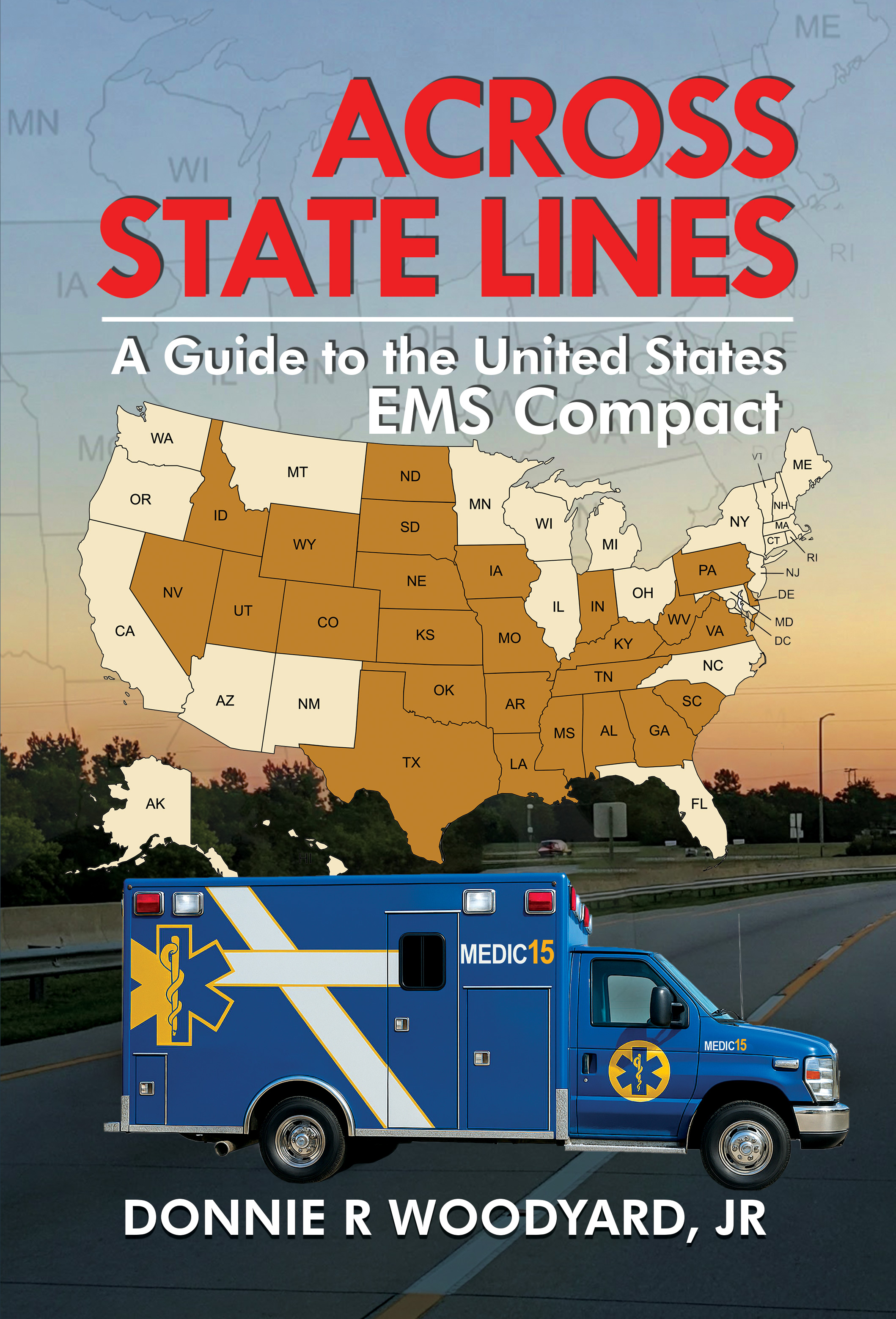
Every chapter of Across State Lines: A Guide to the United States EMS Compact is available here — read online, completely free. No signup, no paywall. This is our gift to the EMS community.
Prefer to read offline? Download the free EPUB. Want the paperback? Buy on Amazon. Also available on Barnes & Noble.
486 words
As Special Legal Counsel for the National Center for Interstate Compacts, it was both an honor and a privilege to serve as a principle compact drafter and member of the EMS National Advisory Panel to provide the legal framework, build consensus, and advance the national dialogue that made the United States EMS Compact a reality.1 It was also a privilege to assist in convening the inaugural meeting of the Interstate Commission for EMS Personnel Practice on October 10, 2017, in Oklahoma City.
Interstate compacts are not widely understood, although the EMS compact and other health occupational licensure compacts mentioned in this Guide have resulted in unprecedented use of compacts in a wide range of interstate regulatory purposes including licensure of EMS personnel. As science and technology have enabled people to travel the country virtually as well as literally. Such mobility has also increased the need for accommodating the need for health practitioners licensed across state lines to provide competent health care commensurate with the rapidly changing laws and regulations concerning the provision of telehealth to our highly mobile society.
As this Guide demonstrates, “clinicians often cross state lines, not as an exception but as part of their day-to-day work, disaster response, or military service. The EMS Compact ensures clinicians can do so legally, safely, and efficiently without sacrificing public protection or clinical oversight.” This Guide also illustrates that a national crisis such as the Covid-19 epidemic
requires a licensure process in which “compact member states could immediately recognize EMS licensees from other Compact states for the first time without requiring additional applications, processing delays, or redundant fees.” A process which once took weeks was now needed to be instantaneous and as the result of the EMS compact, clinicians were quickly deployed across state lines with the legal authority to practice.
Donnie Woodyard has provided a comprehensive analysis of the EMS Compact, including chapters on How the EMS Compact Functions, Disaster Response and Mutual Aid, EMS Data Privacy and National Security, and Advancing the EMS Compact Together. His experience, knowledge, and insights give us an invaluable look from the inside and the impact of the EMS Compact on member states and the nation.
This Guide is an extraordinary resource for those involved in EMS work including clinicians and regulators, as well as legislative and executive branch officials and I am grateful that this definitive work has been made available.
1 Richard L. Masters, J.D. has also been the primary drafter of many multistate licensure compacts including Nursing, Medicine, Physical Therapy, and Psychology. He also provides legal advice to a variety of compact governing boards and testifies about compact legislation before state legislatures and the U.S. Congress. Rick is also a co-author of both the ICAOS Bench Book cited herein and the only current legal treatise on interstate compacts published by the American Bar Association entitled The Evolving Law and Use of Interstate Compacts, 2nd Edition.
226 words
ACKNOWLEDGMENTS
Special appreciation goes to the visionary leaders who recognized the opportunity to improve EMS and took deliberate steps to turn that vision into reality. They laid the foundation for a more unified profession through collaboration, innovation, and a shared commitment to raising standards. Among them, I am especially grateful to Dia Gainor at NASEMSO, Rick Patrick of the U.S. Department of Homeland Security, Deb Cason at the National Registry of EMTs, Doug Wolfberg, JD, at Page, Wolfberg & Wirth LLC, Rick Masters at the Council of State Governments, and the legal team at Vedder Price. Their vision, persistence, and leadership were instrumental in shaping the legal framework, building consensus, and advancing the national dialogue that made the United States EMS Compact a reality. Without their dedication and expertise, the Compact would not have been created.
A special appreciation is extended to Page, Wolfberg & Wirth LLC—specifically Doug Wolfberg, JD, and Christie Mellott, JD—for their enduring support and trusted guidance to the EMS Compact and the broader EMS profession. Their legal insight and steady counsel have helped ensure the EMS Compact’s integrity and success.
To my colleagues in the EMS, legal, and policy communities, your feedback, support, and belief in this profession’s potential have strengthened this book and clarified its message.
To my family, thank you for your patience, encouragement, and steady support throughout this journey.
876 words
The United States EMS Compact is the most significant counterpoint to the fragmentation that has challenged Emergency Medical Services since the 1980s. In the 1970s, the National Registry of EMTs and the Paramedic National Standard Curriculum emerged during a remarkable period of national collaboration, driven by visionary leaders committed to building a unified profession. However, that collaborative model eroded over time, giving way to disjointed state regulations and limited interstate cooperation.
The Compact reconnects with that legacy. It reignites the earlier spirit of shared purpose while providing the legal and operational foundation for a truly national EMS system.
The journey from concept to implementation has taken nearly 15 years. By 2025, 25 states will have enacted the Compact into law—a remarkable milestone built on cross-sector collaboration, bipartisan legislative support, and sustained stakeholder engagement. But here’s the reality: passing the legislation is only the beginning. The more complex task—and the reason this book exists—is to educate the EMS workforce on effectively understanding and utilizing the Compact.
Over the past decade, I’ve had the privilege of speaking at conferences, hosting webinars, answering thousands of questions, and listening to frontline clinicians nationwide. What I’ve learned is this: most questions are not really about the Compact. They reflect deeper gaps in understanding the legal and operational foundations of EMS—concepts like agency affiliation, medical direction, the authority to practice, and scope of care.
I’ve worked in EMS for over 30 years, across multiple states and dozens of agencies. At one point, I was simultaneously employed by three different EMS organizations—each with its own medical director, protocols, medications, and scope of practice. Every time I put on a uniform and stepped into an ambulance, it was my responsibility to understand my authority in that moment, in that place, under that agency’s license. The variability was real. It demanded intentional professionalism.
While I wasn’t part of the Compact’s original drafting team, I joined the effort shortly after the model legislation was completed. The ink was barely dry when I began advocating for adoption. My connection to this work runs deep.
It started with a move. I became an EMT in Virginia while still in high school and soon relocated to Ohio for college. A few hours west, that simple move became my first jarring encounter with the red tape that has long frustrated EMS clinicians trying to continue their careers across state lines. Despite being licensed, Ohio didn’t recognize my Virginia training. I had to repeat coursework, retake exams, and relearn material I had already covered.
Clinically, there was no meaningful difference; however, the delay in getting authorized to work cost me over six months. At a time when I was eager and ready to serve, I was stuck in an administrative maze. That frustration—and the many similar obstacles I’ve seen since—fuels my passion for this Compact.
This book is a guide. It is structured to help you understand not only the history and legal framework of the Compact, but also how it functions in the real world—across agencies, states, disasters, and deployments.
- Part I: Foundations of the Compact explains the history and legal authority of interstate compacts and how this authority applies to EMS.
- Part II: How the EMS Compact Works explores the practical mechanics of implementation, including the Privilege to Practice, roles of home and Remote States, and scope of practice recognition.
- Part III: Supporting the Workforce addresses critical challenges, including military mobility, disaster deployment, workforce retention, and the Compact's response.
- Part IV: Looking Ahead considers the Compact’s future and role in driving innovation, accountability, and national integration in EMS.
Throughout the book, I have made a deliberate effort to include references and citations that support the material. Two particularly valuable resources have shaped my understanding and interpretation of compact law: the Bench Book published by the Interstate Commission for Adult Offender Supervision (https://interstatecompact.org/ bench-book), and the ongoing work of the National Center for Interstate Compacts at the Council of State Governments (https://compacts.csg.org). These resources have been instrumental in grounding this book in legal precedent and proven practice.
My goal is to provide a clear, comprehensive, and actionable understanding of the EMS Compact. It is a tool, not just for regulators or agency leaders, but for every clinician navigating an increasingly mobile profession.
While I currently serve as the Executive Director of the EMS Compact, this book is a personal project, not a formal publication of the Compact or its governing body. Every effort has been made to ensure the accuracy and relevance of the content, but the views expressed here are my own. This book does not represent the official position of the Interstate Commission for EMS Personnel Practice, nor should any portion be interpreted as legal advice. It is intended to inform, educate, and support those working in or alongside the EMS profession.
Ultimately, this is not about policy. It’s about patients. The Compact enables more timely, efficient, and consistent care, regardless of where the emergency occurs. It removes barriers that have long stood in the way of seamless service and lets us focus on what truly matters: delivering care with speed, professionalism, and trust.
This book is a call to action—and a commitment to the future of EMS.
Let’s get started.
Donnie Woodyard Jr., MAML, NRP
August 2025
Part I: Foundations of the Compact
5,916 words
Emergency medical services personnel cross jurisdictional boundaries every day. An EMT or paramedic may start treating a patient in one state and transport them to a hospital or trauma center in another. Additionally, EMS clinicians often deploy hundreds of miles from home to support overwhelmed systems during special events, wildfires, hurricanes, or mass casualty incidents. EMS clinician mobility is not just common—it’s an essential part of being an EMT or Paramedic.
Yet, for most of the history of Emergency Medical Services in the United States, the licensure requirements, process, and laws have varied dramatically between states, even neighboring states. Even the most competent paramedic, with a current National Registry certification, cannot legally provide care in another state without a separate licensure process. Likewise, for many decades, the state licensure process included applications, background checks, fees, and days, weeks, sometimes, of delay.
This mismatch between the professional realities of working in EMS and the legal structures (in place for valid public protection and state sovereignty reasons) created significant administrative burdens, bureaucracy, and, in some cases, negatively impacted patient care, especially during disasters or staffing shortages. To better understand how we arrived at this point—and how we’re addressing the issue—we must look back in time. The story of the United States EMS Compact begins long before modern ambulances, EMTs, Paramedics, or 911 systems. It starts with the original American colonies, the birth of state sovereignty, and the gradual evolution of legal cooperation between states.
It’s a story of boundaries, trust, and the rule of law—and it’s foundational to understanding how EMS became mobile, accountable, and modern.
Before the Constitution: Colonies and Cooperation
In the 1600s and 1700s, the American colonies functioned as independent political communities. Each had its own governor, militia, and legal system. They were loyal to the British Crown but operated with significant autonomy. While their political structures were distinct, their challenges were often shared.
Geography ignores borders. Rivers, forests, and farmlands stretched across colonial lines. So did threats, ranging from wildfires and epidemics to foreign invasion. No single colony could isolate itself from its neighbors for long. Cooperation wasn’t a luxury—it was a necessity.
When disputes arose, especially over land and natural resources, colonies often attempted to resolve them through direct negotiation. If negotiations failed, the matter could be escalated to the Privy Council in London, an imperial arbitration body. These early practices—joint agreements, mutual defense efforts, and outside adjudication—laid the groundwork for legal cooperation between sovereign entities.
One notable example was the New England Confederation, created in 1643 by Massachusetts Bay, Plymouth, Connecticut, and New Haven. This alliance was designed to provide mutual defense and coordinate action on shared concerns. Though not technically a compact in the modern legal sense, it introduced the idea that multiple independent governments could collaborate under a shared legal framework for the common good.
This colonial approach of regional cooperation—driven by shared interests, practical necessity, and political survival—set the stage for more formalized agreements between states after independence.
The Articles of Confederation
After winning independence from Great Britain, the former colonies faced a new challenge: how to govern themselves without falling into chaos or tyranny. The solution, at least initially, was the Articles of Confederation , which were ratified in 1781 as the United States' first constitution.
The Articles were designed to preserve state sovereignty above all else. Under this system, the national government was intentionally weak. No executive branch, national judiciary, or power to enforce laws existed. Congress could pass resolutions, but states could ignore them. It could request money but not compel payment. Each state retained the right to issue its currency, levy its tariffs, and negotiate trade deals with foreign powers.
The Articles did permit states to enter into agreements or compacts with one another, but only with the express consent of Congress. In practice, however, there was no practical way to enforce these agreements or ensure that all parties upheld consistent standards. With no strong federal oversight and no common legal structure to manage shared interests, collaboration between states was sporadic and unreliable.
The resulting dysfunction was particularly evident in areas like commerce, infrastructure, and security, where cooperation was essential. Disputes over river access, tolls, and trade routes became common. States frequently prioritized their economic and political interests over regional or national stability.
Though the historic issues were river tolls and trade disputes, the underlying problem—how states coordinate authority across borders—remains just as relevant in modern times. Nowhere is that more apparent than in regulating healthcare professionals like EMS clinicians, who often must cross jurisdictional boundaries in their duties.
The Articles offered only a loosely stitched patchwork of independent governments incapable of meeting the growing demands of a unified nation. However, the seeds required for creating interstate compacts had been planted, but the soil- the congressional structure—was not yet fertile enough for them to thrive.
This weakness set the stage for the Constitutional Convention of 1787, where delegates sought to build a new system allowing states to cooperate without surrendering their independence. This new system included the Compact Clause.
The Constitution and Article I, Section 10
The weaknesses of the Articles of Confederation became impossible to ignore. Without a cohesive national structure, states competed rather than collaborated, and the young nation teetered on the edge of disunion. In 1787, delegates from across the former colonies gathered in Philadelphia to draft a new framework for governance—the United States Constitution.
The Constitution sought to strengthen the federal government while preserving the sovereignty of individual states. Balancing these competing priorities required careful design. One of the most important—and often overlooked—tools created for this purpose was found in a single sentence within Article I, Section 10, Clause 3, now known as the Compact Clause:
“No State shall, without the Consent of Congress… enter into any Agreement or Compact with another State…”
This clause is short, but its implications are profound. It recognizes the need for interstate cooperation while ensuring that no group of states can form an alliance that might threaten national unity. It effectively provides the constitutional authority for interstate compacts, which today allow states to act jointly to solve problems too significant or too complex for a single jurisdiction to handle alone.
In 1893, the U.S. Supreme Court further clarified the scope of this clause in Virginia v. Tennessee . The Court ruled that congressional consent is not required for compacts that do not "increase political power in the states, which may encroach upon or interfere with the just supremacy of the United States". [1] This interpretation opened the door for a broader range of state-led agreements, enabling more efficient problem solving without federal oversight—so long as those agreements do not threaten federal supremacy. Since that ruling, the number and scope of interstate compacts have grown dramatically, expanding into areas such as education, insurance, transportation, and professional licensure. Notably, although the U.S. Supreme Court has not ruled directly on the new types of compacts, like occupational licensure compacts, the legal foundation of compacts is firmly established.
That ruling created space for the growth of occupational licensing and regulatory compacts—state-based frameworks that promote collaboration while maintaining state sovereignty. These compacts, including the United States EMS Compact, are not federal mandates. They are state-created and state-governed legal structures that reflect both the spirit and the letter of the Compact Clause.
With a solid legal foundation, states leveraged compacts to increase public protection and access to services, allowing licensed professionals in medicine, allied health, public safety, and emergency services to operate across state borders.
The Rise of Cooperative Federalism
The framers of the Constitution envisioned a system of dual federalism, where state and federal governments operated in separate, clearly defined spheres of authority. States maintained control over internal affairs such as education, health, and public safety, while the federal government focused on enumerated powers like national defense, foreign policy, and interstate commerce. This arrangement, often described as “layered cake federalism,” reflected a deliberate effort to limit centralized power based on the memory of British imperial rule.
But as the nation grew, so did the complexity of its challenges. The Great Depression, two world wars, and the civil rights movement pushed the boundaries of federal involvement in domestic policy. In response, during the early to mid-1900s, a new model emerged—cooperative federalism—where state and federal governments began working in tandem to manage overlapping responsibilities. Unlike the rigid separation of dual federalism, this new approach operated more like a “marble cake,” blending state and federal roles through grants, joint programs, and shared regulatory frameworks.
This shift reshaped the American system in tangible ways. In the 1970s, the federal government allocated millions of dollars to states through development grants to establish ambulance services, communications systems, and trauma infrastructure. These funds helped create the foundation for a modern EMS system and built the patchwork of local systems that still form the foundation of emergency care today. (However, as we will explore later in this book, much of the federal support for EMS abruptly ended in 1980, leaving behind a fragmented, fragile, and only partially developed system that would struggle to meet the evolving demands of the profession for decades to come.)
The broader trend has only accelerated: in fiscal year 2022, 36.4 percent of state government general revenues came from the federal government. By contrast, before 1900, states operated almost entirely on their state-generated revenues, receiving little to no federal funding apart from land grants and occasional project-specific allocations. Cooperative federalism has grown from an emergency measure into a structural norm.
This shift had far-reaching effects. Modern policy challenges—healthcare, transportation, disaster response, and professional licensure—rarely stop at state borders. Effective governance now requires coordinated action. However, rather than federal mandates, states have increasingly turned to interstate compacts to manage these shared responsibilities on their terms.
Compacts offer a constitutional solution to this complexity. They allow states to create shared rules, data systems, and oversight bodies—without ceding sovereignty to the federal government. Interstate compacts have become essential tools for modern governance in cooperative federalism. They are not merely contracts but mechanisms for problem-solving, innovation, and accountability across jurisdictions.
The EMS Compact is a direct product of this evolution. It reflects a growing reliance on state-led, legally binding frameworks to manage issues that are too large for one state but inappropriate for direct federal control. As cooperative federalism becomes the norm rather than the exception, the role of interstate compacts will only expand, especially in fields like EMS, where mobility, coordination, and public safety demand collective action.
What are Interstate Compacts?
An interstate compact is a legally binding contract between two or more states, and this special type of contract is enacted as state law by each participating state’s legislature. Unlike traditional legislation, an interstate compact cannot be unilaterally amended, repealed, or ignored by any individual member state. Because compacts function as contracts under the U.S. Constitution, they are legally enforceable, and violations may be challenged in state or federal court.
Today, more than 250 active compacts exist across the United States, with each state participating in an average of 34 interstate compacts [2]. Some are localized and straightforward, such as agreements to manage a shared river or watershed between a few neighboring states. Others are complex, multi-state arrangements designed to address large-scale challenges. Examples include:
- The Driver License Compact extends a ‘privilege to drive’ in states you are not licensed in based on your ‘Home State’ license. It also establishes a national database system for driver’s licenses and promotes uniform reporting of traffic violations. (Every day nationwide, EMS clinicians utilize the Driver’s License Compact without considering the constitutional foundation or required legal structure.)
- The Emergency Management Assistance Compact (EMAC) facilitates the movement of personnel and resources between states during disasters. (Again, another frequently utilized compact by EMS.)
- The Nurse Licensure Compact (NLC) allows nurses to practice across state lines with a multistate license.
These regulatory compacts represent a distinct class. They are not simply about cooperation—they are about governance. They establish shared standards, centralized oversight bodies, and common enforcement mechanisms across state lines. These compacts create new governmental bodies with legal authority and shared databases.
The EMS Compact is positioned in this same category. Like the NLC and EMAC, it addresses a fundamental issue that transcends state boundaries: ensuring that qualified EMS professionals can move and work where needed without unnecessary delay while still protecting the public and maintaining accountability.
By establishing a uniform legal framework and granting an interstate Privilege to Practice, the EMS Compact enables states to collaborate on regulation without compromising their autonomy. It is a textbook example of how compacts are potent tools for state-led innovation, particularly in public safety and healthcare.
Did You Know?
Most people have never heard of an interstate compact—yet they rely on them every single day. These legal agreements between states quietly enable air travel, highway driving, disaster response, insurance, education, and energy management across the country. Compacts are how the United States stays united—functionally, not just politically.
✈️ Airports
Interstate compacts make many airports possible. For example, Virginia and the District of Columbia jointly operate Dulles and Reagan Airports through a compact commission. These two airports anchor one of the busiest travel corridors in the nation, serving millions each year.
🚇 Port Authority of New York and New Jersey
Formed by compact in 1921, this bi-state authority manages major tunnels, bridges, subway lines, shipping ports, and airports across state lines for more than 17 million regional residents.
🚆 Interstate Rail Compacts
Passenger rail services like Amtrak’s Northeast Corridor run smoothly across state lines because multi-state compacts coordinate funding, planning, and infrastructure development.
🚗 Driver License Compact
This agreement allows drivers to legally operate a vehicle in all 50 states using a single state-issued license. No new tests, no new registration, no notice required. It ensures that driving privileges—and violations—travel with the person, not just the vehicle.
🛢️ Oil and Gas Compact
This multi-state agreement ensures the safe, responsible, and coordinated development of America’s energy resources, balancing economic productivity with environmental protection.
🏫 Education Compacts
For students in military families and others who move frequently, interstate education compacts ensure continuity in school enrollment, credit transfers, graduation timelines, and placement, even across jurisdictions with different academic calendars or requirements.
🛡️ Insurance Regulation Compact
This compact helps protect consumers and allows insurance companies to work efficiently across multiple states by aligning rules for life insurance, annuities, and long-term care policies.
👮 Public Safety and Justice Compacts
Other compacts coordinate emergency deployments, allow states to supervise probationers or parolees across borders, and manage interstate foster care and child placement, ensuring safety and continuity during life’s most urgent moments.
From highways to hospitals, classrooms to courtrooms, interstate compacts put the “united” into the United States.
The Rise of Regulatory Compacts
As the United States economy and population expanded in the twentieth century, states increasingly faced challenges that crossed jurisdictional lines. No single state could effectively regulate education, insurance, transportation systems, or coordinate healthcare licensing without overlapping (or conflicting) with neighboring jurisdictions. To solve problems that transcend borders—while preserving state authority—states rediscovered and leveraged the powerful Compact Clause of the Constitution, and started forming regulatory compacts.
The 20th and 21st centuries saw a rapid rise of new compacts addressing concerns from insurance to education, transit systems, and airports. These regulatory compacts allow states to create uniform licensing frameworks, establish multistate commissions, and enforce rules across member states with the force of law (Council of State Governments [CSG], 2020; CSG, 2022).
Unlike informal agreements or other forms of legislation, these compacts are:
- Constitutionally authorized under Article I, Section 10, Clause 3
- Statutorily enacted into law by each participating state
- Protected under contract law, meaning states cannot alter or abandon them unilaterally
- Enforceable in court and may override conflicting state statutes (CSG, 2022)
By 2026, over 40 states are expected to participate in occupational licensure compacts for nurses, EMS clinicians, physical therapists, psychologists, physicians, and other healthcare professionals.
Structure and Legal Authority
Most modern regulatory compacts include:
- A preamble establishing the compact’s purpose
- Definitions and shared legal terminology
- Uniform eligibility requirements for licensees
- A governing body or commission, typically composed of one delegate from each member state
- Processes for enforcement, dispute resolution, rulemaking, and withdrawal
These compacts don’t create federal agencies. Instead, they create state-developed governance structures that operate above any single state’s authority yet remain rooted in state law. As noted in the Compact Resource Guide:
“Compacts create independent, multistate governmental authorities that can address issues more effectively than any one state acting alone” (CSG, 2022, p. 3).
The Interstate Commission for EMS Personnel Practice, the governmental body created by the EMS Compact, is one such body. Like its counterparts in nursing, psychology, and medicine, it holds the authority to make rules, manage licensure data, receive funding, and oversee compliance—all while ensuring that member states retain sovereignty over their own EMS systems (OL Compacts in Action, 2020; ICAOS Bench Book, 2024).
Mutual Recognition vs. Expedited Licensure
There are two dominant models used in occupational licensure compacts:
- Mutual Recognition – In this model, a license issued by any compact state grants a Privilege to Practice or a Compact License that is valid and recognized by all other compact states (used by EMS, Nursing, and Physical Therapy).
- Expedited Licensure—A clinician applies for additional state licenses through this model's expedited and simplified process. Physicians in the Interstate Medical Licensure Compact currently use this model (OL Compacts in Action, 2020).
The EMS Compact follows the mutual recognition model. An EMS clinician maintains their Home State license and can practice in any other Compact member state without obtaining a separate license, assuming they meet all Compact conditions, such as medical direction and agency affiliation. [3]
A National Shift in Governance
Regulatory compacts have become one of the most trusted and scalable mechanisms for multistate problem-solving. They are now used in public health and law enforcement, education, corrections, and environmental protection.
As the Council of State Governments explains:
“Unlike federally imposed mandates, interstate compacts provide a flexible, state-developed structure for collaborative and dynamic action while building consensus among the states” (CSG, 2022, p. 4).
This approach is vital for EMS. Clinicians often cross state lines, not as an exception but as part of their day-to-day work, disaster response, or military service. The EMS Compact ensures clinicians can do so legally, safely, and efficiently without sacrificing public protection or clinical oversight.
Why EMS Needed a Compact
Emergency Medical Services are fundamentally mobile. Unlike most health professionals, who typically work within fixed facilities, EMS clinicians always deliver care on the move—in homes, highways, aircraft, and disaster scenes. Their effectiveness depends on clinical skill and navigating geography, weather, traffic, and jurisdictional boundaries.
Yet for decades, state borders posed significant legal barriers. In most circumstances, practicing in neighboring states without securing an appropriate license or authorization violates state law. The state licensure process was often slow, redundant, and inconsistent, creating delays during emergencies and roadblocks for EMS clinicians and agencies operating near state lines.
Many EMTs and paramedics—including those of us who served on the front lines—assumed that a mutual aid request, a long-standing tradition, or an informal “gentleman’s agreement” allowed us to cross state lines and provide care. Although widespread and often tolerated for decades, that assumption was frequently inconsistent with state law. Each state is a sovereign legal entity, and EMS practice within its borders requires lawful authority granted by the state, in the form of a license to practice. Today, EMS clinicians are regulated medical professionals, frequently performing invasive procedures and billing for services rendered. State EMS officials must consistently apply the legal and regulatory standards established by federal and state regulations. Inconsistent application is not permissible, even in good faith.
However, fragmented approaches to state-based EMS licensure potentially:
- Delays disaster response during hurricanes, wildfires, and mass casualty events
- Complicates staffing for cross-border EMS agencies
- Hinders military medics and their spouses after relocation
- Stifles recruitment, transfers, and surge staffing during shortages
A Flashpoint in Annapolis
The idea of the EMS Compact was not born in a quiet policy office or legal think tank. It was born in a moment of constitutional urgency—in a room full of state EMS officials reacting to what they saw as a direct challenge to state authority.
In the first week of May 2011, leaders of the National Association of State EMS Officials (NASEMSO) were gathered in Annapolis, Maryland, for an in-person meeting. Midway through the agenda, word arrived that staff from the offices of U.S. Senators Joe Lieberman and Susan Collins had drafted legislation to exempt EMS personnel from the Department of Homeland Security (DHS) from state EMS licensure requirements. The proposed legislation would allow federal DHS personnel to cross jurisdictional boundaries and deliver patient care without obtaining a state license.
The reaction was immediate and intense. For decades, state EMS offices had worked to professionalize prehospital care, develop consistent scopes of practice, and ensure accountability through state-level licensure. This proposal—however well-intended—was seen as bypassing that entire framework.
Shortly after, a high-stakes meeting took place inside Senator Lieberman’s office suite in Washington, D.C. Present were NASEMSO leaders, DHS attorneys, and congressional staff. The mood was candid. At one point, a staff member asked directly: “If not a federal exemption, then what is your solution?”
Dia Gainor, a former state EMS director and the president of NASEMSO representative suggested: “An interstate compact.”
That moment was more than a rebuttal—it was a turning point. The idea of a state-driven compact to address EMS licensure mobility took hold immediately. It offered a constitutional alternative to federal overreach and a collaborative framework that preserved state sovereignty.
Over the next seven months, NASEMSO began building out that idea. On December 5, 2011, it submitted a formal project proposal to the DHS Office of Health Affairs outlining a plan to design an interstate compact. The proposal emphasized state authority and operational necessity. It also highlighted the absence of any existing legal structure capable of solving the problem.
In May 2012, DHS awarded a sole-source contract to NASEMSO to lead the development effort. After the project was awarded, NASEMSO reached out to the Council of State Governments (CSG), inviting them to serve as a subcontractor to support compact design and legal alignment. CSG’s its experience guiding compacts in nursing, medicine, and public safety proved critical. CSG’s legal team and compact advisors helped translate NASEMSO’s operational goals into model legislation that aligned with constitutional principles and existing regulatory frameworks.
What started as a challenge in a Senate office became a decade-long movement to modernize EMS licensure across the country. The Compact was not a reaction to change—it was a deliberate decision to lead it.
As this effort gained traction, the vision for an EMS Compact also took shape with awareness of parallel efforts in other health professions. While the federal exemption proposal had sparked the fire, the path forward was grounded in lessons learned from successful state-driven models. Among those, the emerging Nurse Licensure Compact (NLC) offered a compelling example. It demonstrated how states could create legal structures that respected sovereignty while enabling mobility—without federal intervention. EMS leaders saw the potential to build something similar but tailored to the operational realities of prehospital care: mobile teams, time-critical interventions, and the need for seamless clinical oversight across jurisdictions.
In 2000, nursing blazed a new path with the launch of the Nurse Licensure Compact (NLC)—a groundbreaking model that allowed qualified nurses to practice in multiple states under a single state-issued license. EMS leaders saw the promise of this model and began charting a similar course, tailored to the unique realities of prehospital care. In 2013, the EMS Compact Model Legislation became the nation's second major healthcare licensure compact, leading the way for physicians, psychologists, physical therapists, and others to follow.
EMS needed a compact designed for emergency response, one that could:
- Respect state authority and local medical direction
- Provide immediate license recognition for qualified EMS clinicians
- Enable real-time data sharing and shared oversight
- Allow clinicians to serve wherever and whenever needed most
That vision became reality in 2017 when Georgia, the 10th state, enacted REPLICA (the Recognition of EMS Personnel Licensure Interstate Compact) law. Today, commonly referred to as the United States EMS Compact, it allows qualified EMS clinicians to practice across state lines with a recognized Privilege to Practice, based on a valid license from their Home State at the EMT, Paramedic, or equivalent level.
The EMS Compact is a legal remedy that echoes the modern expression of EMS values—mobility, readiness, transparency, collaboration, accountability, and a commitment to care that does not stop at state lines.
The urgency for such a system was also recognized at the federal level. As early as 2013, the U.S. Department of Homeland Security documented persistent legal barriers faced by its EMS personnel during cross-border operations. According to Patrick (2013), while DHS EMS clinicians held National Registry certification and were credentialed through a comprehensive internal quality assurance framework, they were frequently constrained by state licensure laws when rendering care across jurisdictional boundaries. The lack of a consistent legal mechanism delayed care during no-notice incidents and created liability risks for federal responders operating without recognized state authority. These challenges contributed directly to the recommendation that an EMS licensure compact—modeled on the success of nursing and driver license compacts—be developed and adopted nationwide.
In 2000, nursing blazed a new path with the launch of the Nurse Licensure Compact (NLC)—a groundbreaking model that allowed qualified nurses to practice in multiple states under a single state-issued license. EMS leaders saw the promise of this model and began charting a similar course, tailored to the unique realities of prehospital care. In 2013, the EMS Compact Model Legislation became the nation's second major healthcare licensure compact, leading the way for physicians, psychologists, physical therapists, and others to follow.
EMS needed a compact designed for emergency response, one that could:
- Respect state authority and local medical direction
- Provide immediate license recognition for qualified EMS clinicians
- Enable real-time data sharing and shared oversight
- Allow clinicians to serve wherever and whenever needed most
That vision became reality in 2017 when Georgia, the 10th state, enacted REPLICA (the Recognition of EMS Personnel Licensure Interstate Compact) law. Today, commonly referred to as the United States EMS Compact, it allows qualified EMS clinicians to practice across state lines with a recognized Privilege to Practice, based on a valid license from their Home State at the EMT, Paramedic, or equivalent level.
The EMS Compact is a legal remedy that echoes the modern expression of EMS values—mobility, readiness, transparency, collaboration, accountability, and a commitment to care that does not stop at state lines.
The urgency for such a system was also recognized at the federal level. As early as 2013, the U.S. Department of Homeland Security documented persistent legal barriers faced by its EMS personnel during cross-border operations. According to Patrick (2013), while DHS EMS clinicians held National Registry certification and were credentialed through a comprehensive internal quality assurance framework, they were frequently constrained by state licensure laws when rendering care across jurisdictional boundaries. The lack of a consistent legal mechanism delayed care during no-notice incidents and created liability risks for federal responders operating without recognized state authority. These challenges contributed directly to the recommendation that an EMS licensure compact—modeled on the success of nursing and driver license compacts—be developed and adopted nationwide.
COVID-19: A National Crisis & EMS Crisis
In early 2020, the COVID-19 pandemic overwhelmed EMS systems across the United States. Call volumes spiked, and staffing shortages intensified. Field hospitals and quarantine sites emerged overnight. Clinicians needed to move rapidly, often across jurisdictional lines, to meet shifting demand.
On Tuesday, March 10, 2020, the Interstate Commission for EMS Personnel Practice took decisive action. Recognizing the national emergency and the urgent need for flexibility, the Commission formally activated the EMS Compact. Although the National EMS Coordinated Database was not yet operational, the Commission determined that the public benefit of immediate licensure recognition outweighed the risks associated with the delay. This was the EMS Compact’s first operational use—and it came in the middle of a global crisis.
Compact member states could immediately recognize EMS licenses from other Compact states for the first time without requiring additional applications, processing delays, or redundant fees. What once took weeks was now instantaneous. EMS clinicians deployed across state lines with the legal authority to practice.
States used this authority to:
- Rapidly surge EMS personnel to COVID-19 hotspots
- Support overburdened 911 systems and field care sites
- Sustain rural coverage where staffing collapsed
- Reinforce workforce continuity without sacrificing clinical oversight
The Compact functioned exactly as intended. It eliminated friction, preserved public safety, and proved that a state-governed mobility framework could deliver during a national emergency.
But the Compact’s value did not end with the pandemic. Since that activation, it has continued as a foundational tool for a modern EMS workforce. Member states now use the Compact to:
- Support cross-border operations during wildfires, floods, and hurricanes
- Enable seasonal and lateral staffing across jurisdictions
- Simplify transitions for military medics and their spouses
- Expand workforce access in underserved and rural regions
- Create new opportunities for recruitment and retention in a strained workforce environment
The Compact is both an emergency response tool and a durable, everyday solution—streamlining mobility, reinforcing readiness, and strengthening the national EMS system.
A Legacy of Partnership
The United States EMS Compact was the product of a centuries-old American tradition—states working together to solve shared challenges while preserving sovereignty. It reflects the evolution of a core constitutional principle: that cooperation, not centralization, can serve the public good when executed with structure, accountability, and trust.
From early colonial disputes settled by the Privy Council to the failures of the Articles of Confederation to the creation of the Compact Clause in the U.S. Constitution, the road to interstate compacts has been long—but deliberate. Regulatory compacts today, like the EMS Compact, are living extensions of that legal lineage. They embody both the wisdom of the past and the adaptability demanded by the present.
The EMS Compact is not just a policy but a commitment to readiness, professionalism, and public protection. It was designed for EMS clinicians who don’t stop at state lines, agencies that must respond across jurisdictions, and patients who deserve consistent care no matter where they are.
As EMS clinicians, educators, agency leaders, and regulators, we are responsible for using this tool strategically and wisely. The Compact gives us a new language of mobility, a new framework for accountability, and a new opportunity to unify a historically fragmented profession.
By understanding the origins of the EMS Compact, we can better anticipate its future—toward a stronger, more connected, and more responsive EMS system nationwide.
Chapter Review & Summary
🎯 Learning Objectives
After completing this chapter, readers will be able to:
- Describe how colonial cooperation influenced the development of interstate compacts.
- Explain the weaknesses of the Articles of Confederation related to cross-border governance.
- Identify the legal foundation of interstate compacts in the U.S. Constitution.
- Analyze the Supreme Court’s ruling in Virginia v. Tennessee and its relevance to modern compacts.
- Distinguish between dual federalism and cooperative federalism and their influence on EMS systems.
- Compare mutual recognition and expedited licensure models used in regulatory compacts.
- Describe the structure and legal authority of modern regulatory compacts.
- Explain why EMS required a distinct compact and how it functions in disaster and routine operations.
🗝️ Key Terms and Definitions
- Compact Clause: Article I, Section 10, Clause 3 of the U.S. Constitution authorizes states to enter into agreements or compacts with the consent of Congress.
- Cooperative Federalism: A governance model in which state and federal governments collaborate on overlapping responsibilities, often through shared funding and joint programs.
- Mutual Recognition: A compact licensure model in which a license issued in one member state is recognized by other member states.
- Regulatory Compact: A formal, enforceable agreement between states that establishes a common legal and operational framework for a specific policy area, such as professional licensure.
- REPLICA: The acronym of the Model Legislation required for states to enact to join the EMS Compact, the Recognition of Emergency Medical Services Personnel Licensure Interstate Compact.
- Virginia v. Tennessee (1893): A U.S. Supreme Court case that clarified states do not need congressional approval for compacts unless they threaten federal supremacy.
📌 Chapter Summary
- EMS clinicians frequently cross state borders, but until recently, licensing laws did not support this mobility.
- Early American colonies cooperated regionally out of necessity, laying the foundation for modern interstate compacts.
- The Articles of Confederation protected state sovereignty but failed to provide a workable model for cross-border governance.
- The U.S. Constitution’s Compact Clause provided the legal basis for formal state agreements.
- The Supreme Court’s decision in Virginia v. Tennessee allowed states more freedom to create compacts without congressional approval, provided they did not interfere with federal authority.
- Cooperative federalism replaced dual federalism as the dominant model of governance, increasing the need for coordinated interstate solutions.
- Regulatory compacts allow states to manage shared responsibilities like licensure and emergency response while retaining sovereignty.
- The EMS Compact follows the mutual recognition model, allowing clinicians to practice across state lines using their Home State license.
- The EMS Compact was activated for the first time during the COVID-19 pandemic, demonstrating its real-world impact on clinician mobility and system resilience.
- The Compact represents a legal and operational shift toward coordinated state-led governance for EMS professionals.
🧪 Chapter Quiz
1. What was one key weakness of the Articles of Confederation?
A. It required federal oversight of EMS
B. It created a strong national judiciary
C. It lacked enforcement mechanisms for interstate agreements
D. It permitted dual licensing for EMS clinicians
2. What legal provision gives states the authority to form interstate compacts?
A. Supremacy Clause
B. Tenth Amendment
C. Commerce Clause
D. Article I, Section 10, Clause 3
3. Which historical agreement provided an early example of colonial cooperation?
A. New England Confederation
B. Articles of Union
C. Mayflower Compact
D. Federalist Papers
4. In Virginia v. Tennessee, the Supreme Court ruled that:
A. All compacts require congressional approval
B. EMS clinicians can freely cross borders
C. Only compacts that threaten federal supremacy require consent
D. The Articles of Confederation remain in effect
5. Cooperative federalism is best described as:
A. A rigid division of federal and state powers
B. States ceding all health policy to the federal government
C. Shared responsibilities between federal and state governments
D. Federal government control over licensure
6. What is the key legal characteristic of an interstate compact?
A. It is optional for states to follow
B. It is a verbal agreement between governors
C. It functions as a contract enacted into state law
D. It is created by executive order
7. What type of compact is the EMS Compact?
A. Executive compact
B. Regulatory compact using mutual recognition
C. Advisory agreement
D. International treaty
8. During which event was the EMS Compact first activated?
A. Hurricane Katrina
B. 9/11 terrorist attacks
C. COVID-19 pandemic
D. Superstorm Sandy
9. What role did the Council of State Governments (CSG) play in the EMS Compact?
A. Provided legal opposition to the compact
B. Guided the development of the Model Legislation
C. Replaced state EMS agencies
D. Funded all EMS Compact operations
10. Why was the EMS Compact necessary for the profession?
A. To nationalize EMS licensure
B. To provide legal authority for cross-border care
C. To eliminate medical direction requirements
D. To create new EMS schools
Answer Key:
5,602 words
The United States EMS Compact was carefully designed. Its power, legitimacy, and authority are grounded in one of the oldest provisions of the U.S. Constitution and shaped by more than two centuries of constitutional law. Though the concept is simple—states working together—the legal structure behind compacts is deliberate and robust.
Understanding the EMS Compact requires a basic understanding of interstate compacts as legal instruments. Compacts are not informal agreements, MOUs, or symbolic partnerships. They are statutory contracts passed by state legislatures as state law, approved by governors, upheld by courts, and—when necessary—subject to Congressional oversight.
This chapter examines the legal mechanisms that enable the implementation and enforcement of the EMS Compact. We’ll explore how compacts differ from federal laws and traditional state statutes, how the Compact Clause of the Constitution enables their formation, and how courts—including the U.S. Supreme Court—have interpreted their scope, authority, and limits. We’ll also examine the unique authority of compact commissions, such as the Interstate Commission for EMS Personnel Practice, which serves as the EMS Compact’s governing body.
Through this lens, we’ll see that the EMS Compact is not just a policy innovation—it’s a constitutionally grounded, contractually binding, and judicially recognized structure that allows states to lead, govern, and protect together.
The Compact Clause: Article I, Section 10
As introduced in Chapter 1, the foundation of every interstate compact, including the EMS Compact, rests on a single sentence in the U.S. Constitution. Located in Article I, Section 10, Clause 3, the Compact Clause reads:
“No State shall, without the Consent of Congress… enter into any Agreement or Compact with another State…”
This clause reflects the Founders’ effort to strike a careful balance. On the one hand, they recognized the importance of state collaboration in addressing shared problems. Conversely, they feared exclusive alliances or regional coalitions that could threaten national unity. The Compact Clause became a tool allowing states to act within limits.
At first glance, the clause appears to require congressional consent for every compact. However, over a century of Supreme Court precedent has clarified that this is not a blanket requirement. In the landmark case Virginia v. Tennessee (1893), the Court held:
“The compact or agreement must be one which tends to the increase of political power in the states, which may encroach upon or interfere with the just supremacy of the United States” (Virginia v. Tennessee, 148 U.S. 503, 1893).
This distinction reshaped compact law. The Court drew a line between compacts that facilitate cooperation and those that might redistribute political power in a way that threatens or conflicts with federal authority. Only the latter requires Congressional approval (ICAOS Bench Book, 2024, § 2.1).
That judicial interpretation paved the way for hundreds of modern interstate compacts, including occupational licensure compacts, to function without federal involvement. Because the EMS Compact governs issues that fall squarely within state jurisdiction (e.g., professional licensure and public health regulation), it does not infringe upon federal supremacy and requires no action from Congress (Council of State Governments, 2022). This provided an opportunity for states to collaborate on a solution to increase access to EMS personnel and improve public protection, while concurrently reducing bureaucratic barriers to cross-border EMS practice.
In 2013, the U.S. Department of Homeland Security documented that its EMS personnel—trained, certified, and operating under federal authority—often lacked state-specific legal authority to provide care inside a state jurisdiction. Despite holding National Registry certification and providing critical services during “no notice” events, DHS EMS providers routinely encountered legal limitations that delayed or prohibited patient care. The absence of a lawful and consistent mechanism for cross-border practice created operational risks for the agency, legal ambiguity for clinicians, and potential patient harm (Patrick, 2013). [4]
These federal challenges helped catalyze the development of the state-based solution that would eventually morph into the EMS Compact. Rather than relying on piecemeal federal exemptions, the Compact emerged as a constitutionally grounded tool to address a real and urgent operational gap—one recognized at the highest levels of emergency response.
The Constitution permits states to collaborate, but it does so with guardrails in place. These guardrails ensure that interstate cooperation remains a tool for unity, not a source of division. The EMS Compact was crafted within that framework, leveraging the Compact Clause as a basis for permission and the legal foundation for legitimacy, governance, and mutual accountability.
Why a Federal Exemption Was a Legal Dead End
Some may ask why Congress did not create a national EMS, physician, or nursing license. While the Lieberman-Collins proposal for federal legislation to exempt DHS EMS personnel was well-intended, it likely would have been struck down by the Supreme Court—or ignored by states—due to longstanding constitutional doctrine.
Constitutional Framework
Under the Tenth Amendment, the U.S. Constitution reserves to the states all powers not expressly delegated to the federal government. This includes the police powers, which are the authority to regulate matters affecting public health, safety, and welfare. Occupational licensure falls squarely within this domain. EMS licensure, specifically, is a core exercise of this reserved power. It defines who may practice, under what conditions, and according to which clinical and ethical standards.
The answer lies in constitutional law. Occupational licensure authority is reserved to the states, derived from their police powers to regulate health, safety, and welfare. As Patrick (2013) explains, this division of authority meant that any federal attempt to impose a nationwide EMS license would have faced legal and political obstacles. Instead, a compact offered the appropriate path, allowing states to collaborate voluntarily, preserve their sovereignty, and create a binding, legally enforceable system of mutual recognition. The EMS Compact was not an end-run around federal law; it was a constitutional solution rooted in the same principles that govern licensure in medicine, nursing, and law.
Key Legal Conflicts
A federal exemption for EMS personnel—such as the one proposed for the Department of Homeland Security in 2011—would have upended the licensure frameworks embedded in state law. Each state defines its scope of practice for EMS, training requirements, and mechanisms for discipline and oversight. A blanket federal exemption would have overridden those laws and created a parallel regulatory system, immune from state oversight.
While the Supremacy Clause gives federal law precedence over state law, it applies only within the bounds of enumerated federal powers. EMS licensure does not fall under those powers. Congress cannot simply override state authority in a domain to which it was never granted jurisdiction. Attempts to do so would violate not only the Tenth Amendment but also the broader constitutional principle that the federal government may not commandeer state regulatory systems.
Rather than solving a problem, a federal exemption would have introduced legal and operational instability. The EMS Compact, by contrast, offers a state-based alternative that promotes cross-border practice through mutual recognition, without infringing on the sovereignty of individual states.
Case Law Support
This principle—that the federal government may not force states to adopt or dismantle regulatory programs—has been affirmed by the U.S. Supreme Court in multiple landmark rulings. In New York v. United States (1992), the Court held that Congress cannot compel states to administer federal programs [5]. In Printz v. United States (1997), the Court expanded this doctrine, ruling that the federal government may not require state officials to carry out federal mandates.
Together, these rulings form the backbone of what legal scholars refer to as the “anti-commandeering doctrine.” The doctrine prohibits federal efforts to bypass state sovereignty by mandating how states legislate, regulate, or enforce. A federal EMS licensure exemption would have violated this principle by displacing the state’s exclusive role in regulating its healthcare workforce.
Practical Implications
The consequences of such an exemption would have been significant. First, it would have stripped state EMS offices of their ability to investigate misconduct or impose discipline on federally exempt personnel operating within their jurisdictions. This creates enforcement gaps, where patient complaints or clinical errors may go uninvestigated due to a lack of legal authority to do so.
Second, a federal exemption would have created liability risks for states and agencies. Questions of scope of practice, clinical authority, and malpractice would become murky. Who holds jurisdiction if a federally exempt EMS clinician harms a patient in a state that never authorized them to practice?
Finally, it would have undermined the legitimacy of state EMS systems. For decades, states have worked to professionalize EMS, align standards, and ensure public protection through robust licensure. A federal carve-out would have disrupted that ecosystem and signaled that EMS clinicians working under federal authority are not subject to the same accountability as their state-licensed peers.
A Constitutional Third Path
The EMS Compact offers a constitutional “third path.” It avoids both the fragmentation of the status quo and the overreach of a federal exemption. Instead, it creates a lawful mechanism for mobility based on mutual trust, shared standards, and respect for sovereignty. It enables states to collaborate, preserving their legal authority while developing a system that meets modern demands for readiness, workforce flexibility, and patient safety.
Compacts are State Law
An interstate compact becomes state law through the state’s regular legislative process. Each member state must enact the compact’s Model Legislation, word for word, as a statute. Uniform adoption is essential: even slight variations in the language could introduce legal inconsistencies that jeopardize the compact’s enforceability or alter the agreement’s meaning across jurisdictions (Council of State Governments, 2022).
When a state legislature enacts a compact, it does more than express support—it gives the compact the full force of law within that state. The compact becomes binding not only on state agencies, the executive branch, and all state officials but also on future legislatures and governors unless they formally withdraw under the terms of the compact itself (ICAOS Bench Book, 2024, § 2.4).
This legal status sets interstate compacts apart from memoranda of understanding (MOUs), executive agreements, executive orders, or informal agency collaborations. Those tools may express intent, but they lack the binding authority of statute. In contrast, a compact is a statutory contract recognized under constitutional law and protected from unilateral alteration by any individual state (CSG, 2022; ICAOS Bench Book, 2024, § 2.2).
Unlike most state laws, compacts don’t just bind a state to its residents—they bind states to one another. That interstate obligation gives compacts their unique power and introduces legal complexity. Questions of interpretation, enforcement, and compliance must be resolved collectively. A state (or parts of its executive branch of government) can’t simply “opt out” of parts of a compact it finds inconvenient. It is legally obligated to follow the entire agreement or to withdraw formally.
Most modern regulatory compacts, including the EMS Compact, establish a multistate commission to manage this complexity. This governing body provides oversight, the ability to develop administrative rules, resolves disputes, and ensures that the compact is implemented uniformly across all member states. It is the administrative and legal center of gravity for the compact’s operation and integrity.
This combination of state statutory authority and contractual obligation across jurisdictions gives compacts their distinctive legal character. They are not only tools for cooperation—they are mechanisms for shared governance, forged in law and upheld by courts.
Jurisdiction and Enforcement
Section 13.D of the Recognition of EMS Personnel Licensure Interstate Compact (REPLICA) establishes a critical enforcement mechanism for the Commission:
“By majority vote, the Commission may initiate legal action in the United States District Court for the District of Columbia or the federal district where the Commission has its principal offices against a member state in default to enforce compliance with the provisions of the compact and its promulgated rules and bylaws.”
This section provides contractual consent to federal jurisdiction for disputes between the Commission and a member state. The provisions and terms of the EMS Compact are enforceable in federal court under established constitutional principles.
In McComb v. Wambaugh (1991) [6], the Third Circuit affirmed that:
- Interstate compacts are contracts between states and enforceable under the U.S. Constitution's Contract Clause.
- Federal courts may assert jurisdiction over compacts even without congressional consent when a federal question is raised or the compact structure creates jurisdiction, such as an explicit venue provision, as in REPLICA §13.D.
This structural grant of jurisdiction allows the Commission to seek judicial enforcement if a member state fails to meet its obligations under the Compact. A federal court ensures that disputes between states and the Commission can be addressed in a neutral forum with national authority, thereby reinforcing the legal integrity of the Compact’s provisions and the binding nature of Commission rules.
The Role of a Compact Commission
Governmental authority requires a structured framework, dedicated personnel, and sustained resources to function effectively. When states join an interstate compact, they align in principle and commit to building a coordinated regulatory system across jurisdictions. Compacts must be implemented through formal government structures and processes to fulfill this commitment. That is why modern compact laws—including the United States EMS Compact—authorize the creation of a Commission. These Commissions provide the legal framework, administrative staff, and infrastructure needed to operationalize the compact. They adopt rules, coordinate multi-state efforts, and ensure the compact’s provisions are implemented.
The United States EMS Compact law established the Interstate Commission for EMS Personnel Practice. This Commission is not a federal agency, an association, or a coordinating group. It is a multistate regulatory body and governmental entity formed by state law. It is empowered to oversee, implement, and enforce the Compact’s provisions on behalf of all member states (ICAOS Bench Book, 2024, § 2.5; Council of State Governments, 2022).
The Governor, or a delegate of the Governor, of each Compact member state appoints one voting representative—typically the state EMS director or designee—to serve as its Commissioner, or delegate. Collectively, these Commissioners form the governing body of the EMS Compact. Each Commissioner represents the views, positions, and authority of their state. They each have a single vote that cannot be delegated, and their authority is derived directly from the compact statute, as enacted into law by each participating state.
The EMS Compact Commission holds a distinct legal status. It operates above the level of any single state but below the federal government. However, without federal authority, the Commission is the highest regulatory body for the interstate practice of EMS in the United States. Often described in compact literature as a “superstate” body, compact commissions exist to execute functions that states cannot accomplish while preserving state sovereignty (ICAOS Bench Book, 2024, § 2.5; CSG, 2022).
Legal Powers of the EMS Compact Commission
The EMS Compact Commission has focused on specific powers in the compact statute. These include the authority to:
- Adopt binding rules and regulations that carry the force of law in all member states
- Enforce compliance by member states and by EMS clinicians operating under the Compact
- Collect, maintain, and share licensure and disciplinary data across jurisdictions through the National EMS Coordinated Database.
- Respond to noncompliance through formal mechanisms, including investigation, dispute resolution, and remedial actions (REPLICA, 2014; ICAOS Bench Book, 2024, § 2.5)
The Commission has the authority and obligation to take formal action to address violations, initiate corrective measures, and ensure the integrity of the Compact’s operations. Courts have upheld the authority of compact commissions to make rules, conduct enforcement actions, and defend their interests in legal proceedings (ICAOS Bench Book, 2024, § 3.2).
Importantly, compact commissions do not replace state agencies. Instead, they serve as collaborative instruments through which states act jointly. The EMS Compact strategically preserves each state’s authority over its own EMS personnel and regulatory systems, enabling states to solve problems with shared standards, accountability, and interoperability.
The EMS Compact Commission reflects the collective will of the states, but once formed, it operates with an independent legal identity. It may enter into contracts, issue subpoenas, accept grants, and establish administrative systems that enable the multistate practice to function smoothly.
And importantly, in the absence of federal legislation or regulation, compact commissions are the highest governmental regulatory authority for the areas specified in the compact law. The Commission’s rules and actions carry binding authority across all participating jurisdictions in multistate licensure recognition, compliance enforcement, and interstate professional mobility.
Judicial and Administrative Enforcement
A common question about interstate compacts is: What happens if a state does not comply?
The answer is clear: interstate compacts are legally binding and enforceable in state and federal courts. Because the EMS Compact is enacted as statutory law in each member state, its provisions carry the same legal weight as any other state statute. It is also a multistate contract, meaning noncompliance violates state law and constitutes a breach of contract with the other states.
The U.S. Supreme Court has consistently upheld this dual legal status. In West Virginia ex rel. Dyer v. Sims (1951), the Court ruled that “when a state enters into an interstate compact, it surrenders a portion of its sovereign power, and the resulting obligations are binding.” In Texas v. New Mexico (1987), the Court reaffirmed that compact provisions are judicially enforceable and that courts may impose remedies when states fail to comply with them.
Under the Full Faith and Credit Clause of the U.S. Constitution (Article IV, § 1) and 28 U.S.C. § 1738, states must recognize and enforce the statutes and judgments of other states. This principle extends to interstate compacts, which function as state law in each jurisdiction and a collective contractual obligation. Once enacted, the EMS Compact is not optional—it must be enforced and respected as binding law in every member state.
In addition to judicial enforcement, the EMS Compact includes administrative enforcement mechanisms. Under Section 13 of the Compact and Administrative Rule 13, the Commission may:
- Investigate non-compliance by states or clinicians
- Take remedial action, including restrictions or suspension of a state’s Compact participation
- Ensure due process, including written notice, hearings, and appeal rights
For example, Rule 13.1(F)(3–4) gives the Commission authority to suspend or terminate a state’s participation for material noncompliance—actions that are binding and enforceable across all member states.
Together, these tools ensure that the EMS Compact is not a recommendation or suggestion—it is a powerful governance structure protected by courts, enforced by statute, and administered by the Commission with transparency and due process.
Binding Rulemaking Authority
Rulemaking is a cornerstone of compact governance. Section 10 of the EMS Compact statute gives the Commission authority to “promulgate reasonable rules to effectively and efficiently achieve the purpose of the Compact” (REPLICA, 2014, § 10(C)). While limited to the compact's scope, these rules carry the full force and effect of law in every member state (REPLICA, 2014, § 10(F); EMS Compact Administrative Rules, Preface).
REPLICA, 2014, § 10. D. The Commission shall have the following powers:
The authority to promulgate uniform rules to facilitate and coordinate implementation and administration of this Compact. The rules shall have the force and effect of law and shall be binding in all member states;
The rulemaking process must include:
- Public notice of proposed rules
- Open meetings and opportunities for comment
- A majority vote of Commissioners for adoption
This process mirrors state and federal administrative procedures, ensuring transparency, consistency, and legitimacy (EMS Compact Administrative Rule 10.1; ICAOS Bench Book, 2024, § 3.5).
Federal Oversight vs. State Sovereignty
Another frequent question about interstate compacts is whether they conflict with federal authority or undermine national governance.
The answer is no—when properly structured, interstate compacts complement federalism rather than compete with it.
Interstate compacts are not federal mandates. They do not create federal agencies, impose federal obligations, or preempt federal law. Instead, they are expressions of state sovereignty. Compacts are one of the clearest examples of cooperative federalism in action. They allow states to retain control over inherently local matters—like professional licensure—while addressing multistate needs with consistency and shared oversight. The Compact Resource Guide explains that compacts enable states to “retain sovereignty in matters traditionally reserved for the states” while acting together on issues with regional or national implications (Council of State Governments, 2022, p. 4).
The EMS Compact is one of over 250 active compacts in the United States. It represents a growing trend in how states address cross-border issues in public protection and professional licensure. According to Litwak (2024), compacts have increasingly become the legal mechanism through which states govern shared infrastructure, coordinate healthcare readiness, and ensure mobility in regulated professions. The EMS Compact fits squarely within this broader evolution of cooperative federalism, striking a balance between state sovereignty and national accountability.
Licensure Compacts and Reserved State Powers
Occupational licensure is a state-regulated function, historically governed under each state’s police powers, as defined by the Constitution. Congress has never established a federal EMS licensure standard, and no federal agency regulates EMS clinicians practicing across state lines.
This makes licensure compacts, such as the EMS Compact, particularly appropriate. They enable states to maintain authority over:
- Entry-to-practice standards
- Disciplinary and investigative procedures
- Scope of practice definitions
- Medical oversight and agency affiliation
And yet, through mutual recognition, shared data systems, and a unified Privilege to Practice, the EMS Compact ensures that multi-state mobility doesn’t come at the expense of accountability.
Federal Partnerships Without Federal Control
While compacts are state-led, many compact commissions collaborate closely with federal agencies, particularly when national interests intersect with professional mobility or public protection.
The EMS Compact Commission, for example, has worked with:
- The U.S. Department of Defense (DoD) to streamline transition pathways for military medics entering the civilian workforce
- The Department of Homeland Security (DHS) has jurisdiction over federal EMS personnel, emergency response, and national preparedness issues.
- The Federal Emergency Management Agency (FEMA) and the Assistant Secretary for Preparedness and Response (ASPR) to improve surge capacity and coordinate deployment
These relationships are collaborative, not supervisory. The federal government cannot force states to join a compact, nor can it unilaterally override the Commission’s rules or decisions. Compact commissions operate under the sovereign authority of their member states, not as federal subcontractors.
A Constitutional Model for Modern Governance
The compact governance model—states acting jointly through an independent, state-created commission—may be one of American federalism’s most potent and underutilized tools. It allows states to:
- Respond to emerging multistate challenges
- Create flexible, enforceable regulatory systems
- Avoid slow or one-size-fits-all federal mandates
In an era where workforce mobility, public protection, and health system agility matter more than ever, compacts offer a state-led solution with a national-scale impact.
The EMS Compact demonstrates that states don’t need to wait for Congress to act. They can lead legally, efficiently, and constitutionally when properly structured.
The Legal Power of Uniformity
One of an interstate compact’s most potent legal features is its uniformity. Every member state enacts the same model legislation, verbatim. This consistency ensures the compact operates as a valid contract among states rather than a patchwork of conflicting interpretations.
Under the compact law, uniform statutory language gives rise to uniform legal obligations. No member state can unilaterally alter or tailor the terms to suit local preferences, as doing so would breach both the contract and the constitutional authority under which the compact operates (ICAOS Bench Book, 2024, § 2.3). [7]
For the EMS Compact, this uniformity means:
- An EMS clinician licensed in any Compact member state is held to the same eligibility standards
- Agencies and medical directors in Remote States can trust that all EMS clinicians meet the minimum licensure requirements.
- The Commission can enforce rules consistently across all jurisdictions without legal ambiguity or gaps.
Why Uniformity Matters for Enforcement and Trust
The legal clarity created by uniformity enables both mobility and accountability. EMS clinicians practicing under the Privilege to Practice provision can move across borders without confusion over varying requirements. At the same time, states and employers recognize that all clinicians operating under the Compact meet a shared standard of competency, conduct, and compliance.
This consistency also supports enforcement. The Commission can take disciplinary or remedial action with confidence that every state has agreed to the same terms, eliminating claims of unequal treatment or loopholes due to differing statutory wording.
Changing the Compact: A High Legal Bar
Because the compact is a multistate contract, any changes to its core provisions require an extraordinary degree of consensus. Even minor amendments to the Compact statute must:
- Be approved by the Compact Commission
- Be re-enacted verbatim by every participating state legislature
This high bar is by design. It ensures that changes are deliberate, uniform, and widely supported, protecting the compact from political volatility or unilateral reinterpretation.
While this process may be slow, it promotes stability, legitimacy, and public trust—all essential qualities for a legal structure that governs critical public safety functions across state lines.
Uniformity is the legal spine of the EMS Compact—ensuring that states act as one, clinicians are treated equally, and the system functions with cohesion, confidence, and constitutionally grounded authority.
Compact vs. Federal Law: A Deliberate Choice
Some EMS professionals reasonably ask:
“Why wasn’t cross-border licensure solved by a federal law?”
“Why go through the slow process of passing identical legislation in 25 or more states?”
The answer lies in the constitutional structure of American federalism.
The U.S. Constitution does not grant Congress general authority over occupational licensure. That power resides exclusively with the states through their police powers—the legal authority to regulate ‘public health, safety, and welfare.’ Therefore, professions like medicine, nursing, law, and EMS are governed state by state, not from Washington, D.C. (ICAOS Bench Book, 2024, § 2.1; Council of State Governments, 2022).
Congress could attempt to pass a national EMS licensure law, but such legislation would face substantial legal and political challenges. Without a clear constitutional hook, such as interstate commerce or federal funding dependency, it would likely be struck down or resisted by states defending their sovereignty.
Federalism in Action
The EMS Compact reflects a uniquely American idea—that states are not merely administrative districts but sovereign entities capable of joint governance. It honors the Constitution’s design, avoids legal overreach, and embraces the flexibility and responsiveness that federal legislation often lacks.
Ultimately, the EMS Compact isn’t a workaround. It’s a constitutionally grounded governance strategy, tested by other professions and tailored to the needs of modern EMS. It affirms that state-led collaboration—not federal control—is often the best path forward.
A Law of the States, for the Nation
As clearly articulated, the EMS Compact is a law. It is a real, enforceable, and constitutionally grounded agreement enacted by multiple state legislatures, structured through uniform statute, and governed by a Commission of state-appointed leaders. It is neither an aspiration nor an advisory memorandum. It is a legal tool created through state sovereignty and designed for modern realities.
The Compact exists because the Constitution allows it, the courts uphold it, and the states have chosen it. It offers a durable solution to EMS’s most pressing challenges: enabling safe, accountable, and immediate cross-border practice in a high-stakes, highly mobile profession.
As the demands on EMS clinicians grow—whether due to national disasters, workforce shortages, or multi-jurisdictional response—the EMS Compact provides a legal solution that reduces bureaucracy, improves public protection, and increases access to the EMS workforce. The EMS Compact does not replace state authority; it links state authority in a structure that protects the public, supports the profession, and reinforces the rule of law.
When an EMS clinician crosses a state line to provide care under the Compact, they do so with more than a patch on their shoulder—they carry with them the full weight of constitutional law, state authority, and a national commitment to public protection. This is not improvisation. It is governance by design.
The EMS Compact is not a workaround but the legal pathway built for a profession defined by urgency, mobility, and trust. It reflects two centuries of American federalism at work, giving EMS clinicians the legal clarity and operational flexibility they need to serve wherever the call comes from.
Understanding this legal foundation does more than inform—it equips EMS leaders to protect it, educators to teach it, and clinicians to use it confidently. In a profession where seconds matter, the law must move at the speed of care. With the EMS Compact, it does.
Chapter Review & Summary
🎯 Learning Objectives
After completing this chapter, readers will be able to:
- Identify the constitutional provision that authorizes interstate compacts.
- Explain the significance of Virginia v. Tennessee in interpreting the Compact Clause.
- Describe how a compact becomes legally binding within a state.
- Differentiate between interstate compacts and informal agreements.
- Analyze the role and legal authority of the EMS Compact Commission.
- Understand the enforcement mechanisms available when states fail to comply with compact provisions.
- Evaluate the constitutional reasons why EMS licensure remains a state function rather than a federal one.
- Explain how compact uniformity ensures legal consistency and operational trust.
🗝️ Key Terms and Definitions
- Statutory Contract: A legally binding agreement enacted as law by state legislatures, forming the basis of interstate compacts.
- Compact Commission: A multistate governmental entity created by compact statute to oversee implementation, enforcement, and rulemaking.
- Rulemaking Authority: The legal power of a compact commission to create administrative rules with binding effect in all member states.
- Police Powers: The constitutional authority reserved to states to regulate health, safety, and welfare, including licensure.
- Uniformity: The legal requirement that all states adopt the exact same compact language to ensure enforceability and mutual accountability.
- Superstate Body: A legal term describing a compact commission, created by states, that cooperatively operates above individual states but below the federal government.
- Binding Enforcement Mechanism: Legal tools, including administrative and judicial processes, that compel compliance with compact law.
📌 Chapter Summary
- The EMS Compact is legally grounded in the U.S. Constitution’s Compact Clause and upheld by over a century of case law.
- The Virginia v. Tennessee decision established that compacts do not require congressional approval unless they threaten federal supremacy.
- Occupational licensure, including EMS, is a function of state police powers, not a federal authority.
- Each state must adopt the EMS Compact using identical legislative language to function as a valid contract.
- Compact Commissions like the Interstate Commission for EMS Personnel Practice have formal authority to create rules, enforce compliance, and manage data.
- States cannot unilaterally withdraw from or alter compact terms without following strict procedures.
- Courts at both the state and federal levels uphold compact law and may intervene when states fail to comply.
- Compact commissions operate independently of federal oversight but may collaborate with federal agencies on shared goals.
- Uniform adoption ensures trust, legal clarity, and fair enforcement across all jurisdictions.
- The EMS Compact is not a workaround but a constitutional mechanism tailored for public safety and professional mobility.
🧪 Chapter Quiz
1. What constitutional clause authorizes states to form interstate compacts?
A. Supremacy Clause
B. Full Faith and Credit Clause
C. Commerce Clause
D. Article I, Section 10, Clause 3
2. According to Virginia v. Tennessee, when is congressional approval required for a compact?
A. When states share licensing data
B. When a compact increases state political power threatening federal supremacy
C. When more than two states participate
D. When compacts involve healthcare professionals
3. What legal process must occur for a state to join an interstate compact?
A. Executive order from the Governor
B. Signature of the Compact Commission
C. Formal enactment by the state legislature
D. Approval from a federal agency
4. What is the primary function of a compact commission?
A. To enforce federal EMS laws
B. To represent federal interests in state licensing
C. To implement, manage, and enforce compact provisions
D. To act as an EMS training body
5. Which of the following is NOT a power of the EMS Compact Commission?
A. Issuing subpoenas
B. Conducting rulemaking
C. Investigating state non-compliance
D. Unilaterally changing the scope-of-practice laws in each state
6. Why is uniformity in compact legislation essential?
A. To prevent federal intervention
B. To ensure all states can charge the same fees
C. To maintain the compact’s contractual enforceability across states
D. To make it easier for lobbyists to influence the process
7. How is the EMS Compact enforced?
A. Only through voluntary agreements
B. Through judicial and administrative mechanisms
C. By federal law enforcement
D. Via public petition
8. Why has Congress not created a national EMS license?
A. EMS is not important enough to warrant it
B. Federal law preempts state authority on licensure
C. Occupational licensure is reserved for the states under police powers
D. The federal government is not aware of the issue
9. Which federal agency helped highlight the need for a licensure compact?
A. Department of Education
B. Department of Homeland Security
C. Department of Transportation
D. Environmental Protection Agency
10. What does a “superstate body” refer to in the context of Compacts?
A. A state with special EMS authority
B. A federal agency overseeing EMS
C. A compact commission with limited multistate authority
D. A nonprofit advising on compact formation
Answer Key: 1(D); 2(B); 3(C); 4(C); 5(D); 6(C); 7(B); 8(C); 9(B); 10(C)
Resources & Additional Reading
Council of State Governments. (2022). Compact resource guide 1.1. National Center for Interstate Compacts. https://www.csg.org
Council of State Governments. (2020). Occupational licensure interstate compacts in action [Policy report]. https://compacts.csg.org
Interstate Commission for Adult Offender Supervision. (2024). Bench book for Judges and Court Personnel (15th ed.). https://interstatecompact.org
Interstate Commission for EMS Personnel Practice. (2022). EMS Compact administrative rules. https://www.emscompact.gov/rules
New Jersey v. New York, 523 U.S. 767 (1998).
New York v. United States, 505 U.S. 144 (1992).
Patrick, R. J. (2013). Legal constraints on federal EMS operations in state jurisdictions: A review of DHS policy gaps. U.S. Department of Homeland Security, Office of Health Affairs.
Printz v. United States, 521 U.S. 898 (1997).
REPLICA. (2014). Recognition of EMS Personnel Licensure: Interstate Compact Model Legislation. https://www.emscompact.gov
Texas v. New Mexico, 462 U.S. 554 (1983).
4,294 words
The Formation of the United States EMS Compact
The EMS Compact started with a question: How can we facilitate EMS personnel mobility without sacrificing accountability or patient safety?
For decades, the EMS profession operated under a patchwork of state-specific licensure systems, clinical protocols, and disciplinary procedures. While the National Registry of EMTs (NREMT) offered a national certification to assess clinical competence, the legal authority to practice remained defined by state law, and it stopped at each state border.
EMS followed a different trajectory, unlike physicians, nurses, physician assistants, physical therapists, and other healthcare professions that developed under consistent national models with aligned licensure, education, and practice standards. In the early years, national collaboration and federal investment helped build momentum for creating a coordinated system. But in 1980, the abrupt withdrawal of federal funding and legislative support fractured that progress. EMS was left to evolve independently, state by state—fragmented by default, not by design.
EMS, unlike these professions, lacked a unified approach to interstate licensure. However, its leaders looked to earlier models—including the Nurse Licensure Compact (NLC) and the Driver License Compact—as blueprints for how states could recognize credentials issued elsewhere without compromising regulatory control. The EMS Compact emerged as a parallel solution tailored to the unique realities of prehospital care—high mobility, variable geography, and real-time response. As Patrick (2013) notes, these earlier compacts demonstrated that state-based mutual recognition could balance professional mobility and legal accountability, providing a proven structure on which EMS could build.
This disjointed evolution created daily challenges. Clinicians working near state lines encountered legal barriers that limited where they could respond. EMS educators struggled to build consistent curricula across diverse regulatory expectations. Military medics returning to civilian life were often sidelined, forced to repeat training they had already mastered in high-stakes, real-world settings. Even cross-border hiring efforts stalled under redundant and time-consuming licensure processes.
Many well-meaning clinicians—myself included—assumed that responding to mutual aid requests or transporting patients across state lines, especially under written MOUs, was the right thing to do and legally authorized. However, good intentions and interagency agreements do not confer legal authority. State licensure laws and constitutional sovereignty cannot be set aside—even in the name of service. Without a lawful mechanism for mutual recognition, even noble actions can place clinicians, patients, and agencies at risk.
The EMS Compact is that mechanism. While it can support emergency deployments, its true strength lies in everyday use. It creates a consistent, accountable, and legally sound framework for multistate practice, allowing EMS to function as a unified profession, not just an essential service.
This isolation stood in contrast to the progress made by other healthcare professions. As physicians and nurses advanced through licensure compacts that promoted mobility, public safety, and shared accountability, EMS remained constrained by outdated systems and legal uncertainty. The question was no longer aspirational—it was urgent: If other professions could unify their licensure frameworks, why couldn’t EMS? The answer required more than reform. It demanded a new legal pathway.
At the same time, the federal government was grappling with its operational challenge. The Nurse Licensure Compact, the Interstate Medical Licensure Compact, and other models have proven effective. However, for the U.S. Department of Homeland Security (DHS), the issue was not just professional but logistical and constitutional. The federal EMS workforce extended far beyond disaster response teams. It included clinicians embedded across nearly every branch of government:
- Secret Service
- Customs and Border Protection
- Transportation Security Administration (TSA)
- Federal Air Marshals
- U.S. Capitol Police
- FBI, ATF, and other federal law enforcement agencies
- Military units and National Guard medical detachments
- Public health and special operations teams across DHS, HHS, and DOJ
Each component relied on embedded EMTs and paramedics—clinicians who frequently and without notice must cross state lines as part of their federal duties.
Yet, under the Constitution, the licensure of healthcare professionals is exclusively a state function. Despite their training and federal roles, these clinicians had questionable legal authority to operate in many of the states they served. The options were limited:
- Maintaining 50+ state licenses is an impossible administrative burden
- Operate without state licensure, risking legal exposure
- Or develop a better system—a legal structure that respects state sovereignty while enabling multistate practice
That “better system” became the vision for a national EMS Compact—a solution rooted in constitutional authority, modeled after successful healthcare compacts, and designed to solve state-level fragmentation and federal operational risk.
From this need emerged a blueprint, then a strategy, and eventually a nationwide agreement that would change how EMS operates across the United States.
The Initial Spark: A National Dialogue Begins
The idea of a compact for EMS licensure emerged gradually from growing frustration, collaborative conversation, and a shared recognition that outdated legal structures held back EMS.
By the early 2010s, national conversations about the future of EMS licensure were taking shape. These weren’t abstract policy debates—they were urgent, practitioner-driven discussions led by the National Association of State EMS Officials (NASEMSO), the National Registry of EMTs, and key partners from the U.S. Department of Homeland Security (DHS), U.S. Department of Defense (DoD), and other federal and state agencies.
One of the most consistent voices in those early conversations was the U.S. Department of Homeland Security. As Richard Patrick (2013) documented, DHS identified the inability of its EMS personnel to provide care across state lines legally, without multiple individually issued state licenses, as a recurring mission-critical problem. Even with National Registry certification and federal operational authority, clinicians were routinely hampered by state-specific licensure barriers. This real-world challenge elevated the issue from a regulatory inconvenience to a national security and public safety concern. The Department of Homeland Security (DHS) and its Office of Health Affairs initiated outreach to state Emergency Medical Services (EMS) offices, ultimately engaging with 29 states to assess the scope of the issue and build consensus toward a solution.
These early consultations laid the groundwork for developing a national EMS Compact. The concept was no longer hypothetical—it was a direct response to a known vulnerability in interstate emergency medical services response systems. What followed was a coordinated effort by NASEMSO, the Council of State Governments, the National Registry of EMTs, and a coalition of federal and state partners to move from problem identification to policy innovation.
Their concerns were practical and immediate:
- How could federal EMTs operate in multiple states without violating local laws?
- Why did highly trained military medics return home only to face licensing barriers?
- Why did state EMS systems remain locked in isolated licensure models while other healthcare professions had found collaborative solutions?
At the heart of these concerns was a fundamental truth about EMS: Unlike most healthcare professions, EMS is designed for mobility.
EMS clinicians don’t just treat—they respond, transport, deploy, and cross borders. Whether for disaster response, interfacility transfers, or day-to-day operations near state lines, their work frequently demands multistate readiness.
Yet the regulatory environment was frozen in time. Licensure laws remained state-bound and administratively heavy, ill-suited for rapid deployment or consistent credentialing. Even with the National Registry of EMTs (NREMT) providing a national certification framework, each state retained complete discretion over whether—and how—to issue legal authority to practice.
As these challenges came into focus, so did a possible solution:
What if EMS had a compact, like nurses and physicians?
What if states could maintain autonomy and create a shared framework for EMS clinicians to move legally and quickly across jurisdictions?
By 2012, the concept of a compact had evolved from an idea to an agenda. National EMS leaders were no longer asking why EMS had been left behind, but were actively designing a path forward.
The vision was clear:
A legally sound, uniform, and constitutionally grounded system allowed qualified EMS clinicians to cross state lines without undermining public protection or state authority.
In 2013, the National Association of State EMS Officials (NASEMSO) formally partnered with the Council of State Governments (CSG) to develop a model compact for EMS licensure.
CSG brought unparalleled experience to the table. Through its National Center for Interstate Compacts (NCIC), CSG provided legal and policy guidance in creating dozens of compacts across healthcare, criminal justice, education, public safety, and infrastructure. Their role was to guide EMS leaders through a structured development process, ensuring that the EMS Compact would be constitutional, enforceable, scalable, and responsive to real-world operational needs.
The process followed CSG’s proven compact development framework and involved four key phases:
- Assessment of the Problem
CSG partnered with EMS leaders to define the operational, legal, and administrative barriers to cross-border EMS practice. The assessment also included an analysis of existing regulatory frameworks in other professions to identify lessons learned.
- Stakeholder Engagement
A broad coalition of stakeholders—including national EMS organizations, federal agencies (e.g., DHS, DoD, HHS), state regulators, medical directors, and legal counsel—were brought together in structured meetings to surface goals, concerns, and desired safeguards. This ensured that the final product would reflect the collective voice of the EMS profession.
- Drafting of Model Legislation
A dedicated Drafting Team, composed of subject matter experts and legal counsel, translated the stakeholder recommendations into a uniform model law. This legislation would serve as the exact language to be introduced and enacted by each state, ensuring consistency and legal cohesion across jurisdictions.
- Formation of a Governing Body
The early planning process also included the blueprint for establishing a governing Commission. This multistate regulatory body would oversee the Compact, promulgate rules, manage licensure data exchange, and ensure compliance once it reached its activation threshold.
Each step was designed to ensure that the EMS Compact would be more than an aspirational policy. It would be a binding, legally operable agreement—anchored in constitutional principles and prepared to meet the operational demands of a modern, mobile EMS workforce.
The foundation for a truly transformative regulatory framework had been laid with CSG's guidance.
Identifying the Core Principles
As the formal drafting process began, the diverse coalition of stakeholders—spanning state EMS offices, national EMS associations, legal experts, and federal partners—agreed on several core principles that would anchor the Compact. These principles ensured that the Compact would be operationally effective, politically viable, legally enforceable, and centered on public protection.
The guiding principles included:
- Public safety must remain the top priority.
The Compact had to preserve each state’s right to determine who could practice within its borders. At the same time, it needed to recognize the validity of licensure issued by other member states, ensuring both accountability and mobility.
- No national license would be created.
The stakeholders would not attempt to federalize EMS licensure or replace existing state authority. Instead, it would function similarly to a driver’s license model—allowing a state-issued EMS license in one Compact member state to confer a Privilege to Practice in others.
- Participation must be voluntary.
The Compact would only apply to states that enacted it through legislation. There would be no federal mandate, and non-member states would retain their existing licensure processes unchanged.
- The Compact must be enforceable.
For the Compact to function effectively, states had to trust that the rules would be followed. That meant including legal mechanisms to ensure compliance, share disciplinary actions, and enable interstate accountability for EMS clinicians.
- The Compact must support national security and disaster response.
Federal agencies—particularly the Departments of Defense (DoD) and Homeland Security (DHS) —emphasized the need for a system to support the no-notice, rapid deployment of EMS clinicians in multiple states without delays.
Together, these principles formed the framework for the model legislation that would soon be known as the Recognition of EMS Personnel Licensure Interstate Compact—or the EMS Compact.
The goal was never to bypass state authority but to align it so qualified EMS clinicians could move across borders when needed. In contrast, states retained control, the public remained protected, and the profession took a bold step toward modern, unified practice.
Building Consensus & Drafting the Compact
Transforming model legislation into a functioning interstate compact required national buy-in. EMS leaders had to do something rarely accomplished in state-based regulation: build consensus across 50 different legislative landscapes, each with its own legal, political, and professional dynamics.
Some states welcomed the Compact as a tool for modernizing their workforces. Others approached it cautiously, concerned about the impact on state authority or local control. Legislative staff, legal counsel, EMS boards, and lobbyists combed through every word of the model bill in each state. Passage often required trusted legislative champions, typically working in tandem with state EMS directors and national advocates.
Education and outreach were critical. Many policymakers were unfamiliar with the fragmentation of EMS licensure or how it differed from more established healthcare professions. To bridge that gap, a coalition of experts—including former state EMS directors, legal scholars, and federal officials—visited capitols, provided testimony, answered questions, and helped tailor the message for each state’s unique landscape.
Several national EMS organizations publicly endorsed the Compact, helping to build a unified front. These included:
- National Registry of EMTs (NREMT)
- National Association of EMS Educators (NAEMSE)
- National Association of Emergency Medical Technicians (NAEMT)
- International Association of Fire Chiefs (IAFC)
- International Association of EMS Chiefs (IAEMSC)
- National EMS Management Association (NEMSMA)
And that coalition went even further. The original advisory panel, convened in 2013, as documented in the official EMS Compact history, included a broad and influential group of stakeholders representing nearly every sector of emergency medical services and public safety. Participants included:
|
|
The Drafting Team
Following consensus from the National Advisory Panel, a formal Drafting Team was assembled in 2013 to develop the model legislation. This smaller group met in June, August, and October of that year and translated the advisory panel’s guidance into a workable legal framework. The Drafting Team included representatives from the:
- National Association of State EMS Officials (NASEMSO)
- Council of State Governments (CSG)
- Association of Air Medical Services (AAMS)
- International Association of Flight and Critical Care Paramedics (IAFCCP)
- International Association of Fire Fighters (IAFF)
- National EMS Management Association (NEMSMA)
- National Association of EMTs (NAEMT)
- Vedder Price Law Firm
Their task was straightforward: to develop legally consistent model legislation that could be passed, word for word, by state legislatures. The Compact Model Legislation they produced did precisely that. It:
- Created a uniform contract between states
- Allowed a Privilege to Practice across member states
- Gave states authority over visiting clinicians
- Established a Commission to promulgate rules
- Built the National EMS Coordinated Database for EMS licensure and discipline
This foundational work enabled the EMS Compact to evolve from an idea into a functioning national regulatory framework. The drafting team’s commitment to legal precision, operational feasibility, and political neutrality ensured that the Compact could be widely adopted and stand the test of time.
The First 10 States and Legal Activation
Every interstate compact includes a legal activation threshold—a minimum number of states that must enact the compact legislation before the agreement becomes operational. For the EMS Compact, that threshold was set at ten states.
State by state, EMS leaders, legislators, and advocacy groups worked to introduce and pass the model legislation. Some states moved quickly, recognizing the urgent need to modernize workforce mobility. Others took more time, carefully analyzing the legal structure and operational implications.
By April 2017, ten states had formally enacted the Compact, triggering the legal activation. The first ten states, in order of adoption, were:
- Colorado – May 8, 2015
- Texas – September 1, 2016
- Virginia – March 1, 2016
- Idaho – March 16, 2016
- Utah – March 21, 2016
- Wyoming – March 21, 2016
- Kansas – March 31, 2016
- Tennessee – April 19, 2016
- Mississippi – March 20, 2017
- Georgia – May 8, 2017
With the tenth state—Georgia—signed into law in May 2017, the Compact crossed its legal activation threshold.
A few months later, on October 10–11, 2017, the newly formed Interstate Commission for EMS Personnel Practice held its inaugural meeting in Oklahoma City. Each member state appointed a voting Commissioner, and for the first time in U.S. history, a multistate governmental body was empowered to oversee, regulate, and enforce EMS practice across state lines.
This new governmental agency, the Commission, has responsibilities, authority, and formal powers written directly into the Compact statute, including the authority to:
- Adopt binding rules and regulations that have the force of law in all member states
- Enforce compliance related to the EMS
- Collect, maintain, and share licensure and disciplinary data
- Coordinate multistate investigations and adjudications
- Administer the National EMS Coordinated Database
Honorary Commissioners recognized at the inaugural EMS Compact Commission meeting on October 10, 2017. From left to right: Deb Cason, Chair of the NREMT Board; Rick Patrick, U.S. Department of Homeland Security; and Dia Gainor, President of NASEMSO—each honored for their visionary leadership and foundational contributions in shaping the EMS Compact. Not pictured: Doug Wolfberg, JD, inaugural Interim Chair of the Commission.
Likewise, when the Commission was officially formed in 2017, the states created a new governmental body that was the highest regulatory authority for the interstate practice of EMS—a body created not to override state sovereignty but to unify it.
The Commission’s operations are transparent and accountable. Like any governmental body, meetings are open to the public, its rulemaking process mirrors state administrative law procedures, and its decisions are subject to internal dispute resolution and judicial review under compact and state law.
This design ensures that the EMS Compact is not just a policy guideline. It is a living, enforceable legal framework, backed by the collective authority of each state that enacted it, and governed by the professionals entrusted to carry it out.
What started as a bold idea by a few visionary leaders was now a functioning government entity, rooted in the Constitution, designed to serve clinicians and the public.
Growing the Compact: From 10 to 25 States
The momentum accelerated once the EMS Compact reached the threshold of ten states in 2017.
States that had taken a “wait and see” approach now had a fully operational model to observe. Legislators, agency heads, and EMS leaders watched as the Compact Commission established rules, adopted a governance framework, and demonstrated that interstate mobility could be achieved without sacrificing patient safety or state authority.
Word of its success spread quickly through national EMS conferences, regional planning groups, and state legislative hearings. Agencies began to recognize the operational value: faster onboarding of EMS clinicians, fewer delays during mutual aid deployments, and improved legal clarity for cross-border practice.
Federal support deepened as well. The National EMS Advisory Council (NEMSAC) formally endorsed the Compact, urging states to adopt the legislation and calling on the Federal Interagency Committee on EMS (FICEMS) to provide technical and financial support for implementation. NEMSAC recognized the Compact as a solution to:
- Interstate licensure barriers
- EMS workforce shortages
- Delays in federal EMS deployment
- Legal risks for military and federal EMS clinicians operating across state lines
The Advisory highlighted the thousands of federal EMS clinicians embedded within DHS, DoD, TSA, the FBI, and the U.S. Public Health Service—personnel routinely expected to operate in multiple jurisdictions without legal clarity. It concluded that REPLICA was a strategic solution aligned with national preparedness goals and constitutional principles of state licensure.
In addition to NEMSAC, the Council of State Governments (CSG) passed a resolution supporting REPLICA, and over a dozen national EMS and public safety organizations endorsed the Compact publicly, including:
- American Ambulance Association
- Association of Air Medical Services
- Association of Critical Care Transport
- International Association of Fire Chiefs
- National Association of EMS Educators
- National Association of EMS Physicians
- National Association of Emergency Medical Technicians
- National Association of State EMS Officials
- National EMS Management Association
- National Registry of Emergency Medical Technicians
- National Volunteer Fire Council
By May 2025, 25 states had enacted the Compact, representing half of the country and most of the licensed EMS workforce in the United States.
This expansion represents more than just legislative victories; it also marks a significant milestone. It reflects:
- A visionary legal strategy backed by constitutional authority
- The broad professional consensus among EMS organizations
- Ongoing federal alignment with national security and disaster response goals
- And the sustained effort of advocates, regulators, and educators across all levels of EMS
As the Compact grows, it reinforces a simple truth: when states act together, they can modernize, unify, and lead without waiting for federal mandates—and without compromising their sovereignty.
Legislative Support by the Numbers
Since its introduction in 2015, the EMS Compact has enjoyed extraordinary bipartisan support across state legislatures. In the 25 states that have enacted Compact legislation, more than 3,300 individual legislative votes have been cast. Of those, only 59 votes in House chambers and 2 in Senate chambers opposed the Compact—a remarkable endorsement of both the Compact’s legal framework and its practical value to public safety.
This level of support cuts across red and blue states, urban and rural districts, and varying models of EMS system governance. The Compact was not a partisan experiment; it was a strategic solution embraced by both sides of the aisle.
The following table highlights the legislative history of each EMS Compact member state, including the year joined, bill designation, and recorded votes in both House and Senate chambers:
State |
Year Joined |
Bill |
House Yes |
House No |
Senate Yes |
Senate No |
Alabama |
2017 |
HB 250 |
100 |
0 |
26 |
0 |
Arkansas |
2025 |
HB 1253 |
99 |
1 |
34 |
0 |
Colorado |
2015 |
HB 1015 |
65 |
0 |
34 |
0 |
Delaware |
2017 |
SB 35 |
38 |
0 |
20 |
0 |
Georgia |
2017 |
SB 109 |
191 |
9 |
54 |
1 |
Idaho |
2016 |
SB 1281 |
63 |
4 |
34 |
0 |
Indiana |
2020 |
SB 61 |
94 |
0 |
50 |
0 |
Iowa |
2019 |
HF 694 |
96 |
0 |
50 |
0 |
Kansas |
2016 |
SB 225 |
124 |
1 |
39 |
0 |
Louisiana |
2020 |
SB 13 |
95 |
0 |
36 |
0 |
Mississippi |
2017 |
SB 2828 |
120 |
0 |
51 |
0 |
Missouri¹ |
2018 |
SB 870 |
131 |
13 |
32 |
0 |
Nebraska² |
2018 |
LB 1034 |
— |
— |
49 |
0 |
Nevada |
2023 |
AB 158 |
42 |
0 |
21 |
0 |
North Dakota |
2019 |
HB 1337 |
89 |
3 |
46 |
0 |
Oklahoma |
2023 |
HB 2422 |
87 |
0 |
45 |
0 |
Pennsylvania |
2022 |
SB 861 |
172 |
28 |
37 |
0 |
South Carolina |
2018 |
H 4486 |
98 |
0 |
43 |
0 |
South Dakota |
2021 |
HB 1065 |
68 |
0 |
33 |
0 |
Tennessee |
2016 |
HB 1888 |
93 |
0 |
31 |
0 |
Texas |
2015 |
HB 2498 |
144 |
0 |
31 |
0 |
Utah |
2016 |
HB 100 |
74 |
0 |
25 |
0 |
Virginia |
2016 |
HB 222 |
91 |
0 |
40 |
0 |
West Virginia |
2020 |
HB 4179 |
96 |
0 |
32 |
0 |
Wyoming |
2017 |
HB 0112 |
59 |
0 |
28 |
1 |
TOTAL |
— |
— |
2,329 |
59 |
921 |
2 |
¹ The Missouri vote occurred as part of a larger omnibus bill containing unrelated provisions. Recorded opposition was not specific to the EMS Compact language.
² Nebraska has a unicameral (single-chamber) legislature. The vote shown reflects only the final approval by the Nebraska Legislature.
From Vision to Practice
Turning a concept into law is rare in any field. It is remarkable in EMS—a profession rooted in tradition, stifled by fragmentation, and historically underserved in policy reform.
The EMS Compact is proof that coordinated, state-driven legal innovation is possible. It demonstrates that EMS can keep pace with other healthcare professions and lead to modernizing licensure, workforce mobility, and multistate regulation.
But this achievement was not easy. Every step—from early discussions to legislative passage to operational activation—required collaboration, education, and persistence. It demanded that EMS leaders cross traditional boundaries:
- Professional silos had to give way to shared governance.
- Political divisions had to yield to a common cause.
- Technical complexity had to be translated into clear and concise legislative language.
Importantly, the EMS Compact came from within the profession—from EMS clinicians, state regulators, and public safety professionals who believed we could do better. It is a rare example of professional self-governance, born out of a commitment to solving real problems rather than waiting for someone else to solve them.
Today, the Compact is enacted and operational.
- Member states actively share licensure, disciplinary, and investigative data.
- EMS clinicians licensed in one Compact state may legally provide care in others under the Privilege to Practice.
- The Interstate Commission for EMS Personnel Practice meets quarterly, adopts rules, oversees compliance, and ensures the Compact remains transparent and responsive.
- Compact rules are publicly noticed, debated, and adopted through formal processes with built-in due process and public accountability.
The EMS Compact represents a turning point for EMS as a profession:
A move toward unity. A step away from fragmentation. A bold example of what happens when we stop waiting for others to solve our problems—and instead come together to solve them ourselves.
As the EMS Compact continues to evolve, its origin story reminds us of what’s possible when a profession chooses to lead. Its future will be written by the same community that built it—one decision, one state, and one clinician at a time.
Leadership Reflection: Leadership in PracticeThe EMS Compact didn’t come from a federal mandate. It came from you—from EMS professionals, state officials, and public safety leaders who believed the system could (and should) improve. It started with a question: Why not us? And it moved forward because people took action—step by step, state by state. This is what leadership in EMS truly looks like:
As the Compact continues to expand, let it be a reminder: Leadership isn’t always about titles. It’s about taking responsibility for the future. What problem are you willing to lead through next? |
6,834 words
Chapter Review & Summary
🎯 Learning Objectives
After completing this chapter, readers will be able to:
- Describe the fragmentation of EMS licensure before the Compact.
- Explain how the Nurse Licensure Compact and other models inspired the EMS Compact.
- Identify the federal agencies that influenced the need for a multistate EMS licensure solution.
- Outline the role of the Council of State Governments in the Compact’s development.
- Summarize the four-phase process used to create the EMS Compact.
- Identify key stakeholder organizations involved in developing and drafting the Compact.
- Explain the activation threshold for the EMS Compact and the events that followed its legal enactment.
- Analyze how the Compact reflects professional leadership and state-based governance.
🗝️ Key Terms and Definitions
- Privilege to Practice: The legal authorization granted under the EMS Compact allowing a clinician licensed in one Compact state to practice in another Compact member state without obtaining a separate license.
- Model Legislation: Uniform statutory language developed for adoption by individual state legislatures to ensure consistency across all Compact member states.
- Interstate Commission for EMS Personnel Practice: The multistate governing body established by the EMS Compact to oversee its implementation, rulemaking, and enforcement.
- National EMS Coordinated Database: A secure, centralized database used to share licensure, disciplinary, and investigative information among Compact member states.
- Compact Activation Threshold: The minimum number of states that must enact the Compact before it becomes legally operational—in the EMS Compact, this number was ten.
📌 Chapter Summary
- Despite its inherently mobile nature, EMS faced longstanding barriers to multistate practice due to inconsistent licensure laws.
- Other professions, like nursing and medicine, had successfully implemented licensure compacts, providing a roadmap for EMS.
- The Department of Homeland Security identified the lack of a licensure compact as a national security and operational risk.
- National EMS stakeholders partnered with the Council of State Governments to assess needs, engage stakeholders, draft model legislation, and build a governing framework.
- Key principles guiding the Compact included preserving state authority, voluntary participation, enforceability, and public protection.
- A national coalition of EMS and public safety organizations supported the Compact’s development and passage.
- The EMS Compact became legally operational in 2017 when ten states passed identical legislation.
- The first meeting of the Compact Commission occurred in October 2017, marking the start of formal governance.
- By 2025, the Compact expanded to 25 states, demonstrating bipartisan support and national applicability.
- The EMS Compact showcases how grassroots leadership, strategic collaboration, and constitutional tools can transform fragmented systems into unified, operational frameworks.
🧪 Chapter Quiz
1. What problem did the EMS Compact primarily aim to solve?
A. Inconsistent EMS curriculum
B. Lack of federal oversight in EMS
C. Barriers to interstate practice for EMS clinicians
D. Low pass rates on the National Registry exam
2. What model inspired the EMS Compact’s Privilege to Practice approach?
A. Interstate Medical Licensure Compact
B. Driver License Compact
C. National Highway Safety Compact
D. Mental Health Compact
3. Which federal agency first documented the legal and constitutional concerns of EMS cross-border operations?
A. Department of Defense
B. Centers for Disease Control and Prevention
C. Department of Justice
D. Department of Homeland Security
4. What is the purpose of the National EMS Coordinated Database?
A. To collect EMS billing data
B. To manage continuing education compliance
C. To share licensure and disciplinary data among member states
D. To store EMS patient care reports
5. What was the legal activation threshold for the EMS Compact to become operational?
A. 5 states
B. 10 states
C. 15 states
D. A majority of U.S. states
6. What role did the Council of State Governments (CSG) play in the EMS Compact?
A. Provided operational funding
B. Enforced compact compliance
C. Drafted model legislation and facilitated the development process
D. Regulated EMS education programs
7. Which of the following was not a principle guiding the Compact’s development?
A. Establishing a federal EMS license
B. Ensuring enforceability
C. Respecting state sovereignty
D. Supporting national disaster response
8. What is the Interstate Commission for EMS Personnel Practice?
A. A federal oversight agency
B. A national EMS certification board
C. A multistate governmental regulatory body
D. A private EMS membership association
9. Why did some EMS professionals incorrectly believe they could cross state lines legally under MOUs?
A. Because MOUs automatically change state law
B. Because they assumed federal funding permitted cross-border care
C. Because they misunderstood mutual aid as legal authority
D. Because National Registry certification allows interstate practice
10. What does the EMS Compact demonstrate about professional leadership?
A. That EMS professionals must rely on federal mandates
B. That solving national problems requires legal intervention from Congress
C. That professions can lead reform through state-based governance and consensus
D. That EMS cannot operate outside of local jurisdictions
Answer Key: 1(C); 2(B); 3(D); 4(C); 5(B); 6(C); 7(A); 8(C); 9(C); 10(C)
Chapter 4: Model Legislation and State Adoption
Creating the concept of an interstate compact was only the beginning. For the EMS Compact to function, states had to do something independent and coordinated: each state must adopt the Compact as binding state law, using an identical legislative blueprint.
This chapter examines how compact law is drafted.
Model legislation is at the heart of every compact: a carefully constructed, uniform law enacted verbatim by each participating state. This unique legislative process transforms a shared vision into a legally enforceable, multistate agreement. It’s also the tool that ensures all member states are aligned in their commitments, obligations, and operational rules.
Why is uniformity so important? As previously discussed, compacts function as state law and as contracts between states. In this special type of contact, each party to the agreement is a sovereign state. This legal consistency transforms a good idea into a functioning interstate system. Without it, the Compact would lose coherence or enforceability. With it, states can trust that their clinicians, data systems, and enforcement actions will be recognized and respected across jurisdictions.
In this chapter, we examine:
- How model legislation works and why exact language is essential
- What’s included in the EMS Compact law, and how it was constructed
- The typical legislative pathway—from bill introduction to final signature
- The crucial role played by state EMS offices and public stakeholders
- The military and bipartisan support that helped drive the adoption
- What does implementation look like after the passage
- And how 25 states, as of 2025, turned uniform law into a national movement
Adopting the Compact isn’t just about passing a bill—it’s about joining a governance framework. And that journey begins with a single law—the same in every state, but powerful because of its unity.
What Is Model Legislation?
Model legislation is the contract terms, the state law, and the legal instrument designed to be adopted verbatim across multiple jurisdictions. It’s the structural backbone of any interstate compact.
For the EMS Compact, the model legislation—the Recognition of Emergency Medical Services Personnel Licensure Interstate Compact—includes all the legal elements necessary to create, authorize, enforce, and sustain the Compact. Legal experts, EMS regulators, and interstate compact specialists have carefully constructed and vetted every word, definition, and procedural clause.
Why such precision? When a state passes the Compact, it is making a legal promise to all other member states:
“Our state will abide by these exact terms without alteration, and your state will abide by these terms.”
This uniformity is the legal glue that holds the Compact together. If even one state were to modify the model language—by changing definitions, inserting exceptions, or altering obligations—it could:
- Prohibit that state from being accepted into the Compact by the Commission (other states)
- Undermine trust between member states
- Trigger legal challenges over interpretation and enforcement
- Weaken the ability of the Commission to apply rules consistently
- Erode the Compact’s legitimacy as a multistate legal framework
Uniform adoption ensures that every state has the same expectations and plays by the same rules. It protects the Compact’s legal integrity and guarantees clinicians, agencies, and regulators can rely on a consistent, interoperable system.
Model legislation isn’t just how the Compact begins—it’s how it stays strong.
Core Components of the EMS Compact Legislation
The legislative authority for the Recognition of Emergency Medical Services Personnel Licensure Interstate Compact (REPLICA) originates with each member state’s identical adoption of the model legislation.
The Model Legislation for the EMS Compact contains 15 sections:
- Purpose
- Definitions
- Home State Licensure
- Compact Privilege to Practice
- Condition of Practice in a Remote State
- Relationship to EMAC
- Veterans, Active Duty, Spouses
- Adverse Actions
- Additional Powers
- Interstate Commission for EMS
- Coordinated Database
- Rulemaking
- Oversight, Dispute Resolution
- Implementation
- Severability
While all sections are essential, we will focus on a few core elements.
Purpose
The opening section of the EMS Compact carefully outlines its objectives and justifies its existence in terms of the legal and policy considerations. The complete purposes and intent of the EMS Compact legislation, as codified in the legislation, are included below:
In order to protect the public through verification of competency and ensure accountability for patient care related activities all states license emergency medical services (EMS) personnel, such as emergency medical technicians (EMTs), advanced EMTs and paramedics. This Compact is intended to facilitate the day-to-day movement of EMS personnel across state boundaries in the performance of their EMS duties as assigned by an appropriate authority and authorize state EMS offices to afford immediate legal recognition to EMS personnel licensed in a member state. This Compact recognizes that states have a vested interest in protecting the public’s health and safety through their licensing and regulation of EMS personnel and that such state regulation shared among the member states will best protect public health and safety. This Compact is designed to achieve the following purposes and objectives:
- Increase public access to EMS personnel;
- Enhance the states’ ability to protect the public’s health and safety, especially patient safety;
- Encourage the cooperation of member states in the areas of EMS personnel licensure and regulation;
- Support licensing of military members who are separating from an active duty tour and their spouses;
- Facilitate the exchange of information between member states regarding EMS personnel licensure, adverse action and significant investigatory information;
- Promote compliance with the laws governing EMS personnel practice in each member state; and
- Invest all member states with the authority to hold EMS personnel accountable through the mutual recognition of member state licenses.
While the EMS Compact is widely recognized for reducing bureaucracy and enabling qualified EMS clinicians to practice across state lines, its legislative purpose reaches far deeper. The Compact represents a deliberate, coordinated effort to reverse the fragmentation that emerged in EMS during the 1980s. By establishing shared legal standards, supporting military transitions, improving public safety, and promoting state cooperation, the Compact lays the foundation for a more unified professional identity. These seven core purposes are not peripheral—they are central to building a stronger, more resilient EMS system for the future.
As of 2025, twenty-five state legislatures have formally adopted these priorities into law, affirming through bipartisan legislation that these seven purposes are not just aspirational—they are official priorities of state government's legislative and executive branches.
Key Terms
Precise definitions are essential for any legal agreement. The EMS Compact provides a shared vocabulary that ensures consistency and mutual understanding across all jurisdictions. To ensure consistency and clarity, all key terms used throughout this book align with the official definitions adopted in the EMS Compact model legislation (REPLICA, 2014, §2) [8]:
- Home State: “A member state where an individual is licensed to practice emergency medical services.”
- Remote State: “A member state in which an individual is not licensed.”
- Privilege to Practice: “An individual’s authority to deliver emergency medical services in Remote States as authorized under this compact.”
- Adverse Action: “Any administrative, civil, equitable or criminal action permitted by a state’s laws which may be imposed against licensed EMS personnel by a state EMS authority or state court, including, but not limited to, actions against an individual’s license such as revocation, suspension, probation, consent agreement, monitoring or other limitation or encumbrance on the individual’s practice, letters of reprimand or admonition, fines, criminal convictions and state court judgments enforcing adverse actions by the state EMS authority.”
- License: “The authorization by a state for an individual to practice as an EMT, AEMT, paramedic, or a level in between EMT and paramedic.”
NOTE ON LICENSURE: Due to the profession’s historical development, some states still refer to their state-issued EMS credentials as “certifications.” The Compact clarifies that state-issued certifications are legally treated as licenses under the EMS Compact law. This unifying approach ensures consistency across states without requiring changes to internal administrative terminology.
Compact Rights and Obligations
This part of the compact is included in multiple sections of the legislation, but the law delineates what each member state agrees to do when they adopt the Compact. These obligations include:
- Immediately recognizing EMS licenses from other member states and granting a Privilege to Practice
- Reporting adverse actions and significant investigatory findings to other states through the national database
- Cooperating in investigations and enforcement actions across state lines
- Ensuring that only EMS clinicians who meet minimum qualifications may practice under the Compact
This is the heart of the Compact: a mutual promise between states to uphold shared standards and ensure cross-border accountability.
Creation of the Interstate Commission
Section 10 of the legislation establishes the Interstate Commission for EMS Personnel Practice as the Compact’s governing body.
The Commission, via this law, has been granted the authority to do the following (and more):
- Adopt binding rules with the force of law in all member states
- Oversee enforcement and dispute resolution procedures
- Manage the National EMS Coordinated Database
- Develop bylaws, convene subcommittees, and hire staff as needed
- Hold public meetings and ensure transparency in all proceedings
The Commission operates as a governmental body, not a nonprofit or advisory group, and is recognized as such under state and compact law.
Dispute Resolution and Enforcement
To prevent and resolve legal conflicts, Section 7 of the legislation includes provisions for:
- Handling disputes between member states
- Addressing noncompliance with Compact obligations
- Enforcing rules and actions against clinicians or states as needed
- Suspending or terminating participation by states in cases of continued default
These mechanisms help ensure that the Compact is not merely aspirational—it is enforceable.
Rulemaking and Transparency
The Commission is empowered to write rules with the same legal weight as state regulations. However, that authority is balanced by precise requirements for:
- Public notice of proposed rules
- Meaningful stakeholder comment periods
- Open meetings and published decisions
- Opportunities for legislative oversight
These provisions ensure that Compact governance remains transparent, participatory, and accountable to the public.
Effective Date and Withdrawal Procedures
Finally, the model legislation includes language about when the Compact becomes effective in a given state and how a state can choose to withdraw. Key provisions include:
- The Compact became operational once ten states enacted it.
- A state may withdraw only after formal written notice and a six-month delay.
- Withdrawal does not relieve a state of obligations incurred before its exit.
This section ensures stability while preserving each state’s right to change course through its legislative process.
These seven components represent the core functional themes of the EMS Compact’s model legislation. Each member state voluntarily joins a contractual agreement with other states by adopting the model legislation without alteration. This contractual agreement is also state law that governs multistate EMS practice, protects the public, and enables clinicians to respond where needed most.
In every word, every section, and every definition, the EMS Compact’s model legislation is crafted to align, unify, and hold together states and the entire EMS profession.
How a State Adopts the Compact
Adopting the EMS Compact requires deliberate action by each state’s legislature. Although the specific legislative process varies slightly from one state to another, most states follow a standard legislative process.
This section explains the typical five-step process and highlights the roles of key actors involved in guiding any legislation from introduction to implementation.
Step 1: Bill Introduction
The process begins when a legislator introduces the Compact bill in the House or Senate. This legislator frequently has a background in public safety, EMS, emergency medicine, veterans’ affairs, or health policy, but not always.
In some states, the request to introduce the bill originates from the state EMS office. In others, it may come from local stakeholders, an EMS association, a military support group, or a coalition of public safety agencies advocating for licensure mobility and disaster readiness.
Regardless of legislative sponsor, the bill must use the model legislation verbatim.
Step 2: Committee Review
After the introduction, the bill is referred to one or more legislative committees, commonly focused on:
- Health and Human Services
- Public Safety
- Veterans and Military Affairs
- Government Operations or Interstate Cooperation
During this stage, the committee holds hearings or work sessions. Expert testimony is often provided by:
- State EMS officials
- Legal counsel
- EMS clinicians and educators
- Military family advocates
- National experts affiliated with the Compact
This is a critical opportunity to explain the Compact’s purpose, legal authority, and benefits, especially to legislators unfamiliar with EMS licensure or the challenges of interstate practice.
Step 3: Floor Vote
If the committee approves the bill, it advances to the full chamber for a floor vote. The process then repeats in the opposite chamber. The bill must pass both the House and Senate without modification to the model language.
After passage, the bill is sent to the governor for signature.
Step 4: Becoming Law
Once the governor signs, the EMS Compact legislation becomes a binding law within that state.
At this point:
- The state is eligible to join the EMS Compact.
- The Interstate Commission for EMS Personnel Practice reviews the enacted legislation to ensure no modifications or variances were made and determines whether the state meets all requirements to be admitted to the Compact.
- The governor, or their designee, appoints a Commissioner to represent their state on the Interstate Commission for EMS Personnel Practice.
- The state takes on a Compact member’s full rights, obligations, and responsibilities.
Step 5: Implementation
Once a state enacts the EMS Compact, the real work begins. Implementation is not automatic—it requires the State EMS Office to assess current operations, identify gaps, and align existing practices with the Compact’s legal and regulatory requirements. Every Compact member agrees to uphold a shared set of minimum standards to ensure safe, coordinated, and interoperable practice across state lines.
This alignment often involves technical upgrades, policy adjustments, and staff training. Key implementation steps include:
- Connecting the state’s EMS personnel licensing systems to the National EMS Coordinated Database to enable real-time licensure verification and data sharing
- Establishing protocols for receiving and investigating complaints and securely sharing disciplinary and investigatory information with other Compact member states
- Ensuring all new EMS licensure applicants complete FBI-compliant biometric fingerprint-based criminal history record checks
- Verifying that all initial EMS licenses for EMTs and Paramedics are issued based on successful completion of the National Registry of EMTs (NREMT) examination
- Educating EMS agency staff and stakeholders on the Compact’s operational provisions, including enforcement responsibilities and jurisdictional authority
- Notifying EMS clinicians and agencies about their new legal ability to practice across state lines under the Privilege to Practice
- Participating in rulemaking processes and Commission meetings to help shape the evolving governance of the Compact
Implementation timelines may vary based on the state’s information technology infrastructure, statutory and regulatory procedures, and the availability of administrative staff. However, successful implementation ensures that the Compact functions effectively as a legal framework and a day-to-day operational tool that supports EMS clinician mobility, accountability, and public protection.
Implementing these requirements is neither optional nor left to the discretion of individual administrators. The state legislature and governor have enacted a law that mandates these actions. Like all interstate compacts, the EMS Compact carries the full force and effect of state law. Failure to implement these obligations violates the Compact and the state statute that created it. Under the law the governor has signed, noncompliance is grounds for disciplinary action by the Interstate Commission for EMS Personnel Practice. This may include a formal warning, suspension of the state’s voting rights, suspension of the state’s membership in the Compact’s governing body, or, if unresolved, termination from the Compact altogether.
States are not passive observers in this process. They are active participants in a legally binding government agreement. By joining the Compact, each state commits to a shared structure of cooperation, accountability, and continuous compliance. That commitment begins with implementation, and failure to act undermines the integrity of the Compact itself.
The Critical Role of Stakeholders
Every stage of Compact adoption requires collaboration, education, and advocacy. Legislators often have limited knowledge of EMS licensure structures or why the EMS Compact matters, so advocacy and outreach are essential.
However, it’s essential to understand what the Interstate Commission for EMS Personnel Practice can—and cannot—do.
As a governmental body, the Commission does not engage in lobbying. Lobbying is not a governmental function, and the Commission is bound by its legal status as a governmental regulatory authority formed under compact law.
That said, the Commission can provide technical assistance:
- Offering states the official model legislation
- Responding to legal and operational questions
- Participating in committee hearings to explain how the Compact works
- Supporting implementation efforts once the law is enacted
Because the Commission cannot lobby, the responsibility for advocacy falls to EMS stakeholders within each state. This includes:
- EMS clinicians and medical directors
- National and state EMS associations
- Veterans’ and military family advocates
- Fire, rescue, and public safety leaders
These voices are also the most persuasive in communicating the Compact’s benefits, particularly those related to workforce mobility, disaster response, and supporting military-connected professionals.
While the process of adopting the Compact may vary in form and timing, its substance is clear: a state must pass the model legislation without alteration, appoint a Commissioner, and implement internal changes that enable participation in a nationally coordinated EMS licensure system.
The Compact represents a shared legal structure, but joining it depends on each state's action. Education, advocacy, and collaboration make that action possible and transformative.
The Role of State EMS Offices
Although legislation enacting the EMS Compact is passed by elected officials, the Executive Branch of government, specifically the State EMS Office, brings the Compact to life. These offices are the operational backbone of the Compact’s success, ensuring that statehouse policy decisions are translated into practice across every agency, system, and clinician under their jurisdiction.
State EMS directors and their teams support the adoption process and manage the day-to-day integration of Compact requirements into the state’s regulatory and licensing systems.
Key Responsibilities of State EMS Offices
Once a state decides to pursue Compact adoption, the State EMS offices typically lead or support the following activities:
- Educating Legislators and Stakeholders
EMS leaders help clarify what the Compact does and doesn’t do. They often serve as the authoritative voice in legislative hearings and stakeholder meetings, helping to dispel misconceptions and build trust in the Compact’s design.
- Legal and Technical Review
State EMS officials work closely with legal counsel to ensure the model legislation is introduced, interpreted, and enacted appropriately. Their involvement helps safeguard the legal consistency required for Compact participation.
- Testimony and Support
State EMS leaders frequently provide formal testimony during committee hearings, participate in policy briefings, and meet directly with legislative sponsors, often alongside national advocates and military stakeholders.
- Systems Integration
EMS offices oversee the alignment of their state’s licensure systems with the National EMS Coordinated Database (NEMSCD). This includes enabling real-time data reporting on licensure status, adverse actions, and investigative outcomes.
- Coordination with the Commission
Once a state joins the Compact, its EMS office becomes the primary liaison with the Interstate Commission for EMS Personnel Practice. This includes participation in rulemaking processes, compliance reporting, and onboarding milestones.
- Clinician Communication and Education
EMS offices are responsible for informing in-state EMS clinicians about how participation in the Compact affects their privileges. This may involve updating licensure application materials, publishing guidance documents, or hosting public webinars and outreach campaigns to promote awareness and understanding.
From Legislation to Implementation
Adopting the Compact is a multi-phase process that requires careful planning, adequate staffing, and strong leadership. State EMS offices ensure that the Compact is operationalized effectively and legally so that clinicians and the public benefit from a seamless system of cross-border EMS practice.
When implemented effectively, state EMS offices transform policy into practice and vision into action.
Common Questions During Adoption
As states consider adopting the EMS Compact, legislators and stakeholders frequently raise similar questions. Many of these concerns reflect misunderstandings about the function of interstate compacts or uncertainty about what states agree to. Fortunately, compact law is well-established, and guidance from the Bench Book for Interstate Compacts helps provide clear, authoritative answers.
Below are the most common questions, along with the answers Compact leaders and legal experts provide:
Q: Will adopting the Compact cost the state money?
The EMS Commission has never imposed a fee on states or individual EMS clinicians. But, there may be modest implementation costs, such as:
- Updating IT systems to interface with the National EMS Coordinated Database
- Training staff on new regulatory and data-sharing procedures
- Travel for the Commissioner to attend an annual Commission meeting
- ‘On-Duty Time’ for the Commissioner to participate in quarterly Commission meetings, and committee meetings
Most states report that these are minor and one-time investments. In return, the state gains:
- A streamlined disaster response framework (no need to issue ad hoc temporary licenses)
- Reduced administrative burden in processing out-of-state applications
- Better access to national licensure and disciplinary data
Additionally, Compact participation may minimize liability exposure and improve clinician tracking during emergencies.
Q: Is there a membership fee or annual cost to participate in the Compact?
No. As of 2025, the EMS Compact has not levied fees on participating states. The model legislation includes the authority to collect fees if necessary. Still, to impose a fee, the state-appointed Commissioners must vote and pass the fee as an Administrative Rule. As of 2025, the National Registry of Emergency Medical Technicians (NREMT) has provided all required operational funding resources. This funding model is not unique to the EMS Compact. The Nurse Licensure Compact is operationally supported by the NCSBN, the Physical Therapy Compact is supported by their licensure exam body, and the same is true for the other medical compacts. The NREMT has offered administrative and technical support at no cost to states, significantly reducing the need for direct state contributions.
Q: Does the Compact give up state authority?
No. The Compact preserves state sovereignty, while choosing to collaborate with other states in the areas of EMS clinician licensure and practice. Each member state retains complete control over:
- EMS clinician licensure renewal requirements
- Scope of practice and clinical protocols
- Investigations, discipline, and enforcement actions
- Standards for EMS agencies and medical direction operations
The Compact becomes part of your state law and expands the state law to authorize each member state to recognize EMS licenses issued by other Compact states and share information for public protection.
Compacts allow states to “exercise sovereign authority collectively without surrendering their sovereignty” (ICAOS, 2020, §1.2).
Q: Are Commissioners accountable to the public, even though they are not elected?
Yes. Each state’s Commissioner is typically the State EMS Director or a senior executive branch official appointed by the governor or health department leadership. These individuals are public officials subject to state oversight, ethics laws, and the same accountability structures that govern their daily regulatory responsibilities. The Commission is a governmental entity, not a nonprofit or private organization, and fully complies with state and public governance standards.
Q: Does this create a national EMS license?
No. The EMS Compact does not create a national license.
Instead, it creates a legal structure for mutual recognition. A clinician must still:
- Hold a valid, unrestricted license in a Compact member state
- Meet all state-specific licensure requirements
- Practice only under the laws of the state where care is delivered
This “driver’s license” model is widely accepted in interstate compact law and is used by other professions. The Compact “does not create new licenses but provides a privilege to operate across borders under existing state authority” (ICAOS, 2020, §2.4).
Q: What happens if a clinician violates the law in a Remote State?
The Compact provides dual accountability mechanisms:
- The Remote State may restrict or revoke the clinician’s Privilege to Practice within its jurisdiction.
- The Home State retains primary authority and may investigate and impose sanctions on the clinician’s license based on information shared through the Compact.
This shared responsibility ensures that public protection is not compromised, and clinicians cannot evade discipline simply by moving between states. As with other regulatory compacts, states may act on information obtained from Compact databases and collaborate on joint enforcement actions (ICAOS, 2020, §3.1).
Q: How does the Compact enhance patient safety and care quality across state lines?
The EMS Compact improves public protection by aligning minimum standards across member states. All EMS clinicians practicing under the Compact must:
- Hold a valid license from a Compact member state
- Be authorized by and affiliated with an EMS agency in the Remote State
- Operate under medical oversight and a defined scope of practice
Additionally, states share real-time disciplinary and investigatory data through the National EMS Coordinated Database, allowing swift action on safety concerns. If an EMS clinician faces suspension or restriction in their Home State, their Compact privilege is automatically deactivated until the matter is resolved. This dual-state oversight helps prevent unsafe practices and ensures accountability.
Q: Can a state withdraw from the Compact?
Yes. The EMS Compact includes a clearly defined withdrawal process, which mirrors best practices from other compacts:
- The state must provide written notice of its intent to withdraw
- The state must repeal the legislation
- A six-month delay is required before the withdrawal becomes effective
- The state remains responsible for all obligations and actions taken before the withdrawal
This ensures continuity and due process while protecting the state and other Compact members. Compacts may contain “contractual provisions for withdrawal,” and that withdrawal is lawful as long as notice and obligations are honored (ICAOS, 2020, §1.4).
Military Support
Another compelling motivation for states to adopt the EMS Compact comes from the military community. Across the United States, active-duty personnel, veterans, reservists, and military spouses have emerged as powerful advocates for Compact legislation, explaining in personal terms how licensing barriers affect their ability to continue serving their country and their communities.
The EMS Compact directly supports the needs of military-connected EMS clinicians in several keyways:
- Transitioning Service Members
Many military medics leave active duty with the training and experience to serve immediately in civilian EMS roles, but they face regulatory barriers that delay or prevent employment. The Compact establishes transparent and uniform licensure requirements for EMS personnel and removes the need to relicense in every new state. This allows qualified military medics to move more quickly into critical EMS positions.
- Military Spouses
Frequent relocations are common in military family life. For EMS-certified spouses, every move often meant a new licensure process with different rules, timelines, and costs. The Compact provides immediate license recognition across state lines, facilitating seamless transitions and enhancing continuity of employment.
- National Guard and Reserve Personnel
EMS clinicians in the Guard or Reserve frequently cross state lines during deployments, disaster responses, and training exercises. The Compact ensures they can legally practice in other member states without separate credentialing, improving readiness and legal clarity.
Legislative Impact of Military Advocacy
In many states, legislators reported that grassroots testimony from service members and military families was decisive in moving the Compact forward. Advocacy often included:
- Personal stories from veterans who were unable to practice in their new state
- Letters and emails from active-duty families highlighting the licensing burden
- Testimony during committee hearings from military spouses, DoD liaisons, and National Guard officials
This direct, constituent-driven advocacy proved especially persuasive in legislative environments focused on workforce development, veterans’ services, and public safety.
According to the Department of Defense’s State Policy Dashboard on licensure compacts, “participation in interstate licensing compacts is a key strategy to reduce employment barriers for military spouses and transitioning service members” (Military OneSource, 2023). The Department has formally endorsed compacts in multiple professions, including EMS, as part of its national readiness and family support priorities.
The military community has played a crucial role in helping propel the EMS Compact from idea to reality. Their advocacy has informed lawmakers and inspired them to take action. In state after state, the stories of medics, spouses, and reservists have reminded policymakers that licensure isn’t just a regulatory process—it’s a gateway to service.
As more states consider adoption, this coalition of voices continues to grow, reinforcing the Compact’s value to EMS and the nation’s broader mission of readiness, resilience, and respect for those who serve.
Integration with Broader Workforce Reform
Several states have also linked EMS Compact adoption to broader legislative initiatives, such as:
- Healthcare workforce modernization
- Emergency response and disaster preparedness
- Omnibus bills supporting veterans and public safety
- Licensing reform initiatives to reduce administrative delays and shortages
In these contexts, the EMS Compact is often positioned as a bipartisan, high-impact solution, addressing mobility, national security, workforce shortages, and professional recognition with a single legislative act.
What Happens After Passage
Passing the EMS Compact into law is a critical milestone—but it’s only the beginning. Once legislation is enacted, a state must take deliberate steps to operationalize the Compact. This phase involves much more than flipping a switch; it requires thoughtful coordination of systems, staff, and communication.
Implementation Priorities
After the law takes effect, state EMS offices must align internal procedures with Compact requirements and begin participating in the shared regulatory infrastructure. The following activities are essential:
- Licensing System Integration
State EMS licensing databases must connect to the National EMS Coordinated Database (NEMSCD). This allows member states to exchange real-time data related to licensure status, adverse actions, and investigative findings.
- Disciplinary and Investigatory Protocols
States must establish internal workflows to receive and transmit disciplinary information consistent with the Compact rules. This includes identifying reportable actions, configuring automated reporting tools, and assigning staff responsibilities for compliance.
- Clinician and Agency Education
State EMS offices must ensure that in-state clinicians, medical directors, and EMS agency administrators understand how the Compact works. Topics may include:
- How the Privilege to Practice is applied
- What documentation is required for practice in a Remote State
- How to respond to or report misconduct across jurisdictions
- Who to contact for regulatory questions or verifications
These educational efforts often involve outreach through webinars, email updates, association newsletters, and revised licensure instructions.
The Power of One Law, Many States
The EMS Compact is a rare achievement in public policy: a national system created not by federal mandate but by state cooperation and legislative alignment. Its success depends on a simple yet powerful idea—one law enacted uniformly across multiple states.
That law becomes the bond of trust between jurisdictions. It ensures that EMS clinicians, agencies, and regulators operate from a shared rulebook with clear definitions, consistent rights and obligations, and enforceable standards for cross-border practice.
At the heart of that trust is model legislation. It transforms professional consensus into legal reality. It moves states from discussion to action. And once adopted, it becomes more than policy—it becomes a promise:
- To protect the public
- To empower EMS clinicians
- To modernize and unify a critical part of the healthcare system
As of 2025, the Compact is the law in 25 states, enacted by bipartisan votes and backed by coalitions of clinicians, military families, educators, and public safety leaders. These states represent a diverse cross-section of the country but are united in their commitment to better governance and professional mobility.
For EMS professionals, that commitment means more than just paperwork. It means:
- Fewer barriers between jobs, jurisdictions, and deployments
- Stronger systems that support readiness and accountability
- More freedom to serve—when and where they are needed most
The groundwork has been laid, and the structure is sound. With every new state joining, the EMS Compact becomes a symbol of what EMS can achieve and a blueprint for what comes next.
Chapter Review & Summary
🎯 Learning Objectives
After completing this chapter, readers will be able to:
- Define model legislation and explain its importance to interstate compacts.
- Identify the core components of the EMS Compact’s model legislation.
- Describe a state's legal and procedural requirements for adopting the EMS Compact.
- Outline the roles of state EMS offices and other stakeholders in supporting Compact legislation.
- Explain the five steps of the typical legislative process for Compact adoption.
- Understand the post-enactment responsibilities required for implementation.
- Analyze how the Compact supports military-connected clinicians and workforce mobility.
- Address common legislative concerns using compact law and administrative guidance.
🗝️ Key Terms and Definitions
- Privilege to Practice: The legal authorization granted under the EMS Compact allowing a clinician licensed in one Compact state to practice in another Compact member state without obtaining a separate license.
- Model Legislation: Uniform statutory language developed for adoption by individual state legislatures to ensure consistency across all Compact member states.
- Interstate Commission for EMS Personnel Practice: The multistate governing body established by the EMS Compact to oversee its implementation, rulemaking, and enforcement.
- National EMS Coordinated Database: A secure, centralized database used to share licensure, disciplinary, and investigative information among Compact member states.
- Compact Activation Threshold: The minimum number of states that must enact the Compact before it becomes legally operational—in the EMS Compact, this number was ten.
📌 Chapter Summary
- Model legislation forms the legal backbone of the EMS Compact, requiring every participating state to adopt identical language.
- The EMS Compact law includes 15 sections outlining definitions, legal powers, enforcement, data sharing, and the Commission's role.
- Uniformity is essential: changes to the language of the model bill by a state would undermine the Compact’s integrity and enforceability.
- The five stages of Compact adoption include bill introduction, committee review, chamber votes, governor signature, and operational implementation.
- State EMS offices are critical in advocating, testifying, integrating IT systems, and ensuring compliance with Compact rules.
- Common questions—about state sovereignty, costs, public safety, and national licensure—are addressed with well-established legal guidance.
- Military support for the Compact has been influential in state legislatures, especially among transitioning medics and spouses facing licensure delays.
- Successful implementation includes database integration, clinician education, rule adoption, and enforcement protocols.
- The Compact remains enforceable under state law, and the Commission may take disciplinary action if obligations are not implemented.
- The Compact’s legal structure is not just a bill but a mutual promise among states to modernize EMS licensure while protecting the public.
🧪 Chapter Quiz
1. What is the primary purpose of model legislation in an interstate compact?
A. To create a framework for federal mandates
B. To allow each state to interpret laws differently
C. To ensure legal uniformity and enforceable obligations across all member states
D. To simplify state lawmaking through executive orders
2. Which of the following is a requirement for states joining the EMS Compact?
A. Adopting the model legislation with minor state-specific amendments
B. Enacting the model legislation verbatim
C. Signing a Memorandum of Understanding
D. Receiving approval from Congress
3. What legal entity is created by Section 10 of the EMS Compact model legislation?
A. The U.S. Department of EMS Standards
B. The National Registry of Compact EMS Professionals
C. The Interstate Commission for EMS Personnel Practice
D. The Federal Advisory Board on EMS Licensure
4. Why is it critical that the Compact’s language is adopted without changes?
A. Because it is a requirement for federal funding
B. To make it easier for EMTs to transfer certifications
C. To preserve the compact’s legitimacy as a multistate contract
D. So local EMS agencies can make internal changes
5. What role do state EMS offices play after Compact adoption?
A. They cease regulatory responsibilities
B. They regulate hospitals across state lines
C. They implement Compact requirements and maintain compliance
D. They appoint legislators to Compact committees
6. Which of the following is NOT one of the 15 sections of the EMS Compact model legislation?
A. Coordinated Database
B. Reciprocity for Federal EMTs
C. Rulemaking
D. Implementation
7. How is the Privilege to Practice granted under the Compact?
A. By the U.S. Department of Transportation
B. Automatically by holding a National Registry certification
C. Through a valid, unrestricted EMS license issued by any EMS Compact member state
D. By the Remote State’s governor
8. What is one reason military advocacy has been influential in Compact adoption?
A. Veterans are exempt from licensing altogether
B. Many medics require multistate recognition after relocating
C. Military bases provide Compact legal advice
D. Congress mandated adoption for military-friendly states
9. What can the Commission do if a state fails to implement the Compact after passage?
A. Ignore the noncompliance
B. Send a warning to the public
C. Suspend or terminate the state’s Compact membership
D. Transfer the state’s EMS authority to the federal government
10. What must a state do to withdraw from the Compact?
A. Repeal the law and provide six months’ notice
B. Submit an appeal to the Commission
C. Hold a public referendum
D. Receive approval from a majority of Compact states
Answer Key: 1(C); 2(B); 3(C); 4(C); 5(C); 6(B); 7(C); 8(B); 9(C); 10(A)
3,697 words
The Governance and Authority of the Interstate Commission for EMS Personnel Practice
Behind every transformative idea is the structure that brings it to life. For the EMS Compact, that structure is the Interstate Commission for EMS Personnel Practice—the governmental body created by law that oversees, implements, and enforces the provisions of the EMS Compact.
As previously established, the Commission is a governmental entity established under the terms of the Compact law. Specifically, Section 10 of the REPLICA Model Legislation, “[t]he member states hereby create and establish a joint public agency known as the Interstate Commission for EMS Personnel Practice” (REPLICA, 2014, §10). The Commission’s existence is a legal requirement of Compact membership and the mechanism by which it is operationalized.
Unlike informal cooperative groups, the Commission holds absolute statutory authority. It can:
- Create and adopt Administrative Rules that carry the force and effect of law in every member state
- Oversee compliance and enforcement among states and clinicians
- Manage the National EMS Coordinated Database, which supports licensure verification and disciplinary data sharing
- Resolve disputes, hold hearings, and issue sanctions when necessary
Understanding how the Commission functions is essential for anyone involved in EMS. Whether you are:
- A clinician practicing under the Compact’s Privilege to Practice
- An agency leader responsible for hiring and credentialing out-of-state EMS professionals
- A state regulator tasked with maintaining compliance and reporting requirements
—the Commission affects your role directly. It is the regulatory backbone of this multistate system, ensuring that interstate practice is legal, safe, consistent, and accountable.
In this chapter, we’ll explore:
- How the Commission was created and structured
- How the authority is derived and exercised
- What powers and responsibilities does it hold
- Why does it represent a national milestone in EMS governance
As EMS evolves, the Commission is the profession’s first interstate regulatory body connecting state sovereignty with national readiness.
A Governmental Body by Design
The Interstate Commission for EMS Personnel Practice was not created by administrative memo or executive order—it was written directly into law. Its formation is not incidental but foundational. As outlined in Section 10 of the REPLICA Model Legislation:
“The member states hereby create and establish a joint public agency known as the Interstate Commission for EMS Personnel Practice… which shall be a body politic and an instrumentality of the member states.” (REPLICA, 2014, §10(A))
This provision makes the Commission a joint governmental entity formed under the authority of the Compact Clause of the U.S. Constitution (Article I, Section 10, Clause 3), which allows states to enter into binding agreements with one another, provided they do not infringe upon federal supremacy.
When a state enacts the EMS Compact, it not only authorizes multistate license recognition, but it also agrees to:
- Become a legal party to an interstate contract
- Appoint one voting commissioner to the Interstate Commission
- Participate in the governance, rulemaking, and enforcement structure outlined in the Compact
Each state has one vote, regardless of population size, EMS volume, or geographic location. This ensures the Commission reflects coequal state participation, consistent with the foundational compact principle of mutual consent and balanced sovereignty.
In legal terms, the Commission is a governmental regulatory body, not a federal agency or a private nonprofit. It is governed by the statutes enacted in member states, and its rules and actions carry the force of state law in each jurisdiction.
The Commission is also the highest regulatory authority related to the interstate practice of EMS in the United States. It is the sole entity empowered to:
- Oversee the implementation of the Compact
- Adopt rules binding in all member states
- Resolve disputes, manage shared databases, and enforce compliance
- Represent the collective interests of the states in national policy and planning efforts
Each state’s Commissioner is appointed according to its internal policies—typically by the Governor, or a delegate of the Governor. Commissioners must be directly involved in the licensure of EMS personnel, typically through the State EMS Director.
Although they represent their state’s interests, Commissioners are also expected to act on behalf of the entire Compact, ensuring that decisions promote uniform standards, cross-border accountability, and public protection. Every Commissioner is more than a delegate—they are a guardian of the Compact’s legal and operational integrity.
Commissioner Appointment
The appointment of a Commissioner is a legal and administrative act that reflects the seriousness of a state’s commitment to the Compact. Once a state enacts the Compact, it must formally designate its voting representative to the Interstate Commission. The designation is documented through an official memorandum or letter, filed with the Commission, and retained in the public record.
B. Membership, Voting, and Meetings
Each member state shall have and be limited to one (1) delegate. The responsible official of the state EMS authority or his designee shall be the delegate to this Compact for each member state. Any delegate may be removed or suspended from office as provided by the law of the state from which the delegate is appointed. Any vacancy occurring in the Commission shall be filled in accordance with the laws of the member state in which the vacancy exists. In the event that more than one board, office, or other agency with the legislative mandate to license EMS personnel at and above the level of EMT exists, the Governor of the state will determine which entity will be responsible for assigning the delegate.
Each delegate shall be entitled to one (1) vote with regard to the promulgation of rules and creation of bylaws and shall otherwise have an opportunity to participate in the business and affairs of the Commission. A delegate shall vote in person or by such other means as provided in the bylaws. The bylaws may provide for delegates' participation in meetings by telephone or other means of communication. (REPLICA, 2014, §10(B))
For example, when Arkansas joined the EMS Compact in 2025, the Arkansas Department of Health Secretary, acting on the governor's delegated authority, issued an official appointment letter designating the Emergency Medical Services Program Manager as the state’s voting representative to the Commission. The memo was formally signed, dated, and filed, demonstrating the governmental nature of the appointment and the Commissioner’s authority to represent Arkansas in all Compact matters.
These appointments empower Commissioners to:
- Vote on rules and regulatory policies that carry legal weight in all member states
- Represent their state in enforcement actions, compliance reviews, and governance decisions
- Participate in standing committees that shape the Compact’s future
- Ensure their state’s voice is heard in national EMS regulatory dialogue
Each Commissioner serves as a public official, not just a participant but a guardian of the Compact’s integrity.
Commission Structure and Leadership
The Interstate Commission for EMS Personnel Practice is organized to reflect the seriousness of its charge and the diversity of its membership. Its structure promotes collaborative governance, equal representation, and public transparency—principles central to all successful regulatory compacts.
As established in Section 10(A) of the REPLICA Model Legislation, the Commission is empowered to promulgate uniform rules to facilitate and coordinate the implementation and administration of this Compact. The Commission operates with formal officers, standing committees, adopted bylaws, and an open-meetings policy to accomplish this.
Commission Officers
Per the EMS Compact legislation (Recognition of EMS Personnel Licensure Interstate Compact, or REPLICA), the Interstate Commission for EMS Personnel Practice elects five officers from among its voting members to serve on the Executive Committee. This body provides leadership, strategic direction, and operational support between full meetings of the Commission.
The five voting officers are:
- Chair – Presides over Commission meetings, sets strategic priorities, and represents the Commission in external affairs
- Vice Chair – Supports the Chair and assumes leadership duties in their absence
- Secretary – Maintains official records, meeting minutes, and oversees Commission communications
- Treasurer – Provides fiscal oversight, manages budgets, and ensures financial accountability
- Member-at-Large – Offers additional representation and supports the Executive Committee’s responsibilities
Additionally, the Past Chair is a non-voting advisor to the Executive Committee, offering continuity, institutional knowledge, and historical perspective.
This officer structure, established under Section 10 of the REPLICA model legislation, ensures that the Commission’s governance is transparent, representative, and responsive to the needs of all Compact member states.
Officers are elected for fixed terms defined in the Commission’s bylaws and may be re-elected subject to Commission rules. Their responsibilities include:
- Approving agendas
- Managing meeting procedures
- Supervising staff and contractors
- Ensuring budget transparency and compliance with state fiscal standards
Standing and Ad Hoc Committees
To appoint committees, including advisory committees comprised of members, state regulators, state legislators or their representatives, and consumer representatives, and such other interested persons as may be designated in this compact and the bylaws. (REPLICA, 2014, §10(D)(11))
Much of the Commission’s detailed work is conducted through its standing committees, which include:
- Rules Committee - Draft proposed rules and amendments for public comment and Commission approval.
- Finance Committee - Oversees budgeting, dues collection, audits, and fiscal transparency.
- Technology and Data Committee - Guides data exchange systems, cybersecurity policies, and integration of licensure platforms across states.
Other ad hoc committees may address emerging issues such as military policy, workforce innovation, or disaster response.
These committees comprise Commissioners and appointed advisors, often supported by Commission staff, general counsel, IT specialists, and regulatory consultants.
This formal governance structure ensures that the Commission remains:
- Legally accountable to all member states
- Transparent in its decision-making and operations
- Adaptable to future regulatory and technological needs
- Equitable in its distribution of voting power and leadership opportunities
By modeling its governance on proven interstate frameworks, the Commission reflects the best traditions of federalism, public protection, and cooperative state authority.
Key Responsibilities of the Commission
The EMS Compact grants the Interstate Commission for EMS Personnel Practice a range of express legal authorities, each defined in the REPLICA Model Legislation and enforceable in every member state. These responsibilities, outlined primarily in Sections 9 through 13 of the Compact statute are granted jointly by the states to ensure uniform accountability, operational transparency, and regulatory consistency across jurisdictions.
Rulemaking with the Force of Law
One of the Commission’s foundational authorities is its ability to adopt Administrative Rules that have the force and effect of law in every Compact state. This rulemaking authority is provided under Section 12 of the REPLICA Model Legislation, which authorizes the Commission to “promulgate reasonable rules to effectively and efficiently achieve the purposes of the Compact.”
Rules adopted by the Commission may cover topics such as procedures for granting or suspending the Privilege to Practice, standards for data reporting, compliance expectations for member states, and operational guidance for the Commission’s internal governance. The rulemaking process mirrors administrative procedures used by state and federal agencies. Each proposed rule is subject to public notice, a formal comment period, stakeholder review, and a majority vote by the full Commission. Some states require legislative notification or allow for override procedures; however, absent such action, the rule becomes binding law across all member states.
This public rulemaking structure provides transparency and participatory governance while preserving the uniformity needed to maintain interstate licensure recognition and coordinated disciplinary oversight.
Oversight and Enforcement of State Compliance
The Commission is also responsible for monitoring and enforcing compliance with the Compact among member states. Section 10(B)(5) of the REPLICA Model Legislation authorizes the Commission to monitor Compact compliance of member states and provide technical assistance and training. The Commission may intervene if a state fails to fulfill its statutory obligations, such as updating clinician records, submitting disciplinary data, or properly administering the Privilege to Practice.
Initial interventions generally involve informal outreach and technical assistance. If deficiencies are not addressed, the Commission may issue a formal notice of noncompliance under Section 13. Continued failure to comply may result in the suspension or limitation of that state’s Compact privileges.
Enforcement actions are governed by principles of procedural fairness, including advance notice, an opportunity to respond, and an internal dispute resolution mechanism. This process helps maintain mutual trust among states while upholding public protection as the Compact’s central goal.
Secure Data Coordination and Privacy Stewardship
One of the EMS Compact’s most innovative features is creating a secure, nationwide data-sharing platform. Section 8(C) of the REPLICA Model Legislation requires each member state to report licensure and disciplinary data to a centralized system called the National EMS Coordinated Database (NEMSCD).
Each state must report four categories of information:
- The status and history of EMS clinician licenses,
- Any final adverse actions taken against those licenses,
- Significant investigatory findings that may impact clinical practice,
- And the status of any Privilege to Practice authorizations or restrictions.
The Commission oversees this system, ensuring the data’s accuracy, security, and lawful use. It also develops policies to prevent bulk disclosure or misuse of personally identifiable information (PII), particularly for EMS clinicians with military or federal affiliations. Data privacy and cybersecurity policies are guided by national standards and tailored to the EMS context, reinforcing the Compact’s commitment to balancing transparency with clinician protection.
Dispute Resolution Among States
Interstate cooperation inevitably involves disagreements. The EMS Compact includes an internal dispute resolution mechanism to resolve conflicts among member states. Section 13 authorizes the Commission to “resolve disputes between member states concerning the Compact.”
These disputes may relate to the interpretation of the Compact rule, licensing eligibility, disciplinary reciprocity, or concerns regarding its implementation. Rather than escalating to state-level litigation or federal intervention, disputes can be mediated or arbitrated under Commission oversight.
By embedding this process within the Compact structure, member states are provided a predictable, collaborative venue for resolving regulatory issues while preserving their legal autonomy and political equality.
Governance Through Open Meetings and Transparency
Transparency is a defining characteristic of the Commission’s operations, embedded within the framework of the REPLICA Model Legislation. Section 10 of the legislation mandates that the Commission operate in a manner that is open and accessible to the public. This commitment is reflected in the requirement for all meetings to be publicly noticed in advance, with agendas published online and minutes recorded and archived for stakeholder review. Section 10(B) further specifies that the Commission must hold at least one in-person meeting annually, with additional virtual meetings or special sessions scheduled as necessary, and these meetings must be conducted under open meeting rules.
All meetings are open to the public, and public notice is given in the same manner as required for rulemaking provisions under Section XII (REPLICA, 2014, §10(B)(4)).
During meetings, the Commission deliberates rule proposals, votes on policy actions, reviews compliance metrics, and receives reports from its standing committees. Rule proposals are also released for public comment, inviting participation from members of the EMS community, including clinicians, educators, employers, and patients.
This transparent and participatory governance model, distinct from many non-governmental organizations, strengthens the legitimacy of the EMS profession by ensuring that all Commission activities—from strategic goals and compliance reports to budget and enforcement activities—are reviewed in open sessions. The publication of final rules and ongoing stakeholder engagement ensure accountability and public trust in the Commission’s work.
Moreover, the Commission’s structure fosters trust and creates a platform for innovation. As the EMS field evolves with new technology, changes in the scope of practice, and increasing workforce mobility, the Commission’s governance framework provides the flexibility to respond agilely while maintaining legal legitimacy and public engagement. This ensures that the EMS Compact remains a deliberate, well-regulated system of shared responsibility, safeguarding both the public and the profession.
National Significance
As of 2025, the EMS Compact remains the only occupational licensure compact in the United States governed by a Commission exclusively focused on emergency medical services personnel. While other healthcare licensure compacts share governing bodies or operate under broader administrative umbrellas, the EMS Compact Commission is a specialized interstate authority built by and for the EMS profession.
This distinction gives the Commission a unique and growing role in national policy. Absent a federal EMS license, the Commission serves as the closest equivalent to an interstate regulatory authority for EMS practice, with the legal ability to issue binding rules, manage multistate licensure recognition, and resolve disputes across state lines.
That status carries significant implications for national security, public health, and disaster preparedness. Federal agencies such as the Department of Homeland Security and the Department of Defense increasingly rely on the Compact to support mobility for military medics, national response teams, and federal EMS personnel. Commissioners often act as key contact points during federal planning exercises or multistate operations.
By participating in the Commission, each state ensures that its voice is included in national EMS policy decisions—and that its regulatory decisions are coordinated with a broader network of trusted partners.
Leadership That Links States Together
The Interstate Commission for EMS Personnel Practice is the governing infrastructure transforming the EMS Compact from an aspirational framework into a functional legal system. It is not an advisory group or a symbolic council—it is a governmental body created by statute, authorized to act, and accountable to the states it serves.
The Commission provides the structure and legitimacy necessary for multistate EMS licensure to operate consistently, quickly, and with integrity through formal rulemaking, coordinated enforcement, secure data management, and open public proceedings.
The Commission provides confidence that due process, common standards, and professional accountability support EMS clinicians' Privilege to Practice. It provides states with a collaborative forum to share regulatory responsibilities while preserving their sovereignty. For the public, it represents a commitment to high safety standards, transparency, and responsiveness.
The EMS Compact offers a solution to fragmented licensure, and the Commission ensures that the solution is enforceable, equitable, and enduring. As the Compact expands, the Commission’s role in unifying EMS systems and promoting readiness across all 50 states will become even more essential.
Chapter Review & Summary
🎯 Learning Objectives
After completing this chapter, readers will be able to:
- Explain the legal basis for the creation of the Interstate Commission for EMS Personnel Practice.
- Describe the structure and roles of the Commission, including its officers and committees.
- Identify the Commission’s core regulatory functions and enforcement authorities.
- Summarize how Commissioners are appointed and how they represent their states.
- Evaluate how the Commission uses open meetings and rulemaking to promote transparency.
- Describe the purpose and content of the National EMS Coordinated Database (NEMSCD).
- Analyze the dispute resolution mechanisms included in the Compact.
- Discuss the Commission’s national significance in EMS policy, regulation, and readiness.
🗝️ Key Terms and Definitions
- Executive Committee: A five-member leadership team of the Commission that includes the Chair, Vice Chair, Secretary, Treasurer, and Member-at-Large.
- Standing Committee: A permanent committee within the Commission assigned to specific areas of regulatory or operational focus (e.g., Rules, Finance, Technology and Data).
- Public Rulemaking Process: A legally mandated procedure in which proposed rules are publicly noticed, subject to comment, and voted upon by the Commission.
- Dispute Resolution Mechanism: The formal process by which conflicts between Compact states are resolved within the Commission’s governance framework.
📌 Chapter Summary
- The EMS Compact required the creation of a legally recognized interstate agency: the Interstate Commission for EMS Personnel Practice.
- The Commission is established by statute in each Compact state and holds the legal authority to adopt rules, oversee compliance, and resolve disputes.
- Each state appoints one Commissioner, typically through gubernatorial designation, who acts both as a state delegate and national steward of the Compact.
- The Commission operates through an Executive Committee and several standing committees to handle governance, finance, rules, and technology.
- Rules created by the Commission undergo a transparent, participatory rulemaking process and carry the force of law in every member state.
- The Commission monitors state compliance and may take formal enforcement action in cases of non-compliance, following due process procedures.
- States report licensure and disciplinary data to a secure system, the NEMSCD, to enable cross-border verification and public protection.
- Dispute resolution procedures help maintain cooperative relationships among states without escalating regulatory conflicts to court.
- All Commission meetings are publicly announced, open to observers, and include mechanisms for stakeholder engagement and accountability.
- The Commission holds national importance as the only interstate regulatory body dedicated solely to EMS clinicians, influencing disaster response and workforce mobility policy.
🧪 Chapter Quiz
- What is the primary purpose of the Interstate Commission for EMS Personnel Practice?
A. To create national EMS standards independently
B. To advise federal EMS agencies on clinician mobility
C. To implement, enforce, and manage the EMS Compact
D. To operate private EMS systems across states
- Which section of the REPLICA Model Legislation establishes the Commission?
A. Section 8
B. Section 10
C. Section 12
D. Section 6
- How is the Commission’s legal authority defined?
A. As a federal agency created by Congress
B. As a nonprofit organization recognized by the Department of Health
C. As a joint public agency formed under the Compact Clause of the US Constitution
D. As a licensing board operated by NASEMSO
- Who appoints a state’s Commissioner to the Interstate Commission?
A. The U.S. Secretary of Health
B. The National Registry of EMTs
C. The Governor or designated state authority
D. The Executive Committee of the Commission
- What voting power does each state have within the Commission?
A. Based on the state population
B. Equal to their number of EMS agencies
C. One vote per Commissioner
D. Varies depending on annual dues
- What is the role of the Rules Committee?
A. Manages elections for Commissioners
B. Oversees database technology
C. Drafts rules for Compact implementation
D. Resolves disputes among EMS agencies
- Why was the National EMS Coordinated Database (NEMSCD) created?
A. Recruiting EMS clinicians across state lines
B. Storing patient records nationally
C. Sharing licensure and disciplinary data securely
D. Tracking agency compliance with HIPAA
- Which of the following is a core responsibility of the Commission?
A. Creating EMS training programs
B. Resolving Compact-related disputes between states
C. Certifying private EMS education vendors
D. Operating ambulance services across states
- What process does the Commission use for adopting rules?
A. Confidential voting by executive staff
B. Public notice, comment period, and majority vote
C. Presidential decree
D. Annual referendum by clinicians
- Why is the EMS Compact Commission nationally significant?
A. It replaces all state EMS regulations
B. It provides a federal EMS license
C. It serves as the only multistate EMS regulatory authority
D. It operates under the Department of Defense
Answer Key: 1(C); 2(B); 3(C); 4(C); 5(C); 6(C); 7(C); 8(B); 9(B); 10(C)
Part II: How the EMS Compact Works
4,571 words
Immediate Legal Recognition, Eligibility, and Limitations
Every day, EMS clinicians operate across jurisdictional boundaries. Whether responding to a multi-county emergency, filling a shift for a regional EMS agency, or supporting a large-scale disaster response, EMS professionals routinely cross state lines to deliver time-sensitive care. Historically, these border crossings triggered administrative delays—clinicians had to apply for temporary licenses or license reciprocity, submit applications and wait for approvals that often took weeks or months, or in some cases obtaining a license in another state was not possible without completing a new education program! The EMS Compact changes that.
The Privilege to Practice allows an EMS clinician licensed in one Compact Member State [9] to legally practice in another Compact state immediately and without obtaining an additional license. This legal recognition requires the EMS clinician to meet specific Compact eligibility requirements and comply with local laws, agency protocols, and medical direction.
The Privilege to Practice is a statutory right, enacted into law by each Compact state and governed by the Interstate Commission for EMS Personnel Practice. Like other healthcare licensure compacts, it reflects a shared belief: qualified clinicians should be able to serve where needed, without unnecessary delays or duplicate licensure processes.
For EMS clinicians, educators, medical directors, and state officials, understanding how the Privilege to Practice works—who qualifies, how it is regulated, and what it requires—is essential to operating safely and legally under the Compact.
What Is the Privilege to Practice?
The Privilege to Practice is the legal mechanism at the center of the EMS Compact. It authorizes an EMS clinician licensed in one Compact member state—called the Home State [10]—to practice in any other Compact member state—referred to as the Remote State—without needing to obtain an additional license in that jurisdiction.
This is not a transfer of licensure. The clinician remains licensed only in their Home State. However, under the Compact, that license is legally recognized as valid authorization to practice in all other member states. The legal foundation is found in Section 4(A) of the REPLICA Model Legislation:
“Member States shall recognize the Privilege to Practice of an individual licensed in another Member State...” (REPLICA, 2014, §4.A)
Unlike the traditional state-license approach, that required clinicians to apply for reciprocity, temporary permits, or wait for emergency waivers, the Privilege to Practice is immediate and automatic. When affiliated with a state approved EMS Agency, EMS clinicians do not apply for a ‘compact license’, register, or seek advance approval. Remote States cannot impose additional application or delay requirements before recognition.
This real-time recognition allows clinicians to respond across borders, staff shifts in neighboring jurisdictions and deploy during disasters without administrative delays. It reflects the operational urgency of EMS and the Compact’s design: to support mobility while upholding public protection.
Once eligibility criteria are met, the Privilege to Practice becomes a non-discretionary obligation. Each Compact state is legally bound to honor it as part of the national agreement they enacted into law. This mutual recognition structure is essential to the Compact’s goal of streamlining workforce access while maintaining regulatory oversight.
Who Is Eligible for the Privilege to Practice?
The EMS Compact does not grant automatic multistate mobility to all EMS clinicians. Instead, it establishes eligibility requirements—for both the individual clinician and the licensing state—that must be met before the Privilege to Practice can be exercised.
These requirements are outlined in Sections 3 and 4 of the REPLICA model legislation and are binding on all Compact member states. They ensure that clinicians practicing across state lines meet uniform standards for education, criminal background checks, and regulatory accountability, while avoiding the inefficiencies of duplicate licensure processes.
This shared eligibility framework allows the Compact to balance mobility with public protection, ensuring that only fully qualified and actively licensed EMS clinicians can operate under the Privilege to Practice in Remote States.
Licensure Level and Status
To be eligible for the Privilege to Practice, a clinician must hold a current, unrestricted license from a Compact member state. The license must be issued at one of the following levels, as defined in Section 3(A) of the Model Legislation:
- Emergency Medical Technician (EMT)
- Paramedic
- A state-recognized and licensed level with a scope of practice between EMT and Paramedic (including, but not limited to Advanced EMT or EMT-Intermediate, depending on the state)
The license must be active and in good standing—free of restrictions, suspensions, or probation. A clinician with an expired or sanctioned license cannot practice under the Compact until that license is fully restored and verified.
The Compact is clear:
E. If an individual's license in any Home State is restricted or suspended, the individual shall not be eligible to practice in a Remote State under the Privilege to Practice until the individual's Home State license is restored.
F. If an individual's Privilege to Practice in any Remote State is restricted, suspended, or revoked, the individual shall not be eligible to practice in any Remote State until the individual's Privilege to Practice is restored. (REPLICA, 2014, §4(E)(F)).
These provisions ensure that only fully qualified, actively licensed clinicians can practice across state lines under the Compact's framework.
Individual Clinician Criteria
In addition to holding a qualifying license from a compliant Home State, an EMS clinician must meet specific conditions to be eligible for the Privilege to Practice. These criteria ensure that only qualified, accountable, and appropriately supervised clinicians operate across state lines.
According to Section 4 of the REPLICA Model Legislation and Commission Administrative Rules, the clinician must:
- Be at least 18 years of age (REPLICA, §4(B)(1))
- Not be subject to any current adverse action—such as suspension, probation, or restriction—that limits their license or Compact privilege (REPLICA, §4(B)(2); Administrative Rules §4(D))
- Hold an unrestricted license from a Compact member state (Administrative Rules §4(C))
- Be performing duties assigned by an EMS agency authorized to operate in the Remote State (Administrative Rules §4(B))
- Have no revocation of Privilege to Practice by any member state, unless reinstated through proper process (Administrative Rules §4(D))
- Adhere to the Commission’s Professional Code of Conduct, as outlined in Administrative Rules §4.6
- Have a license and Privilege to Practice status that is visible and marked as ‘Active’ in the Coordinated Database when queried by EMS ID number (Administrative Rules §4(F)–(G))
These safeguards ensure that clinicians practicing under the Compact are appropriately licensed, actively supervised, and fully accountable within the EMS system of each state where they operate. The Compact does not authorize independent or unsupervised practice.
This eligibility structure reflects a careful balance between workforce mobility and public protection. By aligning standards across member states, the Compact builds a foundation of trust that allows EMS clinicians to respond quickly and legally wherever needed, while maintaining clear regulatory oversight.
What Can Be Done Under the Privilege?
The EMS Compact grants qualified clinicians the Privilege to Practice in Compact member states where they are not licensed, enabling them to deliver emergency medical services across state lines without needing to apply for or obtain a separate license in each state. This privilege, established in Section 4(A) of the REPLICA Model Legislation, allows for immediate legal recognition of a clinician’s license from another Compact state, streamlining deployment while maintaining accountability.
“Member States shall recognize the Privilege to Practice of an individual licensed in another Member State that is in conformance with Section 3.”
(REPLICA, 2014, §4(A))
The Privilege to Practice allows clinicians to:
- Provide emergency or scheduled EMS care across state lines, such as during patient transports into or out of a Compact member state;
- Work shifts for authorized EMS agencies in Remote States without requiring additional licensure;
- Deploy for mutual aid, special events, wildfires, or federally declared disasters, enabling rapid response without bureaucratic delay;
- Support multistate EMS operations during regional or cross-border incidents involving multiple jurisdictions.
This expanded legal mobility is especially valuable for EMS clinicians in aeromedical, border-region roles, military, federal, disaster response, or where geographic flexibility is routine. Though the privilege is uniform across Compact states, its use is always subject to local oversight, clinical standards, and regulatory enforcement by the Remote State.
Subject to Remote State Control
While the Privilege to Practice provides real-time license recognition, it does not exempt clinicians from compliance with the laws and standards of the Remote State. According to Section 4(D) of the Compact, a Remote State may enforce its own rules and take disciplinary action against a clinician’s privilege within that jurisdiction:
“A Remote State shall be authorized, in accordance with existing state due process law, to take adverse action against an individual’s Privilege to Practice within that member state.”
(REPLICA, §4(D))
This means that any clinician practicing under the Compact must fully comply with:
- The Remote State’s scope of practice and clinical protocols;
- The direction of a licensed physician medical director authorized in that local state;
- Employment or affiliation requirements of a licensed EMS agency authorized to operate in that state (REPLICA, §4(C)(2)).
As the Commission’s legal guidance emphasized, no clinician may use the Compact to practice independently. Privilege to Practice is tied to proper oversight and agency affiliation. Working for an unrecognized EMS agency, even if the clinician is individually eligible, would place the provider outside the scope of lawful Compact activation.
In cases where a clinician’s Home State’s scope of practice differs from that of the Remote State, the Remote State may limit or modify permitted activities as necessary for public safety. This flexibility preserves each state’s right to control care standards within its borders, even while participating in a shared recognition model.
Clarifying What the Privilege Does Not Allow
It is essential to understand that the Privilege to Practice:
- Does not override any Remote State’s medical direction, scope of practice, or laws related to clinical practice;
- Does not authorize independent or unsupervised practice—all clinicians must operate under a licensed EMS agency and physician medical direction;
- Does not replace a full state license—EMS clinicians are required to maintain their license in their Home State(s);
- Does not apply in non-compact states or territories; clinicians must follow the local licensure process in those jurisdictions.
The Compact is a tool for enhancing mobility, not bypassing regulatory standards. Its design ensures speed and structure, allowing clinicians to respond when and where needed while respecting each member state’s authority.
Can a Remote State Limit or Delay the Privilege?
One of the EMS Compact's foundational strengths is the immediacy and uniformity of the Privilege to Practice. Once a clinician meets the eligibility requirements outlined in Sections 3 and 4 of the REPLICA legislation and applicable Administrative Rules, the clinician’s license is automatically recognized in every other Compact state without additional registration, application, or state-specific authorization.
This principle is clearly stated in the Compact’s structure, which contains no provision permitting a Remote State to impose prerequisites or procedural delays before the Privilege to Practice becomes active. As such, a Remote State cannot require clinicians to register, apply, or seek approval before recognizing that privilege.
The Commission and its legal counsel have formally reaffirmed this position. In a 2022 legal opinion authored by attorney Doug Wolfberg, the Commission’s general counsel clarified:
“A Member State cannot implement a process to require EMS personnel to apply for a Privilege to Practice… The Model Compact contains no provision permitting a Remote State to implement such a process.”
(Wolfberg Legal Opinion, 2022)
Further clarification was provided in Position Paper 2024-01, which emphasized that Remote States may not impose blanket time limits or expiration dates on a clinician’s Privilege to Practice, except through formal disciplinary procedures:
“A Member State may not implement any blanket limitation of the duration of a Privilege to Practice… other than through the process of adverse action.”
(Commission Position Paper 2024-01)
These interpretations reinforce that the Compact is designed to function as a seamless system of legal recognition, not a collection of state-specific exceptions. Remote States retain the authority to oversee clinical care, enforce protocol adherence, and take disciplinary action under Section 4(D)—but they may not obstruct the activation of the Privilege to Practice by adding local administrative steps.
By prohibiting additional application or registration requirements, the Compact protects against fragmentation and delay, ensuring that EMS clinicians can operate efficiently during routine care, special events, and emergency deployments. This legal uniformity is essential for maintaining the Compact’s functionality and legitimacy as a cooperative instrument of interstate law.
What Happens When an EMS Clinician Is Disciplined?
The EMS Compact promotes clinician mobility while ensuring consistent accountability across state lines. A critical part of this system is how the Compact handles adverse actions—disciplinary measures imposed by a licensing authority. If an EMS clinician is suspended, restricted, or otherwise sanctioned in their Home State, those Adverse Actions directly affect their Privilege to Practice in Remote States.
According to the Compact’s model legislation:
“If an individual’s license in any Home State is restricted or suspended, the individual shall not be eligible to practice in a Remote State under the Privilege to Practice until the license is restored.”
( REPLICA, 2014, §4(E)).
This means that a license restriction or suspension in any one Compact member state automatically triggers the loss of the clinician’s multistate privilege. The Compact operates as a shared enforcement network: once a clinician is determined to be unfit to practice in their Home State, that restriction applies everywhere under Compact authority.
In cases where the adverse action does not involve a suspension or restriction—for example, a letter of reprimand, administrative fine, or corrective order—the Home State is responsible for determining if the Privilege to Practice remains active or restricted. However, under the Compact, each Remote State retains the authority to assess risk and limit the privilege based on its own statutory or regulatory framework.
More complex disciplinary scenarios are addressed in Section 8(B)(2) of the REPLICA Model Legislation, which states:
“An individual currently subject to adverse action in the Home State shall not practice in any Remote State without prior written authorization from both the Home State and the Remote State’s EMS authority.” (REPLICA, 2014, §8(B)(2)).
This Dual-Authorization process provides flexibility when disciplinary action is pending, under appeal, or limited in scope. For example, a clinician whose license is under investigation but not formally restricted may be authorized to continue practicing in a Remote State with the mutual consent of both regulatory authorities. This provision establishes a collaborative mechanism for conditional authorization, while ensuring patient safety and maintaining public trust.
The EMS Compact Administrative Rules also outline further procedural guidance, expanding upon how such restrictions are reported and recognized through the National EMS Coordinated Database. Rule 3.2 requires states to “report any adverse action… including suspension, revocation, limitation, or restriction of a license or privilege” to the national system within five business days of issuance (Interstate Commission for EMS Personnel Practice, 2021, Rule 3.2). This ensures real-time data sharing and near-immediate enforcement of restrictions across all member states.
The Commission may also act if a state fails to report adverse actions or comply with Compact enforcement provisions. Such oversight reinforces that the Compact is not merely a policy tool, but a fully operational regulatory structure supported by statute, administrative rule, and shared enforcement responsibility.
What the Privilege Does Not Allow
While the EMS Compact’s Privilege to Practice offers significant mobility and operational flexibility benefits, it is not without its limits. Misunderstanding the scope of this legal recognition can result in unintended violations of state law or Compact policy. EMS clinicians, educators, agency leaders, and legal advisors must understand what the Compact does not permit.
1. It Does Not Override State Laws or Protocols
The Compact does not allow clinicians to bypass or ignore local statutes, regulations, or medical protocols. A clinician practicing under the Privilege to Practice must always comply with the laws of the Remote State, including clinical guidelines, documentation procedures, scope of practice restrictions, and medical direction models.
Section 4(D) of the REPLICA Model Legislation makes this explicit:
“A Remote State shall be authorized, in accordance with existing state due process law, to take adverse action against an individual’s Privilege to Practice within that member state.”
(REPLICA, 2014, §4(D)).
2. It Does Not Grant the Right to Practice Independently
A clinician may not use the Privilege to Practice to function independently or outside a recognized EMS system. According to Section 4(C)(2) of the Compact:
“The EMS Clinician is performing EMS duties that are assigned by an EMS agency that is authorized in the Remote.”
(Administrative Rules, 2025, §4(B)(2)).
This provision ensures that all Compact-authorized practice is supervised, accountable, and connected to the Remote State’s EMS infrastructure. The Compact does not support freelance or unsupervised medical activity.
3. It Does Not Replace a License
The Compact does not create a national or universal license. Instead, it provides for conditional recognition of an individual’s license from a Compact member state. The clinician retains their license solely in their Home State and exercises their Privilege to Practice in Remote States under the Compact’s terms.
If a clinician wishes to become licensed in a Remote State, they must still apply through that state’s traditional licensure process and meet all requirements for initial licensure, as defined by state law.
4. It Does Not Apply in Non-Compact States
The Privilege to Practice is only valid in Compact member states. A clinician entering a non-member state must follow that state’s independent licensing procedures, even if they hold Compact-authorized credentials elsewhere.
This limitation is significant during regional deployments or multistate transports. Agencies must confirm that all jurisdictions involved are members of the EMS Compact or risk exposing clinicians to liability or unlicensed practice violations.
The EMS Compact represents a powerful innovation in emergency medical services, but it operates within defined boundaries. Understanding what the Privilege to Practice does not allow is just as important as understanding what it does. These limitations protect patients and clinicians while reinforcing the Compact’s commitment to mobility with accountability.
Operational Conditions of Privilege to Practice
The EMS Compact grants qualified EMS clinicians a legal Privilege to Practice across state lines, but only under specific conditions outlined in Section 5 of the REPLICA Model Legislation. These conditions define when and how a clinician may operate in a Remote State, ensuring clarity, accountability, and consistency in interstate EMS practice.
Importantly, to use the Privilege to Practice under any of these five authorized scenarios, the Compact also requires that:
- The clinician is affiliated with an EMS agency authorized to operate in that jurisdiction,
- The clinician is under physician medical direction, and
- The clinician holds an active, unrestricted Privilege to Practice status as verified through the National EMS Coordinated Database.
It is critical to interpret these conditions exactly as written, without inserting assumptions about timing, setting, or duration that are not found in the statute. Misinterpretation can lead to improper privilege denial or enforcement issues.
The law states:
“An individual may practice in a Remote State under a privilege to practice only in the performance of the individual’s EMS duties as assigned by an appropriate authority, and under the following circumstances.”
— REPLICA, Section 5
The five authorized conditions are:
1. Transport Originates in the Home State
A clinician begins care and transport in their Home State and crosses into a Remote State to complete the transport. For example, a paramedic licensed in Kansas may transport a patient from Kansas into Missouri. The Privilege to Practice activates automatically when crossing the border. Scope of practice and agency oversight from the Home State remain in effect during the transport.
2. Pickup in a Remote State, Return to the Home State
A clinician enters a Remote State to pick up a patient and return them to the Home State. For example, a Virginia-based crew may cross into Tennessee to retrieve a patient and return them for care. The clinician operates under their Home State’s license and scope, and the Privilege to Practice is automatic.
3. Care and/or Transport Entirely Within a Remote State
A clinician may provide care and/or transport within a Remote State—even if the patient is not transported. This broad authorization includes most EMS operational scenarios: event standbys, staffing assignments, or on-scene assessments without transport.
- No time limit or expiration is defined in the law.
- The clinician must be assigned by an authorized agency and comply with the Remote State’s laws, protocols, and oversight.
This condition supports multistate operations, relocations, job transfers, temporary or long-term assignments, disaster deployments, and surge staffing. For example, a Louisiana-licensed EMT or paramedic may affiliate with an EMS agency in any of the 24 other Compact Member States and function as a clinician under that state’s local system, fully recognized under the law and practicing per the Remote State’s requirements.
4. Transport Between Two Remote States
A clinician may begin transport in one Remote State and deliver the patient to another, neither of which is their Home State. For example, an Idaho-licensed paramedic may transport a patient from Wyoming to Nevada. This condition supports aeromedical operations, regional systems, interfacility transfers, and coordinated emergency responses.
5. Other Conditions Established by Commission Rule
The Compact allows the Interstate Commission to authorize additional conditions through formal rulemaking. As of 2025, no further conditions have been adopted beyond Section 5(1)–(4).
The Privilege to Practice is a legal authorization embedded in the laws of all EMS Compact Member States. When a clinician performs EMS duties under one of the five authorized conditions, their practice across state lines is legal, immediate, and enforceable. These conditions are intentionally broad and designed to support most daily EMS operations in border regions, special deployments, and multistate systems.
The Power of Recognition
The Privilege to Practice established by the EMS Compact is one of the most significant regulatory innovations in the modern history of emergency medical services. It replaces fragmentation with coordination, substitutes delay with immediacy, and offers a unified framework through which EMS clinicians can legally serve across state lines.
Unlike traditional licensure models, the Compact’s approach does not seek to eliminate state authority. Instead, it aligns the powers of sovereign states through mutual recognition, shared standards, and collective enforcement. This balance ensures clinicians maintain high accountability standards while enjoying the mobility and flexibility required in today’s dynamic healthcare environment.
For EMS clinicians, educators, and agency leaders, understanding the scope, requirements, and limitations of the Privilege to Practice is essential to lawful, efficient operations. For regulators and public policymakers, it offers a powerful example of how cooperative governance can expand access to care while preserving local control.
The Compact does more than streamline practice. It represents a shift in how EMS is regulated—from isolated systems to an integrated profession capable of swiftly and legally meeting public needs wherever they arise.
Chapter Review & Summary
🎯 Learning Objectives
After completing this chapter, readers will be able to:
- Define “Privilege to Practice” as used in the EMS Compact.
- Explain the eligibility requirements for EMS clinicians to operate under the Privilege to Practice.
- Describe the legal obligations of both Home States and Remote States under the Compact.
- Identify what is permitted and what is prohibited under the Privilege to Practice.
- Summarize how disciplinary actions affect a clinician’s multistate authorization.
- Discuss how the Compact preserves state authority while enabling interstate mobility.
- Outline the operational conditions under which the Privilege to Practice can be used.
- Recognize the significance of immediate license recognition for EMS system readiness and disaster response.
🗝️ Key Terms and Definitions
- Home State: The Compact member state where a clinician holds a primary, unrestricted license.
- Privilege to Practice: The legal authorization granted under the EMS Compact allowing a clinician licensed in one Compact state to practice in another Compact member state without obtaining a separate license.
- Remote State: A Compact member state where the clinician is practicing but is not licensed.
- Adverse Action: Disciplinary action taken against a clinician’s license or privilege, such as suspension, revocation, or restriction.
- Coordinated Database: The national EMS Compact database is used to verify license status and privilege eligibility in real time.
- Agency Affiliation Requirement: The requirement that clinicians must be assigned by an authorized EMS agency in the Remote State; independent practice is not permitted.
📌 Chapter Summary
- The Privilege to Practice enables EMS clinicians to work across state lines without applying for additional licenses.
- It is activated immediately once a clinician meets eligibility criteria; no registration or delay is allowed.
- Eligibility requires a current, unrestricted license from a Compact member state and compliance with additional individual criteria.
- The Privilege does not override Remote State laws, protocols, or clinical supervision requirements.
- Disciplinary actions in any Compact state may restrict or suspend a clinician’s multistate authority.
- Remote States retain full authority to enforce their rules and take local action against a clinician’s privilege.
- Operational use includes interstate transports, intra-state shifts, and multistate deployments.
- The Compact ensures legal consistency and accountability through shared standards, rulemaking, and real-time data sharing
🧪 Chapter Quiz
- What does the Privilege to Practice under the EMS Compact allow EMS clinicians to do?
A. Obtain automatic licensure in any Compact state
B. Bypass local medical direction requirements
C. Immediately practice in any Compact state without additional licensure
D. Work independently in any state, regardless of local rules
- What is a requirement for a clinician’s license to be eligible under the Compact?
A. It must be issued by the federal government
B. It must be unrestricted and from a Compact member state
C. It must be renewed annually by the Commission
D. It must be dual-certified with another healthcare profession
- What happens if a clinician’s license is suspended in their Home State?
A. They can continue practicing under supervision in a Remote State
B. They can appeal to the Commission for temporary approval
C. They lose the Privilege to Practice in all Compact states
D. They are only banned from the Home State
- Which of the following is not authorized under the Privilege to Practice?
A. Cross-border transport from a Home State to a Remote State
B. Staffing an EMS shift in a neighboring Compact state
C. Practicing independently without EMS agency affiliation
D. Deployment for federally declared disasters
- Who maintains authority over clinical standards and protocols in a Remote State?
A. The EMS Compact Commission
B. The clinician’s Home State
C. The Remote State itself
D. The National Registry of EMTs
- Can a Remote State impose registration requirements before recognizing the Privilege to Practice?
A. Yes, with Commission approval
B. Only during declared emergencies
C. No, it must be automatic and without delay
D. Yes, but only for EMTs, not paramedics
- What must appear in the Coordinated Database for a clinician to be authorized to practice in Remote States?
A. A completed travel log
B. Supervising physician’s signature
C. An ‘Active’ license and privilege status
D. A letter of assignment from the Commission
- Which condition would make a clinician ineligible for the Privilege to Practice?
A. Holding dual licensure in multiple Compact states
B. Being under license probation or restriction
C. Being affiliated with two EMS agencies
D. Working under a physician’s supervision
- What must a clinician do to provide EMS care in a non-Compact state?
A. Apply for Compact recognition
B. Follow that state’s independent licensing procedures
C. Notify the EMS Compact Commission
D. Submit a special registration application
- What type of model does the EMS Compact represent?
A. A federal takeover of state EMS systems
B. An informal agreement between agency leaders
C. A mutual recognition model balancing mobility and accountability
D. A replacement of state medical direction systems
Answer Key: 1(C); 2(B); 3(C); 4(C); 5(C); 6(C); 7(C); 8(B); 9(B); 10(C)
2,177 words
Home State and Remote State Defined: Understanding Dual Roles and Responsibilities
The EMS Compact introduces a simple but essential structure: each participating state plays one of two roles depending on whether it issued a clinician’s EMS license or is recognizing it under the Compact. These roles are known as the Home State and the Remote State.
This distinction affects who holds regulatory authority, how clinicians are supervised, and which clinical protocols must be followed. It also determines where disciplinary action occurs, what data must be reported to the Compact’s Coordinated Database, and how the Privilege to Practice is applied.
See Chapter 6: Privilege to Practice for a detailed overview of the Privilege to Practice, including eligibility and limitations.
In brief:
- The Home State is the state that issued a clinician’s license. It holds full authority over that license, including issuance, renewal, and discipline.
- The Remote State is any Compact state where the clinician is not licensed but is authorized to practice under the Compact. It governs how the clinician operates within its borders and may suspend or limit the Privilege to Practice locally.
Defining the Home State
Under the EMS Compact, the "Home State" refers specifically to the state where an EMS clinician holds a valid EMS license. Significantly, residency or workplace location does not influence this determination—the Home State is solely defined by licensure.
According to the Compact's Model Legislation:
"Home State" means: "A Member State where an individual is licensed to practice emergency medical services." (REPLICA, 2014, §2(G))
This definition is intentionally license-based, distinguishing the EMS Compact from other healthcare compacts that often link licensure to domicile or residency. The EMS Compact enhances clinician flexibility and professional mobility by decoupling licensure from residency.
EMS clinicians frequently hold licenses in multiple Home States, reflecting their diverse career pathways and mobility. Practical examples include:
- A flight paramedic who maintains licenses in both Utah and Arizona.
- A clinician who relocates from Texas to Colorado but retains licensure in both states.
In each scenario, every state issuing a valid EMS license to the clinician qualifies as a Home State under the Compact, granting clinicians the advantages and responsibilities associated with Compact membership.
Defining the Remote State
Under the EMS Compact, the "Remote State" is any Compact Member State where an EMS clinician does not hold a license. According to the Compact's Model Legislation:
"Remote State" means: "A Member State in which an individual is not licensed."(REPLICA, 2014, §2(M)).
The Remote State is where the Privilege to Practice is exercised. This jurisdiction recognizes the clinician’s existing license issued by another Compact state, allowing them to practice without obtaining a new, state-specific license, provided they comply with all Compact requirements.
The Key Difference: Regulatory Authority
(For a deeper explanation of disciplinary coordination and Compact enforcement, refer to Chapters 2 and 6.)
Holding Licenses in Multiple Home States
Some EMS clinicians hold licenses in more than one Compact state. This practice is acceptable and is not prohibited by the EMS Compact.
It’s important to note that EMS clinicians who maintain multiple state licenses do not fully utilize the EMS Compact's primary benefits. The Compact was explicitly designed to eliminate the need for numerous licenses by immediately recognizing a single-state license across Compact member states.
When a clinician has licenses in multiple Home States, each state carries equal responsibilities under the Compact, including:
- Submitting required data to the Coordinated Database
- Reporting adverse actions
- Recognizing the Privilege to Practice from other states
- Appointing a voting Commissioner to the Commission
Each license is managed independently under Compact rules. If a clinician’s license becomes restricted or suspended in one Home State, their Compact Privilege to Practice in all Remote States is suspended until the restriction is resolved. However, if they hold an active license in another Home State, they may continue practicing under that license, subject to the regulations and authorization of other states.
When A Home State May Not Be Your Home
A common misconception is that your residence or work location determines your Home State; it does not.
Under the EMS Compact, your Home State is solely any state that issued you an EMS license. Residency may determine where you vote or pay taxes, but it does not affect your licensure status under the Compact.
This flexibility is intentional. EMS clinicians often:
- Live in one state,
- Work in another,
- And hold a license in a third.
The Compact supports these realities—especially for military medics, traveling clinicians, air medical teams, and those working in rural or border regions.
Why the Distinction Matters
Understanding whether your state functions as a Home or Remote State in a particular scenario has critical legal and operational implications. Specifically, this distinction:
- Determines which state has disciplinary and enforcement authority.
- Clarifies where complaints and misconduct investigations should be filed and conducted.
- Identifies the specific data each state must report to the Coordinated Database.
- Defines the applicable scope of practice, as Remote States may legally modify or restrict clinical practice.
It establishes whether an EMS clinician can lawfully utilize the Privilege to Practice within a given jurisdiction.
Home State vs. Remote State – Know the Difference
Feature |
Home State |
Remote State |
Definition |
The Compact state where your EMS license was issued |
Any other Compact state where you are not licensed |
Regulatory Power |
Full licensure authority: issues, renews, and disciplines licenses |
Controls how you practice under the Privilege to Practice |
Privilege to Practice |
Grants the privilege to others, based on licensure status |
Receives clinicians under the privilege—must recognize valid licenses from other Compact states |
Investigations |
Conducts investigations and reports adverse actions to the Compact database |
May investigate incidents occurring in its jurisdiction and suspend the Privilege to Practice |
Medical Direction & Protocols |
Sets clinical protocols for its licensed clinicians |
Enforces local protocols and supervision over clinicians practicing via the Compact |
Example |
A clinician licensed in Georgia holds a Georgia license—Georgia is the Home State |
That clinician works a shift in Alabama using the Privilege to Practice—Alabama is the Remote State |
Know Your Role, Follow the Law
The EMS Compact works because each state and clinician has a clearly defined role.
As a clinician, you must know:
- Where you are licensed,
- Where you are practicing,
- And under whose authority you are operating.
As an EMS agency, you are responsible for being properly licensed or authorized (as an EMS agency) in the local jurisdiction, verifying clinician eligibility, ensuring proper affiliation, and enforcing medical direction within your state.
As a state EMS office, your responsibilities depend on your role:
- Home States must maintain licensure records, report adverse actions, and participate in Compact governance.
- Remote States must enforce local protocols, monitor clinician activity, and protect the public through Privilege to Practice enforcement when needed.
This shared framework only works when every party understands its part. The strength of the Compact is not just legal—it is operational. It delivers accountability, mobility, and protection because it is structured, enforced, and clearly defined.
Know your role. Follow the law. That is what makes the Compact work.
Understanding the distinction between Home and Remote States is foundational to how the EMS Compact ensures safe, coordinated, and accountable care across state lines. By clearly defining which state controls licensure and which state governs practice, the Compact creates a reliable framework that respects state authority while enabling national mobility. These roles do more than clarify responsibility—they shape clinical expectations. As EMS clinicians move across jurisdictions, the next critical question becomes: What care are they authorized to provide once they arrive?
Chapter Review & Summary
🎯 Learning Objectives
After completing this chapter, readers will be able to:
- Define “Home State” and “Remote State” under the EMS Compact.
- Distinguish between the regulatory roles and responsibilities of Home States and Remote States.
- Explain how the Privilege to Practice applies differently in a Home State versus a Remote State.
- Identify scenarios where a clinician might hold multiple Home State licenses and the implications of that status.
- Evaluate the impact of residency misconceptions on licensure under the EMS Compact.
- Describe how disciplinary authority is shared between states under the Compact framework.
- Analyze how the distinction between Home and Remote States shapes clinical oversight and public protection.
🗝️ Key Terms and Definitions
- Home State – A Compact member state where a clinician is licensed to practice EMS; holds full authority to issue, renew, and discipline that license.
- Remote State – A Compact member state where the clinician is not licensed, but where they may practice under the Privilege to Practice granted by the Compact.
- Dual Licensure – The status of a clinician holding valid EMS licenses in more than one Compact member state.
- Licensure-Based Jurisdiction – The legal principle that licensure, not residency or workplace location, determines a clinician’s Home State under the Compact.
- Role-Specific Enforcement – The division of responsibilities where Home States manage licensure and Remote States enforce local practice protocols and may suspend the Privilege to Practice.
- Agency Affiliation – A requirement that clinicians practicing in a Remote State must do so under the authority of a licensed EMS agency within that state.
📌 Chapter Summary
- The EMS Compact divides authority into two roles: Home State (licensing state) and Remote State (practice location under Compact recognition).
- The Home State controls licensure—granting, renewing, and disciplining a clinician’s EMS license.
- The Remote State governs how a clinician practices within its borders, enforcing local clinical protocols and the Privilege to Practice.
- A clinician may hold multiple EMS licenses across different Compact states, meaning they can have multiple Home States simultaneously.
- The Compact is license-based, not residency-based—residence does not determine a clinician’s Home State.
- Remote States cannot discipline a clinician’s license but may suspend or restrict a clinician’s ability to practice locally under the Compact.
- The Coordinated Database ensures that Home and Remote States can access licensure and disciplinary data to support public protection.
- Clinicians and EMS agencies must understand their roles, responsibilities, and limitations based on state status.
- States have distinct operational duties depending on whether they function as a Home or Remote State in a given scenario.
- Clear role definitions enable clinician mobility while maintaining regulatory oversight and accountability.
🧪 Chapter Quiz
- What determines a clinician’s Home State under the EMS Compact?
A. The state where the clinician lives
B. The state where the clinician works most frequently
C. The state where the clinician is licensed
D. The state where the clinician votes
- What is a Remote State?
A. Any state that is not part of the EMS Compact
B. A state where the clinician lives but does not work
C. A state that has not issued the clinician a license
D. A state that shares a border with the Home State
- Which of the following is true about the Home State’s authority?
A. It can suspend a clinician’s Privilege to Practice in other states
B. It enforces medical direction protocols in Remote States
C. It is responsible for issuing, renewing, and disciplining the EMS license
D. It must register the clinician in each Remote State
- Which of the following actions can a Remote State take?
A. Suspend a clinician’s license in all Compact states
B. Limit or revoke a clinician’s Privilege to Practice within its jurisdiction, and all Member States
C. Remove a clinician’s license from the Coordinated Database
D. Issue a federal certification under the Compact
- How is the EMS Compact different from other healthcare compacts?
A. It does not allow cross-border practice
B. It bases licensure on the clinician’s residency
C. It separates licensure from residency, increasing mobility
D. It requires federal enforcement
- What is the role of a Remote State in clinician oversight?
A. It oversees license renewal processes
B. It sets national EMS education standards
C. It enforces local clinical protocols and can take local enforcement actions
D. It appoints clinicians to the Compact Commission
- What happens if a clinician holds licenses in two Compact states?
A. They may choose which license counts as their Home State
B. Each state is considered a Home State under the Compact
C. They must give up one of the licenses
D. Only the first state license is valid under the Compact
- Why does the Compact define roles based on licensure and not residency?
A. To reduce voter registration conflicts
B. To simplify tax reporting for clinicians
C. To reflect the real-world practice of mobile EMS clinicians
D. To enforce federal EMS policy
- If a clinician is under investigation for misconduct during a shift in a Remote State, what can that state do?
A. Discipline their license directly
B. Submit a complaint to the clinician’s employer only
C. Conduct a local investigation and suspend their Privilege to Practice
D. Ignore the issue if the clinician is not licensed there
- Why is it important for EMS agencies to know whether they operate in a Home or Remote State?
A. Because only Home States can bill Medicare
B. To understand who pays for Compact dues
C. To follow correct affiliation, supervision, and enforcement rules
D. To determine which state sets the EMT curriculum
Answer Key: 1(C); 2(C); 3(C); 4(B); 5(C); 6(C); 7(B); 8(C); 9(C); 10(C)
4,132 words
Medical Direction, Protocols, and Compliance
When an EMS clinician practices across state lines under the EMS Compact, their license is recognized—not reissued—by other member states. This recognition grants the EMS Clinician a legal Privilege to Practice in another Compact member state. While this privilege enhances professional mobility and supports flexible staffing, it raises a crucial regulatory question: What clinical procedures and treatments are permitted in the Remote State where the clinician is now working?
Consider the following example: An EMT licensed in Texas—where EMTs may initiate intravenous (IV) access if trained and authorized by their Physician Medical Director—is now in Arkansas with a Privilege to Practice under the EMS Compact. In contrast, Arkansas does not authorize EMTs to perform IV insertion under any circumstances.
So, can the Texas EMT start IVs in Arkansas, or must they follow Arkansas’s scope of practice?
The answer depends on which state controls the clinical setting, and that depends on agency affiliation. As detailed in Chapter 7, the EMS Compact grants license recognition, not license transfer. A clinician starts with their Home State scope but must comply with Remote State limitations if practicing under that state’s authority.
Suppose the EMT operates under a Texas EMS agency legally authorized to function in Arkansas. In that case, the EMT may continue to practice under Texas medical direction and within the scope of practice established by Texas law. The EMT could perform IV insertion in this case, provided Texas permits the skill and the Texas agency’s medical director authorizes it.
For example, this might occur when a Texas EMS unit is transporting a patient from Texas into Arkansas, or when the Texas agency operates temporarily in Arkansas under mutual aid, for a special event, or in response to a mass casualty incident. In these cases, the clinician remains under the operational and clinical control of the Texas agency and should function as they would back home—following the agency’s protocols, scope of practice, and medical direction. The Compact facilitates this continuity, but it does not eliminate local authority.
However, if the EMT works for an Arkansas-based EMS agency, Arkansas’s protocols and scope of practice rules apply. Because Arkansas does not permit EMTs to start IVs under any condition, the EMT would be prohibited from performing that procedure, even if trained and authorized in Texas.
In this second scenario, the Texas EMT has joined an Arkansas agency, which is permitted under the Compact. But now, that clinician must function just like every other EMT employed by that Arkansas agency, under the Arkansas scope of practice and oversight.
This scenario reflects a key legal principle embedded in Section 4(C) of the REPLICA model legislation:
“An individual providing patient care in a Remote State under the Privilege to Practice shall function within the scope of practice authorized by the Home State unless and until modified by an appropriate authority in the Remote State as may be defined in the rules of the commission.”
That provision is further detailed in the EMS Compact Administrative Rules, Section 4.4, which states:
“An EMS Clinician providing patient care in a Remote State under the Privilege to Practice shall function within the Scope of Practice authorized by the EMS Clinician’s Home State unless or until modified by the Remote State Appropriate Authority.”
When operating in a Remote State:
- The clinician must function through an EMS agency authorized in that state.
- Follow all laws and rules of the Remote State; and
- The Remote State may impose scope modifications, additional training requirements, or competency demonstrations.
As clarified in Section 4.5, clinicians are responsible for understanding and adhering to any such modifications.
⚠️ Reminder: No Independent Practice
Every EMS clinician practicing under the Compact in a Remote State must be affiliated with an EMS agency authorized by the state and have a designated physician medical director. The Compact does not allow independent practice or freelancing. Mobility depends on structure, supervision, and legal compliance.
Defining Scope of Practice
Scope of Practice refers to the range of clinical procedures, interventions, and treatments an EMS clinician is legally authorized to perform. These parameters are not nationally standardized but are defined by each state’s EMS regulatory authority. Typically, a state establishes its scope of practice through legislative statutes, administrative regulations, statewide protocols, and physician medical oversight.
The Model Legislation defines the scope of practice as follows:
"Scope of Practice" means: defined parameters of various duties or services that may be provided by an individual with specific credentials. Whether regulated by rule, statute, or court decision, it tends to represent the limits of services an individual may perform. (REPLICA, 2014, §2(P)).
This definition reinforces the legal boundaries that shape what EMS clinicians can and cannot do within any jurisdiction.
Although the National EMS Scope of Practice Model, developed by the National Highway Traffic Safety Administration (NHTSA), offers a conceptual framework for consistency, it is not binding. States retain full authority to adopt, modify, or reject elements of the national model. As a result, there is meaningful variation in how EMTs, Advanced EMTs, and Paramedics function across states, even when their certifications align at the national level.
These interstate differences become significant under the EMS Compact. A clinician may be trained and authorized to perform specific skills in one state but find those same procedures restricted or prohibited in another. This legal landscape affects patient care, clinician liability, agency operations, and state enforcement responsibilities.
Understanding the scope of practice boundaries—at home and across state lines—is essential for ensuring lawful and competent practice under the Compact.
Home State Scope of Practice Applies First
As established earlier in this chapter, when an EMS clinician practices in a Remote State under the Compact, their starting point is the scope of practice authorized by their Home State. This default rule ensures that clinicians continue to operate within their familiar medical protocols, education, and training when delivering care outside their state of licensure.
As specified in the Model Legislation:
“An individual providing patient care in a Remote State under the Privilege to Practice shall function within the scope of practice authorized by the Home State unless and until modified by an appropriate authority in the Remote State as may be defined in the rules of the commission.” (REPLICA, 2014, §4(D)).
However, this is only the starting point, because the Remote State retains the right to modify what is permitted within its borders, a topic explored in the following section.
Remote States May Modify Scope of Practice
Remote States retain the legal authority to modify, limit, or expand the procedures that may be performed within their borders. This flexibility ensures that states preserve their ability to safeguard public health, align EMS practice with state-specific protocols, and maintain oversight within their unique regulatory environments.
Commission Rule 4.4(B) clarifies this authority:
“If the modified Scope of Practice differs from or exceeds that of the Home State, the Remote State Appropriate Authority may:
(i) Require additional education or training;
(ii) Mandate a demonstration of competency;
(iii) Restrict the EMS Clinician’s Scope of Practice.”
— EMS Compact Commission Rule 4.4(B)
While the clinician’s Home State scope sets the initial baseline, the Remote State ultimately determines what clinical care may be delivered within its jurisdiction. In practice, this authority allows Remote States to:
- Restrict procedures that are permitted in the clinician’s Home State if they are not authorized locally;
- Permit additional or advanced procedures beyond the clinician’s Home State scope, but only if the clinician completes specified education or competency assessments;
- Enforce local EMS protocols, physician medical direction, and agency policies that further define or limit clinical activity.
For example, a Paramedic from “State A” may be authorized to perform rapid sequence intubation (RSI) in their Home State, but not in a Remote State unless explicitly approved. Importantly, even with a valid Privilege to Practice, EMS clinicians are not automatically entitled to perform procedures beyond what the Remote State’s laws and regulations permit. States are not required to match another state’s scope of practice, and many intentionally maintain distinct scopes to fit their clinical systems, demographics, or legal environment.
By preserving this authority, the Compact reinforces the dual commitments of mobility and accountability. Clinicians benefit from cross-border flexibility, while states control how care is delivered to residents.
Who Decides in the Remote State?
In every Compact member state, the decision about what procedures an EMS clinician may perform under the Privilege to Practice ultimately rests with the Remote State Appropriate Authority. This authority is legally empowered to approve, restrict, or modify a clinician’s scope of practice based on the state’s laws, policies, and clinical oversight systems.
The EMS Compact Administrative Rules define this authority:
“Remote State Appropriate Authority” means: the State EMS Authority, the Physician EMS Medical Director, or the EMS Agency .
— Administrative Rules, 2025, 2.18
This provision reinforces that while the Compact creates mobility, it preserves and respects the sovereignty of every Member State. Each state retains complete control over clinical practice within its borders.
The Remote State Appropriate Authority may take several forms, including:
- The State EMS Office is responsible for licensure, scope of practice rules, and regulatory enforcement.
- A state-designated physician medical director who may interpret clinical protocols and approve advanced or restricted procedures;
- The EMS agency authorized in the Remote State assigns clinicians, applies local policies, and ensures compliance with all clinical and operational requirements.
These authorities may require documentation of prior training, mandate additional education, or assess clinical competency before allowing specific interventions. In some cases, additional credentialing or written approval may be necessary to perform skills beyond the clinician’s Home State scope.
Due to this variability, EMS clinicians and agencies must clearly define scope expectations before initiating care. Protocols, medical direction requirements, and practice limitations should be discussed and confirmed before the clinician provides services in the Remote State. This proactive coordination prevents legal missteps and ensures alignment with the Compact and the Remote State’s rules. While the Compact opens doors for interstate practice, the Remote State determines how wide those doors swing.
EMS Agencies and Medical Direction
EMS agencies are the operational bridge between clinicians and Remote State oversight. Under the Compact, clinicians may only exercise the Privilege to Practice when affiliated with a recognized EMS agency authorized in that state.
This requirement is codified in the Compact’s rules:
“A Remote State shall recognize the Privilege to Practice of an EMS Clinician who is Licensed in another Member State…performing EMS duties that are assigned by an EMS agency that is authorized in the Remote State.”
— Commission Rule 4(B)
Furthermore, the model legislation reinforces that the Privilege to Practice is not a blanket authorization but a legal right that must be exercised in compliance with the laws of the Remote State and under appropriate supervision:
“A Remote State may, in accordance with due process and that state's laws, restrict, suspend, or revoke an individual's Privilege to Practice in the Remote State and may take any other necessary actions to protect the health and safety of its citizens. If a Remote State takes action, it shall promptly notify the Home State and the Commission.”
— REPLICA, Section 4(D)
To meet these requirements, three conditions must be satisfied before a clinician may operate under the Compact:
- Agency Affiliation: The clinician must be formally affiliated with an EMS agency recognized and authorized to operate in the Remote State.
- Medical Direction : The clinician must operate under the physician's medical direction per the Remote State’s laws, protocols, and oversight structures.
- State Compliance: The clinician must adhere to all Remote State scope of practice rules, clinical protocols, and agency policies.
EMS agencies are responsible for verifying each clinician’s credentials, ensuring the Privilege to Practice is valid through the National EMS Coordinated Database, and reviewing any Remote State-specific scope limitations or requirements. This due diligence includes verifying that the clinician’s assigned duties are consistent with the legal requirements in that jurisdiction.
In practice, the EMS agency functions as a bridge between the clinician and the regulatory framework of the Remote State. Agency leaders must ensure their personnel are qualified, authorized, and briefed on any local variations in protocol, documentation expectations, or limits to practice.
This shared accountability—between the clinician, the agency, and the medical director—is a cornerstone of lawful, safe, and coordinated interstate practice. It ensures that EMS operations remain compliant, patient-centered, and aligned with the professional standards expected across all Compact member states.
Important Clarification: Privilege Is Not a License
The EMS Compact does not create a national license or override state authority. Instead, it grants a clinician the Privilege to Practice across state lines—but only under the control, protocols, and supervision of the Remote State. This privilege is not automatic independence. It cannot be exercised without affiliation with a recognized EMS agency, compliance with medical direction, and adherence to state-specific protocols. In every case, the clinician retains their license in the Home State only. The privilege extends recognition, not exemption.
Scope Conflict Scenarios
Even with legal recognition under the EMS Compact, clinicians must remain vigilant. The Privilege to Practice does not override state law or authorize procedures outside the Remote State’s scope or oversight. Misunderstanding these differences can lead to serious consequences.
Here are a few real-world examples of how scope conflicts may arise:
Surgical Cricothyrotomy
A paramedic licensed in State A is authorized to perform surgical cricothyrotomies. However, the paramedic also works for an EMS agency in Remote State B, and this state’s Scope of Practice prohibits this procedure. Even if the clinician has performed it numerous times in their Home State, they may not do so in the Remote State unless explicitly approved by the Appropriate Authority. Otherwise, doing so would violate Commission Rule 4.4 and could lead to disciplinary action.
IV Access for EMTs
In State A, EMTs are permitted to initiate IV access. In Remote State B, this procedure is outside the legal scope for EMTs. The EMT also works for an EMS agency in Remote State B. Even though the clinician is trained and authorized in their Home State, they must follow the more restrictive rules of the Remote State. The Compact does not allow broader practice simply because the clinician is qualified elsewhere.
Advanced Interfacility Transports
State A allows Paramedics to manage ventilators, IV pumps, and high-acuity interfacility transfers. Remote State B requires additional credentialing for these responsibilities. If a clinician attempts these tasks without fulfilling the Remote State’s requirements, they could exceed their permitted scope, even if those tasks are routine in their Home State.
Consequences of Scope Violations
Crossing state lines under the EMS Compact does not absolve clinicians or agencies of legal responsibility. The Compact creates the Privilege to Practice, not a waiver of state laws. Any clinician operating beyond their authorized scope—intentionally, inadvertently, or under the assumption that Home State training applies—risks significant professional and legal consequences.
Violations of the scope of practice in a Remote State may result in the following:
- Loss of the Privilege to Practice in the Remote State, either temporarily or permanently;
- Disciplinary action from the clinician’s Home State licensing authority, including license suspension or revocation;
- Agency liability, which may involve regulatory sanctions, loss of authorization to operate, or exposure to civil litigation;
- Patient harm or legal exposure puts individual careers and public trust at risk.
Even well-intentioned actions, such as performing a familiar skill in an unfamiliar state, can have profound implications if that skill is not authorized under the Remote State’s laws or oversight.
The Compact emphasizes a culture of accountability and legal compliance. Every EMS clinician working across state lines must be vigilant. This includes verifying the scope of practice permitted in the Remote State, reviewing local modifications, and seeking formal clarification when questions arise.
In multistate EMS practice, compliance is not optional but a legal and professional obligation. The strength of the Compact depends on the commitment of clinicians, agencies, and states to operate within its clearly defined boundaries. Respecting those boundaries protects individual providers and strengthens public confidence in the EMS system.
Physician Medical Direction and the Compact
Under the EMS Compact, the authority to practice across state lines never eliminates or replaces the requirement for physician supervision. Every EMS clinician operating under the Privilege to Practice must be affiliated with a legally authorized EMS agency in the Remote State and functioning under that agency’s approved physician medical director.
This distinction is critical: the EMS Compact does not permit clinicians to practice independently. Instead, it affirms that all Compact-authorized practice must occur within the operational and clinical framework of the EMS agency and its medical direction in the jurisdiction where care is delivered.
EMS medical directors in the Remote State have both legal authority and clinical responsibility to:
- Validate the clinician’s eligibility and Compact status;
- Assess and bridge any knowledge or skill gaps;
- Provide education and onboarding to ensure safe integration into the system;
- Establish and authorize the scope of practice based on the Remote State’s rules, protocols, and clinical expectations;
- Supervise and document care in alignment with local regulations.
These responsibilities are generally shared between the EMS agency and its physician medical director, and they must be executed before a Compact clinician delivers care.
“The medical director functions as the bridge between the EMS clinician and the broader healthcare and regulatory system… In Compact settings, this responsibility extends to understanding the cross-jurisdictional authority of assigned personnel.”
— Handbook for EMS Medical Directors, NHTSA/ACEP, 2023
For example, a paramedic may be licensed in a Compact Member State that does not authorize surgical airways or whole blood administration. However, suppose that clinician takes a part-time position with an EMS agency in another Compact state where those interventions are within the state-approved protocols. In that case, the clinician may be authorized to perform them, but only after:
- Completing appropriate training or credentialing;
- Receiving approval from the Remote State’s EMS medical director;
- Operating under a local EMS agency licensed or authorized to function in the jurisdiction.
The Compact does not create a national scope of practice. In a Remote State, clinicians must conform to that state’s rules—no more, no less. Similarly, when returning to their Home State, they must revert to their original scope of practice, regardless of what they were authorized to perform elsewhere.
EMS medical directors must therefore understand not only their state’s protocols, but also the boundaries of the Compact. They must:
- Confirm that out-of-state clinicians meet local clinical and legal expectations;
- Ensure that credentialing processes are applied fairly and consistently;
- Actively monitor Compact-deployed personnel as they would any other provider.
The role of the EMS medical director under the Compact is essential and expanded. The Compact enables mobility, but the medical director ensures safety, readiness, and accountability.
Confident Practice Within Defined Boundaries
The EMS Compact enables licensed EMS clinicians to respond across state lines with legal recognition of their qualifications. However, this mobility does not erase the foundational principle of state authority. Each Compact state retains the right to define and regulate the clinical scope of practice within its borders.
Under the Compact, an EMS clinician begins with the scope of practice authorized by their Home State. This serves as the baseline for clinical activity. Yet the final word always belongs to the Remote State, which may restrict, expand, or modify that scope per its laws, protocols, and clinical oversight structures. The Privilege to Practice does not grant immunity from these requirements—it functions only within them.
The Remote State Appropriate Authority—whether the EMS Office, medical director, or authorized agency—sets the boundaries of clinical care. EMS agencies serve as critical intermediaries, responsible for verifying credentials, ensuring compliance with Remote State rules, and supporting medical oversight. Clinicians, in turn, must confirm their permitted scope and follow all legal, clinical, and operational directives.
Failure to operate within approved boundaries can result in disciplinary action, legal exposure, or loss of Compact privileges. Even when a clinician is highly trained and well-intentioned, unfamiliarity with Remote State requirements is not a valid defense.
The Compact succeeds only when clinicians, agencies, and states share accountability. By honoring practice limits, clarifying expectations, and upholding professional standards, EMS clinicians can safely deliver care across jurisdictions, bringing flexibility to the workforce without compromising public safety.
Chapter Review & Summary
🎯 Learning Objectives
After completing this chapter, readers will be able to:
- Explain how the scope of practice is initially determined under the EMS Compact.
- Describe the legal authority Remote States have to modify an EMS clinician’s scope of practice.
- Identify the conditions under which a clinician may function under the Privilege to Practice.
- Analyze how agency affiliation influences the scope of practice enforcement in a Remote State.
- Evaluate the role of the Remote State Appropriate Authority in regulating clinical procedures.
- Compare how variations in state protocols impact clinical decision-making across state lines.
- Interpret Commission Rule 4.4 as it applies to the modified scope of practice in Remote States.
🗝️ Key Terms and Definitions
- Scope of Practice: The defined parameters of various duties or services that may be provided by an individual with specific credentials. Whether regulated by rule, statute, or court decision, it tends to represent the limits of services an individual may perform.
- Remote State Appropriate Authority: The designated entity (such as a State EMS Office, EMS Medical Director, or EMS Agency) in the Remote State determines if and how the scope of practice may be modified.
📌 Chapter Summary
- The EMS Compact allows EMS clinicians to practice in other Compact states through the Privilege to Practice, but the scope of practice is not automatically standardized.
- Clinicians begin with their Home State’s scope of practice but must comply with any restrictions imposed by the Remote State.
- Remote States may modify the scope of practice based on their laws, requiring additional training or demonstration of competency.
- Scope of practice differences often emerge in procedures like IV access, RSI, or advanced interfacility transports.
- The Remote State Appropriate Authority—such as a state EMS office or medical director—has final say over what procedures are allowed.
- EMS agencies are critical in verifying scope limits, ensuring medical direction, and aligning clinicians with state protocols.
- Clinicians must be affiliated with an EMS agency authorized in the Remote State to use the Privilege to Practice.
- Violating a Remote State’s scope of practice can result in disciplinary action, legal consequences, or loss of Compact privileges.
- The Compact reinforces clinician mobility while preserving state control over patient care.
- Understanding scope boundaries protects the public and ensures safe, legal clinical practice across state lines.
🧪 Chapter Quiz
- What determines the initial scope of practice when an EMS clinician practices under the Compact?
A. National Registry certification
B. The Remote State’s protocols
C. The clinician’s Home State scope
D. The clinician’s agency policy
- Who can modify a clinician’s scope of practice in the Remote State?
A. The Home State licensing board
B. The National EMS Scope of Practice Model
C. The Remote State Appropriate Authority
D. The Commission Chair
- Which of the following is true about the scope of practice under the Compact?
A. It is automatically the same across all states
B. Remote States must accept the clinician’s full scope
C. It begins with the Home State’s scope
D. The Remote State cannot change it
- What must an EMS clinician have to practice in a Remote State under the Compact?
A. A local state license
B. Federal approval
C. Agency affiliation within the Remote State
D. Direct approval from the Governor
- Which of the following may result in a restriction of the Privilege to Practice?
A. Holding multiple licenses
B. Following national protocols
C. Violating the Remote State’s scope of practice
D. Responding under mutual aid
- What is Commission Rule 4.4 primarily concerned with?
A. Licensing renewal timelines
B. Election of Commissioners
C. Scope of practice modification in the Remote State
D. Federal EMS funding formulas
- What is the role of the EMS agency in the interstate scope of practice?
A. Enforce federal mandates
B. Report misconduct directly to Congress
C. Ensure the clinician complies with the Remote State’s rules
D. Issue Compact licenses
- Which of the following best describes “Privilege to Practice”?
A. A national license
B. A type of emergency credential
C. A legal right to operate in a Compact state without a local license
D. A permanent transfer of licensure
- In which case can an EMT perform a skill allowed in their Home State but not in the Remote State?
A. When the Home State provides written approval
B. If the clinician’s agency allows it
C. Only if the Remote State explicitly permits it
D. Whenever the patient’s outcome is at risk
- What is the consequence of practicing outside the permitted scope in a Remote State?
A. Increased pay
B. Automatic license transfer
C. Disciplinary or legal action
D. Loss of national certification
Answer Key: 1(C); 2(C); 3(C); 4(C); 5(C); 6(C); 7(C); 8(C); 9(C); 10(C)
6,060 words
Employment, Supervision, and Accountability
The EMS Compact grants EMS clinicians the legal recognition to practice across state lines. However, with that authority comes a corresponding obligation: uphold the highest standards of professional conduct, regardless of location. As emergency medical professionals entrusted with public safety, EMS clinicians must demonstrate clinical competence, ethical integrity, and personal accountability. While these traits should be cornerstones of the EMS profession, they are legal mandates when an EMS Clinician utilizes the Privilege to Practice.
Recognizing the need for a unified standard across all participating states, the Interstate Commission for EMS Personnel Practice adopted a Professional Code of Conduct. This document outlines ethical duties, professional expectations, and legal responsibilities for all clinicians under the Privilege to Practice. Modeled after long-standing principles in healthcare, including the values found in the Hippocratic tradition, this Code serves as a cornerstone for professional behavior across the Compact Member States.
Under Administrative Rule 4.6, all EMS Clinicians operating under the Compact must adhere to this Code. Violations may lead to a referral to both the clinician’s Home State and the Remote State and can result in restriction, suspension, or revocation of the Privilege to Practice. These actions are not isolated. Rule 4.6 requires Home and Remote States to coordinate disciplinary processes. At the same time, the Commission is responsible for notifying all Member States of outcomes to ensure shared oversight and protect the public.
The Uniform Code of Conduct, adopted in October 2024, affirms the clinician’s responsibility to:
- Provide care competently, ethically, and without bias.
- Respect patient dignity, confidentiality, and rights.
- Remain honest and accurate in documentation and testimony.
- Follow all laws, rules, and protocols applicable in the jurisdiction of practice.
- Maintain licensure, medical oversight, and agency affiliation as required.
- Engage in continued professional education and self-monitor compliance.
As explicitly stated in the Code:
“It is my professional responsibility and obligation to read, understand, and comply with all state statutes and regulations related to the provision of Emergency Medical Services in the relevant jurisdiction(s).”
These standards apply equally within the Home State and in every Compact Member State where a clinician functions under the Privilege to Practice. The Compact ensures that professionalism is not bound by geography through coordinated licensure data, disciplinary reporting, and interstate enforcement. By crossing state lines, clinicians cannot escape accountability because all member states communicate, collaborate, and share data.
This chapter outlines the mechanisms that uphold these standards: how violations are reported, how investigations proceed, and how disciplinary outcomes are enforced. But the foundation is clear from the outset: interstate mobility is a privilege, not a shield. Professionalism is the clinician’s constant companion.
EMS Agencies as Stewards of Accountability
The United States EMS Compact was established to streamline bureaucratic processes and enable EMS clinicians to respond across state lines. It provides immediate licensure recognition in participating states and enhances workforce mobility. But it does not eliminate the need for supervision, oversight, or accountability.
That responsibility rests, first and foremost, with EMS agencies.
Every EMS clinician practicing under the Compact must do so through an agency authorized to operate in the Remote State. This is not a best practice but a legal requirement of the Compact law. Agencies are more than employers; they are the operational anchor point for clinical care, the link to medical direction, and the frontline enforcers of the scope of practice, safety standards, and regulatory compliance.
Clinicians Must Practice Through an EMS Agency
The EMS Compact requires that all clinicians exercising the Privilege to Practice do so under the authority of an EMS agency legally operating within the Remote State. As established in Commission Rule 4.2, the Privilege to Practice is valid only when the clinician is formally assigned by and practicing through a recognized EMS agency in that state.
The Compact does not permit Independent practice, freelancing, or unsupervised cross-border deployments. Agencies serve as the operational anchor of accountability. They are responsible for verifying clinician eligibility, ensuring compliance with state laws, providing appropriate medical direction, and maintaining clinical oversight.
Because each state defines and regulates EMS agencies differently, it is essential that any agency affiliation fully complies with that state’s laws and administrative rules. If there is any uncertainty, clinicians should contact the State EMS Office or the EMS Compact Commissioner for clarification.
The Compact removes licensure barriers, not regulatory safeguards. Every cross-border assignment must be deliberate, documented, and directed by an agency authorized to operate in that jurisdiction.
Agency Responsibilities Under the Compact
EMS agencies are not passive participants in the Compact—they are active enablers of legal practice across state lines. They are central to ensuring that every interstate deployment is safe, compliant, and grounded in proper oversight.
Agencies must take the following responsibilities seriously:
- Assign only eligible clinicians. Clinicians must hold an active, unrestricted license in a Compact Member State and meet all Privilege to Practice requirements.
- Be authorized in the Remote State. An agency cannot send clinicians across state lines unless it is legally recognized and permitted to operate in that Remote State.
- Ensure proper medical direction. Clinicians must work under a medical director approved in the Remote State, not under Home State oversight.
- Follow Remote State protocols and scope rules. Procedures allowed in the Home State may be limited or prohibited in the Remote State. Agencies must understand the difference and ensure that clinicians do as well.
These are not optional tasks or administrative details. They form the legal and clinical foundation of interstate EMS operations. Agencies that fail to meet these obligations not only put patients at risk—they jeopardize their clinicians, their license to operate, and the integrity of the Compact itself.
Supervision and Scope of Practice
Under the EMS Compact, the scope of practice begins with the clinician’s Home State license but may be modified by the Remote State. As explained in Chapter 8, the Remote State Appropriate Authority has the right to limit or expand clinical procedures based on its laws, protocols, or credentialing systems.
For EMS agencies, this means that responsibility extends beyond simply assigning clinicians. It includes confirming that each assignment aligns with the Remote State’s scope of practice requirements and ensuring clinicians understand those limitations before care is delivered.
Failing to account for state-specific differences can put clinicians and the agency at risk. Scope misunderstandings are not technical errors. Under Compact law, violations may lead to disciplinary action, liability exposure, or loss of Compact privileges.
Misuse of the Compact: What Agencies Must Avoid
While the EMS Compact enables agencies to assign eligible clinicians across state lines, it does not remove or relax the foundational requirements of legal authorization, medical direction, or scope compliance.
As covered earlier in this chapter, agencies must be formally authorized to operate in the Remote State, confirm clinician eligibility, and enforce all applicable rules and medical oversight. Any attempt to shortcut these steps—by deploying clinicians without affiliation, assigning beyond the permitted scope, or neglecting documentation—violates the Compact and puts the agency at risk.
The Compact expands opportunity, not immunity. Agencies must treat it as a regulatory framework, not a workaround.
Agency Discretion and Fair Oversight
The EMS Compact preserves an agency’s right to set internal hiring policies. While the Compact grants clinicians a legal Privilege to Practice, it does not compel agencies to assign, hire, or credential them. An EMS agency may still require full state licensure, apply additional onboarding standards, or tailor its use of Compact-eligible clinicians based on clinical risk, operational need, or internal policy.
Similarly, State EMS Offices may request documentation or rosters that include Compact-eligible personnel—especially for coordination, workforce planning, or compliance reviews. These requirements are lawful when applied evenly across all clinicians, regardless of license origin.
However, states must avoid policies that single out Compact personnel in a way that creates administrative barriers or discourages lawful practice. Oversight should support integration, not obstruction.
Reducing Risk Through Best Practices
The Compact enables agencies to operate across state lines, but this opportunity comes with corresponding legal and clinical responsibilities. Agencies must establish proactive safeguards to ensure that every deployment is authorized, documented, and aligned with Commission rules.
Essential practices include:
- Confirm Compact eligibility. Before every assignment, verify that the clinician holds an active, unrestricted license in a Compact Member State and is marked as eligible in the National EMS Coordinated Database.
- Maintain deployment documentation. Keep accurate records of assignments, including agency affiliation, Remote State authorization, and medical oversight. This ensures transparency and supports any future compliance review.
- Provide Remote State orientation. Before delivering patient care, clinicians must be briefed on state-specific scope of practice, protocols, and documentation expectations. Cross-border readiness begins with preparation.
- Review liability coverage. Confirm that agency insurance policies extend to Compact-based operations and that medical direction responsibilities are assigned and understood.
These steps are more than risk reduction—they are a duty. Agencies that embed Compact compliance into their standard operating procedures help protect their clinicians, patients, and organizational credibility across jurisdictions.
The Compact Is Not a Loophole
Agencies that treat the Compact as a way to bypass licensure, credentialing, or oversight are misusing it and risking patients, clinicians, and their operations.
To remain compliant, every cross-border deployment must follow these Compact requirements:
- Clinicians must be assigned by an EMS agency that is authorized to operate in the Remote State.
- Physician Medical Direction must align with the laws and standards of the Remote State.
- The clinician’s practice must remain within the state-approved scope and be appropriately documented.
When used correctly, the Compact enables a legal, rapid, and coordinated response. When misused, it becomes a liability. Agencies must lead with discipline because the Compact’s strength is trust, not shortcuts.
The Operational Advantage
The EMS Compact empowers agencies to meet urgent demands with agility and precision. By recognizing licensure across state lines, the Compact allows agencies to staff border regions more effectively, deploy clinicians during disasters, and support regional operations without delay.
This flexibility is a game-changer, but only when matched by strong internal governance. Agencies must apply the same credentialing, supervision, and documentation standards to out-of-state clinicians as to in-state personnel.
The Compact is not a shortcut—it is a readiness multiplier. It rewards agencies that approach mobility with structure, clarity, and compliance. Those that do will move faster, deploy smarter, and meet the mission—when every minute matters.
The Workforce Opportunity: A Leadership Shift Begins
The EMS Compact does more than streamline licensure—it invites agency leaders to think differently about their workforce. With interstate mobility now a legal reality, EMS agencies are no longer limited by borders when building, supporting, and deploying their teams.
The Compact opens the door to a more flexible, responsive, and resilient EMS workforce. It removes long-standing barriers that once delayed hiring, complicated relocations, or prevented multi-state collaboration.
But this opportunity requires action. Agency leaders must move beyond compliance and start designing systems that support clinician mobility, align with modern expectations, and retain skilled professionals.
Chapter 14 examines the more profound implications of this workforce transformation, including recruitment, retention, and multi-state staffing models. The message is clear for now: The Compact does not just authorize mobility—it challenges EMS agencies to lead with vision, adapt with purpose, and prepare their teams for a more dynamic future.
The Compact is not just a legal tool—
it’s an invitation to lead EMS into a more mobile,
resilient, and connected future.
The agencies that lead in this new era will not be those with the fastest onboarding. They will be the ones who lead with innovation, clarity, and purpose—who treat compliance as the foundation, not the finish line. In doing so, they build a mobile, professional, and trusted workforce across every state line.
At the heart of the Compact is a promise: with every privilege comes accountability, and with every assignment, a chance to raise the standard. The Compact does not lower the bar. It raises it. And for EMS agencies, that opportunity is real—but it must be earned through oversight, documentation, and a commitment to professional excellence. When mobility increases, so must accountability. And when trust is shared across states, so is the duty to protect it.
Compact in Practice: Real-World Scenarios
The following examples illustrate some of the most common scenarios and questions asked by EMS clinicians, educators, and agency leaders regarding the application of the EMS Compact. These real-world situations highlight how the Compact functions across state lines and demonstrate its power and limits.
While these scenarios are based on frequently encountered use cases, they are only intended for general educational purposes. Laws, protocols, and licensure regulations can vary by state, and specific situations may involve additional legal or operational nuances.
EMS clinicians and agencies should consult with their State EMS Office and review applicable local statutes and administrative rules before acting on cross-border employment, practice, or deployment decisions. The Compact provides a legal foundation for multistate practice—but compliance requires coordination, oversight, and a clear understanding of the jurisdiction in which care is delivered.
Common Privilege to Practice Scenarios
Scenario: Wildland Deployment and Agency Affiliation
The Situation
A paramedic is licensed in Georgia and works full-time for “City Fire Department”, a municipal agency legally authorized to operate in Georgia. The paramedic’s license is unrestricted, and they appear in good standing in the National EMS Coordinated Database with an active Privilege to Practice.
Separately, this clinician is also part of a national wildland firefighting team and is deployed as a paramedic to support a multi-agency wildfire response in Idaho. Georgia and Idaho are both Compact member states.
Upon arrival, the paramedic reports to the wildfire incident base, assembles their gear, and prepares to begin clinical operations on-site.
The Question
Does this paramedic have legal authority to begin practicing in Idaho under the EMS Compact?
The Answer: It depends—but most likely, no.
Even though the clinician is properly licensed in Georgia and has an active Privilege to Practice under the Compact, the Compact does not authorize independent practice. The Privilege to Practice is valid only when the clinician is operating under the authority of an EMS agency that is licensed or legally recognized in the Remote State. In this case, that is Idaho.
There is a high probability that City Fire Department is not a licensed EMS agency in Idaho. If that is the case, then the paramedic’s affiliation with City Fire in Georgia does not satisfy the Compact’s requirement for legal agency assignment in the Remote State.
The clinician cannot simply show up and start functioning independently as a paramedic in Idaho.
The Correct Path
If, however, the clinician is deployed through or assigned to an Idaho-licensed (or Idaho approved) EMS agency—one with an established medical director and approved protocols—then the Compact does apply. No additional license would be required in Idaho, because the clinician would be operating within Compact rules.
This is one of the most frequent areas of confusion regarding Compact implementation. Clinicians often assume that having a Compact-eligible license automatically grants them the ability to function anywhere in a Compact state. But geography is not enough—agency affiliation matters.
Key Takeaway
To practice legally under the Compact, a clinician must be assigned through an EMS agency that is authorized to operate in the geographic jurisdiction where care is delivered. The Compact enables immediate licensure recognition for the EMS Clinician, but only through agency-based deployment—not individual or freelance assignment.
Scenario: Retirement Relocation and Volunteer Service
The Situation
EMT Mary has served as an EMS professional for more than 25 years in Texas. She holds an active, unrestricted EMT license issued by the Texas Department of State Health Services. Because she was licensed before Texas required National Registry certification, Mary has never taken the NREMT exam. However, she meets all current Texas licensure requirements and maintains his license in good standing.
Recently, Mary retired from full-time EMS work and moved with her family to a small mountain town in Colorado. The local volunteer EMS agency is short-staffed and welcomes the possibility of having a seasoned clinician like Mary on their team. However, Colorado law (and the EMS Compact) requires National Registry certification for all new license applicants, and Mary does not hold that credential.
The Question
Can EMT Mary function in Colorado under the EMS Compact, even though she does not meet Colorado’s licensure requirements for new EMTs?
The Answer: Yes—absolutely.
The EMS Compact allows licensed clinicians from one Compact Member State to practice in another without obtaining a new license, so long as the clinician meets Compact eligibility and is assigned through a local EMS agency authorized to operate in the Remote State.
In this case:
- Mary maintains an active, unrestricted Texas license (her Home State),
- Texas is a Compact Member,
- Colorado is a Compact Member,
- Mary is in good standing in the National EMS Coordinated Database, and
- She is being invited to affiliate with a Colorado-licensed EMS agency.
Under these conditions, Mary is legally authorized to practice in Colorado under the Privilege to Practice provision of the EMS Compact. She does not need to obtain Colorado licensure or meet the National Registry requirement, because she is not applying for a Colorado license—she is exercising an interstate privilege based on his Texas license.
The Responsibilities
While Mary does not need a Colorado license, she is still legally accountable to follow Colorado’s rules, protocols, and oversight. The State of Colorado has full authority to:
- Investigate any complaints involving Mary’s practice in Colorado,
- Take action against her Privilege to Practice if necessary, and
- Share disciplinary information with other Compact states if warranted.
As long as Mary meets Texas renewal and regulatory requirements and maintains agency affiliation in Colorado, she may continue to serve indefinitely under the Compact framework.
Key Takeaway
The EMS Compact removes artificial barriers to practice, but it does not remove accountability. Thanks to the Compact’s promise of mobility, continuity, and professional trust across state lines, EMT Mary can continue making a difference in her new community without starting over.
Scenario: Working in a Plasma Donation Center
The Situation
Paramedic Jon holds an active, unrestricted paramedic license in Louisiana, a Compact Member State. He lives across the state line from Mississippi, which is also a Compact State. Jon saw a job posting from a plasma donation center in Mississippi that seeks paramedics to assist with donor screening and recovery monitoring. Considering supplementing his income, Jon considers applying and using his Compact Privilege to Practice to begin work in Mississippi.
The Question
Can Paramedic Jon practice under the EMS Compact at a plasma donation center in Mississippi?
The Answer: Probably not.
While Jon is licensed in Louisiana and appears to meet all Compact eligibility criteria, this scenario does not involve EMS practice as defined under the Compact. The EMS Compact applies only when the clinician is assigned through and functions under an EMS agency that is authorized to operate in the Remote State. That agency must have physician medical direction, approved protocols, and recognized oversight under the state’s EMS regulatory framework.
A plasma donation center is not a licensed EMS agency in most states. Even if the employer advertises for “paramedics” and values their training and clinical background, the role typically falls outside licensed EMS practice. Instead, the clinician may be functioning as:
- An unlicensed healthcare worker under general supervision,
- A delegated assistant under the direct authority of an on-site physician, or
- A technician performing specific tasks unrelated to EMS licensure.
The Compact does not apply in these settings because:
- The clinician is not working for an EMS agency, as defined by Mississippi,
- There is no defined medical direction through the state EMS system,
- And the services delivered do not fall under EMS regulatory definitions.
The Responsibilities
If Paramedic Jon chooses to take the job, he must understand that:
- He is not practicing under his Louisiana EMS license or Compact privileges,
- Mississippi EMS officials would likely view him as functioning outside EMS jurisdiction, and
- He would not be protected by EMS-related legal structures or practice authority.
Any patient care provided would be subject to general healthcare regulations, not EMS statutes. If a critical incident occurs, the protections and processes of the Compact would not apply.
Key Takeaway
Compact privileges are linked to licensed EMS practice, the jurisdiction, and the clinical environment. The Compact is not in effect if a clinician is not working through an authorized EMS agency, even if they have physician medical direction. Clinicians must verify that their assignment qualifies as EMS practice under state law before assuming that Compact protections apply.
⚠️ Scope and Setting: Know the Limits of EMS Practice
In the plasma center scenario, it is noted that an EMS clinician may be hired “under direct physician delegation” without formally functioning as an EMS clinician. This is true in many states, but not in all.
The legal definition of EMS clinical practice—including where it may occur, who provides oversight, and what duties are permitted—varies by state law. In some states, Paramedics can practice as Paramedics in clinics, hospitals, urgent care centers, or specialty roles such as critical care or tactical teams. In other states, EMS clinicians may only legally practice when operating under the authority of a licensed EMS agency with physician oversight and approved protocols.
The EMS Compact applies only when a clinician functions in an EMS role authorized by the Remote State. If a Paramedic is hired into a role that does not meet that state’s legal definition of EMS practice, then Compact provisions—such as the Privilege to Practice—do not apply.
It is every EMS clinician’s professional and ethical responsibility to know and understand the laws of their jurisdiction. This legal knowledge is commonly referred to as jurisprudence. Whether practicing in a traditional 911 system or a nontraditional setting, clinicians must ensure they are authorized under EMS state law, regulations, and the REPLICA Compact law and rules.
EMS clinicians should consult the appropriate State EMS Office or licensing authority when in doubt. Legal privilege does not replace legal awareness.
Scenario: Cross-Border Transport for a STEMI Patient
The Situation
Paramedic Jane works for a licensed EMS agency based in Wyoming, a Compact Member State. During a 911 call for chest pain in a rural Wyoming community, the crew recognizes a classic ST-elevation myocardial infarction (STEMI). The nearest hospital with a functioning cardiac catheterization lab is across the state line in Colorado—another Compact state.
Paramedic Jane holds an active, unrestricted paramedic license in Wyoming and appears in good standing in the National EMS Coordinated Database with a valid Compact Privilege to Practice.
Under Colorado law, neighboring EMS agencies from bordering states may transport patients into Colorado hospitals without holding a Colorado ambulance license. Jane’s agency routinely transfers patients into Colorado under this provision.
The Question
Is Paramedic Jane covered by the EMS Compact while providing care during this cross-border transport into Colorado?
Which protocols and scope of practice should she follow?
The Answer: Yes—Paramedic Jane is fully covered.
This scenario is exactly what the EMS Compact was designed to support: real-time, cross-border continuity of care, where patient needs and regional access drive clinical decisions.
Because:
- Wyoming and Colorado are both Compact states,
- Jane holds an unrestricted Wyoming license and is listed as eligible in the Compact database,
- Her EMS agency is legally authorized to deliver care in Wyoming, and
- Colorado law permits patient drop-offs by neighboring-state EMS units,
- Jane’s Compact Privilege to Practice is automatically valid when she crosses into Colorado with the patient.
Scope of Practice and Medical Direction
Paramedic Jane will continue operating under Wyoming EMS protocols and medical direction during transport. The Compact does not require her to switch protocols mid-transport. The care initiated in Wyoming remains under Wyoming clinical governance, even when the ambulance is physically in Colorado.
Colorado, as the receiving state, recognizes Jane’s legal authority under the Compact and does not require her to conform to Colorado-specific protocols for the duration of the patient handoff.
Key Takeaway
The EMS Compact ensures that cross-border patient care is seamless, safe, and legally protected, as long as the EMS agency operates under its Home State’s authority and the Remote State does not prohibit entry. In this case, Colorado’s permissive stance on patient delivery across state lines, combined with Jane’s Compact eligibility, ensures full legal and clinical alignment.
Scenario: Event-Based EMS Assignment at Burning Man
The Situation
EMT Josh holds an active, unrestricted EMT license in Indiana, a Compact Member State. While browsing online job boards, he saw a post recruiting EMTs to assist with medical coverage at the annual Burning Man event in Nevada. Curious, Josh checked the EMS Compact map and confirmed that Nevada is also a Compact Member State.
After applying, Josh was offered a 10-day contract by an EMS agency that manages event medical services in Nevada. Before accepting the position, he asks the recruiter a critical question: “Is your agency licensed to operate as an EMS provider in Nevada?” The recruiter confirms that the agency is legally authorized under Nevada state law.
Josh takes vacation time from his full-time job in Indiana and flies to Nevada to begin work.
The Question
Is this a valid use of the EMS Compact? Does EMT Josh need a separate Nevada EMT license to participate?
The Answer: Yes—this is a valid and appropriate use of the EMS Compact.
Because:
- Josh has a valid, unrestricted EMT license in Indiana,
- Indiana and Nevada are both Compact Member States,
- He is in good standing and eligible in the National EMS Coordinated Database,
- And he is assigned by a Nevada-licensed EMS agency,
Josh may legally function under the Compact Privilege to Practice during the event without applying for a Nevada EMT license.
Agency Responsibilities and Local Oversight
Once Josh arrives in Nevada, the local EMS agency must:
- Credential him based on Nevada standards,
- Provide him with protocols specific to Nevada EMS practice, and
- Ensure medical oversight is available and compliant with Nevada EMS law.
Josh, in turn, is legally obligated to:
- Understand and comply with Nevada’s EMS scope of practice,
- Function under Nevada-approved medical direction,
- And adhere to all relevant state regulations while providing care.
Even though Josh is practicing under his Indiana license, Nevada retains full authority to investigate, restrict, or suspend his Privilege to Practice if any issues arise.
Key Takeaway
The EMS Compact allows licensed clinicians to participate in events like festivals, sporting events, and public gatherings without obtaining a new state license, as long as they are properly assigned through an EMS agency legally recognized in the Remote State. This flexibility supports operational readiness while preserving clinical oversight and state-level accountability.
Scenario: Interstate Rotations to Improve Retention
The Situation
A large EMS agency in Central Texas faces a familiar challenge: high attrition among paramedics. Despite offering competitive pay, the average employment duration is just five years, partly driven by the intense workload and high unit hour utilization.
The agency asks its personnel for input to address burnout and improve retention. The most common request is variety in assignments and new environments. Clinicians express interest in rotating to different settings—mountains, coastlines, and rural communities—to stay engaged in EMS without abandoning the profession.
In response, leadership develops cooperative agreements with EMS services in 10 other Compact Member States, including:
- A frontier agency in the mountains of Wyoming,
- A beachside service in Mobile, Alabama,
- A rural operation in the Appalachian region of Virginia,
- A ski town in Colorado,
- And a snow-prone, trout-fishing-friendly service in eastern Tennessee.
Through these agreements, inner-city paramedics can rotate into scenic or lower-call-volume environments for temporary assignments. At the same time, clinicians from rural agencies visit Texas for high-acuity, high-volume experience.
The Question
Can these workforce exchanges be supported under the EMS Compact?
The Answer: Absolutely.
This is an example of how the EMS Compact can be used creatively and proactively, not just for urgent needs or deployments, but to support professional growth, workforce sustainability, and retention.
As long as:
- Each participating clinician holds an active, unrestricted license in their Home State,
- All clinicians are in good standing in the National EMS Coordinated Database,
- Each rotation occurs through an authorized EMS agency in the Remote State, with proper medical direction, protocol orientation, and scope of practice adherence,
Then these interstate rotations are fully compliant with the Compact.
The Benefits
- Urban clinicians gain a chance to decompress while remaining clinically active.
- Rural clinicians gain access to complex calls and urban system workflows.
- Agencies form cross-state partnerships that enhance training, resilience, and interoperability.
- Clinicians remain in the workforce longer, building deeper careers instead of burning out or leaving EMS entirely.
Key Takeaway
The EMS Compact creates space for innovation in staffing models, not just licensure efficiency. Agencies that think beyond geography can build multi-state collaborations that improve retention, reduce burnout, and keep skilled EMS clinicians where they belong—serving patients and growing in their profession.
Scenario: Dual Licensure at Different Levels
The Situation
An EMT licensed in Missouri—an EMS Compact Member State—is employed full-time by an EMS agency in Kansas, another Compact state. Through the Compact, they legally work in Kansas under their Missouri EMT license.
While employed there, the clinician enrolls in a Kansas-based paramedic program and successfully obtains a Kansas paramedic license. At this point, the individual holds:
- An EMT license issued by Missouri, and
- A paramedic license issued by Kansas.
clinician a weekend paramedic position. The clinician is excited about the opportunity and asks: Can I use my Kansas paramedic license under the EMS Compact to work as a paramedic in Missouri?
The Question
Because Kansas and Missouri are both EMS Compact Member States, can this clinician exercise the Privilege to Practice in Missouri as a paramedic under the Compact using their Kansas Paramedic license?
The Answer: No, not in this case.
This is a nuanced situation that requires an understanding of how the EMS Compact defines Home State and Remote State:
- A Home State is any Compact Member State that has issued the clinician a current EMS license at any level.
- A Remote State is a Compact Member State where the clinician is not licensed.
In this case, the clinician holds a valid EMT license in Missouri and a paramedic license in Kansas. Therefore, Kansas and Missouri are Home States, and Missouri is not a Remote State, although the license level (EMT vs. paramedic) differs.
The Compact only authorizes the Privilege to Practice in a Remote State, not another Home State. Since the clinician already holds any level of licensure in Missouri, they cannot use the Compact to import their Kansas paramedic credential back into Missouri.
How to Resolve the Situation
The clinician has two options:
- Let their Missouri EMT license expire. Once Missouri’s license is no longer active, Missouri will become a Remote State. The clinician could then use their Kansas paramedic license under the Compact to practice in Missouri, assuming they meet all Compact eligibility requirements.
- Apply for a Missouri paramedic license through the standard state licensure process.
Key Takeaway
Holding EMS licenses in multiple states—especially at different levels—can unintentionally limit how the Compact applies. The Compact only functions between Home and Remote states. If a clinician is already licensed in a state at any level, they must hold the appropriate license level within that state to practice at that level. The Compact does not override that requirement.
Chapter Review & Summary
🎯 Learning Objectives
After completing this chapter, readers will be able to:
- Explain the legal and ethical responsibilities of EMS clinicians under the EMS Compact.
- Describe the requirements and expectations of the Uniform Code of Conduct.
- Identify the role of EMS agencies in ensuring compliance with Compact rules.
- Analyze the connection between agency authorization and clinician eligibility in Remote States.
- Evaluate best practices for risk reduction and legal compliance in interstate deployments.
- Interpret Commission Rules 4.2 and 4.6 about clinician supervision and discipline.
- Distinguish between lawful Compact practice and misuse of the Privilege to Practice.
- Assess how the Compact shifts leadership expectations for EMS agency operations.
🗝️ Key Terms and Definitions
- Uniform Code of Conduct: A standardized set of professional and ethical expectations adopted by the Commission in 2024, binding on all EMS clinicians operating under the Compact.
- Commission Rule 4.2: The Compact rule stating that a clinician’s Privilege to Practice is valid only when assigned by and operating through an EMS agency authorized in the Remote State.
- Commission Rule 4.6: The Compact rule requires clinicians to adhere to the Uniform Code of Conduct and mandates coordinated disciplinary action between Home and Remote States.
- Agency Affiliation Requirement: A legal condition under the Compact mandating that clinicians must be affiliated with an authorized EMS agency to operate across state lines.
- Operational Oversight: EMS agencies are responsible for verifying clinician eligibility, ensuring medical direction, and enforcing scope compliance when deploying clinicians under the Compact.
📌 Chapter Summary
- The EMS Compact requires EMS clinicians to maintain high standards of professionalism, including ethical conduct, clinical competence, and legal compliance.
- The Commission’s Uniform Code of Conduct applies to all clinicians operating under the Compact and includes obligations regarding care, documentation, and legal adherence.
- Violations of the Code can result in disciplinary action from both the clinician’s Home State and the Remote State, with notification to all Compact states.
- Commission Rule 4.2 mandates that clinicians must be affiliated with an EMS agency authorized in the Remote State; independent practice is prohibited.
- EMS agencies are legally responsible for verifying clinician eligibility, maintaining medical oversight, and ensuring adherence to the Remote State’s scope of practice.
- Agencies must not treat the Compact as a loophole; any misuse, such as unapproved deployments, can result in legal and operational penalties.
- Agency discretion in hiring remains intact, but oversight must be applied equally and without creating barriers for Compact-eligible clinicians.
- Best practices include verifying Compact eligibility, maintaining documentation, providing Remote State orientation, and confirming liability coverage.
- The Compact empowers agencies to meet flexible staffing demands, but it demands disciplined governance and internal compliance systems.
- The Compact challenges EMS agencies to take on a leadership role in workforce innovation, cross-border readiness, and professional accountability.
🧪 Chapter Quiz
- What is the primary purpose of the Uniform Code of Conduct under the EMS Compact?
A. To define clinical protocols across all states
B. To establish licensure renewal requirements
C. To outline professional and ethical responsibilities
D. To regulate EMS agency staffing policies
- According to Commission Rule 4.2, when is the Privilege to Practice valid?
A. When a clinician receives verbal approval from a medical director
B. When assigned by a licensed agency in the Remote State
C. Only during emergency declarations
D. Whenever a clinician is off duty
- What happens when a clinician violates the Uniform Code of Conduct?
A. The clinician must reapply for a license
B. The Remote State alone handles the investigation
C. Both Home and Remote States are notified and may coordinate discipline
D. No action can be taken outside the Home State
- Which of the following is a legal requirement for a clinician practicing under the Compact?
A. Employment in a federal EMS agency
B. Permanent residence in the Remote State
C. Affiliation with an EMS agency authorized in the Remote State
D. Holding multiple state licenses
- What is the role of EMS agencies in Compact deployments?
A. Licensing Compact clinicians
B. Directing Commission meetings
C. Ensuring legal, clinical, and operational compliance
D. Setting national certification standards
- Which of the following best describes agency discretion under the Compact?
A. Agencies must hire all Compact-eligible clinicians
B. Agencies may develop their own licensure exams
C. Agencies may apply additional internal hiring standards
D. Agencies cannot operate in multiple states
- What does the Compact prohibit concerning clinician practice?
A. Working in large urban systems
B. Freelancing or independent practice in the Remote State
C. Following Remote State protocols
D. Agency-led orientation
- What is the best practice for EMS agencies under the Compact?
A. Requiring clinicians to work in the Home State only
B. Submitting Compact clinicians to federal registration
C. Verifying Compact eligibility and documenting each deployment
D. Creating their own disciplinary database
- What is the consequence of agency misuse of the Compact?
A. Increased funding
B. Faster clinician credentialing
C. Risk to licensure, patient safety, and Compact integrity
D. Expanded federal exemptions
- How does the Compact shift the leadership role of EMS agencies?
A. Agencies are expected to outsource medical oversight
B. Agencies must enforce national protocols
C. Agencies are challenged to lead with vision and accountability in workforce development
D. Agencies focus only on in-state staff expansion
Answer Key: 1(C); 2(B); 3(C); 4(C); 5(C); 6(C); 7(B); 8(C); 9(C); 10(C)
6,318 words
Reporting, Restrictions, and Regulatory Coordination
Accountability and transparency are not afterthoughts in the EMS Compact—they are core design and legal purpose features. From its inception, the Compact was intended to increase workforce mobility and enhance public protection by improving communication, coordination, and accountability across state lines.
As outlined in Section 1 of the REPLICA Model Legislation, the Compact was created to:
- Increase public access to EMS personnel;
- Enhance states’ ability to protect public health and patient safety;
- Encourage cooperation in licensure and regulation;
- Support military personnel and spouses seeking licensure;
- Facilitate the exchange of information about licensure, adverse actions, and investigations;
- Promote compliance with each state’s EMS laws and
- Empower states to hold EMS personnel accountable through mutual recognition of licenses.
This structure strengthens the Compact and the EMS profession. The Compact ensures that information is shared with all states when one state takes action to protect the public. This marks the end of the era of jurisdictional blind spots and closes the loopholes that once allowed clinicians to evade consequences by relocating from state to state.
Self-Regulation and the Integrity of the Profession
Self-regulation is a defining trait of any true profession. It reflects a shared commitment to uphold ethical standards, protect the public, and take corrective action when necessary. Like nursing and medicine, EMS is evolving into a more cohesive, nationally recognized healthcare profession, and the Compact is a key step in that journey.
By linking licensure recognition to shared enforcement and data-sharing, the Compact allows EMS to self-regulate nationally. It ensures that EMS clinicians are held to consistent expectations, regardless of where they practice. It also promotes transparency because the public’s trust depends on knowing that disciplinary concerns are not ignored or hidden.
A single adverse action can trigger immediate consequences across the 25 states participating in the Compact. The clinician’s Privilege to Practice is suspended across all member states until the issue is resolved. This is how a coordinated, professional system should function.
Federal Reporting Obligations: The NPDB
Although the EMS Compact is not affiliated with the National Practitioner Data Bank (NPDB), Compact member states must comply with all applicable federal reporting laws. Under Title 45 CFR Part 60, state licensing boards must report specific adverse actions to the NPDB, including:
- License suspensions, revocations, or restrictions;
- Voluntary surrenders made during an active investigation;
- Criminal convictions related to the delivery of care; and
- Clinical privilege actions taken by a healthcare entity.
These reports are separate from Compact reporting, but aligned in intent. The NPDB ensures transparency across healthcare professions, and EMS falls under those exact federal expectations. As the Compact states in its enabling law, member states must “promote compliance with the laws governing EMS personnel practice,” which includes federal mandates like NPDB reporting.
In practice, this means that state EMS offices must report qualifying actions to both systems:
- The National EMS Coordinated Database (NEMSCD) under Compact Rule 11.1
- The NPDB is required by federal law.
This dual-reporting framework strengthens the EMS system by ensuring patient safety concerns are flagged consistently across interstate and national platforms.
What Is an Adverse Action?
Under the EMS Compact, "adverse action" is intentionally broad to account for different states’ varying terminology, procedures, and enforcement mechanisms. The key is not the name of the action but its impact on a clinician’s ability to practice.
According to the REPLICA Model Legislation:
“Adverse Action means any administrative, civil, equitable or criminal action permitted by a state’s laws which may be imposed against licensed EMS personnel by a state EMS authority or court.”
— REPLICA, §2(B)
This definition includes disciplinary actions imposed by state EMS offices and specific court-ordered penalties. It encompasses formal license suspensions, revocations, and restrictions or limitations that affect a clinician’s ability to practice safely or independently.
Common examples of Adverse Actions include:
- Suspension or revocation of an EMS license
- Probation or limitation on clinical scope or duties
- Consent agreements with required supervision or monitoring
- Criminal convictions related to EMS practice or professional conduct
- Civil penalties, administrative fines, or formal letters of reprimand
The effect of the action, not the format, matters under Compact law. If the action impairs or restricts a clinician’s ability to function as a licensed EMS professional, it qualifies as an Adverse Action and must be reported.
This ensures that a restriction imposed in one state is recognized across all member states. It prevents clinicians from escaping disciplinary consequences by moving to a new jurisdiction. It gives regulators, agencies, and medical directors a clear and consistent understanding of the clinician’s standing, regardless of where they were licensed.
Under the Compact, every state’s enforcement actions are respected—and reflected—in the national picture. This transparency protects the public, supports professional accountability, and reinforces EMS as a regulated healthcare discipline.
Voluntary Actions Are Not Adverse Actions
The Compact distinguishes clearly between voluntary actions initiated by the clinician and adverse actions imposed by a state EMS authority or court.
A license status change is not considered an Adverse Action under Compact law if:
- It is voluntary;
- It is not connected to discipline, misconduct, or a public safety concern;
- It does not impose limits or restrictions on the clinician’s ability to practice imposed by the state.
Examples of voluntary actions that do not qualify as Adverse Actions include:
- A clinician requesting to place their license in inactive or retired status;
- Voluntarily relinquishing a license (e.g., due to relocation or no longer working in that state);
- Failing to renew a license by choice, without disciplinary proceedings or enforcement involvement.
In contrast, an Adverse Action involves a state-imposed restriction on the clinician’s license or practice authority. This may include suspensions, revocations, probation, required supervision, summary actions, or other regulatory sanctions. The key distinction is who initiates the action and whether it reflects a concern about public protection.
This interpretation is consistent with guidance adopted by the Interstate Commission in 2024:
“Adverse Actions must be ‘imposed against’ an individual. Voluntary changes to license status—such as failure to renew, or placing a license in retired status—are generally not considered Adverse Actions.”
— EMS Compact Position Paper 2024-01
However, it is important to note that under federal law, some actions that may appear voluntary can still be considered reportable.
According to the Code of Federal Regulations:
“Voluntary surrender of license or certification means a surrender made after a notification of investigation or a formal official request… in exchange for a decision… to cease an investigation or in lieu of a disciplinary action.”
— 45 CFR §60.3, Title 45 – Public Welfare
If an EMS clinician voluntarily surrenders their license after learning of an impending investigation, or in exchange for avoiding discipline. In this situation, the action must be reported to the National Practitioner Data Bank (NPDB) and the National EMS Coordinated Database. This qualifies as an Adverse Action under Compact law.
State EMS offices must carefully distinguish between voluntary administrative decisions and those made in the context of potential or ongoing disciplinary action. The context, timing, and motivation surrounding the voluntary surrender are determining factors.
The Reporting Obligation
Timely and consistent reporting is essential for the EMS Compact to function as a proper national accountability system. When a state takes disciplinary action against a clinician, that information must be immediately available to all other Compact states.
According to Compact Rule 11.1, every member state is required to submit adverse actions to the National EMS Coordinated Database:
“Any changes to the status of the adverse action must be reported as soon as possible, but no later than two (2) business days of the change being processed by the Member”
— Commission Rule 11(D)
This obligation encompasses actions taken directly by the state EMS authority and those resulting from a court order or adjudication. Whether the issue involves a license suspension, a probation order, or a criminal conviction related to practice, the requirement is clear: if it qualifies as an Adverse Action, it must be reported.
This real-time data sharing ensures that:
- Other states are immediately aware of a clinician’s disciplinary status;
- Remote States can deny or restrict the Privilege to Practice if warranted;
- Employers and medical directors can make informed decisions about staffing, supervision, and patient care responsibilities.
Delays in reporting compromise more than regulatory integrity—they place patients and agencies at risk. A clinician suspended in one state should not be unknowingly assigned to patient care in another.
The Interstate Commission for EMS Personnel Practice monitors reporting timelines to protect the public and follows up with states when obligations are unmet. In cases of repeated noncompliance, the Commission can initiate corrective measures, including formal findings, letters of concern, and action plans for resolution.
Timely reporting isn’t just a Compact rule—it’s a professional duty. It supports a culture of trust, transparency, and patient safety throughout the EMS system.
Impact on the Privilege to Practice
The EMS Compact supports clinician mobility, but only for those in good standing. When an EMS clinician’s license is suspended or restricted in their Home State, the Compact automatically suspends their Privilege to Practice in all other member states.
“If an individual’s license in any Home State is restricted or suspended, the individual shall not be eligible to practice in a Remote State under the Privilege to Practice until the license is restored.”— REPLICA, §4(E)
This rule ensures that a clinician under disciplinary action cannot continue practicing elsewhere under Compact provisions. It eliminates the loophole of “license hopping” by linking all states through shared data and immediate reporting.
No additional steps are required. Once reported to the National EMS Coordinated Database, the clinician’s multistate privilege is suspended, preserving patient safety and reinforcing professional accountability across state lines.
Voluntary Actions vs. Disciplinary Actions
Not every change to a clinician’s license status qualifies as a disciplinary matter under the EMS Compact. Understanding the difference between a voluntary action (not a voluntary surrender related to an investigation) and adverse actions is essential for the fair and consistent application of the Compact’s rules.
For example, a clinician may request to place their license inactive or even relinquish their license while taking parental leave, serving overseas, or pursuing further education. In these cases, the clinician chooses to step away from active practice. No misconduct is alleged, and the state is imposing no restrictions.
The key distinction lies in who initiates the action and why:
- If the license change is voluntary, initiated by the clinician, and not connected to misconduct or a safety investigation, it is not an Adverse Action.
- If the state imposes the license restriction, especially for disciplinary or safety-related reasons, it is an Adverse Action and must be reported under Compact rules.
This interpretation is formally supported by the Commission’s 2024 position paper:
“Adverse Actions must be ‘imposed against’ an individual. Voluntary changes to license status… are generally not considered Adverse Actions.”
— EMS Compact Position Paper 2024-01
This clarification protects clinicians from unintended consequences when making valid professional or personal decisions to remove from practice. At the same time, it ensures that only actions tied to public protection or regulatory discipline are escalated across the Compact network.
The result is a fair, consistent system that upholds individual rights and patient safety while preventing the misclassification of routine licensure changes as disciplinary events.
Remote State Actions and Privilege Limitations
Even when a clinician’s Home State license is active, a Remote State may independently limit or suspend that clinician’s Privilege to Practice. This ensures that local oversight remains intact, even under interstate recognition.
“A Remote State shall be authorized… to take adverse action against an individual’s Privilege to Practice within that member state.”— REPLICA, §4(D)
If a clinician violates protocols, falsifies documentation, or engages in misconduct in a Remote State, that state may:
- Restrict the Privilege to Practice (nationally) immediately;
- Launch an investigation or impose conditions;
- Report the action to the National EMS Coordinated Database within two business days (Rule 11.1).
This framework preserves each state’s sovereignty while reinforcing shared accountability across all Compact members. Misconduct in one state cannot be hidden in another.
Restoration and Dual-State Authorization
When a Home State restricts a clinician’s license, their Compact Privilege to Practice is automatically suspended in all other member states. This suspension continues until the Home State license is fully restored and reported as active in the National EMS Coordinated Database.
An exception exists under REPLICA §8(B)(2), which provides a narrowly tailored mechanism for continued practice in a Remote State. This provision allows a clinician with a restricted Privilege to Practice to continue practicing only if the Home State and the Remote State explicitly authorize a limited Privilege to Practice restoration.
“A member state may allow an individual to continue to practice in that member state under the Privilege to Practice if the individual is authorized to do so by both the member state where the individual is licensed and the Remote State.” — REPLICA §8(B)(2)
This dual authorization process is not automatic, but it allows for a discretionary option that may be exercised in limited circumstances, such as:
- Administrative holds not tied to patient safety (e.g., unpaid renewal fees)
- Incomplete but non-disciplinary renewals
- Low-level infractions during resolution that both states agree do not compromise clinical safety
Both states must formally approve the arrangement. If either state declines, the Compact Privilege to Practice remains suspended. The clinician may not resume practice under the EMS Compact in any Remote State until the Home State restores the Privilege to Practice.
This mechanism does not override a formal disciplinary action and cannot be used to bypass the normal process of license reinstatement. The Interstate Commission for EMS Personnel Practice does not adjudicate or approve these agreements; it relies on accurate and timely reporting by the Member States.
This safeguard ensures clinicians meet all regulatory obligations before resuming multistate practice and prevents informal workarounds that could undermine public trust. It reflects the Compact’s foundational balance between mobility and accountability: enabling flexibility when appropriate, while preserving the authority of states to protect patients and uphold professional standards.
Coordination With the NPDB
The EMS Compact operates in conjunction with—but does not supersede—federal reporting obligations. Many state EMS offices have an independent duty to report disciplinary actions to the National Practitioner Data Bank (NPDB) under federal regulations (Title 45 CFR Part 60).
The NPDB is a national repository of information about healthcare-related disciplinary actions used by hospitals, credentialing agencies, insurers, and other state licensing bodies to support quality and accountability across the healthcare system. EMS clinicians, as licensed healthcare professionals, are subject to this requirement.
While the EMS Compact facilitates real-time interstate sharing of licensure and disciplinary data through the National EMS Coordinated Database (NEMSCD), it does not alter or negate a state’s duty to report to the NPDB. The systems are complementary:
- The Coordinated Database is Compact’s internal multistate license and privilege tracking platform.
- The NPDB fulfills a broader federal role in national healthcare oversight and credentialing.
To ensure consistency and alignment, the Interstate Commission for EMS Personnel Practice encourages all Compact states to:
- Report all applicable adverse actions to the NPDB, especially license suspensions, revocations, and any action taken as a result of misconduct or patient safety concerns;
- Ensure data in both systems is accurate and aligned, minimizing discrepancies that could affect clinician employment, credentialing, or legal standing;
- Use the Coordinated Database as a primary verification tool for cross-border assignment or staffing decisions.
Clinicians may also perform a self-query through the NPDB to view any reports submitted under their name and have the right to dispute inaccuracies through the NPDB’s established procedures.
This dual-reporting system strengthens public protection by increasing visibility and transparency. It helps prevent adverse actions from being overlooked due to fragmented systems and ensures that both EMS Compact regulators and broader healthcare entities have access to consistent, verified information.
Standardized Disciplinary Codes
One of the most critical advancements in healthcare regulation is the adoption of standardized disciplinary coding, which has been used across medicine, nursing, and other licensed professions. The National Practitioner Data Bank (NPDB) requires every report of adverse action to include:
- Action Codes – identifying the type of disciplinary measure imposed (e.g., suspension, revocation, probation), and
- Basis Codes – describing the reason for the action (e.g., substandard care, criminal conviction, falsification of records).
While these codes have been standard across most healthcare fields for years, they are still relatively new in EMS. The EMS Compact aligns EMS with national reporting standards and expectations.
Sample Action & Basis Codes
The EMS Compact requires all Member States to use standardized disciplinary codes when submitting reports to the National EMS Coordinated Database and the National Practitioner Data Bank (NPDB) to promote transparency, accountability, and consistency in reporting.
The NPDB provides a detailed framework of action and basis codes used to describe actions taken against a license and the reasons for their occurrence. These codes support alignment between federal reporting systems and the Compact’s goal of shared accountability across jurisdictions.
Below is a sample list of commonly used NPDB codes to illustrate how state EMS offices may classify disciplinary actions. This list is provided for educational purposes only and does not represent the complete catalog of NPDB codes. [11]
Sample Action Codes: What Action Was Taken by the State
Code |
Description |
1110 |
Revocation of License |
1125 |
Probation of License |
1135 |
Suspension of License |
1138 |
Summary or Emergency Limitation or Restriction on License |
1139 |
Summary or Emergency Suspension of License |
Sample Basis Codes: What was the 'Basis for Action'
Code |
Description |
19 |
Criminal Conviction |
E3 |
Filing False Reports or Falsifying Records |
05 |
Fraud - Unspecified |
F9 |
Patient Abandonment |
15 |
Patient Neglect |
Alignment With NPDB Coding
To support consistency and transparency, the EMS Compact has adopted the NPDB’s standardized action and basis codes for all reporting to the National EMS Coordinated Database (NEMSCD). This supports uniformity across Compact states and complements the federal reporting structure.
Although the Compact does not govern the NPDB, it aligns with it by requiring states to report adverse actions in a format that mirrors NPDB standards. This helps ensure that:
- A clinician’s disciplinary history is understandable across state lines;
- The underlying cause of the action is documented in a way that transcends differences in state-specific legal terminology and
- EMS employers, agencies, and licensing boards can make timely and informed decisions.
Model Legislation Reference:
Section 1 outlines the Compact’s purpose to “facilitate the exchange of information between member states regarding EMS personnel licensure, adverse action, and significant investigatory information.”
Section 8. C. “C. A member state shall report adverse actions and any occurrences that the individual's compact privileges are restricted, suspended, or revoked to the Commission in accordance with the rules of the Commission.”
State Responsibility for Code Selection
Because criminal codes and administrative regulations vary widely by state, each state EMS authority is responsible for evaluating its law and selecting the most appropriate action and basis code when reporting. This ensures that the Compact database presents a clear and standardized picture of disciplinary actions, regardless of origin.
States may consult the NPDB’s Codebook for Adverse Action Reports to align their findings with the appropriate reporting categories. This effort reduces ambiguity, increases national clarity, and ensures inconsistent language across jurisdictions does not weaken enforcement.
Inclusion in Final Disciplinary Orders
The Commission strongly encourages all Compact member states to include the selected action and basis codes directly in the final disciplinary order issued to the clinician. This promotes:
- Transparency for the clinician receiving the order;
- Accuracy in documentation and reporting; and
- Alignment with expectations is already a common practice in other healthcare disciplines.
Embedding these codes in final consent agreements, findings of fact, or administrative rulings enhances the clinician’s understanding of the action and improves consistency in future evaluations, appeals, or credentialing.
Required Review of the Compact Privilege
Under the Compact, any time a state imposes disciplinary action, it must explicitly address the clinician’s Privilege to Practice as part of the final decision.
Model Legislation Reference:
Section 4(E) states:
“If an individual’s license in any Home State is restricted or suspended, the individual shall not be eligible to practice in a Remote State under the Privilege to Practice until the license is restored.”
Section 8(B)(2) allows continued practice in a Remote State only with written approval from both the Home and Remote States.
States must determine whether the action affects only the state license or triggers a Compact-wide impact on the clinician’s Privilege to Practice. Even if the adverse action is minor or administrative, the effect on the Compact privilege must be addressed and documented.
Additionally, this determination must be reported to the Coordinated Database under:
Administrative Rule 8.1:
(A) A Remote State that imposes adverse action against an EMS Clinician’s Privilege to Practice, shall notify the Commission as soon as possible, but no later than two (2) business days after the imposition of the adverse action.
(B) A Home State that imposes adverse action against an EMS Clinician’s License shall notify the Commission as soon as possible, but no later than two (2) business days after the imposition of the adverse action and notify the individual in writing that the individual’s Remote State Privilege to Practice is revoked.
Ensuring that every disciplinary action includes a review of the Compact privilege and is reported using standard codes, the Compact advances a culture of accountability, visibility, and professional equity across all member states.
Clarifying Home State, Remote State, and Multiple Licenses
As discussed in prior chapters, the Compact defines a Home State as any Compact Member State that has issued an EMS license to the individual at the EMT, Paramedic, or any level between EMT and Paramedic. In the context of the EMS Compact law, a Home State is not determined by where the EMS clinician lives, works, or holds a driver’s license. An EMS clinician may have multiple Home States if they hold current EMS licenses in more than one Compact Member State.
The Privilege to Practice under the Compact applies only in Remote States, such as those Member States where the clinician is not licensed. If a clinician holds any EMS license, at any level, in a state, that state is automatically a Home State—not a Remote State—and the Compact privilege does not apply there.
This distinction becomes especially important when a clinician holds:
- A Paramedic license in one Compact state and an EMT license in another;
- Multiple state licenses at the same level;
- An inactive license in one state and an active license in another.
Importantly, a clinician-initiated voluntary change to a license, such as relinquishing a license outside the context of discipline, does not count as an Adverse Action under Compact law. However, it does remove that state as a Home State. Once a license is no longer valid, that jurisdiction no longer counts in the Home State-Remote State determination.
States must be careful to:
- Identify when they are acting as the clinician’s Home State;
- Determine whether a reported change affects Compact eligibility;
- Report adverse actions only when they meet the Compact’s definition of “imposed restrictions.”
The Interstate Commission for EMS Personnel Practice does not adjudicate license status changes—it implements the determinations reported by the Member States. It is the state’s responsibility to evaluate whether the change affects Compact privileges and to report accordingly.
Clarifying the Privilege to Practice and Coding in Final Orders
Each state must determine whether an action affects the Compact Privilege to Practice and documents that determination in the final disciplinary order. This is required under both the Compact Model Legislation and Administrative Rules.
All home state adverse action orders shall include a statement that the individual's compact privileges are inactive. The order may allow the individual to practice in remote states with prior written authorization from both the home state and remote state's EMS authority.
-REPLICA Section 8.B.1
To avoid confusion, the recommended best practice is for the final board or state EMS office order to explicitly state whether the adverse action affects the clinician’s Compact Privilege to Practice. This ensures compliance with the Compact and provides clear guidance to employers, regulators, and other states reviewing the clinician’s record.
In addition, states are strongly encouraged to embed the appropriate Action Code(s) and Basis Code(s) from the National Practitioner Data Bank (NPDB) in the final disciplinary order. Including these codes during issuance eliminates the need for administrative staff to interpret the decision after the fact and ensures that reporting is consistent, accurate, and transparent.
Sample language to be added to a final discipline order may include:
Per applicable state and federal reporting requirements, this action shall be reported to the Interstate Commission for EMS Personnel Practice and the National Practitioner Data Bank (NPDB) under the following codes [Select the appropriate NPDB codes for your situation, this is an example] :
Action Code(s):
i. 1139 – Summary or Emergency Suspension of License
ii. 1339 – Summary or Emergency Suspension of Multi-State Licensure Privilege
Basis Code(s):
i. A6 – Violation of Federal or State Statutes, Regulations , or Rules
ii. 19 – Criminal Conviction
iii. D1 – Sexual Misconduct
iv. F1 – Immediate Threat to Health or Safety
This format leaves no ambiguity about which codes will be submitted to the NPDB and the Compact database, and this avoids unintended consequences for the clinician or delays in compliance. It is a straightforward, transparent practice that protects the integrity of the Compact and improves the efficiency of regulatory coordination across states.
National Impact
When a Home State restricts a clinician’s license, the Compact Privilege to Practice is automatically suspended in every other member state. This safeguard, established under REPLICA §4(E), ensures clinicians cannot continue practicing under Compact privileges until the underlying issue is resolved.
However, REPLICA §8(B)(2) provides a narrow exception: a clinician may resume practice in a Remote State—but only with written authorization from both the Home State and the Remote State. This dual-approval pathway is not a workaround. It exists for limited circumstances, such as administrative holds or minor infractions unrelated to clinical safety.
These provisions are not technicalities—they are foundational. They reflect a simple, shared commitment: that public protection must travel with the clinician, just as mobility does.
The Compact depends on more than good intentions to make this possible. It requires real-time information, secure data sharing, and consistent jurisdiction visibility. One of the Compact’s most powerful tools, the National EMS Coordinated Database, fulfills that responsibility.
The next chapter explores how that system works—what it collects, who it serves, and why it represents a national milestone in EMS regulation.
Interstate Investigations and Remote State Authority
The EMS Compact promotes mobility and strengthens public protection by expanding the legal authority of all Compact Member States. Before the Compact, state investigations were often limited to in-state evidence, in-state testimony, and discipline on in-state licensees. The EMS Compact changes that.
Section 9 of the REPLICA Model Legislation grants each Member State two significant enforcement tools that did not exist before:
- Subpoena Power Across State Lines
Any Compact state may issue subpoenas for witnesses or records in another Member State as part of an investigation or hearing. The subpoena must be honored and enforced by a court in the state where the person or evidence is located, using that state’s procedures. For the first time in EMS, this creates a legal mechanism for cross-state investigatory collaboration.
- Cease and Desist Authority in Remote States
A Remote State may immediately issue a cease and desist order if a clinician’s actions violate local law or endanger public safety. That action may include restricting, suspending, or revoking the clinician’s Privilege to Practice in that state, even though the clinician remains fully licensed in their Home State.
Example Scenario: EMT Chris
EMT Chris is licensed in Alabama (his Home State) but works a seasonal contract in Nevada (a Remote State) under the Compact Privilege to Practice. During that assignment, Nevada authorities determined that Chris violated the Nevada EMS Practice Act—possibly even committing a criminal offense while on duty.
In response, Nevada may initiate its own investigation and, if warranted, suspend or revoke Chris’s Privilege to Practice in Nevada. Once the action is imposed and reported to the National EMS Coordinated Database, Chris’s Compact privilege is immediately suspended in all Compact states, not just Nevada. However, Chris’s Alabama license remains valid until Colorado reviews the case.
Under the Compact law, Nevada must report the adverse action and share its investigative findings with Alabama. Alabama may then initiate its investigation under Alabama law. Alabama is not required to impose the same sanction, but may do so if it determines the conduct violates its own practice laws. In such cases, Alabama’s law controls, and any resulting license action would also affect Chris’s Compact eligibility in the future.
This cooperative enforcement model reinforces the shared responsibility of states to protect the public while preserving the legal authority of each state within its borders.
Compact Rule and Legal Structure
The Compact divides and enhances enforcement authority and power:
- Remote States may:
- Investigate conduct occurring in their jurisdiction;
- Limit, restrict, or revoke the clinician’s Privilege to Practice in their state;
- Issue cease and desist orders;
- Share findings with the Home State for possible licensure action;
- Enforce subpoenas from other Compact states.
- Home States:
- Retain exclusive authority to take action against the license;
- May initiate their own disciplinary proceedings based on findings from other states;
- They are not obligated to mirror the Remote State’s actions but must evaluate the information;
- Control whether the clinician regains Compact privileges following disciplinary resolution.
As codified in Section 8(F) of REPLICA:
“A Home State’s EMS authority shall investigate and take appropriate action with respect to reported conduct in a Remote State as it would if such conduct had occurred within the Home State. In such cases, the Home State’s law shall control in determining the appropriate adverse action.”
This approach balances state sovereignty with shared accountability. A Remote State may act immediately to protect its residents, while the Home State ensures that due process and discipline are applied consistently across the clinician’s licensure record.
Investigative Collaboration: A New National Standard
Perhaps the most powerful element of the Compact’s enforcement authority is its mandate for cross-state investigatory collaboration. Before the Compact, most states could not obtain medical records, patient complaints, or witness testimony from individuals, agencies, or medical facilities in other states without entering complex legal processes. The Compact changes that.
Now, under REPLICA §9(A), any Compact Member State may:
- Issue subpoenas to another Compact state;
- Request evidence or testimony across borders;
- Receive investigative assistance from Remote or Home States;
- Coordinate efforts to build a complete disciplinary record.
This transforms EMS regulation from a fragmented, state-by-state system into a national network of regulators working together. By removing jurisdictional silos and enabling real-time data and investigative sharing, the Compact significantly improves the professional foundation of Emergency Medical Services by ensuring EMS clinician are not able to escape accountability by simply crossing state lines.
This is one of many ways the Compact delivers on its core mission—enhancing public protection, increasing trust, and elevating EMS into a modern, cooperative profession.
Chapter Review & Summary
🎯 Learning Objectives
After completing this chapter, readers will be able to:
- Define what constitutes an “Adverse Action” under the United States EMS Compact.
- Explain how the Compact supports real-time sharing of disciplinary data across state lines.
- Describe the role of the National EMS Coordinated Database (NEMSCD) in enforcing accountability.
- Identify states’ reporting obligations under the EMS Compact and the National Practitioner Data Bank (NPDB).
- Differentiate between voluntary license changes and reportable disciplinary actions.
- Evaluate how the Compact preserves state sovereignty while ensuring shared professional oversight.
- Summarize the process for suspending and restoring a clinician’s Privilege to Practice.
- Analyze the purpose and importance of standardized action and basis codes in reporting.
- Define what constitutes an “Adverse Action” under the United States EMS Compact.
- Explain how the Compact supports real-time sharing of disciplinary data across state lines.
- Describe the role of the National EMS Coordinated Database (NEMSCD) in enforcing accountability.
- Identify states’ reporting obligations under the EMS Compact and the National Practitioner Data Bank (NPDB).
- Differentiate between voluntary license changes and reportable disciplinary actions.
- Evaluate how the Compact preserves state sovereignty while ensuring shared professional oversight.
- Summarize the process for suspending and restoring a clinician’s Privilege to Practice.
- Analyze the purpose and importance of standardized action and basis codes in reporting.
🗝️ Key Terms and Definitions
- Action Code – A standardized code used in federal and Compact reporting to identify the type of disciplinary action taken (e.g., suspension, probation).
- Adverse Action – [REPLICA Definition] “Any administrative, civil, equitable, or criminal action permitted by a state’s laws which may be imposed against licensed EMS personnel by a state EMS authority or state court, including, but not limited to, actions against an individual’s license such as revocation, suspension, probation, consent agreement, monitoring or other limitation or encumbrance on the individual’s practice, letters of reprimand or admonition, fines, criminal convictions and state court judgments enforcing adverse actions by the state EMS authority.”
- Basis Code – A standardized code that describes the reason for an adverse action (e.g., patient neglect, falsified records).
- Cease and Desist Order –A formal, enforceable directive issued by a state EMS authority that requires an individual or agency to immediately stop a specific action or behavior. In the context of the EMS Compact, a cease and desist order may be used to halt unauthorized practice, prevent further violations of state law, or restrict a clinician’s Privilege to Practice when patient safety is at risk. It serves as an emergency enforcement mechanism to protect the public.
Dual-State Authorization – A rare exception under Compact law that allows a clinician currently under adverse action in their Home State to continue practicing in a Remote State, only if both the Home and Remote States grant written authorization. Without dual-state approval, the Privilege to Practice is suspended.
- National Practitioner Data Bank (NPDB) – A federal database that collects and reports disciplinary and adverse actions involving healthcare professionals. It is used to promote transparency, prevent license evasion, and support accountability in clinician licensing and oversight.
- Subpoena – A legal order that compels a person to appear at a hearing, testify under oath, or produce documents or other evidence. Under the EMS Compact, state EMS authorities may issue subpoenas as part of formal investigations or disciplinary proceedings. These subpoenas are enforceable across state lines through local courts in other Compact states, ensuring that essential information and testimony can be obtained regardless of state boundaries.
📌 Chapter Summary
- The EMS Compact was designed to strengthen accountability and public protection by ensuring all member states share disciplinary information.
- “Adverse Action” refers to any formal enforcement measure that limits a clinician’s ability to practice, regardless of what it is called in state law.
- Under Rule 11.1, states must report adverse actions to the National EMS Coordinated Database within two business days.
- The Compact automatically suspends a clinician’s Privilege to Practice in all member states if their Home State license is suspended or restricted.
- Remote States may also take independent action against a clinician’s Privilege to Practice within their jurisdiction.
- Voluntary license status changes (such as going inactive for personal reasons) are not considered Adverse Actions and are not reportable under the Compact.
- Compact reporting does not replace federal obligations; states must also report qualifying actions to the NPDB.
- The Compact promotes standardized action and basis codes to improve consistency and understanding across jurisdictions.
- Disciplinary orders should include the specific action and basis codes and clearly state whether the Compact Privilege to Practice is affected.
- These systems prevent “license hopping” and ensure that all patients, regardless of location, are protected by transparent, coordinated enforcement.
🧪 Chapter Quiz
- Why does the EMS Compact require states to report adverse actions?
A. To help states advertise job openings
B. To standardize patient care protocols
C. To ensure public protection and transparency
D. To eliminate all forms of state sovereignty
- Under the EMS Compact, what qualifies as an Adverse Action?
A. A clinician requesting a license renewal
B. A clinician voluntarily stepping away for military duty
C. A state-imposed license suspension for misconduct
D. A change in address by the clinician
- Which database is used by the EMS Compact to track disciplinary actions?
A. NPDB Central Hub
B. National Registry of EMTs (NREMT)
C. National EMS Coordinated Database (NEMSCD)
D. Compact Clearinghouse
- What happens if a clinician’s license is suspended in their Home State?
A. They can still practice in their Remote State
B. The suspension must be reviewed by Congress
C. Their Privilege to Practice is suspended in all Compact states
D. They are permanently banned from EMS practice
- What distinguishes a voluntary action from an adverse action?
A. Whether it occurs during the holidays
B. The clinician’s salary level
C. Whether it is initiated by the clinician and not due to misconduct
D. Whether the employer approves the action
- What is the maximum time allowed for a state to report a change in adverse action status to the Coordinated Database?
A. One week
B. Five calendar days
C. Two business days
D. Thirty days
- What does “Dual Authorization” under REPLICA §8(B)(2) refer to?
A. Congressional review of EMS protocols
B. Federal licensure of paramedics
C. Written approval from both the Home and Remote States to allow practice
D. A process for military spouses to waive certification
- Which federal regulation requires state licensing boards to report certain actions to the NPDB?
A. Title 15 USC Part 93
B. REPLICA Section 5
C. Title 45 CFR Part 60
D. HIPAA Title II
- What do “Action Codes” and “Basis Codes” do?
A. Increase EMS salaries
B. Support patient billing practices
C. Standardize how adverse actions are documented
D. Allow clinicians to change licensure categories
- What is the core purpose of aligning EMS Compact reporting with NPDB standards?
A. To create a federal EMS agency
B. To reduce paperwork for employers
C. To ensure consistency and protect public safety
D. To eliminate local disciplinary procedures
Answer Key:1(C); 2(C); 3(C); 4(C); 5(C); 6(C); 7(C); 8(C); 9(C); 10(C)
4,133 words
Data Integration, Transparency, and Use Cases
At the heart of the EMS Compact is a simple but essential principle: every state must be able to see what every other state sees. Whether it’s license status, disciplinary history, or the current standing of a clinician’s Privilege to Practice, transparency across jurisdictions is vital to public protection.
To make that possible, the Compact established something no national EMS system had ever implemented before: a shared, secure, real-time data system. Known as the National EMS Coordinated Database, this platform forms the technological backbone of the Compact, enabling verification, enforcement, and cross-border coordination.
This chapter explains how the database works, what it contains, how states use it, and why it matters for EMS clinicians, regulators, and the public.
Model Legislation Reference:
Section 9 of the REPLICA Model Legislation mandates the creation of a coordinated database and outlines its purpose:
“The Interstate Commission shall provide for the development, maintenance and utilization of a coordinated database and reporting system containing licensure, adverse action, and significant investigatory information on all licensed individuals in member states.”
— REPLICA, §9
Administrative Rule Reference:
Commission Rules Section 11 details the types of data states must submit and the format in which they must submit it. These include license status, disciplinary actions, privilege modifications, and investigatory information when permitted by law.
Before the Compact, no such system existed. States operated in silos, often with no easy way to confirm whether a clinician had been disciplined in another jurisdiction or was even still licensed to practice. The Coordinated Database changed that. It turned the Compact from a legal agreement into a working system—a real-time, regulator-to-regulator infrastructure for trust and coordination.
Why a Coordinated Database Was Necessary
Before the EMS Compact, each state EMS office operated in relative isolation. There was no national system for tracking EMS licensure across jurisdictions and no consistent way for states to share disciplinary or investigatory information in real-time.
The consequences were severe. A paramedic could be suspended in one state, then cross the border and resume practice in another, with no one the wiser. State licensing systems varied widely. Many had no practical method for verifying out-of-state disciplinary history or checking for restrictions on a clinician’s practice.
Even criminal history record checks were inconsistent. While the Compact now requires FBI-compliant biometric criminal history record checks for all initial licensure in Compact-participating states (REPLICA, §3(B)(1)), the default process in many states was a checkbox on the National Registry of EMTs application or a state EMS application:
“Have you been convicted of a felony or serious crime since your last application?”
Applicants would check “yes” or “no.” Without access to primary source criminal history data and no centralized database, states had no practical way to verify these responses. Not unsurprisingly, individuals with the most serious criminal records were often the least truthful. And because calling all 50 states for every new application was not feasible, many applicants were approved without a complete regulatory picture.
But the issue extended beyond discipline.
A more fundamental national problem has persisted for decades: How many licensed EMTs and paramedics are in the United States?
Surprisingly, no one could confidently answer that question—not federal agencies, academic researchers, or EMS leadership organizations. The best estimates were based on collecting headcounts from individual state EMS offices and aggregating them.
That method, however, had a significant flaw: many EMS clinicians are licensed in multiple states. Some individuals are licensed in 20, 30, or more states. These individuals were counted numerous times without deduplication, inflating workforce estimates and distorting workforce planning models.
The Compact offered a path forward: by creating a centralized, real-time Coordinated Database that aggregates primary source state licensure data, the system can now de-duplicate records, identify unique individuals, and provide the first accurate picture of the licensed EMS workforce nationwide.
The creation of this database solved two urgent and long-standing national problems:
- It enabled transparency across jurisdictions, closing the loopholes that allowed clinicians to evade discipline or misrepresent their credentials and
- It allowed for accurate workforce quantification and analysis, ensuring that EMS planning—from disaster response to national workforce strategy—is grounded in real data.
By combining operational visibility with workforce intelligence, the Coordinated Database transforms the Compact from a policy idea into a real system that serves regulators, EMS agencies, policymakers, and the public.
What the Database Includes
The National EMS Coordinated Database is not a public directory or general information system. It is a regulatory tool that supports interstate coordination, transparency, and enforcement between Compact member states. Its use is limited to authorized officials from state EMS offices and the Interstate Commission for EMS Personnel Practice.
Each Compact state is required to submit standardized data for every licensed EMS clinician under its jurisdiction. This data includes:
- Licensure status and expiration date
- License level (e.g., EMT, AEMT, Paramedic)
- Compact Privilege to Practice status (e.g., Active, Suspended, Inactive)
- Adverse Actions taken by the state EMS office or ordered by a court
- Significant Investigatory Information, if permitted by state law
- NPDB-reportable actions, when applicable
These data points are submitted electronically, securely, and in compliance with Commission technical standards.
This database does not rely on self-reported information. It is populated with primary source data from official state EMS records. That means the license status, disciplinary history, and privilege standing displayed in the database are the same data used for state enforcement.
Because every member state contributes and accesses this information, the database serves as a real-time, shared foundation for regulatory decision-making. It empowers states to:
- Verify eligibility before a clinician enters the state to work;
- Confirm the validity of licensure for employment, disaster deployment, or agency affiliation;
- Monitor disciplinary trends or patterns across jurisdictions.
In short, the Coordinated Database provides the visibility needed to manage a mobile EMS workforce while preserving each state’s regulatory authority and duty to protect the public.
How It Supports Public Protection
The National EMS Coordinated Database is more than a licensure tracking system—it is a core component of the Compact’s mission to protect the public through visibility, accountability, and informed decision-making.
At its foundation, the database gives every Compact member state the ability to:
- Verify whether a clinician’s license is active and in good standing
- Determine if the clinician holds a current Compact Privilege to Practice
- Identify disciplinary actions or ongoing investigations
- Detect whether a Privilege to Practice has been suspended or revoked by another state
This level of access enables state EMS offices, medical directors, and EMS agencies to make informed decisions based on verified, real-time data, rather than relying on assumptions or incomplete records.
Model Legislation Reference:
Section 1 of the REPLICA Model Legislation emphasizes the Compact’s purpose to “enhance the states’ ability to protect the public’s health and safety, especially patient safety” and to “facilitate the exchange of information between member states regarding EMS personnel licensure, adverse action and significant investigatory information.”
— REPLICA, §1(2) and §1(5)
Before the database, regulators relied on phone calls, faxed verification forms, or informal peer networks to track a clinician’s standing in other jurisdictions. These methods were slow, inconsistent, and easily bypassed.
Today, the Coordinated Database provides instantaneous access to primary source data, including disciplinary outcomes, scope limitations, and active investigations, whenever a state needs to make a licensing, credentialing, or enforcement decision.
This supports multiple layers of public protection:
- Prevents clinicians from working under revoked or suspended licenses
- Identifies unreported disciplinary concerns before a clinician is hired or deployed
- Alerts states when a clinician’s privilege is at risk, enabling proactive intervention
- Promotes consistent enforcement across all Compact states
It also reinforces the Compact’s foundational principle: mobility must be paired with accountability. The database ensures that the Compact serves clinicians and the communities they are licensed to protect by equipping states with the information to make safe, lawful decisions.
Use Case: Surge Staffing for Large-Scale Events
Large public events draw tens or even hundreds of thousands to a single location each year. These high-attendance gatherings—like the Indianapolis 500, Burning Man, or multi-day music festivals—often overwhelm the routine capacity of local EMS systems.
Host states frequently coordinate with surrounding jurisdictions or private EMS agencies to bring additional personnel to meet public safety demands. When those clinicians come from other states, verifying their licensure and eligibility to practice becomes a critical step.
For the Compact Member States, the National EMS Coordinated Database provides a real-time, regulator-to-regulator tool to ensure that surge staffing is legal and safe.
Case Example: Burning Man and the Nevada Office of EMS
Before joining the EMS Compact, the Nevada Office of EMS faced a significant regulatory and operational challenge each year during the Burning Man festival, which draws over 70,000 attendees to the Nevada desert. EMS agencies relied heavily on clinicians outside the state to support this multi-day event. However, Nevada law requires that each out-of-state clinician submit a complete licensure application and be individually approved by the Office of EMS.
This process took weeks or months, depending on application volume, background checks, and internal review timelines. Despite being legally necessary, it resulted in a recurring administrative bottleneck.
When Nevada joined the Compact, this burden was significantly reduced. EMS agencies authorized to operate at the event could now deploy Compact-eligible clinicians from other member states without requiring those individuals to apply for Nevada licensure.
The Nevada Office of EMS could now use the Coordinated Database to:
- Verify that each clinician held an active, unrestricted license
- Confirm Compact eligibility and good standing
- Check for any disciplinary actions or privilege restrictions
- Validate full rosters instantly without processing individual licensure applications
The impact was substantial: reduced paperwork, faster deployments, and less frustration for everyone involved. Most importantly, it allowed the Office of EMS to focus on public protection and operational oversight rather than chasing down documentation.
This example demonstrates exactly what the Compact was built to do: support legal mobility, reduce bureaucracy, and strengthen safety, not just in emergencies but in high-demand, real-world scenarios where system capacity and public trust are on the line.
Use Case: EMS Agency Hiring Decisions
For EMS agencies operating across multiple states, making confident hiring decisions requires more than a résumé and a license card. Agencies require accurate, primary-source information, especially when clinicians come from other jurisdictions. The EMS Compact streamlines this process, making it easier, faster, and more reliable.
Example: Regional EMS Hiring in Tennessee, Georgia, and Alabama
A growing EMS agency based in northern Georgia is expanding its service into Tennessee and Alabama. As part of its hiring process, the agency is beginning to screen paramedics and EMTs from Compact states throughout the region.
Instead of checking multiple state licensure websites individually, the agency uses the Compact’s public licensure lookup tool, entering the clinician’s National EMS ID number. This public system provides:
- Confirmation that the clinician is currently licensed
- A list of states in which the individual holds licensure
- Validation that the Compact Privilege to Practice is active and in good standing
This lookup saves time and reduces administrative burden. It also provides primary source verification, meaning the information comes directly from the state EMS licensing authority and reflects the most current data.
In most cases, the agency proceeds solely on the public lookup results. However, if questions arise—such as a potential discrepancy or concern about disciplinary history—the agency may refer the matter to the Georgia Office of EMS for further clarification.
Through their secure access to the National EMS Coordinated Database, the Georgia Office of EMS can view:
- Detailed disciplinary actions and basis codes
- Compact-related Privilege to Practice restrictions
- Authorized investigatory information, if permitted by Georgia law and Commission rules
For example, a candidate licensed in Alabama appears clear on the public lookup. However, the hiring agency noticed a vague employment gap and, as a precaution, asked the Georgia EMS office to check the Coordinated Database. There, regulators discovered a recently imposed scope limitation agreement from Tennessee—information not yet available in public records. The agency, now fully informed, removes the candidate from consideration.
This process maintains the proper role of each party:
- The agency conducts hiring and screens candidates;
- The Compact’s public lookup tool offers transparent, trusted data;
- The state EMS office provides deeper regulatory insight only when needed.
This approach:
- Protects public safety by flagging high-risk candidates early
- Reduces liability for agencies through verified hiring
- Supports state regulators in their oversight role
- Simplifies hiring across state lines using a single, integrated system
The Compact helps EMS agencies move faster while making safe, informed decisions grounded in legal compliance and regulatory integrity.
Integration With Other Systems
The National EMS Coordinated Database (NEMSCD) is designed to operate in conjunction with federal and state systems rather than compete with them. Its goal is to support interstate coordination, enable real-time license verification, and ensure regulatory transparency across all Compact member states.
NPDB: Complementary Federal Reporting
Compact member states are still required to report qualifying disciplinary actions to the National Practitioner Data Bank (NPDB) per federal law (Title 45 CFR Part 60). These reports typically include:
- License revocation or suspension
- Voluntary surrender during an investigation
- Other adverse actions affecting public safety or professional standing
While the NPDB supports broader healthcare oversight, the Coordinated Database focuses on EMS-specific license verification and enforcement of the Compact. Both systems serve distinct but complementary roles.
To maintain consistency, states are encouraged to:
- Submit required actions to both the NPDB and NEMSCD
- Use aligned reporting codes for accuracy and comparability
- Reconcile discrepancies to ensure consistent recordkeeping
National Registry of EMTs: Real-Time Certification Integration
The Coordinated Database has a real-time API connection with the National Registry of EMTs (NREMT). This integration provides state EMS officials with live certification status and credentialing information, including:
- Initial National Registry exam completion, as required by REPLICA §3(B)(2)
- Certification level (e.g., EMT, AEMT, Paramedic) and expiration date
- Current standing and validation of national certification
This integration supports state EMS offices during licensure decisions, renewals, and audits, allowing them to verify national certification without relying on manual lookups or self-reported data.
This automated system improves transparency, speeds decision-making, and ensures that Compact Privilege to Practice is grounded in current and accurate certification data.
Authorized Expansion Through Rule 11(B): Integration with Additional Data Sources
The 2025 EMS Compact Administrative Rules authorize integrating additional government and third-party datasets into the Coordinated Database to improve data quality, oversight, and public protection.
Administrative Rule Reference:
Rule 11(B)(4):
“The Commission may incorporate additional third-party data from government and/or non-government sources into the Coordinated Database for the purpose of the Commission fulfilling its legislative mandates.”
Planned or potential data integrations include:
- The U.S. Postal Service National Change of Address (NCOA) database for updated contact and residency tracking
- The Social Security Administration’s Death Master File to flag records of deceased clinicians
- Non-compact state licensure data, enabling broader visibility into the national EMS workforce
- Other verified federal, state, or healthcare datasets relevant to licensure, discipline, or verification
These integrations are subject to appropriate data use agreements and remain under the custody and control of the Commission while respecting ownership of the data source.
These connections position the Coordinated Database as the primary interoperability hub for EMS licensure enforcement, regulatory coordination, and national workforce intelligence. By complementing the NPDB, integrating with the National Registry, and expanding responsibly, the Compact is helping to modernize EMS regulation with the tools and infrastructure needed for multistate, 21st-century practice.
Commission Oversight and Compliance
The National EMS Coordinated Database is administered under the authority of the Interstate Commission for EMS Personnel Practice, the regulatory body created by REPLICA §10 to implement and enforce the Compact across all member states.
The Commission is responsible for ensuring the database operates accurately and consistently. This includes overseeing how states submit data, how it is used, and whether states meet their reporting obligations under the Compact law.
Model Legislation Reference:
REPLICA §9 and §10 authorize the Commission to maintain the Coordinated Database and enforce compliance with data-sharing obligations.
If a state:
- Fails to submit required licensure or disciplinary data
- Reports contain inaccurate, outdated, or incomplete information
- Does not take corrective steps when notified of a reporting issue
Then, the Commission may initiate a compliance review to evaluate the issue and support resolution.
Depending on the nature and frequency of noncompliance, the Commission is authorized to:
- Conduct targeted audits of state data submissions
- Offer technical assistance or guidance to help states correct issues
- Issue written findings, enter into corrective action plans, or take formal enforcement actions under Compact rules
These powers ensure the Coordinated Database remains a trusted, primary source for licensure and privilege data across all member states. They also uphold the Compact’s central value: interstate cooperation backed by shared responsibility.
Importantly, the Commission approaches compliance from a problem-solving mindset, prioritizing support and transparency over punishment. Most compliance matters are resolved cooperatively through communication, clarification, and mutual commitment to public protection.
In this way, the Compact achieves what no single state could: a modern, multistate regulatory system grounded in real-time data, accountability, and collaborative enforcement.
Security, Access, and Privacy
The National EMS Coordinated Database is a secure government system maintained and administered by the Interstate Commission for EMS Personnel Practice. It is designed and operated in compliance with all applicable government data security requirements to protect personally identifiable information (PII), regulatory integrity, and appropriate system access.
Controlled Access for State Use
Access to the Coordinated Database is strictly limited to:
- Authorized state EMS officials, as designated by each member state
- Commission staff and data administrators, acting under official duty
The system is not open to the public and is not designed for general access. It is a state-to-state regulatory tool created under REPLICA §9 and §10 to fulfill the Compact’s legal mandates related to licensure recognition, discipline enforcement, and clinician accountability.
Each data access event is tracked, role-based, and subject to Commission oversight.
Public Verification Through Separate Portal
The Commission operates a separate public-facing licensure verification portal to support public transparency while protecting confidential information. This system allows employers and agencies to:
- Confirm current license status
- Identify the states in which a clinician holds licensure
- Verify whether a clinician’s Compact Privilege to Practice is active
The public portal is limited in scope and does not expose investigatory details, personal information, or disciplinary history. It exists to confirm eligibility and credential status without compromising clinicians' privacy.
Personally Identifiable Information (PII) Protections
The Commission has established policies to protect personally identifiable information (PII). These protections are codified in the Administrative Rules and reinforced in Position Paper 2025-01, which outlines best practices for accessing, using, and safeguarding sensitive data.
Member states must not use the database for:
- Generating lists for outreach, marketing, or non-regulatory purposes
- Conducting mass queries based on incomplete or partial data
- Sharing individual records with non-governmental entities, unless permitted under law
These policies ensure that the system remains focused on public protection and Compact enforcement, not data mining or administrative overreach.
The Coordinated Database is a cornerstone of the Compact’s operational success, built on a foundation of privacy, security, and data stewardship. It ensures that EMS clinicians are protected, regulators are empowered, and the public can rely on a system built for safety, legality, and accountability.
Infrastructure for a Modern Workforce
The National EMS Coordinated Database is more than a technology platform—it is the infrastructure that turns the Compact from an idea into a functioning, enforceable system. It supports states, agencies, and clinicians by enabling real-time, cross-jurisdictional coordination rooted in transparency, accountability, and public trust.
Without the database, the Compact’s core functions—such as the Privilege to Practice, mutual recognition of licensure, and enforcement of disciplinary actions—would be unworkable. With it, states can:
- Instantly confirm the licensure and privilege status
- Share and receive disciplinary actions across borders
- Protect the public with shared, verified data
- Hire and deploy clinicians efficiently while upholding professional standards
Built and maintained as a secure government system, the Coordinated Database complies with all applicable data security and privacy requirements. Access is governed by Commission Rules that safeguard public protection and clinician rights. Member states retain ownership of their data while sharing it responsibly as part of a collective commitment to system integrity.
As the EMS workforce grows more mobile and regulatory demands become more complex, such systems are no longer optional. They are essential.
The Coordinated Database is how the Compact delivers on its promise to promote licensure recognition without compromising oversight, support mobility without eroding accountability, and give states the tools they need to protect the public in a modern, multistate EMS environment.
It is not just a tool for today’s compliance. It is the foundation for tomorrow’s workforce readiness, disaster response, credentialing, and leadership.
Chapter Review & Summary
🎯 Learning Objectives
After completing this chapter, readers will be able to:
- Explain the purpose and function of the National EMS Coordinated Database.
- Identify the types of data submitted by states to the Coordinated Database.
- Describe how the database supports interstate licensure recognition and public protection.
- Discuss how the database improves workforce visibility and prevents license evasion.
- Distinguish between public and secure regulatory access to database information.
- Explain how the Coordinated Database integrates with the National Registry of EMTs and the NPDB.
- Recognize the Commission’s role in database compliance and security oversight.
- Analyze real-world use cases for surge staffing, hiring decisions, and regulatory enforcement.
🗝️ Key Terms and Definitions
- Primary Source Data: Information directly provided by the licensing state’s official EMS record systems, not self-reported by the clinician.
- Public Licensure Lookup Tool: A separate verification system that allows employers and the public to confirm licensure and Compact Privilege status without accessing private data.
- Dual Data Integration: Synchronizing Compact data systems with third-party or federal systems like the NPDB and NREMT to improve accuracy and transparency.
📌 Chapter Summary
- The EMS Compact created the National EMS Coordinated Database to enable real-time, interstate visibility of licensure and disciplinary information.
- Before the database, states operated in silos, making it challenging to track clinicians who had been disciplined or were licensed in multiple states.
- The database uses primary source data from state EMS offices and is not reliant on clinician self-reporting.
- States must submit data, including license status, adverse actions, privilege standing, and investigatory findings, when permitted by law.
- The Coordinated Database prevents “license hopping,” improves workforce estimates, and allows rapid verification during hiring or disaster response.
- It integrates with the National Practitioner Data Bank (NPDB) and National Registry of EMTs (NREMT) to ensure alignment of certification and disciplinary records.
- The Commission oversees compliance with reporting requirements and may take corrective actions for inaccuracies or data omissions.
- The public portal allows for transparent license verification without exposing personal or investigatory details.
- Use cases include large-scale event staffing (e.g., Burning Man), multistate EMS hiring, and early identification of disciplinary trends.
- The system is designed with privacy, role-based access, and government-level cybersecurity standards to protect public and EMS clinicians.
🧪 Chapter Quiz
- What is the primary purpose of the National EMS Coordinated Database?
A. Track ambulance mileage
B. Support EMS clinician payroll
C. Enable real-time visibility of licensure and disciplinary status
D. Collect EMS continuing education records
- Which type of data is not included in the Coordinated Database?
A. Privilege to Practice status
B. License level and expiration date
C. Patient satisfaction scores
D. Adverse actions and investigatory information
- Why is “primary source data” important to the database?
A. It includes feedback from patients
B. It is cheaper to collect
C. It ensures data comes directly from official EMS licensing authorities
D. It prevents clinicians from changing states
- What system allows employers and the public to verify EMS licensure and Compact status?
A. NPDB Public Access
B. National Registry Email Alert
C. Public Licensure Lookup Tool
D. Clinician Self-Reporting Form
- What does the database enable during large-scale public events like Burning Man?
A. Celebrity meet and greets
B. Manual application processing
C. Instant credential verification for out-of-state clinicians
D. National Guard deployment
- How does the database help with national EMS workforce planning?
A. By counting all job postings
B. By measuring ambulance usage
C. By deduplicating license holders and estimating unique clinicians
D. By tracking hours worked per shift
- What agency must still receive qualifying reports from states under federal law?
A. CDC
B. Department of Education
C. National Practitioner Data Bank (NPDB)
D. FEMA
- How does the Coordinated Database interact with the National Registry of EMTs?
A. Through mailed paper reports
B. Via clinician phone interviews
C. Through a real-time API that verifies certification status
D. Through random audits
- What is one method the Commission uses to enforce data compliance?
A. Public naming and shaming
B. Financial penalties
C. Technical assistance and corrective action plans
D. Cutting off state funding
- Why is limited, role-based access to the database necessary?
A. To encourage marketing use
B. To reduce user errors
C. To protect personally identifiable information (PII)
D. To help EMS clinicians update their résumés
Answer Key: 1(C); 2(C); 3(C); 4(C); 5(C); 6(C); 7(C); 8(C); 9(C); 10(C)
Part III: Supporting the Workforce
4,206 words
Serving Those Who Serve
The desire to serve doesn’t end with the uniform for many military medics. After tours in combat zones, humanitarian deployments, or years spent supporting the health of fellow service members, these clinicians return home with advanced decision-making skills, real-world clinical experience, and a deep sense of duty. Yet, many lack a clear and efficient pathway to continue that service in civilian EMS.
Too often, that pathway is fragmented. Despite national certification, extensive hands-on training, and military discipline, many military EMS clinicians and their spouses encounter inconsistent state licensure requirements, redundant application processes, and delays caused by frequent relocations. These barriers create unnecessary interruptions to careers and deny the EMS profession the benefit of a highly trained, mission-ready workforce.
The United States EMS Compact helps solve this problem. Created to increase public access to EMS clinicians and promote interstate cooperation, the Compact establishes a legal framework that supports mobility across member states without sacrificing public protection or professional standards.
Model Legislation Reference:
REPLICA §1 affirms the Compact’s purpose to “support licensing of military members who are separating from an active duty tour and their spouses” while enhancing public safety and facilitating cross-border coordination of licensure and discipline.
The Compact removes bureaucratic barriers for military medics and EMS spouses and provides a legally recognized Privilege to Practice in any participating state. It does not waive standards—it aligns them. It ensures that clinicians licensed in one Compact Member State can continue to serve in another without restarting the licensure process each time they move.
By supporting clinicians who have already demonstrated their commitment through military service, the Compact affirms a critical principle: service should not be interrupted by unnecessary red tape. EMS professionals who have served this country deserve a system that honors their skills and sacrifice with clarity, efficiency, and respect.
Preparing for Civilian EMS While Still in Uniform
EMS clinicians in the military deserve the same professional foundation as nurses, physicians, and other licensed healthcare providers. That foundation includes standardized education aligned with both military and civilian requirements, successful completion of a national certification exam, and a state-issued license. To utilize the EMS Compact’s Privilege to Practice, military medics must hold a valid EMS license from at least one Compact Member State—preferably obtained while still in uniform. This preparation ensures a seamless transition into civilian roles and affirms their full professional recognition.
This is not a new expectation in military medicine. For example, the U.S. Air Force requires all nurses to maintain a current state license and explicitly encourages licensure in a Nurse Licensure Compact state (AFI 46-101, 2020). EMS should follow this model. Requiring accredited training, board certification through the National Registry of EMTs, and licensure in a Compact state establishes a clear, consistent path into the civilian workforce.
To support this effort, EMS Compact states expedite licensure applications for military personnel and their spouses, minimizing delays and recognizing the unique sacrifices and mobility of military life. When military EMS clinicians are fully prepared and properly licensed, they are ready to continue their service—immediately, confidently, and without barriers.
Frequent Moves, Frequent Frustration
Military life is defined by movement. Whether a service member is reassigned every few years, deployed on short notice, or transitioning from active duty to civilian life, frequent relocations are an expected part of military service. However, for EMS clinicians in uniform—and their spouses—those moves often collide with state-based licensure systems that were never designed for mobility.
Even when military EMS clinicians meet all professional standards, they are frequently required to:
- Repeat criminal history record checks, even if recently completed
- Submit new verification of education, training, and employment
- Navigate unfamiliar state-specific protocols, documents, and fees
- Occasionally, even re-take examinations
Military spouses who are EMS clinicians often face identical challenges. A new duty assignment might mean a 60–90 day delay before they can return to practice, even with a clean disciplinary record and current credentials.
The result is predictable: career disruptions, financial instability, and frustration for highly skilled clinicians eager to continue serving their communities. For an EMS profession struggling with recruitment and retention, these disruptions represent a loss of experience, leadership, and stability.
The EMS Compact addresses this issue directly. It provides a legally recognized Privilege to Practice across all participating states—removing the need for clinicians to reapply for licensure each time they relocate repeatedly.
Model Legislation Reference:
REPLICA §4(A) requires that all Compact states “recognize the Privilege to Practice of an individual licensed in another member state” so long as the clinician meets the eligibility requirements outlined in §3.
REPLICA §3(C) requires that all Compact-qualifying licenses include successful completion of a national certification exam and an FBI -compliant fingerprint-based criminal history record check, ensuring a uniform baseline for credentialing.
By reducing unnecessary duplication and offering a predictable path for relocation, the Compact helps retain qualified EMS clinicians within the profession while supporting military families who have already sacrificed stability for service.
The EMS Compact: A Uniform Legal Framework
The EMS Compact offers a legally consistent and efficient solution for EMS clinicians facing frequent relocations, including military medics and their spouses. Rather than creating a national license, the Compact establishes a framework for interstate license recognition through a legally defined Privilege to Practice.
This allows a clinician with a valid EMS license in one Compact Member State—their Home State—to immediately begin practicing in another Compact state—a Remote State—without having to reapply for licensure.
Model Legislation Reference:
REPLICA §3(C): Requires that Compact-eligible licenses are issued based on successful completion of a nationally recognized certification exam (typically the NREMT exam) and an FBI-compliant fingerprint-based criminal history record check .
REPLICA §4(A): Obligates all Compact Member States to recognize the Privilege to Practice for clinicians licensed in another member state.
REPLICA §4(B)(3): Specifies that clinicians must operate under medical direction in the Remote State.
The Commission’s Administrative Rules further clarify the requirements for practice in a Remote State in Section 4:
4.0 Recognition of Privilege to Practice. A Remote State shall recognize the Privilege to Practice of an EMS Clinician who is licensed in another Member State, provided that the following conditions are satisfied:
(A) The Home State complies with Section 3 of the Compact model legislation and Section 11 of these Rules; and
(B) the EMS Clinician is performing EMS duties that are assigned by an EMS agency that is authorized in the Remote State (for purposes of this section, such duties shall include the individual's travel to, from and between the location(s) in the Remote State at which the individual's assigned EMS duties are to be performed); and
(C) the EMS Clinician has an unrestricted License issued by the Home State; and
(D) the EMS Clinician’s Privilege to Practice has not been restricted or revoked by any Member State (except as provided in section 4.2 of these Rules); and
(E) the EMS Clinician Adheres to the published Professional Code of Conduc t, as Stated in 4.6; and
(F) the EMS Clinician’s Home State License status is visible in the Coordinated Database when queried by the EMS ID Number; and
(G) the EMS Clinician’s Privilege to Practice status in the Coordinated Database is set to ‘Yes’ or ‘Active’.
To qualify for this privilege, a clinician must:
- Hold an active, unrestricted EMS license from a Compact Member State
- Be employed by or affiliated with an EMS agency authorized to operate in the Remote State
- Have a Physician EMS Medical Commission Rules Reference:
Servicemembers Civil Relief Act Example: From Colorado to Kentucky
Consider the case of a military medic separating from active-duty service at Fort Carson, Colorado—a Compact Member State. The medic holds a valid EMS license from the Colorado Department of Public Health and Environment. The medic’s spouse, also an EMS clinician, holds an active Colorado license and works under medical direction for a licensed EMS agency.
When the family receives reassignment orders to Fort Campbell, Kentucky—a state that, as of this writing, has not adopted the EMS Compact—their circumstances change. Because Kentucky is not a Compact Member State, the Privilege to Practice, as defined in Section 4(A) of REPLICA, does not apply. The EMS clinicians from Colorado must follow Kentucky’s standard licensing process, even though their Colorado licenses remain in good standing.
Ordinarily, this would require a complete application, verification of credentials, and possibly a processing period, that could be days, week, or months (depending on the state) before being authorized to resume practice.
However, federal law provides critical protection.
In January 2023, Congress enacted Section 4025a of the Servicemembers Civil Relief Act (SCRA), codified at 50 U.S.C. § 4025a, through the Veterans Auto and Education Improvement Act of 2022. This provision mandates that when a service member or their spouse relocates under official military orders, any professional license (other than law) held in good standing from another state must be recognized by the receiving state.
Under 50 U.S.C. § 4025a(a), the law requires the destination state to recognize the license if five conditions are met:
- The license is in good standing and was actively used within the previous two years;
- The service member or spouse relocates under official military orders;
- The license is in a profession covered by the statute;
- The licensee submits to the jurisdiction of the new state’s licensing authority for enforcement purposes;
- Documentation is submitted to validate the license and military orders.
Furthermore, under 50 U.S.C. § 4025a(b), the law applies only when the destination state is NOT part of an occupational licensing interstate compact.
In its January 2023 guidance document titled “Professional Licensure Portability for Servicemembers and their Spouses,” the U.S. Department of Justice (DOJ) clarified that:
“If your license was issued by a state that participates in an interstate compact, but the new state does not participate in that compact, the SCRA portability requirement applies. The new state may not reject the license based on differences in scope, requirements, or standards. The law mandates recognition.”
(U.S. Department of Justice, 2023, DOJ Fact Sheet: Professional Licensure Portability for Servicemembers and their Spouses).
In a related letter to all state licensing boards dated July 13, 2023, the DOJ reaffirmed:
“States may not impose additional application procedures, require re-testing, or delay recognition of a license held by a relocating servicemember or spouse. Federal law preempts conflicting state regulations.”
(U.S. Department of Justice, 2023, Letter to State Licensing Boards on SCRA Compliance, July 13, 2023).
This creates a stark policy contrast:
- In Compact Member States, license recognition occurs under a mutual agreement adopted by state legislatures. Member States share standards, trust each other’s licensure processes, and operate under a framework that includes data exchange, accountability mechanisms, and mutual enforcement—all defined in REPLICA Sections 3, 4, and 9.
- Federal law unilaterally imposes the SCRA license recognition requirement in non-compact states. These states must accept the license “as is” without any ability to evaluate the issuing state’s requirements or participate in ongoing coordination. There is no shared enforcement, access to coordinated discipline data, or formal collaboration.
While the SCRA ensures that military families are not penalized for frequent relocations, the Compact offers a more robust, cooperative, and transparent regulatory structure. One is a federal mandate; the other is a state-led solution grounded in mutual trust.
Comparison: EMS Compact vs. SCRA License Portability
Feature |
EMS Compact |
SCRA §4025a |
Legal Basis |
State law (REPLICA) |
Federal law (50 U.S.C. § 4025a) |
Applies To |
Compact Member States |
Non-Compact States |
Standards Alignment Required |
Yes – Mutual agreement on licensure standards |
No – License must be accepted regardless of differences |
Mutual Licensure Standards |
Yes – Uniform requirements across states (REPLICA §3) |
No – Accepts any license held in good standing |
Ability To Investigate & Share Records |
Yes – Built-in investigatory and disciplinary coordination (REPLICA §9) |
No – No structured data-sharing or enforcement collaboration |
Coordinated Database & Data Sharing |
Yes – Real-time access through NEMSCD |
No – No integrated system or visibility |
Accountability Mechanisms |
Yes – Includes license status, discipline, and enforcement tools |
No – No shared accountability system between states |
Clinician Notification & Consent |
Yes – Compact clinicians submit to laws of Remote State |
Yes – Licensee must consent to new state’s jurisdiction |
Enforcement Partnership |
Yes – States participate in joint enforcement through the Commission |
No – State must enforce without Compact support |
Interoperability in Action: DoD, Federal Partners, and the Compact
The United States EMS Compact has received strong support from the Department of Defense (DoD) and associated federal health and homeland security agencies. This alignment is rooted in a shared national interest: ensuring that military-trained EMS clinicians can transition into civilian care roles without delay and that states can quickly mobilize licensed personnel during emergencies, without regulatory friction.
Military medics play a vital role in the nation’s EMS system. Many serve as active-duty clinicians, flight medics, or independent duty corpsmen during their military careers. Others serve in the National Guard or Reserve, providing EMS care domestically and abroad. Their seamless integration into the civilian EMS workforce contributes directly to preparedness, resiliency, and continuity of operations.
Model Legislation Reference:
Section 1(4) of REPLICA identifies one of the Compact’s core purposes: to “support licensing of military members who are separating from an active duty tour and their spouses.”
Section 1(2) states that the Compact is intended to “enhance the states’ ability to protect the public’s health and safety, especially patient safety.”
Compact member states benefit directly from this mission-aligned support. When a mass casualty event, natural disaster, or homeland security incident occurs, the Compact provides a legal mechanism for the rapid, coordinated deployment of EMS clinicians across state lines. This includes Guard, Reserve, and active-duty military medics with Compact-eligible EMS licenses.
Because licensure and disciplinary data are already shared through the National EMS Coordinated Database, states do not need to rely on emergency executive orders, temporary waivers, or last-minute license verification calls. The clinician’s eligibility, licensure status, and Compact privilege can be confirmed in real time, before they arrive on the scene.
This legal readiness enhances the reliability and structure of the nation’s EMS surge capacity. In an era of heightened disaster frequency and evolving national security requirements, the Compact promotes interoperability among states and between civilian and military response systems.
As a result, military-trained EMS clinicians are not sidelined by bureaucracy. Instead, they are recognized, mobilized, and integrated—exactly when the nation needs them most.
Spouses, Retirees, and Continuing Service
Not every military-connected EMS clinician is on active duty. Many serve their communities as Guard members, Reservists, retirees, or military spouses—balancing civilian EMS roles with military responsibilities or the long-term impacts of service. Others are veterans who have left uniformed service but remain committed to their calling through ambulance services, fire departments, and hospital-based EMS.
The EMS Compact provides a legal and practical pathway for all of them.
As long as an EMS clinician holds an active, unrestricted license in a Compact Member State, they can practice in any other participating state under the Compact’s Privilege to Practice, provided they are affiliated with an authorized EMS agency and practicing under local medical direction.
This framework benefits individual clinicians by minimizing career disruptions due to relocation, reassignment, or military service transitions. It also benefits the agencies and communities that rely on experienced, adaptable, and mission-ready personnel.
Model Legislation Reference:
Section 4(A) of REPLICA requires each Compact Member State to “recognize the Privilege to Practice of an individual licensed in another member state” as long as the clinician meets the eligibility standards defined in Section 3.
Section 1(4) also explicitly states that one of the Compact’s core objectives is to “support licensing of military members who are separating from an active duty tour and their spouses.”
Significantly, the Compact does not limit its support to full-time, uniformed clinicians. It extends mobility and licensure recognition to those whose continued service may be part-time, transitional, or rooted in community-based roles.
Whether a clinician is a retired military medic joining a rural EMS service, a Guard member serving as a full-time paramedic, or a spouse transitioning between duty stations, the Compact reduces relocation's legal and administrative burden.
It affirms a simple but powerful message:
EMS is a profession that honors service and supports mobility, not one that punishes it.
Aligning Military Training with Civilian Licensure
The United States EMS Compact promotes mobility for qualified EMS clinicians, including those transitioning from military service. It does not, however, create alternative licensure pathways for individuals who have not met nationally recognized standards. Instead, it affirms a clear baseline: accredited education, national certification, and state licensure are the essential foundation for lawful practice across state lines.
This issue has been examined extensively by the National Association of State EMS Officials (NASEMSO), the National Registry of EMTs (NREMT), the National Association of EMTs (NAEMT), the Department of Defense (DoD), the NIH, and several pilot programs. A central finding has emerged: the term medic in a military context is extremely broad—referring to more than 80 unique roles, many of which lack equivalency with civilian EMS standards.
As a result, two categories of military-trained personnel emerge:
Clinicians with a Valid NREMT Credential
These individuals have completed a nationally accredited EMS program, passed the NREMT exam, and meet Compact standards—but often lack state licensure, which is not required for military EMS personnel. Upon separation, these clinicians face avoidable delays in obtaining civilian licensure. To address this, the EMS Compact mandates that member states expedite state licensure for military medics and their spouses who hold a valid NREMT credential.
Individuals Without Civilian-Equivalent Credentials
Many service members complete military-specific programs that lack accreditation or alignment with the National EMS Education Standards. Their training may omit key didactic and clinical components and is not designed for civilian licensure. While some may qualify for advanced placement in accredited paramedic programs, mapping military experience to civilian coursework is complex, individualized, and often unsupported.
The most effective and sustainable solution is to ensure that military medics complete accredited education, obtain NREMT certification, and achieve state licensure—ideally while still in uniform. This approach mirrors licensure expectations for military nurses and physicians and ensures readiness for seamless transition. Operational support roles for non-credentialed personnel may still exist, but those assigned to clinical EMS duties must meet civilian professional standards.
Progress is already underway:
- Army Combat Medics (68W) increasingly complete EMT training and NREMT testing.
- The Navy and Air Force operate accredited paramedic programs whose graduates consistently meet civilian licensure requirements.
These education pathways are fully recognized by the Compact under REPLICA §3(B), and serve as models of how military service can align with civilian licensure.
To obtain an EMS license in a Compact state, clinicians must:
- Graduate from an authorized EMT or accredited paramedic program
- Pass the NREMT exam
- Complete an FBI-compliant fingerprint-based background check
REPLICA §3(C)(4) offers a narrow exception: federal employees, including military personnel, who have undergone a suitability determination under 5 CFR §731.202 may submit documentation in lieu of an additional FBI fingerprint check.
These standards preserve public safety, eliminate duplication, and enable qualified medics to serve their communities with minimal delay.
Remaining Gaps and the Path Forward
Despite this progress, many military-trained personnel still face barriers to licensure. Clinicians with valuable experience but incomplete or nonstandard training often struggle to transition into civilian EMS roles. While bridge programs exist in theory, they are inconsistently available, difficult to scale, and vary by institution.
To strengthen the pathway from military to civilian practice, the EMS Compact encourages the Department of Defense and its service branches to:
- Prioritize nationally accredited EMS education for all medics
- Clearly communicate which programs lead to civilian licensure—and which do not
- Support the development of bridge programs for partially trained medics
- Encourage service members to obtain NREMT certification and state licensure prior to separation
These actions would close persistent gaps, honor military service, and strengthen the national EMS workforce.
Supporting the Ones Who Have Supported Us
The EMS Compact is more than a legal framework—it reflects a profession’s respect for service, mobility, and accountability. For military EMS clinicians and their families, the Compact provides a practical solution to cross-state licensure barriers while maintaining rigorous standards. By aligning military education with national benchmarks and leveraging interstate recognition, the Compact ensures that those who have served—on base, in combat, or during disaster deployments—can continue to serve their communities without delay, disruption, or diminished recognition.
Together with federal protections under the Servicemembers Civil Relief Act, the Compact forms a unified system of honor, integrity, and readiness—ensuring that no qualified clinician is left behind due to bureaucracy or fragmentation.
Chapter Review & Summary
🎯 Learning Objectives
After completing this chapter, readers will be able to:
- Describe how the EMS Compact supports military EMS clinicians and their spouses.
- Explain the challenges military families face when relocating under state-based licensure systems.
- Analyze the role of the Privilege to Practice in reducing career disruptions for military medics.
- Compare the EMS Compact’s license recognition framework to the Servicemembers Civil Relief Act (SCRA).
- Identify the conditions required for a clinician to exercise the Privilege to Practice under the Compact.
- Evaluate the importance of accredited military EMS education programs for civilian licensure eligibility.
- Interpret key sections of REPLICA and administrative rules related to military mobility and public safety.
🗝️ Key Terms and Definitions
- Servicemembers Civil Relief Act (SCRA): A federal law that requires states to recognize professional licenses held by military personnel or spouses who relocate under official orders, even if the new state is not part of the relevant interstate compact.
- 68W: The Army military occupational specialty for combat medics, many receiving EMT-level training and certification aligned with national civilian standards.
- Suitability Determination (5 CFR §731.202): A federal background clearance process for certain federal employees that may substitute for an FBI fingerprint-based criminal history check under REPLICA.
📌 Chapter Summary
- Military EMS clinicians and spouses often face fragmented licensure systems when relocating due to military orders.
- The EMS Compact provides a legal solution by offering a Privilege to Practice across Compact Member States, avoiding repeated licensure processes.
- REPLICA sections 3 and 4 establish uniform standards and mutual recognition mechanisms for qualified EMS clinicians.
- The Compact does not lower standards but ensures alignment across states based on national certification and criminal history checks.
- Military medics from accredited programs can qualify for civilian EMS licensure and benefit from Compact mobility provisions.
- The Servicemembers Civil Relief Act (SCRA) fills gaps in non-Compact states by mandating license recognition for relocating military families.
- Compact participation provides states access to licensure data and shared enforcement, whereas SCRA mandates recognition without coordination.
- The Compact also supports Guard, Reserve, and retired military personnel who continue to serve in civilian EMS roles.
- Federal agencies, including the Department of Defense, support the Compact for its role in readiness, surge capacity, and workforce retention.
- The Compact and federal law work together to ensure that bureaucratic delays do not sideline military-affiliated EMS clinicians.
🧪 Chapter Quiz
- What is one key benefit the EMS Compact provides to military EMS clinicians?
A. Automatic promotion to paramedic
B. Free recertification every two years
C. Privilege to Practice across member states
D. Direct transfer to the Department of Defense
- What is a common barrier faced by military spouses who are EMS clinicians?
A. Inability to obtain national certification
B. Lack of clinical experience
C. Repeating fingerprint-based background checks
D. Mandatory two-year license suspensions
- According to REPLICA §4(A), what must Compact Member States do?
A. Limit licensure to residents only
B. Grant Privilege to Practice to clinicians licensed in other member states
C. Require military service for licensure
D. Eliminate fingerprint checks for all clinicians
- What federal law requires non-Compact states to recognize EMS licenses of relocating military families?
A. Title 10 U.S.C.
B. National EMS Act
C. Servicemembers Civil Relief Act
D. Emergency Medical Services Modernization Act
- Which of the following is a requirement under the EMS Compact for exercising the Privilege to Practice?
A. Employment at a federal agency
B. A minimum of 10 years of clinical experience
C. Affiliation with an EMS agency in the Remote State
D. Completion of a state-specific ethics course
- What is a significant difference between the EMS Compact and the SCRA?
A. The Compact is voluntary and includes mutual enforcement
B. The SCRA requires Compact membership for implementation
C. The Compact excludes all military spouses
D. The SCRA mandates state-level data sharing
- Why is the Coordinated Database critical for Compact operations?
A. It prevents military EMS clinicians from applying in non-member states
B. It lists available jobs for all EMS clinicians
C. It verifies license and Privilege to Practice status in real time
D. It assigns national license numbers to paramedics
- What exemption does REPLICA §3(C)(4) allow?
A. For military medics to bypass NREMT exams
B. For federal employees with a suitability determination to skip the fingerprint-based check
C. For all Compact states to create new exams
D. For spouses to obtain lifetime licenses
- Which category of military EMS training is typically eligible for civilian licensure?
A. Non-accredited field simulations
B. Operational-only military instruction
C. Nationally accredited EMS programs aligned with civilian standards
D. On-the-job experience without formal training
- What message does the EMS Compact send to military EMS professionals?
A. Licensure depends on state discretion alone
B. Military experience is insufficient for civilian roles
C. Career disruptions are unavoidable
D. Service should not be interrupted by red tape
Answer Key: 1(C); 2(C); 3(B); 4(C); 5(C); 6(A); 7(C); 8(B); 9(C); 10(D)
4,662 words
Enabling Rapid Deployment
When disaster strikes, seconds matter—and borders blur. Earthquakes, hurricanes, wildfires, floods, and mass casualty events don’t stop at state lines. In these critical moments, EMS clinicians often become part of a broader, coordinated emergency response that demands legal clarity, rapid mobilization, and trusted interoperability.
Although disaster response is a straightforward application of the EMS Compact, it is not its primary purpose. The Compact was created to support routine, day-to-day EMS practice across state lines—enabling licensed clinicians to work in neighboring jurisdictions, border communities, and regional systems without facing redundant licensure barriers. It is a 24/7 legal framework designed for continuous use, not just during emergencies. Disaster response is one crucial function, but the foundation of the Compact is routine clinical mobility.
The EMS Compact was not intended to replace the Emergency Management Assistance Compact (EMAC),which remains the nation’s primary tool for coordinating interstate disaster response through gubernatorial declarations. EMAC is a congressionally approved interstate compact enacted in all 50 states, the District of Columbia, and U.S. territories, providing a trusted framework for mutual aid during declared emergencies. Originally signed into law in 1996 (Public Law 104-321), EMAC evolved from Cold War-era civil defense legislation and remains the foundational agreement for mobilizing state-to-state disaster assistance in the United States (Patrick, 2013, p. 30). Its longevity and adoption reflect its enduring relevance and limitations regarding immediate clinical authority for EMS professionals.
Through its statutory recognition of multistate practice, the EMS Compact enables pre-credentialed EMS clinicians to deploy immediately to any other Compact Member State under a recognized, enforceable legal privilege, not a waiver or temporary workaround.
Model Legislation Reference:
REPLICA §1(2): The Compact was created to “enhance the states’ ability to protect the public’s health and safety, especially patient safety.”
REPLICA §4(A): Requires that each Compact Member State “shall recognize the Privilege to Practice of an individual licensed in another Member State.”
REPLICA §4(D): A Remote State retains the authority to regulate and take action against an individual’s privilege if needed.
This design means that during an emergency, whether localized or regional:
- EMS clinicians licensed in a Compact Member State can rapidly deploy to another participating state without waiting for new licensure approval, waivers, or special executive action.
- The receiving (Remote) State retains its authority over medical direction, agency authorization, and scope of practice while benefiting from pre-vetted responders.
- The sending (Home) State remains responsible for license oversight, investigation, and reporting of any adverse action.
- The National EMS Coordinated Database, governed under REPLICA §9 and supported by Administrative Rule 11.1, allows real-time verification of licensure status, eligibility, and disciplinary history.
The EMS Compact strengthens disaster readiness by reducing reliance on emergency-only licensing pathways. It transforms licensure recognition from a reactive response into a 24/7 legal infrastructure for multistate EMS deployment—built on shared standards, verified credentials, and mutual trust.
The Problem Before the Compact
Before the EMS Compact, EMS response across state lines—even in emergencies—was often slowed by legal, logistical, and licensing barriers. In declared disasters, state EMS offices frequently had to:
- Issue temporary or emergency licenses with limited vetting
- Rely on executive orders or declarations of emergency
- Make ad hoc exceptions to the scope of practice rules
- Accept mutual aid without formal verification of the responder’s qualifications or status
While well-intentioned, these workarounds created risks. They delayed deployment, opened gaps in accountability, and caused confusion over whether out-of-state EMS clinicians were legally authorized to treat patients. The problem wasn’t with the clinicians—it was with the absence of a consistent, enforceable mechanism for practice across state lines.
The EMS Compact was designed to address this issue by establishing a legal framework for deploying cross-border EMS personnel authorized to operate 24 hours a day, seven days a week, with no paperwork, notification, or pre-approval process required. As long as a clinician:
- Holds an active license in a Compact Member State
- Meets eligibility requirements under REPLICA §3 (including National Registry certification and an FBI-compliant background check)
- Is affiliated with an authorized EMS agency and under approved medical direction in the Remote State (per Rule 4.2 and Rule 4.4)
- Has no restrictions on their Privilege to Practice
Then, they may practice immediately under REPLICA §4(A) in any other Compact Member State, regardless of whether a disaster has been declared.
This is especially critical in the first minutes, hours, or days of a rapidly evolving incident before:
- A governor’s emergency declaration has been issued
- A presidential disaster declaration is authorized
- The Stafford Act is triggered
- The Emergency Management Assistance Compact (EMAC) can be mobilized
While EMAC remains the gold standard for formal, intergovernmental disaster mutual aid—with contracting, resource tracking, and reimbursement built in—it also requires a formal state-to-state request process, which takes time.
By contrast, the EMS Compact allows qualified clinicians to respond immediately, providing the surge support often needed before EMAC or FEMA mechanisms are engaged.
Key Insight:
Not every incident-straining EMS system will meet the threshold for a formal state or federal disaster declaration. A multi-vehicle crash, industrial accident, or flood affecting a small town with one ambulance could constitute a local disaster, even if it never activates EMAC or Stafford Act resources.
In these situations, the Compact allows states and agencies to act quickly and legally, with complete confidence that clinicians responding from other Compact states are qualified, verified, and protected under state law.
How the Compact Enables Immediate Response
The EMS Compact provides something traditional emergency licensing solutions do not: a fully authorized, always-active legal pathway for EMS clinicians to practice across state lines. This is not a waiver, an emergency-only tool, or an ongoing legal authority in force 24 hours a day, 7 days a week.
Under the Compact, an EMS clinician may begin practicing immediately in any other Compact Member State under the Privilege to Practice defined in REPLICA §4(A) who is:
- Licensed in a Compact Member State (Home State),
- Meets all Compact eligibility requirements (including National Registry certification and an FBI-compliant fingerprint-based criminal history check under REPLICA §3),
- Affiliated with an authorized EMS agency in the Remote State, and
- Practicing under medical direction in accordance with the Remote State’s laws and protocols
No notification, paperwork, or state-level approval is required. The Compact is already in force in each Member State by virtue of state law. The clinician’s legal authority to render care is as valid as if they had obtained a full license in the receiving state.
This capability becomes critically important in the early stages of a disaster or mass casualty event when:
- No gubernatorial or presidential disaster declaration has yet been issued,
- The Stafford Act has not been triggered,
- EMAC requests have not yet been initiated or processed.
While EMAC remains essential for formal interstate disaster coordination, it relies on state-to-state requests, contracts, reimbursement mechanisms, and often a time-consuming legal activation process. The EMS Compact complements EMAC by providing a parallel and immediate mechanism for EMS personnel.
Commission Rule 4.2 further reinforces the requirement that a clinician operate under the authority of an EMS agency authorized in the Remote State.
Commission Rule 4.4(A) requires that clinicians operate within their Home State’s scope of practice unless modified by the Remote State’s appropriate authority.
In a disaster, the Compact ensures that:
- States can receive EMS clinicians without delay,
- Agencies and medical directors can assign clinicians with confidence,
- Clinicians are fully vetted, licensed, and accountable, and
- The National EMS Coordinated Database (REPLICA §9; Rule 11.1) enables real-time verification of licensure, disciplinary history, and Privilege to Practice status.
This is not a temporary workaround. It is a pre-built legal and operational infrastructure, ready to respond to the first call for help.
Real-World Example: Mississippi to Florida Deployment
Imagine a licensed paramedic based in Mississippi, a Compact Member State. The clinician holds an active license issued following REPLICA standards, including National Registry certification and an FBI-compliant fingerprint-based criminal history record check, as required by REPLICA §3(B).
A hurricane makes landfall in the Gulf, severely impacting Florida, which, as of this writing, is not a member of the EMS Compact. The Mississippi-based clinician is requested to assist as part of an EMS mutual aid response.
If the disaster had impacted Louisiana, Alabama, or Georgia—all Compact Member States—the clinician’s Mississippi license would have been immediately recognized under the Privilege to Practice provision in REPLICA §4(A). Deployment could occur instantly, with:
- Legal authority to provide care across state lines,
- Real-time licensure and disciplinary status verification through the National EMS Coordinated Database (REPLICA §9, Rule 11.1),
- Full supervision under an authorized EMS agency and medical direction in the Remote State, as required under Rules 4.2 and 4.4.
However, because Florida is not a Compact Member, the clinician cannot legally practice there unless Florida:
- Issues a temporary or expedited license,
- Initiates an EMAC request and executes a formal intergovernmental resource agreement or
- Relies on a special executive order or waiver, which, as discussed later in this chapter, poses risks regarding credential verification and accountability.
This distinction highlights a critical operational gap: EMS clinicians do not automatically gain legal authority to practice across state lines without licensure or Compact recognition, even when a mutual aid request is made. Without the Compact, the individual could be subject to civil or criminal liability for unauthorized practice, and the agency may face exposure for deploying unlicensed personnel.
In contrast, the EMS Compact enables deployment with no delay, application, or administrative uncertainty—provided both states are Compact members and the clinician meets the requirements outlined in REPLICA §§3–4 and the Commission’s administrative rules.
Key Insight:
Not every emergency reaches the level of a gubernatorial or presidential disaster declaration. A surge event that overwhelms a small region or urban system may never trigger EMAC, Stafford Act, or federal response mechanisms—but the need for qualified, licensed EMS clinicians remains urgent.
The Compact fills that gap. It ensures that clinicians from neighboring states can step in legally, safely, and immediately, without waiting for the system to catch up to the crisis.
Mutual Aid Agreements and the EMS Compact
Mutual aid agreements are formal arrangements between agencies or jurisdictions that facilitate emergency assistance. These agreements exist in fire, law enforcement, EMS, and public health and are essential to surge response and interagency coordination. However, they are often misunderstood, especially when crossing state lines.
Many EMS leaders and clinicians have operated under the well-intentioned but incorrect assumption that a mutual aid request alone provides legal authority to practice in another state. While some states may have statutes allowing for temporary cross-border recognition in certain circumstances, many do not, and such assumptions can expose individuals and agencies to legal risk.
Without a license or statutory authority to practice in the receiving state, a mutual aid request generally does not fulfill or supersede a state law requiring licensure.
This is the gap the EMS Compact was designed to fill.
The EMS Compact does not replace mutual aid agreements—it makes them stronger, safer, and more legally sound.
Under the Compact:
- EMS clinicians can be deployed to a Compact Member State as part of mutual aid arrangements without obtaining a new license.
- The Privilege to Practice under REPLICA §4(A) provides the legal authority for interstate practice, complementing operational mutual aid planning with an enforceable licensure structure.
- Clinicians must be assigned through an EMS agency authorized to operate in the Remote State under Commission Rule 4.2(A) and function under that state’s medical direction and scope of practice requirements as clarified in Rule 4.4(A–B).
- The receiving state can instantly confirm licensure status, disciplinary history, and Compact eligibility using the National EMS Coordinated Database governed by REPLICA §9 and Rule 11.1.
This eliminates the need for temporary or emergency licensing processes during disasters and significantly reduces the administrative burden on state EMS offices, which are already under stress.
Compact-supported mutual aid means every clinician deployed across state lines has:
- Verified credentials
- An active home license
- National Registry certification
- A fingerprint-based criminal background check
- Real-time traceability in a shared database
- Oversight under both the Home State and Remote State laws
By pairing mutual aid operational planning with Compact-based legal authority, states can deploy assistance rapidly, without compromising public protection or clinician accountability.
Scope of Practice During Disasters
Even during a disaster, the scope of practice is not universal, and crossing a state line does not authorize a clinician to exceed their training or perform interventions not permitted by the receiving state.
Under the EMS Compact, a clinician deployed to a Remote State begins by functioning within the scope of practice authorized by their Home State license, as defined by REPLICA §4(A) and further clarified in Commission Rule 4.4(A). However, the Remote State retains full authority to modify, restrict, or expand that scope within its jurisdiction.
Commission Rule 4.4(B) provides that the Remote State may:
Require additional education or training,
Mandate demonstration of competency,
Restrict the EMS clinician’s scope of practice.
This is especially important in disaster or mutual aid scenarios. A paramedic from one state may be authorized to perform Rapid Sequence Intubation (RSI), surgical cricothyrotomy, or administer certain controlled medications in their Home State—but unless the Remote State allows those procedures under its scope of practice rules and medical protocols, the clinician is prohibited from performing them.
Agencies participating in cross-border mutual aid must be fully aware of these differences and are responsible for ensuring that:
- Their clinicians understand the Remote State’s limitations,
- Medical directors clarify which procedures are permitted and
- Protocols, credentialing, and expectations are communicated before deployment.
The Compact preserves the balance between clinician mobility and state sovereignty. It enables rapid interstate response but does not override the Remote State's authority to define its clinical, legal, or regulatory boundaries.
In every deployment—disaster or otherwise—the Remote State’s laws, protocols, and medical direction ultimately control what care can be delivered.
Avoiding Waivers, Protecting the Public
Some states have historically relied on executive orders to suspend EMS licensure requirements during large-scale emergencies. While often necessary in the absence of alternatives, this approach introduces substantial risk and is now largely outdated due to the legal and operational strength of the EMS Compact.
When licensure is waived entirely, states lose the ability to verify two foundational elements of professional EMS practice:
- Competency – Has the clinician been trained, certified, and validated at the appropriate level of care?
- Character – Has the clinician passed a criminal history records check or other measures designed to protect public trust?
These are not theoretical concerns. Waiving licensure bypasses the standards codified in REPLICA §3(B), which require National Registry certification, FBI-compliant fingerprint-based background checks, and proper agency oversight—all critical safeguards reaffirmed in Commission Rules 3.1(A) and 4.2.
When these safeguards are set aside:
- Clinicians may provide care without being vetted or verified.
- States lose the ability to confirm qualifications, training, or scope.
- Regulatory oversight disappears, as unlicensed individuals fall outside the jurisdiction of state EMS offices.
- Multistate accountability breaks down, leaving no mechanism to track care or share disciplinary data across states.
Now that the EMS Compact is fully operational, broad licensure waivers issued through executive orders signal a failure to plan, not a strategy for preparedness. They unnecessarily open critical gaps in oversight, documentation, and public protection. While they may have been necessary in the past, they are no longer the best—or the responsible—option.
The EMS Compact offers a modern, accountable alternative. Under the Compact:
- All participating clinicians are pre-licensed, certified, and screened.
- Real-time verification is available through the National EMS Coordinated Database (REPLICA §9; Rule 11.1),
- Accountability is preserved through shared enforcement authority across Home and Remote States (REPLICA §4(D)–(E)),
- Every deployment occurs within a legal structure that ensures both transparency and traceability.
Disasters demand speed—but they also demand trust. The EMS Compact provides both. It replaces temporary workarounds with permanent legal recognition, ensuring that EMS clinicians can respond quickly without compromising safety, legitimacy, or professional standards.
This is not a system for the next emergency. It is a system for today, and for the profession EMS aspires to be.
EMAC & EMS Compact: Two Compacts, One Mission
The Emergency Management Assistance Compact (EMAC) and the EMS Compact are two legally binding interstate compacts that together support the mobility, coordination, and regulation of EMS clinicians across state lines. Each Compact is distinct in function and scope—but both are built on the same constitutional authority: the Compact Clause of the U.S. Constitution (Article I, Section 10, Clause 3).
EMAC: A Foundational Interstate Compact in EMS
Enacted in all 50 states, the District of Columbia, and U.S. territories, EMAC is one of the most widely adopted interstate compacts in the nation. It was granted Congressional consent in 1996 (Public Law 104–321) and is based on a uniform model law that could not be altered by individual states. Just like the EMS Compact, every Member State of EMAC passed the exact same statutory language, ensuring that legal terms, responsibilities, and procedures are fully aligned.
EMAC is a binding interstate Compact, authorized under the same legal mechanism that enables the EMS Compact. This reinforces a key point: interstate compacts are not new to EMS. For decades, EMAC has provided the legal structure for multi-state EMS operations during disasters.
Under EMAC:
- A Governor’s official disaster declaration is required.
- Assistance must be formally requested state-to-state via Emergency Management Agencies.
- Responders are deemed licensed in the requesting state for the duration of the emergency.
- All deployment, reimbursement, and liability protections are pre-negotiated under compact terms.
EMS Compact: 24/7 Professional Mobility
The EMS Compact, as previously covered in this book, addresses routine and pre-planned EMS clinician mobility, not just declared disasters. It allows qualified EMS clinicians to:
- Cross state lines with no notice and begin practicing without delay or additional licenses.
- Be requested by EMS agencies directly, without going through state emergency management.
- Operate during normal operations, special events, or small-scale emergencies—even when EMAC has not been activated.
Unlike EMAC, the EMS Compact:
- Does not require a disaster declaration;
- Does not govern payment or reimbursement (those are arranged locally);
- Is designed for clinical practice continuity, not resource reimbursement.
If Both Compacts Are Activated…
EMAC and the EMS Compact can operate simultaneously, and often do. However, REPLICA Section 6 makes clear that:
“…to the extent any terms or provisions of this Compact conflict with EMAC, the terms of EMAC shall prevail…”
— REPLICA, Section 6
This ensures consistency and avoids jurisdictional conflict during major disasters.
Together, Stronger
In the minutes or hours following a mass-casualty incident, EMS clinicians may deploy immediately under the EMS Compact, offering fast, license-recognized care. As the incident escalates, EMAC requests can bring in larger, sustained deployments with funding and federal coordination.
The EMS Compact and EMAC serve complementary purposes:
- EMAC enables state-directed disaster aid, reimbursement, and liability protection.
- The EMS Compact enables clinician-level mobility for day-to-day operations, special events, or mutual aid.
Both are Compact Clause-authorized, enacted into state law, and critical to a modern, prepared EMS system.
FEATURE |
EMS Compact |
EMAC |
Legal Basis |
Compact Clause of U.S. Constitution; Enacted by State Law |
Compact Clause of U.S. Constitution; Enacted by State Law |
Model Legislation |
Must be adopted as state law without changes |
Must be adopted as state law without changes |
Purpose |
EMS clinician mobility and accountability across state lines |
State-to-state mutual aid during declared emergencies or disasters |
Trigger For Activation |
Always active – 24/7 availability |
Governor’s emergency declaration and formal state-to-state request |
Resource Request Process |
Individual or agency-level requests permitted |
Officially requested through Emergency Management channels (state to state) |
Scope Of Use |
Routine day-to-day EMS practice, special events, relocations, agency staffing, disaster response |
Disaster-only; applies only to requested resources during declared emergencies |
Licensure Recognition |
Based on active Home State EMS license; recognized in Remote States |
Temporary license recognition only during deployment for requested roles during a declared emergency |
Reimbursement |
Not included in Compact; negotiated by agencies or employers |
Established in advance through EMAC process |
Interstate Oversight |
Interstate Commission for EMS Personnel Practice: State EMS Officials |
EMAC Committee; state emergency management officials |
Time To Implement |
Instant recognition via privilege to practice |
Often delayed until formal request is approved and processed |
Best Use Cases |
Cross-border coverage, surge events, relocation, daily mobility, disasters |
Long-term disaster deployments, large-scale mutual aid, federally supported disaster zones |
Primary Focus |
EMS clinician mobility, licensing, scope of practice, public protection |
Resource deployment, logistics, reimbursement, disaster coordination |
National Coordination and the Role of the Commission
Disasters—whether natural or manmade—often affect multiple states at once. While EMAC and FEMA provide the infrastructure for formalized interstate resource coordination under gubernatorial and presidential declarations, the EMS Compact adds a layer of readiness: a real-time, pre-existing framework for clinician licensure recognition and verification.
Unlike EMAC, which requires a formal state-to-state request, contracts, and cost reimbursement, the EMS Compact allows qualified EMS clinicians to practice across state lines without needing a request or declaration. This enables the EMS Compact to function in the earliest moments of a disaster and during less visible surge events that may never trigger EMAC or Stafford Act activation.
During regional or national emergencies, the Interstate Commission for EMS Personnel Practice—the Compact’s governing body—supports coordination across its member states. The Commission can:
- Issue emergency guidance or policy clarification to all Member States for uniform implementation during an active event.
- Coordinate with federal agencies such as FEMA, the Department of Homeland Security, the Department of Defense, or the U.S. Health and Human Services to support federal mobilization efforts,
- Facilitate access to the Coordinated Database, which allows state EMS officials to identify, verify rapidly, and track clinicians licensed and authorized to practice across Compact states.
Under REPLICA §9, all Member States must report licensure data, adverse actions, and Privilege to Practice status into the National EMS Coordinated Database.
Commission Rule 11.1 mandates that all adverse actions be reported within ten business days, and data integrity be maintained for coordinated enforcement.
This infrastructure ensures that state EMS offices—and their federal or regional partners—have access to the most current and verified data on deployed EMS clinicians. It supports mutual aid readiness, investigative continuity, and accountability during deployment operations.
Most importantly, the Commission ensures interstate coordination without sacrificing state authority or public protection. States retain their ability to restrict or revoke an individual’s Privilege to Practice within their borders under REPLICA §4(D), and the Compact provides a structured, multistate framework for resolving disciplinary or operational concerns.
In this way, the EMS Compact provides more than licensure recognition. It offers a national coordination infrastructure rooted in state law and backed by a governing body that understands the operational realities of disaster response.
The EMS Compact is not a workaround or a tool for emergencies only. It is a living, always-active legal framework designed to support real-time, cross-border EMS practice—whether during a hurricane, a music festival, or a routine 911 call in a border town.
Disasters highlight the Compact’s capabilities, but its greatest strength lies in its day-to-day readiness. It replaces outdated licensure waivers with a shared accountability approach. It replaces one-off exceptions with a trusted system. It ensures that when clinicians cross state lines—whether for mutual aid, surge staffing, or everyday coverage—their qualifications are real, their practice is legal, and their oversight is intact.
While it delivers operational efficiency, it also opens new doors for agencies and clinicians to rethink the future of the EMS workforce. The next chapter explores that opportunity—how the Compact can help rebuild and retain the profession by offering clinicians what they need most: flexibility, continuity, and a system that sees mobility not as a problem but as part of the solution.
Chapter Review & Summary
🎯 Learning Objectives
After completing this chapter, readers will be able to:
- Describe how the EMS Compact enables rapid deployment of EMS clinicians during disasters.
- Differentiate between the roles of the EMS Compact and the Emergency Management Assistance Compact (EMAC).
- Analyze the legal framework provided by REPLICA for cross-border practice during emergencies.
- Explain the limitations of executive orders and emergency waivers in EMS disaster response.
- Identify the requirements for exercising the Privilege to Practice during disasters under the Compact.
- Evaluate the role of the National EMS Coordinated Database in real-time verification and accountability.
- Discuss how mutual aid agreements are strengthened by the Compact’s legal infrastructure.
- Interpret Commission Rules 4.2 and 4.4 regarding agency affiliation and scope of practice during deployment.
🗝️ Key Terms and Definitions
- Emergency Management Assistance Compact (EMAC): A congressionally approved interstate agreement enacted in all 50 states, used for formal mutual aid during declared disasters through gubernatorial action.
- Mutual Aid Agreement: A formal agreement between agencies or jurisdictions to provide assistance during emergencies; operational in nature but often lacks legal authority for cross-state licensure.
- Executive Order Waiver: A temporary suspension of licensure requirements issued by a governor during emergencies; bypasses normal credentialing and may compromise accountability.
📌 Chapter Summary
- The EMS Compact provides a legal framework for EMS clinicians to practice across state lines without delay, even before disaster declarations or EMAC activation.
- REPLICA §4 allows licensed clinicians from one Compact state to immediately render care in another Compact state under specific eligibility criteria.
- The Compact complements, but does not replace, EMAC. EMAC remains the gold standard for formal mutual aid and reimbursement.
- Mutual aid agreements alone do not provide legal authority to practice across state lines; the Compact fills that gap.
- Executive orders used to waive licensure introduce risks by bypassing training and vetting standards; the Compact offers a safer alternative.
- Scope of practice is determined by the clinician’s Home State unless the Remote State imposes changes under Rule 4.4.
- All deployments under the Compact require affiliation with an EMS agency and Remote State medical direction per Rule 4.2.
- The National EMS Coordinated Database enables real-time verification of licensure and adverse actions during deployment.
- The Compact allows for immediate, legal deployment during the earliest and most critical phases of disasters.
- The Commission provides national coordination, data integrity, and regulatory oversight during multistate emergencies.
🧪 Chapter Quiz
- What is the primary advantage the EMS Compact offers during a disaster?
A. It replaces all mutual aid agreements
B. It authorizes clinicians to practice in any state
C. It provides immediate licensure recognition between Compact states
D. It suspends all medical direction requirements
- Which of the following is true about EMAC?
A. It is activated without a disaster declaration
B. It requires formal state-to-state requests
C. It replaces the EMS Compact
D. It is only used for federal emergencies
- According to REPLICA §4(A), which of the following is a requirement to practice in a Remote State?
A. A state-issued emergency waiver
B. Active license in a Compact Member State
C. Completion of a state-specific credentialing exam
D. Presidential declaration of disaster
- Commission Rule 4.2 requires EMS clinicians to:
A. Submit a Compact application annually
B. Be affiliated with an authorized EMS agency in the Remote State
C. Obtain a temporary license before each deployment
D. Notify FEMA before any mutual aid response
- What is one risk of using executive orders to waive licensure?
A. They streamline credentialing
B. They guarantee state-to-state accountability
C. They bypass verification of clinician qualifications
D. They increase compliance with Commission rules
- The National EMS Coordinated Database is used to:
A. Assign new license numbers to EMTs
B. Store hospital staffing schedules
C. Verify clinician eligibility, licensure, and disciplinary history
D. Issue Compact licenses
- Commission Rule 4.4 allows Remote States to:
A. Eliminate scope of practice limits
B. Restrict or expand a clinician’s scope of practice
C. Modify Home State licensure exams
D. Approve practice across international borders
- A Mississippi paramedic can immediately deploy to Louisiana under the Compact if:
A. Both states are Compact members, and the clinician meets Compact requirements
B. An EMAC request is filed
C. FEMA authorizes the deployment
D. A presidential waiver is issued
- Mutual aid agreements:
A. Always override state licensure laws
B. Must be approved by the Department of Defense
C. Are strengthened when paired with the EMS Compact
D. Automatically confer Privilege to Practice
- The Commission helps ensure national coordination during disasters by:
A. Waiving scope of practice requirements
B. Overriding all state EMS laws
C. Facilitating access to real-time licensure data
D. Managing EMAC reimbursements
Answer Key: 1(C); 2(B); 3(B); 4(B); 5(C); 6(C); 7(B); 8(A); 9(C); 10(C)
2,594 words
How the Compact Supports the EMS Workforce
Emergency Medical Services is defined by commitment, adaptability, and sacrifice. However, across the United States, EMS agencies are sounding the alarm: persistent staffing shortages, mounting burnout, and difficulty attracting and retaining qualified clinicians threaten the workforce's stability.
These challenges have many causes: low wages in some regions, emotionally demanding shifts, and limited advancement opportunities. But beneath those issues lies a deeper, structural barrier: a fragmented, state-based licensure system that often makes it difficult for clinicians to relocate, adapt, or continue practicing.
The United States EMS Compact was created to address that barrier. By aligning state laws, the Compact eliminates redundant licensing requirements, enabling qualified EMS clinicians to practice across state lines without restarting their licensure each time they move.
Model Legislation Reference:
REPLICA §1(3) identifies one of the Compact's core purposes as increasing “public access to EMS personnel,” and §1(6) commits member states to “promote compliance with the laws governing EMS personnel practice in each member state” while enabling mutual recognition.
The Compact is not a silver bullet but a modern workforce tool. It expands recruitment reach, gives clinicians flexibility, and helps retain experienced professionals by reducing friction during life transitions. It transforms licensure from a geographic limitation into a platform for professional resilience.
A More Mobile Workforce, A More Sustainable Profession
Historically, EMS clinicians faced steep barriers when relocating, even to a neighboring state. A new address often triggered a new application, another background check, and a weeks-long wait for licensure approval. That process became the final frustration for many, pushing them out of EMS altogether.
The EMS Compact helps break that cycle.
Once licensed in a Compact Member State, a clinician can practice in any other Compact state under the Privilege to Practice—a legal authorization fully defined in Chapter 6 and codified in REPLICA §4(A). This is not a temporary permit or emergency workaround; it is a durable, enforceable right granted by law in all participating states.
For Compact-eligible clinicians, that means they can:
- Relocate and begin working without applying for a new license;
- Accept seasonal, per diem, or cross-border job offers;
- Continue practicing during personal transitions without interruption.
REPLICA §4(A): “Member States shall recognize the Privilege to Practice of an individual licensed in another Member State that is in conformance with Section 3.”
Mobility is more than convenience—it is a strategy for retention. When clinicians can grow professionally, respond to family needs, or change locations without leaving the field, they are more likely to stay in it.
The Compact makes EMS more flexible, more responsive, and more resilient.
Recruitment Made Easier
The EMS Compact gives agencies a strategic advantage in recruitment, especially when qualified personnel are in short supply.
By recognizing licensure across state lines, the Compact allows EMS agencies to recruit from a national talent pool, not just within their borders. Instead of requiring new hires to restart the licensing process, agencies in Compact Member States can onboard out-of-state clinicians who meet national standards, reducing delays and increasing readiness.
This flexibility is particularly valuable for:
- Rural and frontier EMS agencies, where local applicant pools may be small or declining;
- Large fire-based EMS systems, which often operate across multiple jurisdictions and must regularly reassign personnel to maintain coverage;
- Agencies supporting seasonal, surge, or event-based operations, such as wildland firefighting deployments, coastal hurricane staging, or large-scale public gatherings.
The Compact also facilitates lateral transfers, enabling experienced clinicians to move between agencies across Compact Member States without disrupting their licensure. Under traditional models, even transferring to a neighboring state might require retesting, duplicative fingerprinting, or weeks of paperwork, often forcing clinicians to take time off from clinical work. The Compact eliminates these delays for eligible clinicians, helping agencies fill roles faster and keep ambulances staffed.
This has become especially important in fire-based EMS services, where shift management, deployment strategy, and regional resource allocation increasingly rely on cross-jurisdictional movement. The Compact enables these transitions without requiring a new license for each assignment, provided the clinician is affiliated with an authorized EMS agency and meets the eligibility standards outlined in Chapter 6: Privilege to Practice and Chapter 8: Scope of Practice Across State Lines.
By reducing friction in hiring, transfers, and staffing flexibility, the Compact gives EMS agencies a valuable tool to address workforce shortages, improve operational continuity, and retain experienced personnel. It removes the unnecessary barriers—and wait times—that too often separate willing clinicians from open positions.
Reducing Burnout Through Flexibility
Long shifts and high-acuity calls do not just cause burnout in EMS—they are often compounded by structural inflexibility. Many clinicians feel stuck, unable to move closer to their families, explore new roles, or take time away without jeopardizing their licenses or careers.
The EMS Compact helps change that.
By allowing practice across Compact Member States without requiring a new license, the Compact gives clinicians more control over where and how they work—a critical factor in job satisfaction and long-term retention.
A Compact-eligible EMS clinician can:
- Move to care for aging parents and begin working immediately in a new Compact state,
- Accept a seasonal assignment without leaving their primary agency,
- Transfer temporarily to a busier system for skill development, or a slower one during personal stress,
- Reenter the profession after time away without restarting the licensure process.
This flexibility is especially valuable for dual-role fire/EMS personnel, who may be reassigned during wildfire seasons, disaster deployments, or interdepartmental needs. Under the Compact, these temporary shifts are legally supported, provided the clinician is affiliated with an authorized EMS agency and meets the eligibility requirements outlined in the Compact.
By removing licensure as a barrier to change, the Compact creates the space EMS clinicians need to balance life and service—often preventing burnout before it begins.
Retaining Experience in the Field
One of EMS’s quietest losses is the experienced mid-career clinician who leaves, not from burnout but because the licensure system cannot keep up with their lives.
In traditional models, even a simple cross-border move could mean:
- Retaking exams,
- Redoing fingerprint checks,
- Abandoning years of licensure history, or
- Waiting weeks or months to practice again.
For EMS clinicians with spouses in the military, public service, or frequently relocating industries, these barriers historically meant leaving the profession altogether.
The Compact helps stop this attrition.
If a clinician holds an active license in a Compact Member State and meets eligibility criteria, they may continue practicing in any other Compact state without relicensing. A job transfer, family move, or personal transition no longer interrupts a career in EMS.
Instead, the clinician can:
- Join an authorized EMS agency in the new state,
- Begin working under local medical direction,
- Maintain continuity in licensure and practice, without gaps.
This model, rooted in REPLICA §4(A) and supported by Administrative Rule 4.2, preserves careers. It keeps experienced clinicians in the workforce—those with years of patient care, leadership, and institutional memory—at a time when EMS systems cannot afford to lose them.
Creating a Culture of Growth
Beyond licenses and logistics, the EMS Compact fosters something more enduring: a professional culture that supports growth, mobility, and lifelong engagement.
Historically, EMS has operated as a fragmented system, with each state having its own licensure rules, barriers to entry, and restrictions on practice. For clinicians, that often meant that career opportunities were limited not by ability but by geography.
The EMS Compact shifts that narrative.
The Compact recognizes that qualified EMS professionals should be able to practice where needed, not just where they were trained. It affirms that EMS is a national profession built on shared standards, mutual trust, and system-level mobility.
This mindset enables:
- Regional or national career paths, where clinicians grow into roles across state lines;
- Easier entry into education, quality, or leadership positions in new jurisdictions;
- Confidence to pursue short-term or temporary assignments without fear of licensure disruption;
- A sense of belonging in a broader professional community that values contribution across boundaries.
REPLICA §1(3) reinforces this mindset by encouraging “cooperation of Member States in the areas of EMS personnel licensure and regulation.” The Compact does not just solve administrative challenges—it supports a culture where growth is possible, mobility is rewarded, and clinicians are empowered to lead.
The Role of State and Agency Leaders
While the EMS Compact creates the legal foundation for mobility, its success depends on how state EMS offices and agency leaders implement it.
Leadership matters. When HR departments, medical directors, and licensing officials embrace the Compact, it becomes more than a law—it becomes a workforce solution.
State and agency leaders can strengthen resilience by:
- Actively recruiting from other Compact Member States, knowing that eligible clinicians can begin work without applying for a new license,
- Streamlining onboarding for Compact-eligible hires by eliminating redundant credentialing or delays,
- Training staff to verify clinician status using the National EMS Coordinated Database, as outlined in REPLICA §9 and Commission Rule 11.1,
- Building deployment models that reflect clinician mobility, such as seasonal, shared, or cross-border staffing partnerships.
See Chapter 9: The Role of EMS Agencies for detailed guidance on agency-level responsibilities under the Compact, including supervision, medical direction, and scope of practice management.
Ultimately, the Compact is only as effective as the systems it is built around. Leaders who align operations, policies, and staffing with the Compact unlock its actual value: a dynamic workforce that can move, adapt, and grow, without administrative barriers standing in the way.
Building a Workforce That Can Move, Stay, and Grow
The EMS Compact is not just a regulatory innovation—it’s a strategic investment in the profession's future.
By reducing friction, supporting mobility, and preserving continuity, the Compact helps agencies recruit faster, clinicians stay longer, and entire systems adapt more effectively to change.
It replaces the outdated notion that licensure must stay locked within borders. Instead, it builds a model that enables EMS clinicians to relocate, grow, and reenter the profession without restarting from scratch.
REPLICA §1(3) articulates that vision: “to increase public access to EMS personnel”—a goal that cannot be met without supporting the professionals themselves.
In a profession stretched thin, the Compact delivers one of EMS’s strongest workforce tools. It recognizes that supporting clinicians means more than better pay—building a system that respects their time, training, and growing ability.
When EMS clinicians can move freely, they are more likely to remain committed, qualified, and in the profession.
That is how we build a workforce that endures.
However, with increased mobility comes a shared responsibility to ensure that every EMS clinician practicing across state lines is qualified and trustworthy.
The Compact includes a foundational safeguard: biometric fingerprint-based criminal history checks. These checks uphold public protection and professional accountability, without compromising the efficiency or integrity of multistate practice.
In the next chapter, we examine how these background check requirements work, why they matter, and how they ensure that the Compact protects not just the workforce but also the people that the workforce is entrusted to serve.
Chapter Review & Summary
🎯 Learning Objectives
After completing this chapter, readers will be able to:
- Explain how the EMS Compact supports recruitment, retention, and resilience within the EMS workforce.
- Describe the concept of licensure mobility and how it applies to EMS clinicians under the Compact.
- Analyze the impact of the Privilege to Practice on clinician career continuity and job satisfaction.
- Identify challenges faced by EMS agencies in staffing and how the Compact provides strategic advantages.
- Evaluate how flexible licensure pathways can reduce burnout and prevent clinician attrition.
- Illustrate the leadership responsibilities of state EMS offices and agencies in implementing the Compact effectively.
🗝️ Key Terms and Definitions
- Resilience – The ability of the EMS workforce to adapt and continue functioning effectively despite challenges such as relocation, burnout, or life changes.
- Recruitment Pool – The group of qualified candidates from which EMS agencies may hire personnel; the Compact expands this from local to multistate levels.
- Lateral Transfer – A move by a clinician from one EMS agency to another in a different state without restarting licensure requirements.
- Retention Strategy – Organizational efforts to keep experienced EMS clinicians in the profession; the Compact facilitates this by reducing licensure barriers.
- Workforce Mobility – The ease with which EMS clinicians can move and practice across jurisdictions; central to the Compact’s purpose.
- Career Continuity – The uninterrupted ability of EMS clinicians to work across life changes or relocations without leaving the field.
📌 Chapter Summary
- EMS agencies across the United States face growing workforce challenges, including shortages, burnout, and retention issues.
- A fragmented state-based licensure system historically created barriers for EMS clinicians seeking to relocate or remain in practice.
- The EMS Compact addresses this by allowing qualified clinicians to practice in other Compact states under a Privilege to Practice.
- This mobility enables faster onboarding, lateral transfers, and broader recruitment across jurisdictions without duplicative licensure steps.
- For clinicians, the Compact provides career stability, allowing them to move, adapt, and return to practice without unnecessary delays.
- Agencies benefit from reduced onboarding time, increased access to national talent, and greater staffing flexibility during seasonal or emergency needs.
- Leadership at the agency and state level plays a critical role in realizing the Compact’s workforce benefits through policy alignment and system support.
- Ultimately, the Compact helps EMS evolve into a more resilient, mobile, and sustainable profession by honoring clinician experience and reducing administrative friction.
🧪 Chapter Quiz
- What core workforce problem does the EMS Compact help address?
A. Low wages in all states
B. National curriculum standardization
C. Barriers caused by state-specific licensure
D. EMS curriculum redesign
- How does the Compact improve agency recruitment efforts?
A. By offering federal salary subsidies
B. By limiting the number of hires per agency
C. By expanding access to a national pool of qualified clinicians
D. By eliminating all onboarding requirements
- What is the “Privilege to Practice” under the EMS Compact?
A. A one-time emergency authorization
B. A legal right to practice in other Compact states
C. A temporary training license
D. A waiver from medical direction
- How does the Compact help reduce clinician burnout?
A. By increasing shift length flexibility
B. By requiring states to offer wellness programs
C. By allowing clinicians to work in different systems based on personal needs
D. By eliminating continuing education
- Why is the Compact especially valuable for fire-based EMS systems?
A. It centralizes all deployment decisions
B. It limits transfers between departments
C. It supports cross-jurisdictional staffing without licensure delays
D. It reduces the number of required medical directors
- Which of the following is an example of how the Compact supports career continuity?
A. Mandatory credentialing for all new applicants
B. Creating new licensure boards
C. Allowing clinicians to continue working when relocating across Compact states
D. Requiring fingerprinting for seasonal assignments
- What does the Compact allow agencies to do more efficiently?
A. Launch EMS training schools
B. Mandate national exams
C. Onboard out-of-state clinicians
D. Eliminate state regulatory offices
- What is one way the Compact helps retain experienced mid-career clinicians?
A. Reimburses relocation costs
B. Requires states to offer housing
C. Prevents licensure disruption after a move
D. Pays bonuses for long-term service
- According to REPLICA §1(3), what is one purpose of the Compact?
A. Eliminate local control of EMS
B. Mandate national salaries
C. Increase public access to EMS personnel
D. Replace existing regulatory agencies
- What should EMS leaders do to implement the Compact effectively?
A. Require double licensure for all hires
B. Ignore national standards
C. Align onboarding policies with Compact provisions
D. Eliminate verification procedures
- What broader professional culture does the Compact support?
A. Isolation and state-specific practice
B. Restrictive credentialing
C. Growth, mobility, and mutual support
D. Uniformity through federal mandates
Answer Key: 1(C); 2(C); 3(C); 4(C); 5(C); 6(C); 7(C); 8(C); 9(C); 10(C)
3,283 words
FBI-Compliant Requirements for Compact Participation
Emergency Medical Services operates on trust. EMS clinicians enter homes uninvited, care for vulnerable patients in chaotic environments, and make rapid, high-stakes decisions. The public rightfully expects EMS professionals to be clinically competent and personally trustworthy.
That trust begins with a rigorous licensure process. Historically, most states relied on name-based or self-disclosure of criminal convictions, which were often incomplete, falsified, and easily circumvented. These methods created inconsistent standards and sometimes failed to detect serious criminal histories.
The EMS Compact established a clear national standard: all participating states must verify the criminal background of new EMS licensees using biometric, FBI-compliant fingerprinting. This requirement applies to any license that confers eligibility for the Compact’s Privilege to Practice, ensuring that all clinicians practicing across state lines have passed the same rigorous vetting process.
As outlined in REPLICA §3(C)(4):
“No later than five years after activation of the Compact, states shall require a criminal background check of all applicants for initial licensure, including the use of the results of fingerprint or other biometric data checks compliant with the requirements of the Federal Bureau of Investigation…”
This is a binding statutory obligation for every EMS Compact member state. Commission Rule 3.1(A)(1) reinforces this standard, making it enforceable by the Interstate Commission for EMS Personnel Practice.
Biometric screening provides consistent, verifiable, and primary-source identity data, protecting the public and closing loopholes that once allowed individuals to bypass scrutiny through inconsistent state processes. By mandating fingerprint-based background checks, the Compact helps ensure that EMS mobility is backed by accountability. It aligns EMS with the national standards in other healthcare professions like medicine, nursing, and physical therapy. It demonstrates that safety, integrity, and professional oversight travel with the clinician across state lines.
Implementation and Legacy Licensure
Recognizing that fingerprint-based background screening was not universally adopted when the Compact was enacted, REPLICA §3(C)(4) granted a five-year implementation window for all Compact Member States. This transition period allowed states to build or align the infrastructure to conduct FBI-compliant fingerprint checks for all new EMS licensees. Full compliance is required by March 2025.
This requirement applies immediately upon entry for states joining the Compact after activation. New applicants must undergo biometric screening as a condition of licensure—no exceptions.
However, the Compact does not retroactively require states to re-fingerprint existing licensees. Clinicians with continuously active licenses may continue practicing without undergoing a new check unless the state chooses otherwise. This grandfathering provision respects state licensing autonomy and acknowledges practical implementation realities.
Even so, many states have voluntarily elected to conduct retrospective screenings. In doing so, some have uncovered previously undisclosed criminal convictions, confirming the value of standardized biometric checks and reaffirming the Compact’s foundational goal “to enhance the states’ ability to protect the public’s health and safety” (REPLICA §1(2)).
This evolution represents a cultural shift in EMS regulation: fingerprint-based screening is no longer an obstacle but the professional baseline for multistate licensure. As more states close these historical gaps, the integrity of the Compact continues to grow.
What Are Biometric Criminal History Checks?
Biometric criminal history checks are the gold standard for verifying identity and assessing criminal background. Unlike name-based checks, which rely on self-
reported or manually entered data—biometric checks use fingerprints or other unique physical identifiers to search criminal records across federal, state, and military databases. These are primary-source verifications that reduce errors and are far more challenging to manipulate.
Under the EMS Compact, biometric checks must meet FBI standards. This means they must include:
- Submission of electronic fingerprints through a state-authorized channel,
- Processing through the FBI’s Integrated Automated Fingerprint Identification System (IAFIS),
- Return of a complete national criminal history report.
As established in Commission Rule 3.1(A)(1):
“All applicants for initial licensure who are eligible for Compact Privilege to Practice shall undergo a fingerprint-based criminal history record check compliant with FBI standards.”
This requirement improves both accuracy and fairness by:
- Reducing false positives (e.g., common names),
- Eliminating missed records due to aliases or spelling errors,
- Standardizing background checks across all Compact Member States.
Fingerprint-based checks ensure that all participating states use the same baseline of identity verification and public safety review, regardless of local licensing variations. The Compact’s approach is aligned with the standards used in medicine, nursing, and other healthcare professions, reinforcing EMS as a nationally accountable and trusted clinical field.
Why the Compact Requires Biometric Screening
The EMS Compact was not created simply to expand mobility—it was designed to strengthen it with integrity. That means ensuring every EMS clinician who crosses state lines to care for patients is held to the same high standards of competency and character.
Historically, licensure background checks varied widely. Some states relied on name-based checks or self-disclosure processes vulnerable to error, omission, or manipulation, resulting in an uneven system of public protection.
To fix this, the Compact established a uniform requirement. All Member States must conduct a biometric, FBI-compliant criminal history check to issue a state EMS license.
“Meeting this standard and public expectation requires state officials to review primary source criminal history information via a biometric FBI compliant criminal history check. Reliance on self-disclosure… is both ineffective and unreliable.”— EMS Compact Position Paper 2023-01, p. 1
This is not optional. It is mandated under REPLICA §3(C)(4) law and Commission Rule 3.1(A). It ensures that clinicians practicing under the Compact have undergone the same high screening standard used in other medical professions.
The rationale is rooted in both law and ethics:
- Public Trust: EMS clinicians care for people in their homes, vehicles, and communities—often without supervision. Trust must be earned, not assumed.
- Public Safety: A single licensing failure can have devastating consequences.
- Legal Clarity: Supreme Court decisions have repeatedly affirmed the state’s right and responsibility to assess clinical knowledge and moral character in issuing medical licenses.
The Commission urges not just Compact states, but all U.S. states and territories to adopt FBI-compliant biometric criminal history checks as the national baseline for EMS licensure. This is a matter of consistency, credibility, and protecting the public in every zip code.
Federal and Military Personnel: Suitability and Exceptions
The EMS Compact requires all applicants for initial licensure in a Compact Member State to undergo an FBI-compliant fingerprint-based criminal history check. However, REPLICA §3(C)(4) includes an important, narrowly tailored exception:
“…with the exception of federal employees who have a suitability determination in accordance with US CFR §731.2 02 and submit documentation of such as promulgated in the rules of the Commission.”
This exception acknowledges that some federal employees—especially those in the military or working in national security roles—have already undergone extensive background vetting through a federally adjudicated “suitability determination.” The Compact respects this process, allowing it to substitute for state fingerprinting if proper documentation is submitted and verified.
As clarified in Position Paper 2023-01, this exception is not automatic:
“States should not exempt any personnel—civilian or military—without confirming that a federally adjudicated suitability determination has been completed under 5 CFR §731.202.”
— EMS Compact Position Paper 2023-01, p. 3
Each state EMS office must validate the documentation. This process typically includes:
- Official notice or federal agency confirmation of adjudicated suitability,
- Clear linkage to the individual’s employment role,
- Acceptance criteria are outlined in Commission Rules.
Most transitioning military medics, veterans, and federal EMS clinicians do not qualify for this exception and must complete the standard fingerprint-based check. However, when appropriately verified, the exception:
- Prevents duplicative government screening,
- Honors prior federal service, and
- Upholds the Compact’s dual commitment to public protection and practical implementation.
This balance maintains national security protocols while ensuring no clinician is deployed under the Compact without proper vetting.
What Is and Is Not Disqualifying
The EMS Compact requires every applicant for initial licensure to undergo an FBI-compliant criminal history record check. However, the Compact does not impose a national standard for what criminal offenses disqualify a clinician. That authority remains with each state.
REPLICA §3(C)(4) mandates the use of biometric criminal history screening, but deliberately leaves decisions about eligibility and licensure outcomes in the hands of state EMS authorities.
Each Compact Member State has the discretion to:
- Define which convictions or offenses are disqualifying under its laws;
- Issue full, conditional, or restricted licenses based on those findings;
- Decide whether an individual qualifies for the Privilege to Practice under the Compact.
This dual framework respects state sovereignty while ensuring the Compact remains a high-trust, safety-driven system. A state may authorize a clinician to practice within its borders, perhaps under supervision or limitation, yet still deny Compact eligibility to protect other states from risk.
As stated in Position Paper 2023-01:
“The decision to grant a license is separate from the decision to grant a Compact Privilege to Practice. States may, and should, restrict Compact eligibility for clinicians who present a risk to public protection—even if the state chooses to authorize in-state practice under supervision or conditions.” — EMS Compact Position Paper 2023-01, p. 4
This approach prevents individuals with serious or unresolved criminal histories from using license recognition as a workaround to gain multistate access.
In practice:
- A clinician may hold a restricted license for local use, but still be marked as ineligible in the National EMS Coordinated Database;
- Remote States can rely on that designation to deny the Privilege to Practice;
- The system balances public protection with flexibility for rehabilitation, workforce considerations, and conditional reentry.
The Compact does not weaken state authority—it strengthens it. Each state decides who practices within its borders and who may extend that privilege across state lines.
Ongoing Oversight: The Rap Back System
While REPLICA §3(C)(4) mandates a fingerprint-based criminal history check for initial licensure, the Compact does not require states to participate in ongoing background monitoring. However, many states have chosen to enhance public protection by enrolling EMS clinicians in the FBI’s Rap Back program.
Rap Back (Record of Arrest and Prosecution Background) is a federal service that notifies authorized agencies if an enrolled individual is arrested, charged, or convicted of a new offense without requiring a new fingerprint submission. It closes the gap between initial screening and ongoing accountability.
For state regulators, the benefits include:
- Efficiency: Eliminates the need for repeat fingerprinting at license renewal.
- Timeliness: Delivers near real-time notification of criminal activity.
- Accountability: Supports rapid response to protect the public and uphold Compact standards.
This ongoing monitoring aligns with the Compact’s statutory purpose under REPLICA §1(2), which emphasizes that the Compact was created “to enhance the states’ ability to protect the public’s health and safety.”
As noted in Position Paper 2023-01:
“The integrity of the Compact depends not only on strong initial screening but on the ability to detect new threats. Rap Back offers one of the most effective, scalable, and secure ways for states to fulfill their Compact obligations after licensure has been granted.” — EMS Compact Position Paper 2023-01, p. 5
Although participation in Rap Back is voluntary, states that enroll clinicians demonstrate leadership in transparency and real-time risk detection. The Commission strongly encourages all Member States to explore Rap Back participation or an equivalent continuous vetting model.
Importantly, any adverse action or limitation discovered through Rap Back must be reported to the National EMS Coordinated Database as required by Commission Rule 11.1, ensuring that other Compact Member States are notified promptly and can take appropriate steps to protect their residents.
Clarifying State Responsibility
The EMS Compact requires that all states mandate an FBI-compliant fingerprint-based criminal history record check as a prerequisite for initial EMS licensure. Still, it does not require that these checks be conducted on behalf of the Compact or for the Commission.
This distinction is often misunderstood. The criminal history record check is a state-level licensure requirement, not a process managed by the Compact. Each state remains fully responsible for performing its screening using FBI-approved methods, per REPLICA §3(C)(4) and Commission Rule 3.1(A)(1). The Compact does not collect fingerprint data or directly request, process, or receive criminal history information from the FBI.
Likewise, the Compact does not require states to retroactively fingerprint every existing licensee upon joining. The legal requirement for biometric criminal history record checks takes effect from the date the Compact is enacted in that state. All new applicants for licensure after that point must undergo FBI-compliant screening, but current licensees may continue practicing unless the state decides to apply the standard retroactively.
Many states have inquired whether they should require fingerprinting of previously licensed EMS clinicians. While the Compact provides no regulatory requirement or enforcement on this question, some states have chosen a measured, public safety–oriented approach by requiring fingerprinting at license renewal for any clinician who has not yet undergone FBI-compliant screening. Over time, this approach enables complete Rap Back enrollment and eliminates legacy gaps without disrupting the workforce.
This strategy respects state autonomy while aligning with the Compact’s goal of creating a uniform, accountable foundation for multistate licensure recognition. It enables states to enhance oversight within their timelines and contributes to long-term public protection without creating unnecessary administrative burdens.
As emphasized throughout this chapter, criminal history record checks are not about compliance—they are about trust. Trust is best supported when states adopt thoughtful, practical, and forward-looking policies that ensure every clinician entering the system meets a consistent standard.
The Cost of Mobility Is Accountability
The EMS Compact enables clinicians to move across state lines with confidence, clarity, and legal certainty. It eliminates delays, reduces duplication, and opens new pathways for recruitment, deployment, and professional opportunity. However, mobility only works because it is built on a strong foundation—rigorous, consistent criminal history record checks.
REPLICA §3(C)(4) mandates that all applicants for initial licensure in a Compact Member State undergo FBI-compliant fingerprint-based criminal history record checks. This requirement ensures that every clinician practicing under the Compact has been screened using the same national standard, regardless of which state issued their license.
This is not merely a compliance checkbox but the price of public trust. EMS clinicians treat patients in their homes, respond to the most vulnerable moments, and act with considerable autonomy. The public deserves assurance that every clinician allowed to operate under the Compact has been appropriately vetted for clinical competence and moral character.
As the 2023 EMS Compact Position Paper explains:
“Criminal history record checks are a non-negotiable part of the Compact’s integrity. They are essential to protect the public, preserve system trust, and uphold the legitimacy of multistate practice.” — EMS Compact Position Paper 2023-01, p. 4
States that go beyond the minimum—e.g., conducting retrospective screenings, adopting the Rap Back system, or establishing additional oversight—strengthen not only their systems but also the Compact itself. They create a culture of vigilance, shared responsibility, and proactive risk management.
The Compact makes licensure recognition possible. Criminal history record checks lend credibility.
By combining mobility with meaningful vetting, the EMS Compact delivers on its dual promise: a workforce that can move—and a public that can trust it.
Chapter Review & Summary
🎯 Learning Objectives
After completing this chapter, readers will be able to:
- Explain why biometric fingerprint-based criminal history checks are required under the EMS Compact.
- Describe the difference between name-based and biometric background checks.
- Identify the legal authorities that mandate fingerprint screening in Compact states.
- Evaluate the role of Rap Back in ongoing EMS clinician oversight.
- Analyze how states implement fingerprinting requirements for legacy licensees.
- Distinguish between eligibility for state licensure and eligibility for the Compact’s Privilege to Practice.
- Interpret the limited federal exception for suitability determinations.
- Assess how fingerprint-based checks contribute to public trust in EMS mobility.
🗝️ Key Terms and Definitions
- Biometric Criminal History Check – A background check using fingerprints or other unique physical identifiers to verify identity and search national criminal databases.
- FBI-Compliant – A process that meets the technical and legal requirements of the Federal Bureau of Investigation, including use of the IAFIS fingerprint database.
- IAFIS (Integrated Automated Fingerprint Identification System) – The FBI’s national fingerprint database used for criminal history screening.
- Suitability Determination – A formal federal adjudication that an employee is fit to serve in a government role based on a background investigation under 5 CFR §731.202.
- RapBak – A federal notification system that alerts authorized agencies of new criminal activity by individuals previously fingerprinted.
- Grandfathering Provision – A policy allowing currently licensed clinicians to continue practicing without retroactive fingerprinting unless required by the state.
- Commission Rule 3.1(A)(1) – The Compact rule that mandates fingerprint-based checks for initial licensure in all Compact Member States.
📌 Chapter Summary
- The EMS Compact requires all Member States to conduct biometric, FBI-compliant criminal history checks for new EMS licensees.
- Biometric checks, including fingerprinting, are more accurate than name-based checks and reduce the risk of undetected criminal records.
- This requirement applies to any license that confers Compact Privilege to Practice and must be implemented within five years of a state joining the Compact.
- States are not required to retroactively fingerprint existing licensees, but many have chosen to do so voluntarily.
- A narrow exception exists for federal employees with a documented suitability determination under 5 CFR §731.202.
- The Compact does not determine which crimes are disqualifying—each state sets its own criteria for licensure and Compact eligibility.
- Some states have implemented the FBI Rap Back system to monitor for new criminal offenses after licensure.
- The Compact requires states to perform their own checks; it does not conduct or manage fingerprinting itself.
- The fingerprint requirement is essential for maintaining public trust and the legitimacy of multistate EMS practice.
- Ensuring uniform background checks reinforces EMS as a trustworthy healthcare profession operating across state lines.EMS agencies across the United States face growing workforce challenges, including shortages, burnout, and retention issues.
🧪 Chapter Quiz
- What is the EMS Compact’s requirement for all initial EMS license applicants in Compact states?
A. Participation in RapBak
B. Self-disclosed name-based background check
C. FBI-compliant fingerprint-based check
D. Local agency criminal database search
- Why are biometric criminal history checks preferred over name-based checks?
A. They are cheaper and easier to conduct
B. They are quicker to process
C. They are more accurate and harder to falsify
D. They eliminate the need for state involvement
- Which rule reinforces the Compact’s requirement for fingerprint-based checks?
A. Commission Rule 2.3(B)(1)
B. REPLICA §2(A)(3)
C. Commission Rule 3.1(A)(1)
D. Commission Rule 1.4(C)(2)
- What is the exception to the biometric screening requirement under REPLICA §3(C)(4)?
A. All military members are automatically exempt
B. Clinicians licensed before 2020 are exempt
C. Federal employees with documented suitability determination
D. Veterans are always exempt
- Which federal system processes the fingerprints for background checks?
A. IAFIS
B. CJIS
C. NEMSIS
D. HHS Secure Database
- What is the purpose of the Rap Back system?
A. To track clinician movement between states
B. To license EMS clinicians faster
C. To notify regulators of new criminal activity
D. To report licensing status updates
- How does the Compact address previously licensed EMS clinicians in terms of fingerprinting?
A. They must be immediately re-fingerprinted
B. They must be removed from the workforce
C. They may continue practicing unless state policy requires otherwise
D. They must be entered into a federal database
- What determines whether a criminal offense disqualifies an EMS clinician from Compact eligibility?
A. Federal law defines disqualifying offenses
B. The Compact defines a uniform national standard
C. Each state defines its own disqualifying criteria
D. The Commission decides on a case-by-case basis
- What must a state do when a clinician qualifies for a federal suitability determination?
A. Issue a national license
B. No action is required
C. Validate and confirm adjudicated suitability documentation
D. Request a Compact waiver
- Why is the Compact’s fingerprint requirement critical to multistate EMS practice?
A. To provide free EMS education
B. To reduce agency paperwork
C. To maintain public trust and safety
D. To promote standardized billing
Answer Key: 1(C); 2(C); 3(C); 4(C); 5(A); 6(C); 7(C); 8(C); 9(C); 10(C)
Part IV: Looking Ahead
3,229 words
Expanding Beyond the Current 25 States
When the United States EMS Compact was conceived, it was more than a legal framework—it was a commitment to modernize licensure, remove artificial state barriers, and strengthen EMS readiness through coordinated governance.
Today, that vision is reality. Twenty-five states have enacted the Compact, establishing a multistate mobility, accountability, and real-time license recognition system. More than 400,000 EMS clinicians are now eligible for Compact Privilege to Practice, and hundreds of agencies rely on its structure to streamline staffing, deployment, and public protection.
However, the Compact’s work is not yet complete.
REPLICA §1(3) declares one of the Compact’s core purposes:
“To increase public access to EMS personnel by facilitating the day-to-day movement of EMS personnel across state boundaries.”
That purpose can only be fully realized with national adoption. As of mid-2025, half the country still operates outside the Compact’s protections, burdening clinicians with redundant licensure processes and states reliant on outdated workarounds during emergencies.
The Compact was never designed as a 25-state solution. It was engineered as a national system, rooted in state authority but serving a mobile, modern profession.
This chapter explores what it will take to expand the Compact to all 50 states—what barriers remain, how progress has been made, and why expanding this framework is no longer just beneficial—it’s necessary.
Why Expansion Matters
As of 2025, the EMS Compact includes 25 states, representing a broad cross-section of the nation’s EMS infrastructure. These states span regions, population densities, and delivery models, collectively encompassing over half of the nation’s licensed EMS clinicians.
This is a milestone. But it is not the endpoint.
EMS clinicians in non-Compact states remain tethered to outdated, state-by-state licensure requirements. These restrictions limit the day-to-day movement of qualified professionals, slow disaster deployments, and fragment cross-border staffing efforts. As outlined in Chapter 6, the Privilege to Practice provides real-time legal authority to cross state lines—but only when both states are members of the Compact. Without national adoption, this critical tool remains incomplete.
The impact is felt in multiple ways:
- Qualified clinicians are delayed or discouraged from practicing across borders.
- Agencies near state lines face extra burdens when recruiting or deploying across jurisdictions.
- Redundant vetting or licensing processes slow mutual aid response during disasters.
- Adverse actions and license statuses may not be visible across state boundaries, limiting public protection.
As REPLICA §1(2) and §1(6) emphasize, the Compact’s purpose is to “enhance states’ ability to protect the public’s health and safety” and to “promote compliance with the laws governing EMS personnel practice in each member state.”
A national Compact achieves these goals through:
- Real-time license recognition;
- Shared criminal background screening standards;
- A single coordinated system for multistate regulatory enforcement;
- Seamless deployment without executive orders or temporary waivers.
Growing the Compact is about more than administrative alignment. It’s about building a unified, accountable, and resilient EMS profession where clinicians are recognized in their Home State and wherever they are most needed.
Why are all States not in the Compact?
As of mid-2025, twenty-five states have enacted the EMS Compact into law. The legislation passed with strong bipartisan support in nearly every case, reflecting broad consensus across political, geographic, and clinical boundaries.
So why have the other 25 states not joined?
Contrary to the common assumption, it is not because they reviewed and rejected the Compact. In most cases, the Compact has never been formally introduced. That silence reflects a deeper challenge in EMS: the profession’s lack of unified legislative advocacy.
Emergency medical services remain one of the most fragmented fields in healthcare. Most clinicians identify with their agency, county, or shift, not necessarily with a statewide or national professional identity. This localization is reinforced by structural barriers:
- EMS often lacks a statewide association or coalition to introduce legislation or champion system-level reform.
- Many state EMS offices are under-resourced or embedded within larger public health departments, limiting their capacity to lead legislative initiatives.
- Few EMS-specific trade associations have the political clout or funding to move licensure reform through the legislature without broader alignment.
Most non-member states are not resisting the Compact—they have simply not had a coordinated proposal supported by sustained, informed leadership.
Other barriers include:
- Policy misunderstandings—such as fears that joining the Compact would reduce state control over licensure, despite REPLICA §4(D) explicitly preserving state sovereignty.
- Operational constraints include a lack of an FBI-channeling agreement or technical readiness to integrate with the Coordinated Database (see Chapter 11).
- Legislative bandwidth—where other health or budget issues dominate the agenda, leaving little time for new regulatory initiatives.
These challenges are real, but they are neither unique nor permanent. Every Compact Member State started from the same place. What changed was local leadership: EMS clinicians, regulators, associations, and policymakers who recognized the value of the Compact and took action.
For a deeper look at how successful states navigated this process, see Chapter 4: Model Legislation and State Adoption, which outlines the legal framework, steps to implementation, and governance structure for ensuring fidelity to the Compact.
The Role of State Advocates
Every state that joined the EMS Compact did so because someone took the initiative.
No federal agency required it, and there was no national mandate. Instead, EMS clinicians, agency leaders, regulators, and association partners recognized the Compact's potential and led the change from within.
The Compact was designed for adoption on a state-by-state basis. Its strength lies in local leadership, which means its successful growth depends on advocates willing to educate, engage, and guide their states through the legislative process.
In states where the Compact passed, the following strategies made the difference:
- Educating stakeholders—including state EMS offices, fire associations, ambulance boards, and health departments—about how the Compact works, what it requires, and how it enhances public protection without surrendering local control.
- Engaging national partners such as NASEMSO, NAEMT, AAA, IAFC, and the National Registry of EMTs to provide model language, technical assistance, and support materials tailored to each state’s legislative environment.
- Meeting legislators where they are—especially those on health, public safety, and licensing committees—to address common misconceptions and present the Compact as a solution to real-world workforce problems.
- Identifying a legislative champion, typically a state house or senate member with EMS, healthcare, or public safety experience, to carry the bill and shepherd it through the process.
Most importantly, the strongest advocates have been EMS clinicians and agency leaders. They can speak from experience about how the Compact:
- Reduces hiring delays across state lines,
- Helps retain experienced personnel during life transitions,
- Supports mutual aid without emergency waivers,
- Expands job opportunities and career flexibility for frontline clinicians.
The Compact is real, operational, and succeeding. States do not need to build it—they only need to join it. The Commission provides implementation checklists, onboarding guidance, and technical support throughout the process.
An informed advocate to initiate the conversation is missing in non-member states.
Federal Support for Expansion
The EMS Compact is a state-led initiative, but its value aligns directly with national priorities.
From workforce readiness to disaster response, the Compact advances the same goals championed by federal agencies like the Department of Homeland Security (DHS), Federal Emergency Management Agency (FEMA), Department of Health and Human Services (HHS), and Department of Defense (DoD). These agencies increasingly rely on cross-jurisdictional cooperation, credentialed clinical surge capacity, and licensure systems that support rapid mobilization.
The Compact delivers all three.
As EMS plays a greater role in public health, disaster management, and national security, the Compact offers a legally established, operationally tested platform that can meet those demands—without requiring new federal legislation or bureaucracy.
The Compact supports several federal priorities:
- Interstate deployment during federally declared disasters, integrated with EMAC and NDMS frameworks
- Military transition support, providing multistate recognition for separating service members and spouses
- Surge staffing coordination, eliminating the need for licensure waivers in times of crisis
- Real-time visibility and accountability through the National EMS Coordinated Database
These align with the purposes of REPLICA §1(1)–§1(7), which call for improved information sharing, public safety, and accountability among states.
As momentum grows, the opportunity for federal alignment expands. Supportive federal actions may include:
- Technical assistance grants for implementation or database connectivity
- Encouragement of Compact participation in federal cooperative agreements
- Prioritization of Compact Member States in readiness planning or reimbursement models
However, growth does not require a federal mandate. The Compact succeeds because it honors state sovereignty while solving national challenges.
The more states that join, the more resilient the EMS workforce becomes—and the better prepared the nation is for what comes next.
What Happens When a State Joins?
When a state passes the EMS Compact into law, it does not automatically become an active Member State. Section 10 of the Commission’s Administrative Rules outlines a structured review and onboarding process that ensures fidelity to the Compact Model Legislation and protects the rights of all participating states.
Here’s what happens step-by-step:
- Notification and Legal Review
Within fifteen (15) calendar days of a state enacting the Compact, the Commission must notify all Member States of the new state’s legislative action (Rule 10.1).
The Executive Committee then conducts a detailed review to determine if the enacted legislation materially conflicts with the Compact Model Legislation (Rule 10.2(A)).
The state is admitted as a full Compact Member if no conflicts are found. It becomes eligible to participate in all aspects of the Compact—including appointing a Commissioner and granting Privilege to Practice.
- Conflict Resolution (if necessary)
If the Executive Committee finds any material conflict, such as changes that restrict practice rights, shift legal venue, or compromise the Compact’s enforcement mechanisms, the state is ineligible for membership until those conflicts are resolved (Rule 10.2(A)(3)–(4)).
The state may appeal this decision or enact corrective legislation to meet eligibility.
- Implementation Plan
Once approved, a state must submit an implementation plan and activation date to the Commission within three calendar months of enactment (Rule 10.3). This plan outlines how the state will:
- Conduct FBI-compliant fingerprint-based background checks (REPLICA §3(C)(4)),
- Integrate with the National EMS Coordinated Database,
- Educate clinicians and agencies,
- Begin granting Compact Privilege to Practice.
- Commissioner Appointment
The new Member State must appoint one Commissioner to represent it on the Interstate Commission for EMS Personnel Practice. This individual must be the head of the state’s EMS authority or their designee, as specified in REPLICA §10(B)(1) and Rule 10.4(A).
States must fill any Commissioner vacancy within 30 calendar days.
- Operational Activation
Once implementation is complete, the state will be fully operational within the Compact. Its licensed EMS clinicians will become eligible for the Privilege to Practice in all other Member States, and the state will receive access to real-time data sharing, rulemaking participation, and national-level coordination.
This process ensures that all Member States join under the same legal framework, preserving trust, ensuring interoperability, and maintaining the legal integrity of the Compact agreement.
Most states can complete implementation in 6–12 months, and the Commission provides technical support at every step. In 2024, the Commission strengthened its governance processes by adopting a new administrative rule requiring legal review of each enacted or amended Compact law. This ensures that every participating state remains consistent with the Compact’s model legislation. This level of oversight—rare among compacts—demonstrates the EMS Compact’s leadership in promoting legal consistency and operational uniformity among its members. [12]
A Unified Future Is Within Reach
The EMS Compact has reached a turning point. What began as an ambitious framework for interstate licensure is now a working, proven system. Twenty-five states have adopted the Compact, and hundreds of thousands of EMS clinicians can practice under its authority. Agencies nationwide are actively deploying personnel across state lines with legal clarity, regulatory oversight, and public confidence.
But this progress is not just a milestone—it is momentum.
Each new state that joins the system strengthens it exponentially. With every additional Member State:
- Clinicians gain access to a broader network of practice opportunities without having to repeat licensure.
- Agencies benefit from faster onboarding, broader recruitment, and fewer administrative barriers.
- States enhance their public protection systems with shared accountability and coordinated enforcement.
This is precisely what REPLICA envisioned in §1(3) and §1(6): “to increase public access to EMS personnel” and “to promote compliance with the laws governing EMS personnel practice in each member state.”
More importantly, the Compact demonstrates that multistate cooperation is possible and sustainable. Legal consistency, operational oversight, and a culture of shared accountability have already been demonstrated across diverse states, agencies, and delivery models.
The remaining barriers are not conceptual. They are procedural. Twenty—five states from every political, geographic, and demographic background have already successfully navigated those procedures—legislation, onboarding, and data alignment.
With implementation pathways now standardized, legal review protocols firmly in place, and increasing federal alignment, the Compact stands ready to grow, state by state, system by system.
It does not take a federal mandate. It takes state leadership.
Although 25 states are significant, the mission is to cover all 50 states.
Growth as a Measure of Trust
The EMS Compact began with a bold idea: that states could voluntarily unite to modernize EMS licensure, support mobility, and improve public protection without sacrificing sovereignty or professional standards.
That idea has become a reality.
With 25 operational states and over 400,000 clinicians eligible for Compact Privilege to Practice, the system is now embedded in daily EMS operations. It has transformed how states coordinate, agencies recruit, and clinicians move across jurisdictions. It has shifted EMS from isolated practice zones to an increasingly connected, accountable profession.
However, the Compact’s success is not measured solely by adoption, but by the level of trust.
- Trust among states that mutual recognition can enhance, not diminish, regulatory strength.
- Trust among clinicians that their credentials are respected wherever they are needed.
- Trust from the public that EMS personnel are qualified, vetted, and accountable, regardless of where care is delivered.
REPLICA is not about deregulation. It is about replacing fragmentation with cooperation, delay with readiness, and uncertainty with clarity. It empowers states to lead—not alone, but together.
As EMS becomes more mobile, data-driven, and collaborative, the Compact is not just a policy—it is infrastructure.
The next chapter explores how that infrastructure evolves through technology, interoperability, and innovation, ensuring the Compact remains functional and future-ready.
Chapter Review & Summary
🎯 Learning Objectives
After completing this chapter, readers will be able to:
- Explain why the United States EMS Compact was designed for national, not partial, adoption.
- Identify the operational and clinical barriers created by non-member states.
- Analyze the structural and political challenges that prevent states from adopting the Compact.
- Evaluate the role of state-level advocates in expanding Compact membership.
- Describe the step-by-step process a state follows after enacting the Compact into law.
- Discuss how the Compact aligns with federal disaster, workforce, and readiness priorities.
- Assess how growth of the Compact enhances clinician mobility and public protection.
- Recognize the connection between Compact participation and multistate trust.
🗝️ Key Terms and Definitions
- Legislative Champion – A state legislator, often with EMS or public safety experience, who sponsors and advocates for Compact legislation in their state.
- Implementation Plan – A required post-enactment document submitted by a new Member State outlining how it will fulfill operational requirements such as background checks, education, and database integration.
- Onboarding Process – The structured steps outlined in the Compact’s administrative rules that a new Member State must complete before it becomes operational.
- FBI-Channeling Agreement – A legal agreement that enables a state to submit fingerprint-based criminal history checks through the FBI’s system, as required by REPLICA §3(C)(4).
- Trust Infrastructure – A term reflecting how the Compact facilitates regulatory coordination and mutual recognition through legal consistency and shared data, creating a foundation of inter-state trust.
📌 Chapter Summary
- The EMS Compact now includes 25 states but was always intended to be a national framework enabling mobility, safety, and coordination across all 50 states.
- Half the country still operates outside the Compact, limiting clinician mobility and slowing response times during disasters and mutual aid events.
- Most non-member states have not rejected the Compact; rather, the legislation has not been introduced due to structural gaps in EMS advocacy and association support.
- Common barriers to adoption include policy misunderstandings, lack of technical infrastructure, and competing legislative priorities.
- Effective expansion depends on local advocates—clinicians, regulators, and agency leaders—educating stakeholders and supporting legislation.
- The Compact aligns with multiple federal priorities, including disaster response, military transition support, and surge capacity management.
- Once a state enacts the Compact, it must complete a formal review and implementation process before becoming fully operational.
- Each new state strengthens the Compact’s ability to support a unified, responsive EMS workforce across jurisdictions.
- The Compact’s growth is not just a legal milestone—it reflects increasing trust among states, clinicians, and the public.
- National expansion remains achievable through state leadership, informed advocacy, and coordinated technical support.
🧪 Chapter Quiz
- What is one of the primary goals of expanding the EMS Compact to all 50 states?
A) Increase federal oversight of EMS licensure
B) Allow each state to set unique standards for practice
C) Facilitate day-to-day movement of EMS personnel across state boundaries
D) Establish a national EMS agency to oversee all clinical practice
- Why have many non-member states not joined the EMS Compact?
A) They formally rejected the Compact due to political opposition
B) They lack qualified EMS clinicians
C) The Compact has not been introduced due to lack of unified legislative advocacy
D) The Commission denied their applications
- What does REPLICA §4(D) clarify regarding state authority?
A) It removes all state power over EMS scope of practice
B) It delegates full control to the federal government
C) It preserves state sovereignty over EMS licensure and regulation
D) It requires states to adopt federal scope-of-practice standards
- Which of the following is a common misunderstanding that prevents Compact adoption?
A) Fear of loss of state tax revenue
B) Belief that EMS clinicians must be federally licensed
C) Concern that joining the Compact reduces state control
D) Requirement to privatize all EMS agencies
- What is the role of state advocates in growing the Compact?
A) Enforce Compact compliance at the federal level
B) Override Commission rules
C) Educate stakeholders and engage legislators to support adoption
D) Control clinician background check procedures nationwide
- Which federal agencies have aligned priorities with the EMS Compact?
A) Internal Revenue Service (IRS) and Department of Education
B) Food and Drug Administration (FDA) and National Park Service (NPS)
C) FEMA, DHS, HHS, and DoD
D) Department of Agriculture and Library of Congress
- What happens after a state enacts the Compact into law?
A) It immediately begins issuing Compact licenses
B) It is automatically admitted to the Commission without review
C) It undergoes legal review and must submit an implementation plan
D) It appoints a federal liaison to manage EMS operations
- What must a new Compact Member State do before it becomes operational?
A) Receive White House approval
B) Re-write its EMS scope of practice
C) Conduct FBI-compliant background checks and appoint a Commissioner
D) Eliminate all local EMS regulations
- What is the impact of each new state joining the Compact?
A) Increases federal regulation of EMS
B) Reduces clinician accountability
C) Expands clinician mobility and strengthens public protection
D) Requires agencies to adopt new medical protocols
- According to Chapter 16, what does the growth of the Compact ultimately represent?
A) Increased competition among states
B) A temporary licensing workaround
C) A measure of trust and shared professional infrastructure
D) A federal takeover of EMS licensing
Answer Key: 1(C); 2(C); 3(C); 4(C); 5(C); 6(C); 7(C); 8(C); 9(C); 10(C)
2,544 words
Compact Compliance in a Digital World
Modern Emergency Medical Services are more than lights and sirens—they operate on data, accountability, and trust. In a profession where clinicians regularly cross jurisdictional lines to answer urgent calls, the ability to verify identity, licensure, and disciplinary status is not a convenience. It is a clinical and regulatory necessity.
That is why the EMS Compact was never intended as a legal framework alone. From its inception, it was engineered to function in the real world—powered by real-time, interoperable technology that connects state EMS offices and supports secure, efficient clinician mobility.
At the center of that infrastructure is the National EMS Coordinated Database (NEMSCD), introduced in Chapter 11. This Commission-governed platform enables Compact compliance by linking state licensing systems through secure, standardized API connections. It allows authorized users to verify credentials, track adverse actions, and confirm Compact eligibility in seconds, not days.
This chapter explores how that technology works, why it matters, and how the Compact’s digital backbone is positioning EMS for its next era of innovation, from deployment readiness to clinician transparency, without overcomplicating the systems that agencies and state regulators rely on daily.
Real-Time Systems for Real-Time Practice
The National EMS Coordinated Database (NEMSCD) is central to the EMS Compact’s operational success. This secure, Commission-administered platform enables states to fulfill their Compact responsibilities in real time. It transforms the Compact from a legal agreement into an active, interoperable regulatory system.
The NEMSCD serves as a centralized clearinghouse for:
- EMS clinician license information, including status, expiration, and level;
- Compact Privilege to Practice status, such as active, revoked, or suspended;
- Adverse actions and disciplinary records; and
- Significant investigatory flags when permitted by state law.
Each Compact Member State must submit this data under the provisions of REPLICA §9 and Commission Rule 3.2, which mandate timely, accurate updates to ensure transparency and accountability across state lines.
The NEMSCD is not a static repository. It is built on secure, API-driven technology that allows each state’s EMS licensing system to communicate automatically with the Coordinated Database. When a state updates a clinician’s record—for example, to reflect a renewal, suspension, or reinstatement—that update is sent securely through the API. It becomes immediately visible to all other Member States.
This infrastructure ensures that:
- State EMS officials can verify licensure or disciplinary status before granting Compact Privilege to Practice;
- Agencies and credentialing bodies can confirm real-time eligibility during hiring, deployment, or audit events;
- Other states receive near-immediate notifications of adverse actions, even before a clinician seeks to practice in their jurisdiction.
These updates occur behind the scenes through secure API connections authenticated with access credentials. But from the user’s perspective, the experience is intuitive and straightforward. Most state EMS officials access the system through dashboards or licensing system integrations, eliminating the need to manage complex technology.
The Compact’s design philosophy is straightforward: build sophisticated infrastructure under the hood so that states, agencies, and clinicians can focus on delivering care rather than navigating technical barriers.
Compact operations would rely on slower, fragmented methods such as emails or manual reporting without this real-time, automated data-sharing network. The NEMSCD eliminates that lag, providing the digital backbone for nationwide safe, accountable, and mobile EMS practice.
How It Works in Practice
To understand how the Compact functions in day-to-day regulation, consider a typical scenario involving an adverse action across state lines:
A paramedic licensed in Missouri—their Home State under the Compact—but practicing under the Privilege to Practice in Texas, a Remote State. The Texas EMS authority receives a complaint, conducts an investigation, and determines that the clinician has violated professional conduct standards. Texas exercises its authority under REPLICA §4(D) to suspend the clinician’s Privilege to Practice within Texas and reports the action to Missouri.
Upon receiving this information, the Missouri EMS office initiates its investigation. After due process, Missouri revokes the paramedic’s EMS license. That revocation is entered into Missouri’s licensing system, and within seconds, the change is transmitted to the National EMS Coordinated Database (NEMSCD) via a secure, real-time API connection.
What happens next illustrates how the Compact protects patients while streamlining accountability:
- The clinician’s Compact Privilege to Practice is automatically revoked across all Compact states. This is consistent with REPLICA §4(E), which states that a suspended or revoked Home State license invalidates the clinician’s Compact eligibility.
- This status change is instantly visible to all other Member States, ensuring that no other jurisdiction unknowingly allows the clinician to continue practicing under the Compact.
- Any state EMS official, credentialing entity, or hiring agency that queries the NEMSCD—whether for onboarding, deployment, or routine verification—will see the updated disciplinary status in real time.
This integrated process eliminates the lag time and communication gaps that once enabled “license hopping.” It supports public protection while ensuring clinicians are subject to consistent enforcement, no matter where they serve.
Just as critically, the NEMSCD also supports proactive regulation:
- License renewals or status updates are reflected immediately.
- State EMS offices receive these real-time updates on audit, enforcement, or deployment planning.
- Public-facing lookup tools—configured with privacy protections—allow verification using a clinician’s name, National EMS ID, or license number without requiring access to dozens of individual state databases.
By embedding regulatory trust into digital infrastructure, the NEMSCD transforms licensure enforcement from a manual process into a shared, real-time system that is practical, scalable, and built for the pace of modern EMS.
Streamlining Licensure and Compliance
The Compact’s digital infrastructure does more than connect systems—it transforms how states manage compliance and how agencies verify licensure across borders.
Through the National EMS Coordinated Database (NEMSCD), state EMS offices and credentialing officials can:
- Validate a clinician’s Compact Privilege to Practice in real time;
- Search by legal name, state license number, or National EMS ID;
- Confirm the status of licenses and view disciplinary history, including suspensions, restrictions, and revoked privileges;
- Track real-time changes to status, such as reinstatements, expirations, or new actions from a clinician’s Home State.
Every query and data update within the system is logged and auditable, supporting transparency and enabling Commission oversight where needed. These audit trails allow the state and the Commission to verify compliance with reporting timelines outlined in Commission Rule 3.2, which requires that adverse actions be entered into the database within ten business days.
States also benefit from automated endpoint health checks, which monitor whether their licensing systems are connected, responsive, and transmitting updates as expected. This ensures the Compact’s integrity across all participating jurisdictions—even in high-volume or resource-limited environments.
For EMS agencies operating across state lines—or those onboarding clinicians from other Compact states—the benefits are immediate:
- No more checking multiple state websites for licensure verification;
- No delays waiting on license confirmation when hiring a new Compact-eligible candidate;
- Fewer errors are caused by outdated spreadsheets or disconnected systems.
Compact participation enables regulators to govern more effectively—and agencies to recruit and retain more confidently—without compromising safety, accuracy, or speed.
In a profession where time is of the essence, the Compact ensures compliance can keep pace with care.
Balancing Innovation With Simplicity
While the EMS Compact operates on a sophisticated digital infrastructure, its design prioritizes ease of use for regulators and agency leaders. The complexity lies beneath the surface, allowing people to focus on decisions, not software.
State EMS officials access the National EMS Coordinated Database (NEMSCD) through secure, role-based dashboards. Many states have also directly integrated the Compact’s API into their existing licensing systems, allowing seamless updates, real-time queries, and automated compliance checks without additional administrative burden.
Importantly, no advanced IT expertise is required to use the system. The Commission provides:
- Step-by-step onboarding support for state integration;
- Ongoing technical assistance and troubleshooting;
- Routine system health monitoring and performance metrics.
Whether a state operates a legacy system or a custom licensing platform, the Compact’s infrastructure is modular, scalable, and adaptable. That flexibility is intentional. It ensures that participation in the Compact is not limited by a state’s budget, staffing, or system age.
This philosophy reflects a broader reality of modern EMS: clinicians and regulators alike are asked to operate in fast-paced, high-accountability environments. The Compact’s technology matches that pace—not by overwhelming users with complexity, but by delivering reliable, real-time information in the simplest possible form.
By pairing innovation with usability, the Compact creates a technically advanced and operationally practical system, making compliance easier and safer for everyone involved.
Preparing for the Next Generation
The Compact’s digital foundation is more than a solution for today—it is a platform for the future of EMS licensure, identity management, and operational readiness.
Because the National EMS Coordinated Database (NEMSCD) is API-driven, centrally governed, and tied to standardized data structures, it is uniquely positioned to support next-generation innovations that benefit clinicians, regulators, and the public.
Some of the most promising future enhancements include:
- Digital Compact ID Cards with embedded QR codes that display live credential status—enabling on-the-spot verification during disaster deployments, hospital access, or multi-agency events.
- Single sign-on (SSO) for clinicians to view licensure, Compact eligibility, and past deployments in one dashboard.
- Federated data exchange with federal and national partners such as the National Registry of EMTs (NREMT), the National Practitioner Data Bank (NPDB), and EMAC deployment rosters—improving cross-system visibility and verification.
The Compact’s infrastructure—especially under Commission Rule 11(B), which permits the incorporation of additional third-party and government data sources—provides the legal and technical groundwork to pursue these capabilities in coordination with Member States.
As EMS becomes more interconnected with public health, homeland security, and emergency management systems, digital interoperability will become valuable and essential.
The Compact’s existing structure doesn’t just enable compliance. It prepares EMS for a future in which clinicians can be verified instantly, deployed securely, and governed transparently across agencies, states, and missions.
The Compact as a Digital Framework
The EMS Compact is a fully operational digital framework that connects regulators, supports agencies, and safeguards the public in real time.
Through the National EMS Coordinated Database (NEMSCD) and secure, interoperable technology, the Compact transforms multistate licensure from a paperwork challenge into a scalable, trackable, and accountable system. Clinicians can be verified instantly, licenses can be monitored continuously, and states can respond decisively, whether onboarding a new hire or managing a multistate disaster.
In a profession where every minute matters, the Compact ensures compliance doesn’t delay care and accountability doesn’t depend on luck or local knowledge.
The infrastructure powering the Compact is not aspirational—it’s in place today. It reflects the best of EMS: adaptive, mission-driven, and built to serve.
As the profession evolves and national coordination becomes increasingly critical, the Compact provides a model for modern regulation that integrates legal authority, technical interoperability, and operational simplicity.
It’s not just a Compact. It’s a platform for the future.
Chapter Review & Summary
🎯 Learning Objectives
After completing this chapter, readers will be able to:
- Describe how real-time data exchange supports compliance and public safety.
- Analyze how adverse actions are communicated and enforced across Compact Member States.
- Identify key features of the Compact’s API-driven infrastructure and its benefits to state EMS offices.
- Evaluate the importance of digital interoperability in EMS regulation and clinician mobility.
- Discuss how future innovations may expand the capabilities of the Compact’s digital framework.
- Illustrate how state and agency leaders use the NEMSCD for hiring, credentialing, and oversight.
🗝️ Key Terms and Definitions
- Application Programming Interface (API): A secure digital connection that allows different software systems to share and update information automatically.
- Endpoint Health Check: A process to verify that a system connection (such as a state’s database link to the NEMSCD) is functioning correctly.
- Federated Data Exchange: A structured method for sharing information across separate organizations or systems while maintaining security and control of data.
- Digital Compact ID Card: The Commission is considering a future tool that would allow real-time verification of a clinician’s Compact status using a QR code or similar technology.
- Single Sign-On (SSO): A login system that allows users to access multiple systems or dashboards using one set of credentials
📌 Chapter Summary
- The EMS Compact’s operational success depends on its real-time, secure data-sharing infrastructure.
- The National EMS Coordinated Database (NEMSCD) connects Member States through API integrations that instantly update licensure, eligibility, and disciplinary information.
- Real-time updates enable immediate revocation of a clinician’s Privilege to Practice when their Home State license is suspended or revoked.
- This infrastructure eliminates delays and reduces risks associated with “license hopping” between states.
- The NEMSCD supports compliance by allowing credentialing officials to verify status and disciplinary history before hiring or deployment.
- Commission rules require timely updates, and the system logs every query for transparency and accountability.
- The Compact’s digital system is user-friendly, scalable, and designed to accommodate states with varying IT resources.
- Future enhancements like Digital Compact ID Cards and SSO portals will improve deployment readiness and clinician verification.
- The Compact’s infrastructure provides a model for modern EMS governance that balances innovation with practical usability.The EMS Compact was designed not only to support clinician mobility but also to promote secure, cooperative information sharing between states.
🧪 Chapter Quiz
1. What is the primary function of the National EMS Coordinated Database (NEMSCD)?
A. To dispatch ambulances in real time
B. To provide continuing education modules
C. To link state EMS offices and support Compact compliance
D. To track national EMS supply inventories
2. What type of technology allows state licensing systems to update the NEMSCD automatically?
A. Firewalls
B. Digital signatures
C. Application Programming Interfaces (APIs)
D. Blockchain
3. If a clinician’s license is revoked in their Home State, what happens to their Compact Privilege to Practice?
A. It remains valid in Remote States
B. It is suspended for 30 days
C. It is automatically revoked in all Compact states
D. It must be reviewed by each Remote State individually
4. Which Commission Rule requires that adverse actions be entered into the NEMSCD within ten business days?
A. Rule 2.1
B. Rule 4.3
C. Rule 3.2
D. Rule 9.5
5. What benefit does the Compact’s real-time data system provide to EMS agencies?
A. It removes the need for background checks
B. It automates billing for EMS services
C. It allows verification of clinician status across state lines instantly
D. It manages payroll and scheduling
6. Which of the following is an example of a future innovation supported by the Compact’s infrastructure?
A. Mandatory online courses
B. Digital Compact ID Cards with QR code verification
C. Public EMS staffing dashboards
D. Physical license renewal centers
7. Why is it important that NEMSCD queries and updates are logged and auditable?
A. To prevent hackers from accessing the database
B. To enable agencies to track patient outcomes
C. To ensure compliance with Commission rules and provide oversight
D. To allow clinicians to modify their own records
8. What is a key advantage of API-driven systems in the context of the EMS Compact?
A. They are only accessible to federal agencies
B. They allow real-time information sharing without manual input
C. They prevent clinicians from changing jobs
D. They replace the need for state EMS directors
9. Which group is primarily responsible for accessing and updating licensure data through the NEMSCD?
A. EMS clinicians
B. Hospital administrators
C. State EMS officials
D. Private insurers
10. What does the Compact’s technology design prioritize?
A. High fees and proprietary software
B. Innovation over usability
C. Simplicity and real-time function
D. Only serving large urban systems
Answer Key:1(C); 2(C); 3(C); 4(C); 5(C); 6(B); 7(C); 8(B); 9(C); 10(C)
2,815 words
Protecting Clinicians While Enabling Transparency
The EMS Compact is widely known for enabling multistate practice. However, from the outset, it was designed to do more than enhance clinician mobility. Embedded in the Compact’s founding legislation is a second, equally important purpose: to support state cooperation in regulatory enforcement, adverse action reporting, and secure data sharing.
These priorities are clearly stated in Section 1 of the Compact’s model legislation, which directs Member States to:
“…facilitate the exchange of information between Member States regarding EMS personnel licensure, adverse actions, and significant investigatory information.”
— REPLICA, Section 1(5)
That mandate creates the legal foundation for transparency between governments. Still, it also imposes a serious responsibility: to ensure that the data used for public protection does not become a liability for EMS clinicians.
As cybersecurity risks grow and foreign actors increasingly target U.S. healthcare and public safety infrastructure, states must be careful. The Compact must balance interstate visibility with information restraint, ensuring that public protection never comes at the expense of clinician privacy, national security, or system trust.
This chapter explores how the Compact delivers on that balance, protecting the public by enabling verification and data sharing while safeguarding clinicians from digital overexposure and operational risk.
Transparency Without Overexposure
The public has a right to verify credentials in any licensed healthcare profession. The same is true for EMS. Communities must be able to trust that the clinicians who respond to emergencies are appropriately licensed, authorized to practice, and subject to oversight.
But transparency must have guardrails. Without thoughtful design, well-meaning public access tools can inadvertently expose EMS clinicians to risks ranging from identity theft and doxxing to foreign targeting or social engineering attacks—especially for those who also serve in military, law enforcement, or homeland security roles.
The EMS Compact Commission has consistently emphasized that transparency and security must coexist. While the Compact encourages states to provide public lookup tools for clinician verification, it also advises that those tools must be configured with strict protections, including:
- Prohibiting bulk data exports or full-roster downloads;
- Preventing wildcard or open-ended searches that allow outsiders to scrape entire state workforces;
- Restricting outputs to only include essential verification fields (name, license level, status, expiration date, state of licensure);
- Excluding sensitive information such as date of birth, address, Social Security number, or agency affiliation.
These best practices were formally codified in the Commission’s 2025 position paper, EMS Clinician Privacy Protection & National Security, reinforcing the principle that information should serve public protection, not public exposure.
By advocating for measured, targeted transparency, the Compact ensures that EMS systems remain verifiable—without making clinicians vulnerable.
Commission Guidance on Public Access
In 2025, the Interstate Commission for EMS Personnel Practice released a formal position paper titled EMS Clinician Privacy Protection & National Security. This guidance document outlines best practices for public licensure verification systems, emphasizing that public protection and clinician safety must be addressed together, not in isolation.
According to the Commission, public-facing lookup tools should be structured to:
- Require exact-match search criteria, such as full first and last name, license number, or National EMS ID;
- Display only a limited data set, including:
- Legal name (no aliases or nicknames),
- License level (e.g., EMT, AEMT, Paramedic),
- License expiration date,
- License status (e.g., active, expired, suspended),
- State or states of licensure;
- Exclude any personally identifiable information (PII), such as date of birth, home address, Social Security number, agency affiliation, or contact details;
- Block any attempts to run wildcard queries (e.g., searches for “A*” to return all names beginning with “A”), which are commonly used for data mining or scraping;
- Prohibit full-roster access or mass exports by the public, vendors, or unauthorized requesters.
These standards are grounded in cybersecurity doctrine and sound governance principles. They are consistent with best practices published by federal agencies such as the Cybersecurity and Infrastructure Security Agency (CISA) and the Federal Bureau of Investigation (FBI), which caution against releasing government workforce directories or credentialing records in bulk, particularly for mission-critical personnel.
As the Commission’s 2025 guidance notes:
“The public has a right to verify licensure—not to mine, distribute, or aggregate EMS workforce data without restriction.”
These recommendations do not discourage verification—they define its boundaries. States are encouraged to adopt standardized public portals, but only if they incorporate protective logic and logging to safeguard the clinicians who serve on the front lines of medical, disaster, and national security response.
The National Security Dimension
For many EMS clinicians, public service extends beyond ambulances and local emergencies. Thousands of Compact-eligible personnel serve in dual roles—as members of the military, National Guard, tactical EMS units, disaster response teams, or federal deployment rosters. Others are embedded in critical infrastructure, working in airport EMS, nuclear facilities, federal installations, or law enforcement operations.
This dual-service reality gives EMS clinicians a heightened national security profile—and creates real operational risk if their data is mishandled.
The Commission’s 2025 position paper, EMS Clinician Privacy Protection & National Security, makes this point unequivocally:
“Excessive data disclosure increases the likelihood of large-scale doxxing, impersonation, or targeting by foreign adversaries… This is not theoretical. It is preventable.”
— Position Paper 2025-01
These concerns are echoed in multiple federal threat assessments. According to a 2023 FBI briefing to public health and emergency services stakeholders, state-licensed medical professionals, particularly those in mobile response roles, have been identified as soft targets for foreign intelligence services and cybercriminal networks. The Cybersecurity and Infrastructure Security Agency (CISA) has similarly emphasized that data exposure of front-line public servants increases the risk of harassment, impersonation, phishing, or worse.
Because the Compact facilitates national coordination and multistate practice, it also requires national-level responsibility for protecting data. The Commission has drawn a clear line:
- Data should be shared government-to-government, not published in open systems.
- Clinician verification must not become clinician exposure.
- Security must be as foundational as transparency in all Compact operations.
This position does not restrict licensure checks—it ensures that they occur with discipline, discretion, and purpose.
Safeguarding the National EMS Coordinated Database
The National EMS Coordinated Database (NEMSCD) is the core infrastructure that supports multistate licensure verification, adverse action tracking, and Compact eligibility status. Because of the sensitive nature of its contents, it is protected with multiple layers of technical, procedural, and legal safeguards.
Access to the NEMSCD is strictly limited to:
- Authorized personnel from Compact Member States, verified through role-based permissions;
- Designated Commission staff and contractors under confidentiality agreements; and
- Integrated state systems are authenticated via secure, encrypted API connections.
Importantly, the database is unavailable to the public, commercial vendors, or unauthorized government users. States are prohibited from exporting data for external publication, bulk access, or third-party licensing following Commission rules and Compact legislation.
Every transaction within the system—whether a query, update, or administrative lookup—is logged. These audit trails allow for:
- Internal review and accountability;
- Investigation of unauthorized access attempts;
- Routine compliance monitoring by the Commission under its enforcement authority established in REPLICA §13.
This security posture aligns with guidance from the Cybersecurity and Infrastructure Security Agency (CISA) and the National Institute of Standards and Technology (NIST) on best practices for protecting identity data in federal, state, and multijurisdictional platforms.
The system is also governed by Commission Rule 11(B)(4), which authorizes using third-party government data sources only when necessary to fulfill the Commission’s legislative mandates and only under custodial control, not ownership.
The result is a system that supports real-time visibility and data integrity while minimizing the risk of external exposure. It protects the public by enabling verification and clinicians by ensuring that verification happens inside the system, not on the open web.
Safeguarding the National EMS Coordinated Database
The National EMS Coordinated Database (NEMSCD) is the core infrastructure that supports multistate licensure verification, adverse action tracking, and Compact eligibility status. Because of the sensitive nature of its contents, it is protected with multiple layers of technical, procedural, and legal safeguards.
Access to the NEMSCD is strictly limited to:
- Authorized personnel from Compact Member States, verified through role-based permissions;
- Designated Commission staff and contractors under confidentiality agreements; and
- Integrated state systems are authenticated via secure, encrypted API connections.
Importantly, the database is unavailable to the public, commercial vendors, or unauthorized government users. States are prohibited from exporting data for external publication, bulk access, or third-party licensing following Commission rules and Compact legislation.
Every transaction within the system—whether a query, update, or administrative lookup—is logged. These audit trails allow for:
- Internal review and accountability;
- Investigation of unauthorized access attempts;
- Routine compliance monitoring by the Commission under its enforcement authority established in REPLICA §13.
This security posture aligns with guidance from the Cybersecurity and Infrastructure Security Agency (CISA) and the National Institute of Standards and Technology (NIST) on best practices for protecting identity data in federal, state, and multijurisdictional platforms.
The result is a system that supports real-time visibility and data integrity while minimizing the risk of external exposure. It protects the public by enabling verification and clinicians by ensuring that verification happens inside the system, not on the open web.
The Commission’s Position on Data Security
Data is essential to public protection, but only when handled responsibly. The Interstate Commission for EMS Personnel Practice has established a clear, enforceable position on the role of data in licensure transparency and multistate regulation.
This philosophy is rooted in the Compact’s foundational legislation—specifically REPLICA §1, which emphasizes accountability and lawful information exchange—and reinforced in Commission Position Paper 2025-01: EMS Clinician Privacy Protection & National Security.
According to the Commission, states must uphold five core principles when managing clinician data:
- The public has the right to verify a clinician’s license status.
Verification is crucial to maintaining public trust and ensuring patient safety. Every Compact Member State must support mechanisms that allow appropriate licensure confirmation and Compact eligibility.
- States must not expose EMS clinicians to digital or physical threats.
The Commission discourages the release of workforce directories, agency affiliations, or personally identifiable information (PII) in any format that could facilitate targeting, impersonation, or harassment, especially for clinicians who serve in military or critical response roles.
- Data must be shared in secure, targeted, and auditable ways.
All data sharing should occur within secure, role-restricted systems, such as the National EMS Coordinated Database (NEMSCD), not in unsecured, open-access environments.
- Any data disclosure must serve a legitimate regulatory or public safety purpose.
The Commission opposes the release of workforce data for non-public protection purposes, including commercial solicitation, vendor aggregation, or political targeting.
- States must actively monitor their public licensure portals to ensure compliance.
Wildcard search capabilities, bulk roster downloads, and open list views should be disabled. States should log access, limit visibility, and routinely audit their portals for misuse.
These principles are not about limiting transparency but governing it responsibly.
By setting these expectations, the Commission ensures that EMS clinician mobility does not come at the expense of clinician vulnerability. The Compact model encourages states to collaborate and share information—but only when that information is protected, proportional, and purpose-driven.
Trust Requires Protection
The EMS Compact is built on trust. Patients trust EMS clinicians to act in moments of crisis. States trust one another to uphold licensure standards and report misconduct. Clinicians trust the Compact to enable their careers without compromising their safety.
That trust depends on more than data sharing—it depends on data stewardship.
The Compact proves that multistate transparency and public protection coexist with security and restraint. By requiring states to share information through government-to-government systems and restricting public access to only what is necessary, the Commission safeguards the profession's integrity and the individuals who serve within it.
Transparency must be deliberate. Security must be embedded. And protection must apply not just to patients, but to those who care for them.
As EMS systems become more integrated with disaster response, homeland security, and national preparedness, the risks to clinician data will only grow. The Compact is prepared. Secure infrastructure, legally grounded standards, and clear privacy guidance ensure that mobility never becomes a vulnerability.
In the Compact’s vision of EMS, every clinician is visible when necessary but always protected.
Chapter Review & Summary
🎯 Learning Objectives
After completing this chapter, readers will be able to:
- Explain the Compact’s dual purpose of clinician mobility and secure regulatory information exchange.
- Describe how the EMS Compact safeguards clinician data while enabling public licensure verification.
- Identify specific risks associated with public exposure of EMS licensure data.
- Analyze Commission guidance on public lookup tools and privacy-protective configurations.
- Evaluate the national security implications of EMS clinician data exposure.
- Explain the security architecture and access controls of the National EMS Coordinated Database (NEMSCD).
- Summarize the Commission’s five core data stewardship principles for Member States.
🗝️ Key Terms and Definitions
- Doxxing: The release or publication of private or identifying information about an individual, often with malicious intent.
- Wildcard Search: A search query that uses partial characters or symbols to return a broad set of results, often exploited for data scraping.
- Audit Trail: A secure, time-stamped record of all system activities, including logins, queries, and data updates, used to monitor access and ensure accountability.
- Position Paper 2025-01: A formal document adopted by the Commission outlining best practices for EMS clinician data protection and licensure transparency.
- Role-Based Access Control (RBAC): A system security approach that limits access to data based on a user’s role or official position.
📌 Chapter Summary
- The EMS Compact was designed to support clinician mobility and promote secure, cooperative information sharing between states.
- Public verification of EMS credentials is essential, but must be balanced with safeguards to prevent clinician overexposure and data abuse.
- The Commission’s 2025 position paper recommends technical protections for public portals, including exact-match search fields and restrictions on personally identifiable information.
- Dual-role EMS clinicians—such as those serving in the military or critical infrastructure—face heightened risks from data misuse.
- The National EMS Coordinated Database (NEMSCD) is protected by multiple layers of legal, technical, and procedural safeguards.
- Access to the NEMSCD is restricted to verified state personnel and Commission staff, with all activity logged for transparency and enforcement.
- The Compact explicitly prohibits bulk data exports, roster downloads, and unauthorized publication of clinician data.
- The Commission’s five guiding principles prioritize both public protection and clinician security, rejecting unnecessary exposure of the EMS workforce.
- Federal partners including the FBI and CISA have warned about the misuse of government credentialing data by foreign actors and cybercriminals.
- The Compact’s approach demonstrates that trust, transparency, and security are not mutually exclusive—they must function together.
🧪 Chapter Quiz
1. According to the Compact’s model legislation, what is one of its foundational purposes beyond mobility?
A. To promote nationwide EMS curriculum reform
B. To share data with insurance companies
C. To support state cooperation in enforcement and data sharing
D. To create a federal EMS registry
2. Why does the Commission advise against wildcard search features in public lookup tools?
A. They slow down the system’s performance
B. They encourage overuse by EMS educators
C. They allow for bulk harvesting of clinician data
D. They are illegal under federal law
3. What type of information should public-facing verification tools exclude?
A. License level and expiration date
B. Agency affiliation and date of birth
C. State of licensure
D. Legal name
4. Which federal agencies have published warnings about exposing workforce data for mission-critical personnel?
A. FDA and CDC
B. NHTSA and DHS
C. FBI and CISA
D. EPA and IRS
5. What is the purpose of the Commission’s Position Paper 2025-01?
A. To mandate use of electronic patient care records
B. To provide guidance on EMS reimbursement rates
C. To outline privacy standards for EMS licensure data
D. To develop a national hiring database for agencies
6. Which of the following is NOT a permitted user of the National EMS Coordinated Database (NEMSCD)?
A. Authorized state EMS officials
B. Commission staff under confidentiality agreements
C. Commercial credentialing vendors
D. State-integrated systems using secure APIs
7. What system feature ensures all access to the NEMSCD is traceable?
A. Biometric fingerprint logins
B. Public transparency reports
C. Audit trails
D. VPN encryption
8. What is the Commission’s stance on clinician license verification?
A. States should publish comprehensive workforce directories
B. Verification must be available, but limited to necessary data
C. Only agencies should have access to license data
D. Verification should be suspended during investigations
9. Why are EMS clinicians with military or homeland security roles at greater risk?
A. They lack national licensure protections
B. Their identities are often tied to public social media
C. They are more likely to become victims of impersonation or targeting
D. Their licenses are visible to all Compact states
10. Which of the following is one of the Commission’s five core data stewardship principles?
A. States must renew all licenses through NEMSCD
B. Data disclosure must serve a legitimate public safety purpose
C. States must allow third-party vendors to verify clinician status
D. License verification should be restricted to one state at a time
Answer Key: 1(C); 2(C); 3(B); 4(C); 5(C); 6(C); 7(C); 8(B); 9(C); 10(B)
1,464 words
Standing Together: A Future Without Borders
The United States EMS Compact is a new opportunity for EMS to reduce fragmentation, improve collaboration, and unite under a common professional identity. It fosters trust, ensures accountability, and empowers clinicians to move purposefully. Whether answering a 911 call in a rural community, supporting a multi-state deployment, or staffing a large-scale event, the Compact ensures clinicians can serve without delay or red tape.
However, the Compact also promises that EMS professionals will no longer be left behind while the rest of healthcare evolves.
When the Compact launched in 2017, it didn’t merely follow in the footsteps of the Nurse Licensure Compact or the Interstate Medical Licensure Compact—it broke new ground. EMS became the first profession to implement immediate license recognition through a Privilege to Practice. Inspired by the Driver License Compact, EMS created a model where clinicians could cross state lines and begin practicing—legally, safely, and without delay.
That innovation changed more than EMS. Since then, compacts for counseling, occupational therapy, audiology, and numerous other professions have adopted EMS’s mobility principles, secure data exchange, and shared responsibility. The EMS Compact didn’t just keep pace with change—it helped lead it.
Yet the path for EMS remains challenging. As a younger profession, we face chronic underfunding, fragmented governance, and one of the highest workforce attrition rates in healthcare. At a time when agencies are closing, rosters are thinning, and burnout is growing, the EMS Compact offers something essential: structure, clarity, and momentum.
Despite the hurdles, the Compact is a national success story. It is the only EMS-specific law passed verbatim in 25 states. Both Republican and Democratic governors have signed it. It enjoys overwhelming bipartisan support and has united legislatures that rarely agree on anything else.
That achievement cannot be overstated. At a time when EMS is often overlooked in national policy discussions, the Compact proves that our profession can be taken seriously when we organize, speak with one voice, and act with purpose.
But legislation alone is not enough.
To unlock the Compact’s full potential, we need action from across the EMS landscape:
- Clinicians must know their responsibilities under the Compact and leverage the mobility it provides to build careers across borders.
- Agencies must train their staff, integrate Compact recognition into hiring and credentialing processes, and ensure that clinicians are appropriately affiliated, supervised, and supported.
- Regulators must continue modernizing their systems and integrate with the Coordinated Database. State officials should resist any unnecessary administrative burdens or traditions, not backed by data, evidence, or legislative mandates, that undermine mobility.
- Educators must teach Compact principles as core content, not optional extras, preparing future EMS professionals to serve in a multistate, interoperable workforce.
The EMS Compact doesn’t fix every problem—it doesn’t address pay, burnout, or infrastructure—but it creates a solid legal platform for workforce modernization—something EMS has never had at a national level; for once, EMS is not the outlier. EMS clinicians now have the same professional mobility that physicians, nurses, and physical therapists enjoy.
This isn’t just a policy shift—it’s a cultural one.
EMS has been defined by localism for too long: fifty states with fifty systems, each with different rules and a limited vision. But our profession is growing up. Now, we are a connected, credentialed, and coordinated national workforce.
The road ahead is open, and the path is clear.
The future of EMS is not fractured—it is unified. But only if we walk forward—together.
The Compact Calls Us to Action:
- Clinicians: Explore leveraging the Compact to support mobility, service, and career growth.
- Agencies: Integrate the Compact into hiring and credentialing. Use it to build flexible, mobile teams ready for today’s challenges.
- Regulators: Ensure compliance, promote transparency, and streamline operations to realize the Compact’s full potential.
- Educators: Teach the Compact as it matters—because it does. Our next generation deserves to know the system they are entering.
The Commission will continue to guide, and states will continue to lead. But the future belongs to those of us—clinicians, educators, administrators, and regulators—who stand up and build something better.
The EMS Compact is not just a document. It’s a platform, a foundation, and a rallying point for a more connected, respected, and resilient profession.
Let’s stand on it—together.
Chapter Review & Summary
🎯 Learning Objectives
After completing this chapter, readers will be able to:
- Explain the EMS Compact’s broader significance for the EMS profession and healthcare at large.
- Analyze the Compact’s influence on other healthcare licensure compacts.
- Describe how different EMS stakeholders—clinicians, agencies, regulators, and educators—can support and implement the Compact.
- Evaluate the Compact as a model for national workforce modernization.
- Identify challenges EMS still faces and how the Compact contributes to long-term solutions.
- Recognize the Compact’s role in shifting EMS culture from fragmentation to unity.
🗝️ Key Terms and Definitions
- Workforce Modernization: Updating workforce systems, policies, and structures to support flexible, mobile, and resilient staffing models aligned with current healthcare demands.
- Cultural Shift: A transformation in the shared beliefs, values, and behaviors within a profession or organization—here, from localism to national coordination in EMS.
- Immediate License Recognition: A legal mechanism under the EMS Compact that allows clinicians to practice in other Compact states without waiting for separate licensure, once their Home State license is verified and active.
📌 Chapter Summary
- The EMS Compact offers EMS a legal and operational framework for interstate collaboration, accountability, and clinician mobility.
- EMS was the first profession to implement immediate license recognition through the Privilege to Practice, influencing other healthcare compacts.
- Despite funding shortages and high attrition, the Compact gives EMS a stable platform for national workforce reform.
- The Compact is supported across political lines and has passed identical legislation in 25 states, a rare bipartisan achievement.
- Stakeholders must now act: clinicians, agencies, regulators, and educators each play a role in realizing the Compact’s full potential.
- The Compact provides structure and momentum, even though it does not directly solve issues like compensation or burnout.
- EMS is moving beyond fragmented local systems toward a national, interoperable workforce.
- For EMS to continue evolving, every part of the profession must engage with and build on the Compact’s legal foundation.
- The Compact is not the end of the journey—it is the beginning of a unified, modern EMS system. Despite its inherently mobile nature, EMS faced longstanding barriers to multistate practice due to inconsistent licensure laws.
🧪 Chapter Quiz
1. What does the EMS Compact provide that was previously missing from the EMS profession nationally?
A. A standardized curriculum
B. A common electronic patient care record
C. A legal framework for workforce modernization
D. A new federal funding source
2. What distinguishes the EMS Compact from many earlier licensure compacts?
A. It requires federal approval
B. It uses delayed reciprocity
C. It enables immediate license recognition
D. It applies only to volunteers
3. According to the chapter, how has the EMS Compact influenced other healthcare professions?
A. By replacing them in national disaster deployments
B. By creating a centralized federal licensure body
C. By inspiring similar mobility, data, and accountability models
D. By mandating that all professions use the same standards
4. What is one action agencies are encouraged to take to support the Compact?
A. Eliminate onboarding requirements
B. Allow clinicians to work without affiliation
C. Integrate Compact recognition into hiring and credentialing
D. Only hire clinicians with licenses in multiple states
5. What cultural change does the Compact encourage in EMS?
A. From independent practice to hospital-based models
B. From state-specific protocols to a national curriculum
C. From fragmented localism to coordinated national identity
D. From volunteerism to mandatory military service
6. Why does the chapter describe the Compact as a “platform”?
A. It is a digital-only product
B. It offers a legal and operational base for future improvements
C. It replaces traditional EMS agencies
D. It runs all emergency communication systems
7. Which of the following is NOT one of the stakeholder groups called to action in this chapter?
A. EMS clinicians
B. Educators
C. State legislators
D. Regulators
8. Why is bipartisan support for the Compact considered significant?
A. It ensures uniform patient care
B. It eliminates the need for elections
C. It shows that EMS can unify policymakers in a divided climate
D. It allows for direct federal funding
9. What does “immediate license recognition” allow clinicians to do?
A. Apply for reimbursement across state lines
B. Begin working in another Compact state without delays
C. Skip NREMT certification
D. Avoid agency credentialing
10. What is the overarching message of this final chapter?
A. The Compact replaces all EMS protocols
B. The Compact is a finished system requiring no further action
C. The Compact is a call to continued collaboration, action, and unity
D. The Compact mandates EMS compensation reform
Answer Key:1(C); 2(C); 3(C); 4(C); 5(C); 6(B); 7(C); 8(C); 9(B); 10(C)